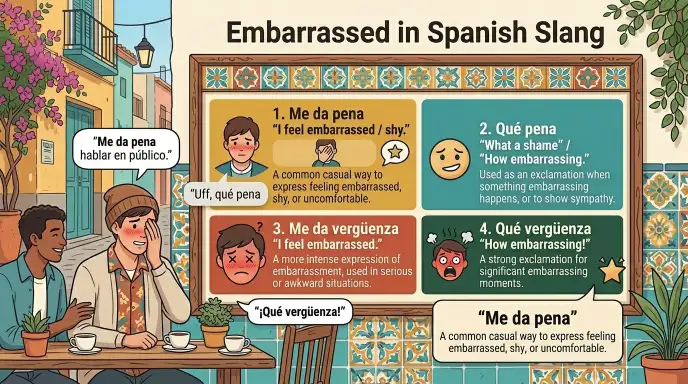
“Embarrassed” in Spanish can be expressed with informal phrases such as “qué vergüenza” and “me da pena.” The best choice depends on the situation and the speaker’s region.
Spanish speakers use different words for embarrassment in casual speech. Some expressions sound natural in Spain. Others are more common in Latin America.If you want to sound natural, context matters. A phrase used with friends may not fit every Spanish-speaking country. This guide explains common informal ways to express embarrassment in Spanish.
Quick Answer: What Is “Embarrassed” in Spanish Slang?
A common informal way to say “embarrassed” in Spanish is “qué vergüenza,” which means “how embarrassing” or “how embarrassing for me.” Another common phrase is “me da pena,” which can mean “I feel embarrassed” in some regions.
What Does “Embarrassed” Mean in Spanish Slang?
There is no single slang word that works in every Spanish-speaking country.
The most natural phrase depends on the situation.
For example:
“Qué vergüenza.”
This can mean:
“How embarrassing!”
It can show embarrassment, shame, or discomfort.
Another phrase is:
“Me da pena.”
This can mean “I feel embarrassed” in some Spanish-speaking regions.
The meaning of “pena” can change by country. Context is important.
Common Informal Ways to Say “Embarrassed”
Spanish has several casual expressions for embarrassment.
Qué Vergüenza
“Qué vergüenza” is a common way to react to an embarrassing situation.
It can mean:
“How embarrassing!”
Example:
“Qué vergüenza, me equivoqué de nombre.”
This means:
“How embarrassing, I got the name wrong.”
The phrase is common in everyday Spanish.
Me Da Vergüenza
“Me da vergüenza” means “I feel embarrassed” or “It makes me feel embarrassed.”
Example:
“Me da vergüenza hablar delante de todos.”
This means:
“I feel embarrassed speaking in front of everyone.”
It is natural in casual speech.
Qué Pena
“Qué pena” can express embarrassment in some Spanish-speaking regions.
It may also mean “what a shame” or “how sad.” The meaning depends on the situation.
Example:
“Qué pena, todos me escucharon.”
The speaker feels uncomfortable about what happened.
Me Da Pena
“Me da pena” can mean “I feel embarrassed” in some regions.
Example:
“Me da pena pedir ayuda.”
This can mean:
“I feel embarrassed to ask for help.”
The phrase can have other meanings in different countries. That regional difference matters.
Is “Qué Vergüenza” Spanish Slang?
“Qué vergüenza” is informal everyday Spanish, but it is not extreme slang.
People can use it in normal conversations with friends and family.
It can also appear in social media posts and messages.
The phrase is useful because it clearly expresses embarrassment.
For stronger slang, people may use other expressions. These can vary greatly by country.
Spanish Slang for “I’m Embarrassed”
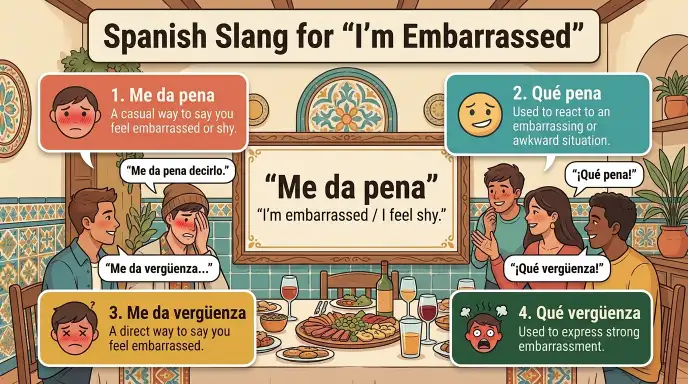
If you want to say “I’m embarrassed,” several options are possible.
Me Da Vergüenza
This means “I feel embarrassed.”
Example:
“Me da vergüenza decirlo.”
“I feel embarrassed to say it.”
Estoy Avergonzado
“Estoy avergonzado” means “I am embarrassed.”
A female speaker may say “Estoy avergonzada.”
This phrase is clear, but it can sound more serious than casual slang.
Estoy Muerto de Vergüenza
“Estoy muerto de vergüenza” is an informal expression.
It means that someone feels extremely embarrassed.
The phrase is not meant literally. It simply shows strong embarrassment.
Example:
“Estoy muerto de vergüenza después de eso.”
“I’m so embarrassed after that.”
Spanish Slang for “That Was Embarrassing”
“Qué vergüenza” is a natural choice.
You can also say:
“Qué vergüenza eso.”
This means:
“That was so embarrassing.”
Another casual phrase is:
“Qué pena.”
In some countries, it can express discomfort about an awkward situation.
The exact choice depends on the region.
Where Is Spanish Embarrassment Slang Used?
These expressions can appear in many casual settings.
In Texting
Friends may use short phrases such as:
“Qué vergüenza 😭”
The emoji can make the message feel more playful.
On Social Media
People may use “qué vergüenza” in comments and captions.
It can describe an awkward video, mistake, or situation.
In Casual Speech
Friends and family often use these phrases during everyday conversations.
The tone can be serious, playful, or dramatic.
In Spanish-Speaking Countries
Spanish varies across countries.
A phrase that sounds natural in Mexico may sound different in Spain or Argentina.
That is why local context matters when learning slang.
Is Spanish Slang for Embarrassment Rude?
Most common phrases for embarrassment are not rude.
“Qué vergüenza” is generally safe in casual conversation.
“Me da vergüenza” is also a normal expression.
Still, tone can change the message.
Saying “qué vergüenza” about your own mistake can sound playful. Saying it about another person can sound critical.
Use the phrase carefully when talking about someone else’s mistake.
Can You Use These Phrases at Work?
Some phrases are fine in casual workplace conversations.
Formal writing needs clearer language.
For example, “Me da vergüenza” may work in a friendly conversation with a coworker.
A formal message may use a clearer sentence instead.
The safest choice depends on your relationship with the other person and the setting.
Real-Life Examples of “Embarrassed” in Spanish
Here are some natural examples from casual conversations.
Example 1: Making a Mistake
“Qué vergüenza, dije el nombre equivocado.”
This means, “How embarrassing, I said the wrong name.”
Example 2: Feeling Shy
“Me da vergüenza hablar en público.”
This means, “I feel embarrassed speaking in public.”
Example 3: Feeling Very Embarrassed
“Estoy muerto de vergüenza.”
This means, “I’m so embarrassed.”
Example 4: Talking About a Situation
“Eso fue vergonzoso.”
This means, “That was embarrassing.”
When Should You Avoid Spanish Slang?
Informal Spanish works best in relaxed conversations.
Use clearer Spanish in:
- Formal emails
- School work
- Job interviews
- Official documents
- Professional messages
Regional expressions can also confuse people from other Spanish-speaking countries.
When you are unsure, use standard Spanish.
Common Mistakes With “Embarrassed” in Spanish
English and Spanish have some words that look similar but mean different things.
The most famous example is “embarrassed” and “embarazada.”
Embarrassed vs. Embarazada
“Embarrassed” means feeling ashamed or uncomfortable.
“Embarazada” means pregnant.
They look similar, but they do not have the same meaning.
This difference is important for Spanish learners.
Frequently Asked Questions About “Embarrassed” in Spanish Slang
Q1. What’s another word for embarrassed in Spanish?
Common alternatives include “avergonzado/a” and “apenado/a.” The best word depends on the situation and the level of embarrassment.
Q2. How do you say embarrassed in Mexico?
In Mexican Spanish, “avergonzado/a” means embarrassed. “Apenado/a” can also describe feeling embarrassed or sorry. For example, “Estoy avergonzado” means “I’m embarrassed.”
Q3. How do I say “ashamed” in Spanish?
“Ashamed” can be translated as “avergonzado/a.” Depending on the sentence, “me da vergüenza” can also express shame or embarrassment.
Q4. How do you say “embarrassing” in Spanish?
“Embarrassing” is commonly translated as “vergonzoso” or “vergonzosa.” For example, “Eso fue vergonzoso” means “That was embarrassing.”
Q5. What is Spanish embarrassment?
Spanish uses “sentir vergüenza” to describe feelings of embarrassment or shame. “Me da vergüenza” can mean “I feel embarrassed” or “It makes me feel embarrassed.”
Q6. What is an embarazada?
“Embarazada” means “pregnant” in Spanish when referring to a woman. It does not mean “embarrassed.”
Q7. What is estoy embarazada?
“Estoy embarazada” means “I am pregnant.” The masculine form is “Estoy embarazado,” although it is much less common.
Q8. Does embarazada mean embarrassed?
No. “Embarazada” means “pregnant,” not “embarrassed.” The two words look similar in English and Spanish, but their meanings are different.
Q9. Why is pregnant embarazada?
“Embarazada” comes from the Spanish verb “embarazar.” Its history is linked to ideas of being hindered or encumbered. It is not the Spanish form of the English word “embarrassed.”
Conclusion
Spanish has several ways to express embarrassment.
“Qué vergüenza” is a common casual phrase. “Me da vergüenza” can mean “I feel embarrassed.” Other words, such as “avergonzado/a,” can also describe the feeling.
Regional use can change the best choice. Always check the situation before using an informal phrase.
Most importantly, remember that “embarazada” means “pregnant.” It does not mean “embarrassed.”
Related Slang Terms:
2011 Slang: Popular Words, Phrases, and Their Meanings

I am Masson Caldwell, a language enthusiast and content writer at SlangAura. I write about internet slang, texting trends, and modern expressions to help readers understand the evolving world of online language with simple and clear explanations.