A Cajun slang dictionary explains informal words linked to Cajun culture in Louisiana. Some words come from French. Others come from local English and regional culture.
People often search for Cajun slang to understand local speech. They may hear these words in songs, food shows, family talks, or online posts.Cajun speech has a strong French influence. It also includes English words and local expressions.
Not every Cajun word is slang. Some words are normal French words. Others describe food, places, or local traditions.This guide explains common terms in simple English. It also shows how people use them.
Quick Answer: What Is a Cajun Slang Dictionary?
A Cajun slang dictionary is a list of informal Cajun words and phrases. It can include Cajun French, local English, and Louisiana expressions.
Some terms are slang. Others are common cultural words.
What Does Cajun Slang Mean?
Cajun slang refers to informal words used in Cajun communities.
Many Cajun terms have French roots. Some also come from local English.
The meaning can depend on the speaker and the setting.
A word may sound friendly in one situation. The same word may sound rude in another.
That is why context matters when you learn Cajun slang.
Common Cajun Slang Words
Here are some well-known Cajun terms.
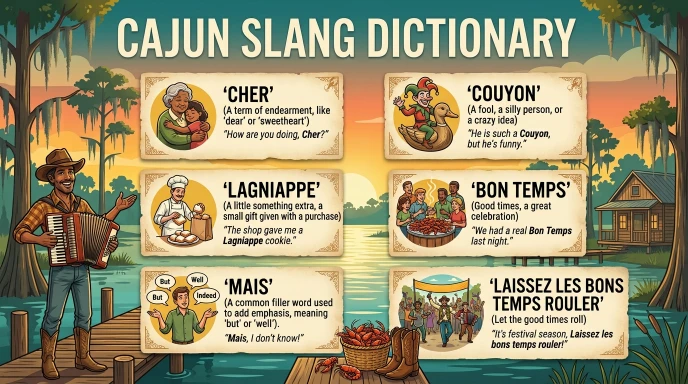
Cher
“Cher” means “dear.”
People can use it as a friendly form of address.
For example:
“Hey, cher!”
The word comes from French. It can sound warm and friendly.
Lagniappe
“Lagniappe” means something extra.
It often means a small free gift.
For example, a shop may give a customer something extra with a purchase.
The word has a strong link with Louisiana culture.
Fais Do-Do
“Fais do-do” is linked to a Cajun dance or party.
The phrase comes from French.
It also has a link with children going to sleep while adults enjoy music.
Today, the term is strongly connected with Cajun music and events.
Couillon
“Couillon” can describe a foolish person.
The tone can change its effect.
Friends may use it as a joke. It can sound insulting in another setting.
Use this word with care.
Allons-Y
“Allons-y” means “let’s go.”
It is a French expression.
You may hear French expressions like this in Cajun settings.
English speakers also use “let’s go” in daily speech.
Bayou
“Bayou” refers to a slow-moving body of water.
The word is strongly linked with Louisiana.
It is not really slang.
It is a regional word that people use when talking about local places and nature.
Boudin
“Boudin” is a type of sausage.
It is popular in Louisiana food culture.
People often use the word when talking about Cajun food.
So, “boudin” is mainly a food term.
Andouille
“Andouille” is a smoked sausage.
It is common in Cajun cooking.
You may find it in dishes such as gumbo and jambalaya.
Like “boudin,” it is mainly a food word.
Cajun Slang vs. Cajun French
Cajun slang and Cajun French are different forms of language.
Spoken in Louisiana, Cajun French has its own history, grammar, and vocabulary.
The term “Cajun slang” has a wider meaning. It covers informal words from French, local English, and Louisiana culture.
Some of these words are part of everyday speech. Others are more common in casual conversations.
Not every French word used in Louisiana counts as slang. The context and usage help define the difference.
Where Is Cajun Slang Used?
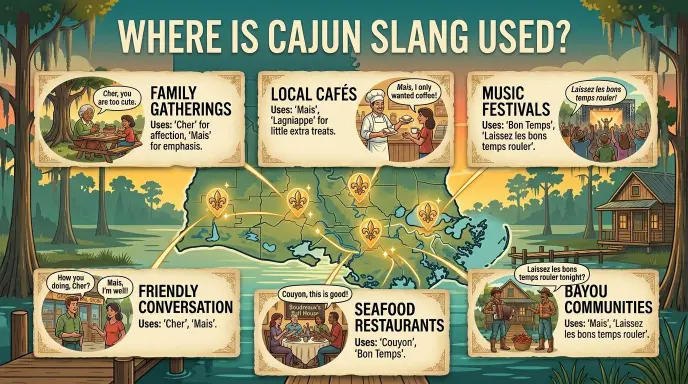
Cajun words can appear in many parts of Louisiana life.
Daily Conversation
Friends and family may use local expressions.
“Cher” is one example. It can sound warm and friendly.
Cajun Music
Cajun music keeps many local expressions familiar.
People may hear Cajun words at dances and music events.
“Fais do-do” is one term linked with this culture.
Louisiana Food
Food is another common place to hear Cajun words.
“Boudin” and “andouille” are good examples.
These words name foods. They are not all slang.
Social Media
Cajun words also appear online.
People may use them in posts, comments, and messages.
Online content can help more people learn regional words.
Is Cajun Slang Still Used Today?
Yes, many Cajun terms are still used today.
Use can vary by age and location.
Some older French expressions are less common in daily speech now.
Still, Cajun words remain part of Louisiana culture.
You can hear them in music, food, festivals, and local events.
Is Cajun Slang Rude?
Most Cajun terms are not rude.
Some words can sound negative in certain settings.
“Couillon” is one example. It can describe a foolish person.
Friends may use it as a joke. It can also sound insulting.
So, always check the context before using it.
Can You Use Cajun Slang at Work?
Some simple Cajun words can fit a casual work chat.
Formal writing needs standard language.
Use clear English for:
- Job applications
- Formal emails
- Business reports
- School work
- Official documents
A local word can add personality to a casual chat.
It may not fit a formal message.
Real Life Examples of Cajun Slang
These examples show how people can use Cajun terms.
Example 1: Friendly Greeting
“Hey, cher! How are you?”
Here, “cher” means “dear.”
Example 2: Something Extra
“The store gave me some lagniappe.”
The speaker means the store gave them something extra.
Example 3: Cajun Food
“We’re having boudin tonight.”
Here, “boudin” means a type of Louisiana sausage.
Example 4: A Cajun Event
“They’re having a fais do-do this weekend.”
Here, “fais do-do” refers to a Cajun dance or social event.
Example 5: A Local Place
“We drove past the bayou.”
Here, “bayou” means a slow-moving body of water.
When Should You Avoid Cajun Slang?
Cajun slang works best in casual settings.
Avoid unfamiliar terms in formal writing.
This includes:
- Business emails
- Job applications
- School assignments
- Official documents
- Professional reports
Some words can also sound rude.
If you do not know a term well, learn its meaning first.
Frequently Asked Questions About Cajun Slang
Q1. What is “I love you” in Cajun French?
In Cajun French, “I love you” can be said as “Je t’aime.” It is the standard French phrase also used by many Cajun French speakers.
Q2. How do Cajuns say “hi”?
Cajun speakers may use “Bonjour” for a polite greeting and “Salut” for a casual one. English greetings are also common in everyday Cajun speech.
Q3. How do you say “let’s go” in Cajun?
A common French way to say “Let’s go!” is “Allons-y!” In casual Cajun speech, English “Let’s go!” is also widely used.
Q4. What are some Cajun sayings?
Popular Cajun expressions include “Laissez les bons temps rouler,” meaning “Let the good times roll.” “Cher” is also a common affectionate term that means “dear” or “dear one.”
Q5. How to talk like a Cajun?
To sound Cajun, learn the region’s French-influenced vocabulary, pronunciation, and Southern English expressions. Words like “cher,” “lagniappe,” and “c’est bon” can help, but natural speech matters most.
Q6. What is Cajun slang called?
There is no single official name for Cajun slang. It is often described as Cajun English, Cajun French, or Louisiana French, depending on the language and expression.
Q7. How do you say chaotic in Cajun?
In Cajun French, “fou” means “chaotic” for a man, while “folle” is used for a woman. cajun English speakers may also simply use “chaotic.”
Q8. How do Cajuns say “go”?
In French, “go” is commonly expressed with “aller,” meaning “to go.” “Va!” can mean “Go!” when speaking informally to one person.
Q9. How do you say “drunk” in Cajun?
In Cajun French, “saoul” or “soûl” can mean “drunk.” Cajun English also commonly uses “drunk” in everyday conversation.
Conclusion
A Cajun slang dictionary helps explain local words and phrases.
Some terms come from French. Others come from local English and Louisiana culture.
Words such as “cher,” “lagniappe,” and “fais do-do” have different uses.
Context is important when using Cajun slang.
Learn the meaning first. Then use each word in the right setting.
Next Up: More Slang:
Welsh Slang: Common Words, Phrases, and Their Meanings

I am Emma Collins, a content writer at SlangAura specializing in internet slang, texting abbreviations, and online language. I create simple and accurate guides to help readers understand modern slang easily and confidently.