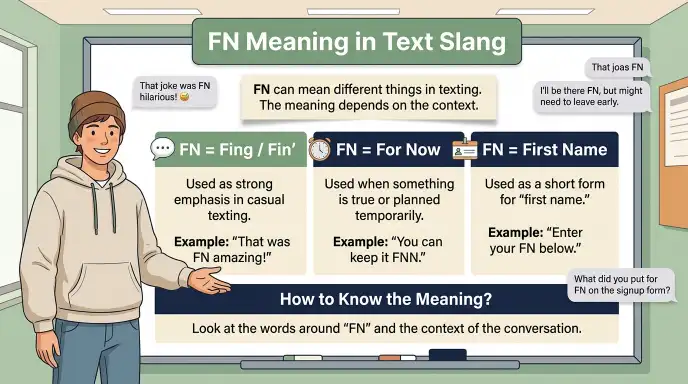
FN can have different meanings in text messages. The exact meaning depends on the conversation. In casual chats, FN may mean “for now,” while some people use it as a short form for other phrases.
If you see “FN” in a message, look at the words around it. Context usually makes the meaning clear.This guide explains the common meanings of FN in texting. It also covers its tone, uses, and examples. You will learn when FN fits a casual chat and when it is better to use the full phrase.
Quick Answer: What Does FN Mean in Text Slang?
In texting, FN can mean “for now.” People use it to talk about a temporary situation. However, FN can have other meanings, so the surrounding message matters.
What Does FN Mean in Text Slang?
FN is a short form used in digital communication.
One common meaning is “for now.” It shows that something is true at the present time but may change later.
For example:
“I’ll stay here FN.”
This means:
“I’ll stay here for now.”
The abbreviation helps keep messages short. It works best in casual chats.
What Does FN Stand For in Texting?
FN can stand for “for now” in texting.
The letters come from the first letters of the phrase:
- F = for
- N = now
People may use FN when they want to type quickly.
For example:
“Let’s keep it like this FN.”
The message means:
“Let’s keep it like this for now.”
The full phrase is still clearer for people who do not know the abbreviation.
Different Meanings of FN in Text
FN does not always have one meaning.
The context can change its meaning. Here are some common possibilities.
FN Meaning: For Now
“For now” is one possible meaning of FN in casual messages.
Example:
“I’m using my old laptop FN.”
This means the person is using the old laptop for now.
FN Meaning: Friday Night
In some chats, FN may refer to “Friday night.”
Example:
“Are you free FN?”
The speaker may mean “Are you free Friday night?”
This meaning depends strongly on the conversation.
FN as a Personal or Group Abbreviation
Some people use FN as a short form for a name, group, phrase, or topic.
This use is not universal.
If FN appears in a private group chat, the group may have its own meaning for it.
That is why context is important.
How Is FN Used in Text Messages?
FN is mainly useful in short and casual messages.
It can appear at the end of a sentence.
Example:
“I’ll keep this plan FN.”
It can also appear in the middle of a message.
Example:
“I’m FN working from home.”
However, this second use may be unclear. The reader may not know what FN means.
Using the full phrase “for now” is often easier.
Where Is FN Used?
FN can appear in different forms of online communication.
FN in Texting
Friends may use short forms to save time while texting.
For example:
“I’ll wait here FN.”
The meaning is easy to understand when both people know the abbreviation.
FN in Social Media Chats
People may use FN in private messages and casual comments.
The meaning still depends on the topic.
FN in Group Chats
Group chats can create their own abbreviations.
If someone writes “FN,” check the earlier messages before deciding what it means.
FN in Online Communities
Online groups may use special terms that are familiar to their members.
An abbreviation can have one meaning in one community and a different meaning somewhere else.
Is FN Formal or Informal?
FN is informal.
It can work in casual texts and online chats. It is not a good choice for formal writing.
Use the full phrase “for now” in:
- Work emails
- School assignments
- Official documents
- Job applications
- Formal letters
For example, write:
“I will keep this plan for now.”
This is clearer than:
“I will keep this plan FN.”
What Is the Tone of FN?
FN usually has a neutral and casual tone when it means “for now.”
It does not normally show a strong emotion.
The rest of the message gives more information about the speaker’s mood.
For example:
“I’ll stay here FN.”
This sounds neutral.
“Okay, I’ll wait here FN.”
This can sound more casual and conversational.
Why Do People Use FN in Texting?
People use abbreviations to make messages faster and shorter.
FN can save a few characters when it means “for now.”
Short forms are common in casual digital conversations. Still, not everyone knows every abbreviation.
If the reader may not understand FN, writing “for now” is the better choice.
Is FN Easy to Understand?
FN can be easy to understand when the context is clear.
A message like “I’ll stay here FN” gives a strong clue that FN means “for now.”
A message like “Are you free FN?” is less clear. FN could refer to “Friday night” in that context.
When the meaning is unclear, ask the sender what they mean.
Context is the best way to understand short abbreviations.
Real-Life Examples of FN in Text
FN can fit into simple, casual messages. Here are some natural examples.
Example 1: Temporary Plan
“I’ll stay here FN.”
This means, “I’ll stay here for now.”
Example 2: Work
“I’m busy FN.”
This means, “I’m busy for now.”
Example 3: Daily Chat
“I’m using this phone FN.”
The speaker means they are using the phone for now.
Example 4: A Change Later
“I’ll keep this plan FN.”
The speaker may change the plan later.
Example 5: Unclear Context
“Are you free FN?”
Here, FN could have another meaning, such as “Friday night.” The context is needed.
When Should You Avoid Using FN?
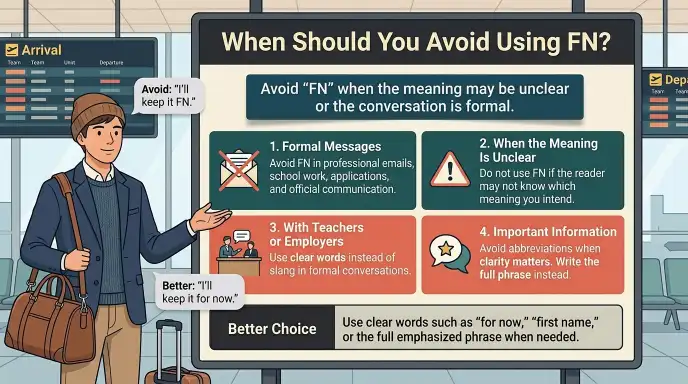
FN is best for casual conversations.
Avoid it in formal writing, such as:
- Work emails
- School assignments
- Job applications
- Official documents
- Formal letters
Use “for now” instead when you want your message to be clear.
This is especially helpful when the reader may not know the abbreviation.
Common Misunderstandings About FN
FN can be confusing because it has more than one possible meaning.
FN always means “for now”
Not always.
“For now” is a common meaning in texting, but context can change the meaning.
FN is only used by Gen Z
No.
Different age groups can use abbreviations in online chats. FN is not limited to one generation.
FN has one fixed meaning on every platform
No.
A group chat, social platform, or online community may use FN in a different way.
FN is suitable for formal writing
Usually not.
The full phrase is clearer in professional and academic writing.
Frequently Asked Questions About FN Meaning in Text Slang
Q1. What does FN mean in slang?
“FN” can have different meanings in slang, but it often stands for “for now” in texting. In some contexts, it can also represent other phrases, so context matters.
Q2. What is the meaning of FN?
The meaning of “FN” depends on where it appears. In casual texting, it can mean “for now,” while other communities may use it differently.
Q3. Is FN used in texting?
Yes, “FN” can be used in texting as a short form of “for now.” For example, “I’m busy fn” means “I’m busy for now.”
Q4. What is FN on social media?
On social media, “FN” can have several meanings. It may mean “for now,” but the surrounding text helps identify the intended meaning.
Q5. What is FN in Gen Z slang?
Gen Z users may use “FN” as a quick abbreviation for “for now.” Its meaning can still vary based on the platform and conversation.
Q6. What is FN in chat?
In chat, “FN” can mean “for now” when used as an abbreviation. It helps shorten messages in casual conversations.
Q7. What is FN on TikTok?
On TikTok, “FN” can mean different things based on the video or comment. In casual text, it may mean “for now,” but context is important.
Q8. What is FN on Instagram?
On Instagram, “FN” may be used as a texting abbreviation for “for now.” It can also have other meanings in captions, comments, or DMs.
Q9. What does FN mean on Snap?
On Snapchat, “FN” can mean “for now” in casual messages. However, users may use the abbreviation differently based on their conversation.
Conclusion
FN is a short abbreviation with more than one possible meaning.
In casual texting, “for now” is a common meaning. Other uses can appear in different chats and online communities.
The surrounding message is the best clue. When the meaning is unclear, use the full phrase or ask the sender for clarification.
Related Texting Slang:
2011 Slang: Popular Words, Phrases, and Their Meanings

I am Emma Collins, a content writer at SlangAura specializing in internet slang, texting abbreviations, and online language. I create simple and accurate guides to help readers understand modern slang easily and confidently.