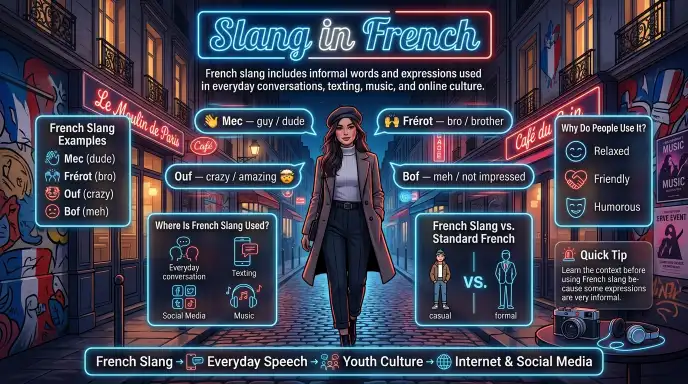
Slang in French means informal words and expressions that people use in casual conversations. These words are common in everyday speech, but they may sound too informal for school, work, or other formal situations.
French slang can vary by age, region, and social group. Some expressions are widely understood across France, while others are more local or connected to youth culture. Words such as “mec,” “meuf,” “fric,” “bouffer,” and “ouf” are well-known examples of informal French.
If you are learning French, understanding slang can help you follow real conversations, films, music, and social media. This guide explains common French slang in simple English, with clear meanings and examples.
Quick Answer: What Does Slang in French Mean?
Slang in French refers to informal words and expressions used in casual speech. Common examples include “mec” for guy, “meuf” for woman or girl, “fric” for money, “bouffer” for eat, and “ouf” for control, or amazing, depending on context.
What Does Slang in French Mean?
French slang is often called “l’argot” in French. It includes informal vocabulary that differs from standard French.
Some slang words are used by many people in France. Others are strongly linked to certain age groups, cities, or social communities.
French slang can also change over time. A word that sounds modern today may become dated later.
Mec
“Mec” is a common informal word for “guy,” “man,” or “dude.”
Example:
“Ce mec est sympa.”
Meaning:
“This guy is nice.”
It is casual and common in everyday speech.
Meuf
“Meuf” is informal French slang for “woman,” “girl,” or “girl/woman” depending on context.
It comes from the reversed form of “femme.” This type of word formation is called “verlan,” a French slang style that changes the order of sounds in a word.
Example:
“Cette meuf est drôle.”
Meaning:
“This girl is funny.”
The word is informal, so it is not the best choice for formal writing.
Fric
“Fric” is informal French for “money.”
Example:
“Je n’ai pas de fric.”
Meaning:
“I don’t have any money.”
It is a casual word rather than a formal term.
Bouffer
“Bouffer” is an informal verb meaning “to eat.”
It is more casual than the standard verb “manger.”
Example:
“On va bouffer?”
Meaning:
“Are we going to eat?”
The word is common in casual speech but should be avoided in formal situations.
Ouf
“Ouf” is a slang word that can mean “control,” “confusing,” or “amazing,” depending on the sentence.
It comes from “fou” through verlan.
Example:
“C’est ouf!”
Depending on context, this can mean:
“That is control.”
It can also express strong surprise or excitement.
Common French Slang Words
French slang contains many expressions that can confuse language learners. The table below gives some common examples.
| French slang | Simple English meaning | Tone |
| Mec | Guy, dude | Casual |
| Meuf | Girl, woman | Informal |
| Fric | Money | Casual |
| Bouffer | Eat | Informal |
| Ouf | control, amazing | Casual |
| Bagnole | Car | Informal |
| Bosser | Work | Informal |
| Gamin | Kid, young boy | Informal |
| Pote | Friend, buddy | Casual |
| Baraque | House, place, or physically large person | Context-based |
These words do not all have exactly the same level of informality. Context can change how natural or appropriate they sound.
French Slang vs Standard French
The main difference is the level of formality.
Standard French is used in formal writing, professional communication, education, and official situations. Slang is more common among friends, family members, and people having relaxed conversations.
| Standard French | Informal French | English meaning |
| Homme | Mec | Man, guy |
| Femme | Meuf | Woman, girl |
| Argent | Fric | Money |
| Manger | Bouffer | Eat |
| Travailler | Bosser | Work |
| Ami | Pote | Friend |
| Voiture | Bagnole | Car |
Using slang can make your French sound more natural in casual settings. However, learners should understand the social setting before using it.
What Is Verlan in French Slang?
Verlan is a French slang style that changes the order of sounds or syllables in a word.
The name “verlan” itself comes from “à l’envers,” which means “backwards.” It became an important part of French informal language, especially in urban and youth speech.
“Meuf” is a well-known example.
The standard word is “femme.” Through verlan, the sounds are rearranged to create “meuf.”
“Ouf” comes from “fou,” meaning control.
Verlan does not mean that every French slang word is reversed. It is one method used to create informal vocabulary.
Where Is French Slang Used?
French slang is mainly used in relaxed situations.
French slang in everyday conversation
Friends may use slang when talking about plans, food, money, work, or other daily topics.
For example, someone may say “pote” instead of the more standard “ami” when talking about a friend.
French slang on social media
Informal French appears often in comments, captions, messages, and online communities.
Young users may combine French slang with abbreviations, emojis, and English internet terms.
French slang in movies and music
French films and songs often include informal language.
This can help learners hear how people speak outside textbooks. However, entertainment does not always represent formal or universal French.
French slang in texting
Texting encourages short and casual language.
A French speaker may use slang with friends but switch to standard French when writing to a teacher, employer, or official organization.
Is French Slang Rude?
French slang is not automatically rude.
Some slang words are completely normal in friendly conversations. Others can sound crude, disrespectful, or offensive.
The safest approach is to learn the meaning and tone of a word before using it.
For example, “mec” is usually a casual word for a guy. “Bouffer” is informal but can be normal among friends. Other slang terms may carry stronger meanings.
Knowing the difference helps you avoid using a casual word in the wrong setting.
Can You Use French Slang at Work?
Most French slang should be avoided in formal workplace communication.
A casual conversation with a close coworker may allow more informal language. A formal email, interview, presentation, or business document requires more standard French.
For example, “argent” is safer than “fric” in formal writing. “Manger” is more neutral than “bouffer.”
When you are unsure, choose the standard French word.
Real-Life Examples of French Slang
French slang sounds different depending on the situation. These examples show how common words may appear in casual conversations.
Example 1: Talking about a friend
“C’est mon pote.”
Meaning:
“He’s my friend.”
Here, “pote” is a casual word for friend.
Example 2: Talking about money
“J’ai plus de fric.”
Meaning:
“I don’t have any more money.”
Here, “fric” is an informal word for money.
Example 3: Talking about food
“On va bouffer quelque chose?”
Meaning:
“Are we going to eat something?”
Here, “bouffer” is a casual way to say “eat.”
Example 4: Talking about a person
“Ce mec est drôle.”
Meaning:
“This guy is funny.”
Here, “mec” is an informal word for guy or man.
Example 5: Showing surprise
“C’est ouf!”
Meaning:
“That’s control!”
Here, “ouf” expresses strong surprise or excitement.
Why Do People Use French Slang?
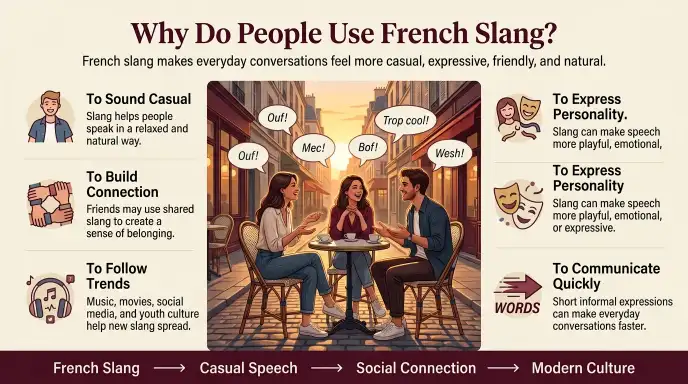
People use French slang because it can make casual speech feel more relaxed and natural.
Friends may use slang to sound familiar and informal. Young people may also use newer expressions that spread through music, television, social media, and online communities.
Slang can also show connection with a certain group or culture.
However, slang changes over time. A word that sounds natural to one age group may sound old-fashioned or unusual to another.
Is French Slang Used by Young People?
Yes, many young French speakers use slang in casual conversations.
However, slang is not limited to young people. Some older slang words have become common parts of everyday speech.
Usage also varies by region and social group.
A French speaker in Paris may use different expressions from someone in another French-speaking area. Canadian French can also have vocabulary that differs from French used in France.
Is French Slang Appropriate for School?
It depends on the situation.
Students may use slang when talking with friends. Formal schoolwork should use standard French.
For example, “fric” is fine in a casual conversation about money. “Argent” is the safer choice in an essay.
The same rule applies to presentations, applications, and formal messages.
When Should You Avoid French Slang?
Avoid slang when you need formal, clear, or respectful communication.
This includes:
- Job interviews
- Formal emails
- School assignments
- Official documents
- Business meetings
- Academic writing
- Conversations with people you do not know well
Slang can be useful when speaking casually. Standard French is safer when you are unsure.
Polite Alternatives to French Slang
You can replace informal words with standard French when the situation is formal.
| Slang | Standard French | English |
| Mec | Homme | Man |
| Meuf | Femme | Woman |
| Fric | Argent | Money |
| Bouffer | Manger | Eat |
| Pote | Ami | Friend |
| Bosser | Travailler | Work |
| Bagnole | Voiture | Car |
These alternatives are more neutral and work well in formal communication.
Common Misunderstandings About French Slang
French slang is the same everywhere
No.
French slang can vary by country, region, age group, and community.
Every informal French word is rude
No.
Some words are simply casual. Others have a stronger or more offensive tone.
Argot means every informal French word
Not exactly.
“Argot” is commonly used for slang, but French informal language includes many styles and expressions.
Verlan is all French slang
No.
Verlan is one type of French slang. It changes the sounds or order of parts of words.
Slang is always used by young people
No.
Some slang words are used by people of different ages. Others are strongly linked to younger speakers.
Frequently Asked Questions About Slang in French
Q1. What is French slang called?
French slang is commonly called “argot.” It refers to informal words and expressions used in casual speech, but not every informal expression belongs to one single slang group.
Q2. What are some slang words in French?
Common French slang includes “mec” for guy, “meuf” for girl or woman, “fric” for money, “bouffer” for eat, and “ouf” for control or amazing.
Q3. What is WTF in French slang?
French speakers may use “WTF” directly, especially online. A French expression such as “C’est quoi ce bordel ?” can also express strong surprise, confusion, or disbelief.
Q4. What is cool in French slang?
“Sympa” is a common informal word meaning nice or pleasant. “Stylé” can also mean cool, stylish, or impressive in casual French.
Q5. What does c’est le fun mean?
“C’est le fun” is mainly associated with Canadian French, especially Quebec French. It means “it’s fun” and describes something enjoyable or entertaining.
Q6. What is “I’m hot” in French?
If you mean “I feel hot,” say “J’ai chaud.” If you mean “I’m attractive,” informal options include “Je suis sexy” or “Je suis canon.”
Q7. What does mec mean in French slang?
“Mec” is an informal French word for a guy or man. It is common in casual speech.
Q8. What does meuf mean in French slang?
“Meuf” is informal French slang for a woman or girl. It comes from “femme” through verlan.
Conclusion
Slang in French adds a casual and lively style to everyday communication. Words such as “mec,” “meuf,” “fric,” “bouffer,” and “ouf” are useful examples for French learners.
French slang is not one fixed system. It changes with age, region, culture, and social groups. Some expressions are mild and common, while others are more informal or stronger.
If you are learning French, learn the standard word first. Then learn its slang version and the setting where people use it. This will help you understand real conversations without using a casual word in the wrong situation.
Related Texting Slang:
2011 Slang: Popular Words, Phrases, and Their Meanings

I am Masson Caldwell, a language enthusiast and content writer at SlangAura. I write about internet slang, texting trends, and modern expressions to help readers understand the evolving world of online language with simple and clear explanations.