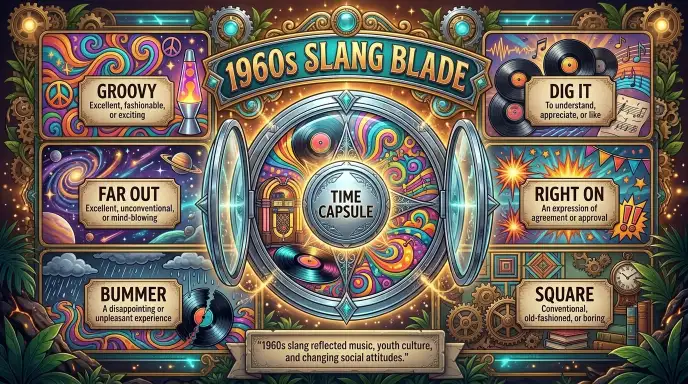
In 1960s slang, “blade” could mean a knife, especially a knife carried as a weapon. The word also had an older slang meaning referring to a man, but the exact meaning depends on the sentence and historical context.
Today, people often search for “1960s slang blade” while exploring vintage language, old movies, music, and online slang discussions.
If you came across the word blade in a 1960s slang list, it may feel confusing. Was it describing someone’s personality? Was it a weapon? Or was it simply another word people used in everyday conversation?
The answer is that slang can carry more than one meaning at the same time. In some historical references, blade meant a knife.
In older English slang, it could also describe a man, sometimes a stylish or dashing fellow. Those meanings should not be mixed up without looking at the context.
This guide explores the word in a clear, interesting way. You will learn what blade meant in the 1960s, how it appeared in conversations, how its meaning differs from modern usage, and how to recognize it in vintage dialogue or online posts.
1. 1960s Slang Blade Meaning in Text
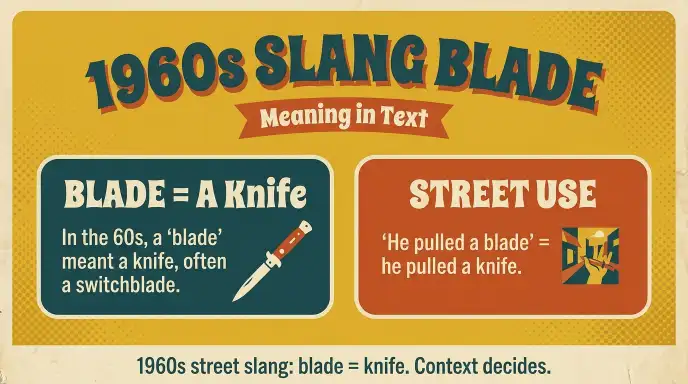
The expression 1960s slang blade usually points to the word blade as it appeared in informal language during the 1960s. One documented meaning from that period was a knife.
A blade is literally the sharp cutting part of a knife, sword, or similar tool. In slang, the word could be used to refer to the whole knife rather than only its sharp edge.
For example:
“He had a blade in his pocket.”
Meaning: He had a knife in his pocket.
This is not an acronym or a texting abbreviation. Blade is an ordinary English word that also appeared in informal and slang contexts.
What did “blade” mean in the 1960s?
The meaning depended on how it was used:
- A knife: A sharp object, sometimes referring to a knife carried as a weapon.
- A man: An older slang meaning, particularly in expressions describing a dashing or confident man.
- A sharp or stylish person: In some older contexts, the word could suggest someone lively, fashionable, or socially confident.
For the 1960s slang keyword, the knife related meaning is important because historical slang lists from the decade include blade in that sense. However, it would be inaccurate to claim that every use of the word in the 1960s referred to a weapon.
Was “blade” a slang word or a normal word?
It was both. The literal meaning of a sharp cutting edge was standard English. The slang use came from informal speech and context.
That distinction matters. If someone says “the blade is dull,” they are probably talking about a cutting tool. If a character in a vintage crime story says “he carried a blade,” the word may refer to a knife used or carried as a weapon.
The same word can move between ordinary language and slang without changing its spelling.
2. Why Did People Use the Word “Blade”?
People often use slang because it is brief, expressive, or familiar within a group. The word blade was already connected with knives and sharp objects, so using it to refer to a knife was easy to understand.
In informal speech, people may choose a short word instead of a longer description. Instead of saying “a sharp edged knife,” a speaker might simply say “a blade.”
This does not mean everyone in the 1960s used the term regularly. Slang varied by region, age, social group, and situation.
The word in crime and street related language
Some 1960s slang collections connect blade with a knife, including knives associated with street violence. The word could appear in crime related writing, stories, or conversations about dangerous situations.
For example:
“The character pulled a blade.”
Meaning: The character pulled out a knife.
This example is fictional and demonstrates the meaning. It should not be taken as a claim that the phrase was used by every group or community during the decade.
The word in everyday language
Not every use was dramatic. A person could also use blade when discussing a tool, razor, or cutting object.
For example:
“The blade needs replacing.”
Meaning: The sharp part of the tool needs to be replaced.
The surrounding words tell you if the sentence is slang, ordinary speech, or a description of a dangerous situation.
3. Where People Use “1960s Slang Blade” Today
The expression is now more likely to appear in historical discussions than in ordinary modern texting. People may search for it when they are studying vintage slang or trying to understand a line from an older film or book.
TikTok
On TikTok, people may discuss blade in videos about old slang, 1960s culture, vintage movies, or historical vocabulary.
A creator might explain that the word could mean a knife in a particular period. Another video might discuss the older meaning of blade as a man.
The key is to look at the context of the video. A historical explanation is different from a modern post about knives.
Snapchat
On Snapchat, someone might send a message about a word they heard in a movie or saw in a slang list.
For example:
“What did blade mean in the 60s?”
This is a question about historical language, not necessarily a use of the slang word itself.
Instagram captions and comments may use blade when discussing retro fashion, old films, music, or vintage vocabulary.
A post about 1960s language might include the term alongside other expressions from the period. However, the word’s meaning still depends on the sentence.
On WhatsApp, a person might share a vintage slang list and ask a friend what a word means.
For example:
“I found ‘blade’ in a 60s slang list. Was it a knife?”
The message is asking for clarification. It does not mean the sender is using blade as a casual nickname.
SMS and Regular Text Messages
In ordinary text messages, blade may be discussed as a historical term or used in its modern literal sense.
For example:
“The old movie used the word blade.”
This could lead to a discussion about the film’s dialogue and the meaning intended by the characters.
4. Real Chat Examples of “Blade” in Context

These examples show how the word can appear in conversations. They are illustrative examples, not verified quotations from people living in the 1960s.
Example 1: Asking about a vintage word
A: I found the word blade in an old slang list.
B: I think it meant a knife.
A: That makes sense for the sentence.
Meaning: They are discussing the historical slang meaning.
Example 2: Watching an old film
A: The character said he had a blade.
B: In that scene, it probably means a knife.
A: I thought it might be an old nickname.
Meaning: The word is being interpreted through the movie’s context.
Example 3: Looking up a word
A: What does blade mean in 1960s slang?
B: It could mean a knife.
A: So it depends on the context?
Meaning: The speakers are clarifying the historical definition.
Example 4: Discussing a crime story
A: The story says the man carried a blade.
B: That usually means he had a knife.
A: The scene sounds dangerous.
Meaning: Blade refers to a knife.
Example 5: Comparing older meanings
A: I read that blade could also describe a man.
B: Yes, that is an older slang meaning.
A: English words can have surprising histories.
Meaning: They are comparing two different uses.
Example 6: A language learning conversation
A: Is blade an abbreviation?
B: No, it is a regular English word.
A: But it can be used as slang?
Meaning: The speakers distinguish slang from abbreviations.
Example 7: A vintage vocabulary post
A: This post lists blade as 1960s slang.
B: It is describing a knife, I think.
A: I’ll check the example sentence.
Meaning: They are interpreting a historical entry.
Example 8: Asking about a character
A: Why did the character say blade instead of knife?
B: It may have sounded more informal or dramatic.
A: That fits the scene.
Meaning: They discuss the word choice in dialogue.
Example 9: Explaining a word to a friend
A: The word blade can have more than one meaning.
B: So the sentence matters?
A: Exactly.
Meaning: Context is essential to understanding slang.
Example 10: Writing a historical scene
A: Would blade work in dialogue set in the 1960s?
B: It could, if the character is referring to a knife.
A: I’ll make the context clear.
Meaning: They are discussing historically appropriate word choice.
5. How to Reply When Someone Says “Blade”
The right reply depends on if the person is talking about the historical slang meaning or using the word literally.
If someone mentions blade in a vintage slang discussion, you can respond with a question or a simple explanation.
Funny replies
These work when the conversation is light and the word is being discussed academically or casually:
- “English really keeps its old secrets.”
- “One word, more than one meaning!”
- “Vintage slang is a whole adventure.”
- “I need a 1960s dictionary for this conversation.”
These are playful responses to the topic, not encouragement to use or carry a weapon.
Casual replies
For a simple discussion:
- “I think it meant a knife.”
- “That’s an older slang meaning.”
- “The context makes it clearer.”
- “I’ve seen that word in old movies too.”
Friendly replies
If someone is explaining the word to you:
- “Thanks, that clears it up.”
- “That’s interesting!”
- “I didn’t know it had an older meaning.”
- “I’m learning some vintage slang now.”
Neutral replies
If you are unsure what the person means:
- “Do you mean a knife or the older slang meaning for a man?”
- “What was the full sentence?”
- “Are you talking about the 1960s usage?”
- “Can you explain the context?”
Asking for the sentence is often the best response because blade has more than one meaning.
6. Is “Blade” Rude or Offensive?
Blade is not automatically a rude word. It is a standard English word that can refer to a sharp cutting edge. It can also appear in slang or in conversations about weapons.
The word itself is not generally a profanity. However, a sentence involving a blade may describe a threat, violence, or an unsafe situation.
Is it safe to use in casual conversation?
If you are discussing a historical meaning, the word is usually fine.
For example:
“In this 1960s slang list, blade means a knife.”
That is a neutral explanation.
But if someone uses the word while threatening another person, the meaning is no longer just a vocabulary question. The situation and the speaker’s intention matter.
Is it appropriate at school or work?
In a classroom, a historical discussion of blade is appropriate when handled as a vocabulary or cultural topic.
At work, the word can be used when discussing tools, equipment, or a historical text. If the context involves violence or threats, use clear and careful language.
For everyday communication, it is better to explain what you mean rather than relying on slang that could be misunderstood.
7. Who Uses the Term “Blade”?
Today, people who encounter the slang meaning of blade are often interested in language, history, vintage media, or old slang lists.
The term is not limited to one age group. A student might find it in a school assignment, a film fan may hear it in an older movie, and a language enthusiast may discover it while exploring historical expressions.
Teenagers and young adults
Younger people may encounter blade through short videos, online vocabulary posts, or historical discussions.
That does not mean it is a common modern texting word. Many young people know the ordinary meaning of blade but may not recognize the older slang meanings.
Older generations
Some older speakers may recognize the term from older books, films, or expressions. Even so, familiarity varies from person to person.
People interested in vintage culture
The word can interest people studying 1960s language, fashion, music, cinema, or social history.
In that setting, blade is more likely to be discussed than used as an everyday expression.
How often does it appear online?
There is no reliable universal figure showing how frequently blade appears specifically as 1960s slang online. The word also has many ordinary meanings, so a search result or post mentioning it does not necessarily refer to vintage slang.
It is more accurate to describe the historical meaning as something people look up than to claim that it is trending across every platform.
8. Origin of the Word “Blade” in Slang
The word blade is much older than the 1960s. Its basic meaning is connected with the sharp edge of a knife or sword.
Over time, the word developed different uses in informal English. Historical slang sources record blade as a term for a man, including a dashing or lively fellow. The word also appeared in 20th century American slang with the meaning “knife.”
This is why a single definition cannot explain every historical use.
Did the 1960s create the slang meaning?
No. The 1960s did not invent the word blade, and the slang meanings existed earlier.
The decade is relevant because the word appeared in slang collections from that period. Some collections recorded it as a knife, while older dictionaries described the person related meaning.
A responsible explanation should distinguish the word’s history from the decade in which a particular meaning was recorded.
How did internet culture affect the word?
The internet did not create the historical meaning. Instead, online searches, vintage slang pages, and social media discussions help people discover it today.
A person may see blade in a retro film, search the phrase “1960s slang blade,” and then find explanations of its different meanings.
Online content can make an old expression visible again, but it does not automatically make the expression common in modern speech.
Is the origin completely clear?
The basic literal meaning is clear, but the exact path from the literal word to every slang use may be difficult to establish. Historical slang often develops gradually through speech, literature, and different communities.
It is best not to claim that one person or one event created the slang meaning unless there is strong historical evidence.
9. Comparison Table: Blade and Common Text Abbreviations
Blade is a full English word, while IDK, IDC, IMO, and BRB are abbreviations commonly used in texting. Comparing them helps explain why blade should not be treated as a texting acronym.
| Term | Meaning | Type | Usage | Popularity |
| Blade | A knife; in older slang, it could also refer to a man | Full word with literal and slang meanings | Historical language, ordinary speech, and context based usage | The literal meaning is familiar; the older slang meaning is less common |
| IDK | I don’t know | Text abbreviation | Chats, texts, and comments | Widely recognized in English texting |
| IDC | I don’t care | Text abbreviation | Informal messages | Widely recognized in English texting |
| IMO | In my opinion | Text abbreviation | Online discussions and messages | Widely recognized in English texting |
| BRB | Be right back | Text abbreviation | Chats and messaging | Widely recognized in English texting |
The main difference is simple: blade is not a shortened phrase. It is a regular word with several meanings, while the other entries are abbreviations formed from the first letters of English phrases.
10. Real World Usage Example
Imagine a student watching a classic crime film set in the 1960s. During a tense scene, one character says that another person is carrying a blade.
The student pauses the movie and asks:
“What does blade mean here?”
A teacher explains that in this context, blade refers to a knife. The teacher also mentions that the word has older slang meanings, including one that could describe a man.
The student then understands why the word cannot be translated with only one definition. The sentence, the characters, and the scene all help reveal the meaning.
This is how historical slang is best learned. Instead of memorizing one definition and applying it everywhere, look at how the word is used.
11. Common Mistakes About 1960s Slang “Blade”
Assuming it always meant a knife
The knife related meaning is important in 1960s slang references, but the word also had older person related meanings.
Assuming it was invented in the 1960s
The word and several slang meanings existed before the decade. A historical slang list may record a meaning without being the first place it appeared.
Treating it as a texting abbreviation
Blade is not an acronym like IDK or BRB. It is a full word.
Assuming everyone used it
Slang varies across communities. A term may appear in a historical source without being universal among people of the same age or era.
Ignoring the sentence
The most common mistake is choosing a meaning before reading the context. A sentence about a sharp tool will likely use the literal meaning. A historical dialogue may use a slang meaning.
Mixing up “blade” and “a blade”
The word can refer to the sharp part of a tool or to a whole knife. In slang, the exact usage may depend on the sentence.
12. How to Understand “Blade” in Old Movies, Books, and Songs
If you hear blade in a vintage movie or read it in a book set in the 1960s, do not assume that it is being used exactly as people use the word today.
Start by identifying the subject of the sentence.
If the speaker is talking about a knife, a weapon, or a sharp object, the meaning is likely literal or related to the knife slang.
If the sentence describes a man’s personality, appearance, or social behavior, the older slang meaning may be relevant.
For example:
“He was quite a blade.”
In older usage, this could describe a dashing or stylish man.
But:
“He carried a blade.”
This usually refers to a knife.
And:
“The blade needs sharpening.”
This is an ordinary description of a tool.
The same word appears in all three sentences, but the meaning changes. That is why context is more helpful than memorizing a single definition.
13. Frequently Asked Questions
Q1. What does “1960s slang blade” mean in text messages?
It usually refers to the historical slang word blade, which could mean a knife. It is not a standard texting abbreviation, so the full sentence is important.
Q.2 What does “blade” mean on TikTok?
On TikTok, blade may appear in historical slang videos, vintage vocabulary posts, or discussions about knives. The meaning depends on the content and context.
Q.3 Is “blade” slang?
It can be. Blade is a standard English word, but it has also been used in slang to mean a knife or, in older usage, a man.
Q.4 Is “blade” rude or offensive?
The word itself is not usually a profanity. However, it may refer to a weapon or appear in a threatening sentence, so context matters.
Q.5 How should you reply to “blade”?
If someone is discussing vintage slang, you can ask, “Do you mean a knife or the older slang meaning?” If you are unsure, ask for the full sentence.
Conclusion
The phrase 1960s slang blade is best understood through its historical context. During the 1960s, blade could refer to a knife, including a knife carried as a weapon. The word also had older slang meanings that could describe a man, particularly someone dashing or socially confident.
It is not a texting acronym, and it was not invented in the 1960s. Today, most people understand blade through its ordinary meaning, while the older slang senses are more likely to appear in vintage language discussions.
If you see the word in an old film, book, or slang list, read the whole sentence before deciding what it means. That small step will help you understand the expression accurately without confusing its different uses.
🔥 Trending Slang Words:
Salvadorian Slang: Common Words, Meanings & Examples
Wax Meaning in Slang: Definition, Uses, and Examples
Slang for Dancing: 35 Fun Words and Phrases People Actually Use

I am Masson Caldwell, a language enthusiast and content writer at SlangAura. I write about internet slang, texting trends, and modern expressions to help readers understand the evolving world of online language with simple and clear explanations.