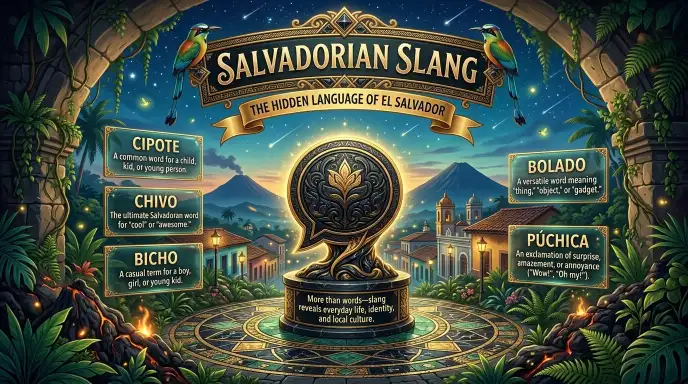
Salvadorian slang refers to the informal Spanish words and expressions used in everyday conversations in El Salvador.
Words like chero, maje, cipote, and chivo can help you understand messages, TikTok videos, Instagram captions, and conversations with Salvadoran friends.
If you have seen a Salvadoran expression online and wondered what it means, you are not alone.
Some words sound unfamiliar to Spanish learners, while others have meanings that change depending on the situation.
Salvadoran slang is more than a collection of funny words. It reflects friendship, humor, local identity, and the way people communicate in daily life.
A short expression can show excitement, agreement, frustration, or affection.In this guide, you will learn popular Salvadoran slang words, how people use them in texts, and what they mean in real conversations.
You will also discover which expressions are friendly, which can sound rude, and how to use them without misunderstanding someone.
1. Salvadorian Slang Meaning in Text
The phrase Salvadorian slang describes informal words and expressions associated with the Spanish spoken in El Salvador. The more common English spelling for the nationality and language variety is Salvadoran, although “Salvadorian” is also used.
It is not one specific acronym or abbreviation. Instead, it is a broad term for the casual language people may use with friends, relatives, classmates, and online communities.
For example, a Salvadoran person might text:
“¿Qué ondas, chero?”
This can mean:
“What’s up, buddy?”
Here, qué ondas is a casual way to ask how someone is doing, while chero means friend or buddy.
Another message might say:
“¡Está chivo!”
That means something like:
“That’s cool!” or “That’s awesome!”
These expressions are informal. Their meaning can depend on tone, relationship, and the context of the conversation. A word that sounds friendly between close friends may feel disrespectful when used with a stranger or an older person.
What makes Salvadoran slang different?
Salvadoran Spanish shares many words with other Central American varieties, but certain expressions are especially associated with El Salvador. Some are also used in neighboring countries, so they should not always be treated as exclusive to El Salvador.
The key is to understand the phrase as a whole rather than translating every word literally.
2. Popular Salvadorian Slang Words and Their Meanings
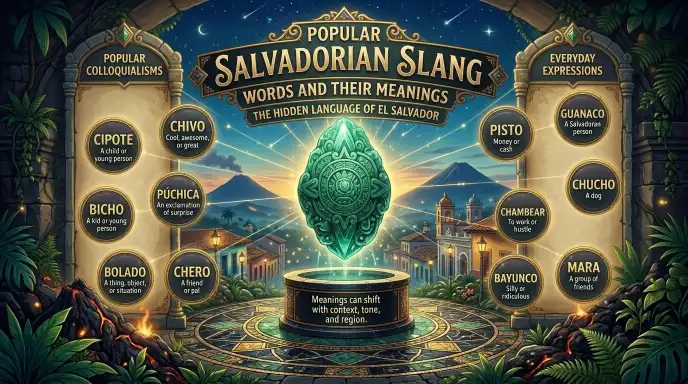
Here are some useful expressions to recognize. These are informal words, so the examples show how they might appear in conversation:not rules that every Salvadoran speaker follows.
2.1 Chero
Meaning: Friend, buddy, or close companion
Chero is one of the best known Salvadoran expressions for a friend. It can be used when greeting someone or talking about a person you know well.
Example:
“Voy a salir con mi chero.”
Meaning: “I’m going out with my friend.”
2.2 Maje
Meaning: Dude, person, or buddy
Maje is common in casual conversation. Depending on tone, it can sound friendly, annoyed, or insulting.
Example:
“¿Qué pasó, maje?”
Meaning: “What’s up, dude?”
Use it carefully. It may be fine among friends, but it is not the best choice in a formal conversation.
2.3 Cipote / Cipota
Meaning: Boy, kid, or young person
Cipote usually refers to a boy or child, while cipota is the feminine form. The word can also be used affectionately for young people.
Example:
“Cuando era cipote, jugaba fútbol todos los días.”
Meaning: “When I was a kid, I played soccer every day.”
2.4 Bicho / Bicha
Meaning: Kid, young person, or girl
In Salvadoran informal speech, bicho and bicha can refer to young people. The exact meaning depends on the sentence.
Example:
“Los bichos están en la escuela.”
Meaning: “The kids are at school.”
2.5 Chivo
Meaning: Cool, great, or awesome
When someone says something is chivo, they are usually saying it is good, exciting, or enjoyable.
Example:
“Tu camisa está bien chiva.”
Meaning: “Your shirt is really cool.”
2.6 Pisto
Meaning: Money or cash
Pisto is an informal word for money, used in El Salvador and other parts of Central America.
Example:
“No tengo pisto hoy.”
Meaning: “I don’t have any money today.”
It is casual language, so it is more suitable for friends than formal financial conversations.
2.7 Simón
Meaning: Yes
Simón is a casual way to say “yes” or “yeah.” It is not the same as the proper name Simon when used in this conversational way.
Example:
“¿Vas a venir mañana?”
“Simón.”
Meaning:
“Are you coming tomorrow?”
“Yeah.”
2.8 Cabal
Meaning: Exactly, that’s right, or just as expected
Cabal can be used to show agreement or confirm that something is correct.
Example:
“Entonces nos vemos a las seis.”
“Cabal.”
Meaning:
“So, we’ll see each other at six.”
“Exactly.”
2.9 Púchica
Meaning: A mild expression of surprise, frustration, or disappointment
Púchica is an exclamation. Its emotional meaning changes with the situation.
Example:
“¡Púchica! Se me olvidó la tarea.”
Meaning: “Oh, shoot! I forgot my homework.”
It is generally milder than some stronger expressions, but tone still matters.
2.10 Dar paja
Meaning: To lie, make excuses, or talk nonsense
This expression is used when someone thinks another person is not being honest or is making up an excuse.
Example:
“No me des paja.”
Meaning: “Don’t lie to me” or “Don’t give me excuses.”
2.11 Bolo / Bola
Meaning: A drunk person
Bolo is commonly used for a man who is drunk, while bola may be used for a woman. Usage can vary.
Example:
“Él estaba bolo en la fiesta.”
Meaning: “He was drunk at the party.”
Because it describes someone’s condition, it may sound judgmental depending on the context.
2.12 Guanaco / Guanaca
Meaning: A person from El Salvador
Guanaco and guanaca are associated with Salvadoran identity. They can be used affectionately or proudly, though the tone and speaker matter.
Example:
“Soy guanaco y me encanta mi país.”
Meaning: “I’m Salvadoran, and I love my country.”
2.13 Alero
Meaning: Friend or buddy
Alero is another informal word for a friend. It may overlap with chero, although local preferences can differ.
Example:
“Mi alero me invitó a comer.”
Meaning: “My friend invited me to eat.”
2.14 Vergón / Vergona
Meaning: Very cool, excellent, or impressive
This expression can be used to praise something, but it is vulgar because it comes from a sexual swear word.
Example:
“¡Qué vergón estuvo el concierto!”
Meaning: “The concert was freaking awesome!”
It may be common in some casual circles, but avoid it in school, work, or polite settings.
2.15 ¿Qué ondas?
Meaning: What’s up? / How are things?
This is a casual greeting. It is often used with friends or people someone knows.
Example:
“¿Qué ondas? ¿Todo bien?”
Meaning: “What’s up? Everything good?”
3. Where People Use Salvadorian Slang
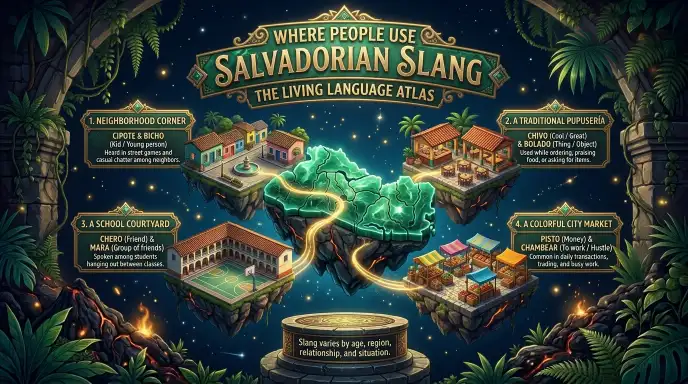
Salvadoran slang is used in face to face conversations as well as digital communication. The platform does not create the meaning; it simply provides a place for people to use the words.
1 TikTok
On TikTok, Salvadoran expressions may appear in comedy clips, local videos, reaction content, and conversations about Salvadoran culture.
A creator might use chivo to describe a funny video or say púchica after an unexpected moment. Captions and comments can help viewers understand the context.
However, not every slang word used in a Spanish language video is specifically Salvadoran. Some expressions are shared across different countries.
2 Snapchat
Snapchat messages are often short and casual, which makes expressions like maje, chero, and simón easy to use.
Example:
“Simón, llego en 10.”
Meaning: “Yeah, I’ll be there in 10.”
The tone is usually relaxed, especially between friends.
3 Instagram
On Instagram, Salvadoran slang can appear in captions, comments, stories, and direct messages.
Someone might comment:
“Está chivo 🔥”
Meaning: “That’s awesome.”
Emojis can add excitement or friendliness, but they do not change the basic meaning of the expression.
4 WhatsApp
WhatsApp is useful for everyday conversations with family and friends. People may use slang when making plans, checking in, or joking around.
Example:
“¿Qué ondas, chero? ¿Tenés pisto para salir?”
Meaning: “What’s up, buddy? Do you have money to go out?”
This message combines a greeting, a friendly term, and an informal word for money.
5 SMS and Regular Text Messages
Salvadoran slang can also appear in ordinary SMS messages. People do not need a special app to use it.
Example:
“Cabal. Nos vemos mañana.”
Meaning: “Exactly. See you tomorrow.”
Some people shorten messages, while others write full sentences. There is no single texting style used by every Salvadoran speaker.
4. Real Chat Examples of Salvadorian Slang
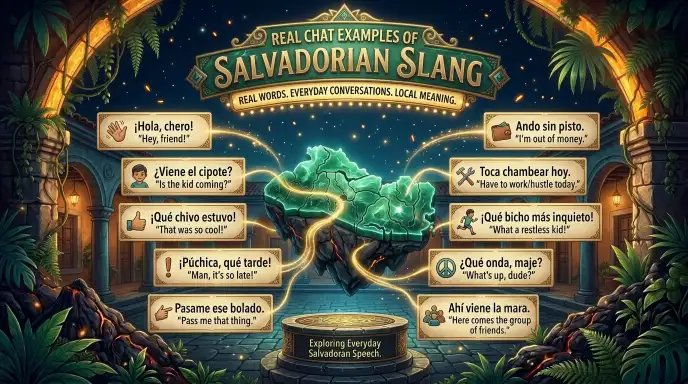
The following conversations show how these words may appear naturally. They are illustrative examples, not quotations from real people.
Example 1: Greeting a friend
A: ¿Qué ondas, chero?
B: Todo bien, ¿y vos?
A: Bien también.
Meaning: “What’s up, buddy?” “All good, and you?” “Good too.”
Example 2: Talking about a cool outfit
A: ¿Te gusta mi camisa?
B: ¡Está chiva!
A: Gracias, maje.
Meaning: “Do you like my shirt?” “It’s cool!” “Thanks, dude.”
Example 3: Asking about money
A: ¿Vamos al cine hoy?
B: No puedo, no tengo pisto.
A: Está bien, otro día.
Meaning: “Are we going to the movies today?” “I can’t, I don’t have money.” “That’s okay, another day.”
Example 4: Agreeing with a plan
A: Nos juntamos a las cinco, ¿va?
B: Cabal.
A: Ahí te veo.
Meaning: “We’ll meet at five, okay?” “Exactly.” “See you there.”
Example 5: Confirming something
A: ¿Entonces sí vas a venir?
B: Simón, ahí llego.
A: Perfecto.
Meaning: “So you are coming?” “Yeah, I’ll be there.” “Perfect.”
Example 6: Reacting to surprising news
A: ¡Me dieron el trabajo!
B: ¡Púchica, qué buena onda!
A: Estoy bien feliz.
Meaning: “I got the job!” “Wow, that’s great!” “I’m really happy.”
Example 7: Calling someone out
A: Te dije que ya había terminado.
B: No me des paja, todavía falta.
A: Bueno, ya casi.
Meaning: “I told you I was finished.” “Don’t give me excuses; there’s still more.” “Okay, almost.”
Example 8: Talking about childhood
A: ¿Jugabas fútbol cuando eras pequeño?
B: Sí, cuando era cipote.
A: Yo también.
Meaning: “Did you play soccer when you were little?” “Yes, when I was a kid.” “Me too.”
Example 9: Describing a concert
A: ¿Cómo estuvo el concierto?
B: ¡Estuvo chivo!
A: Qué bueno que te gustó.
Meaning: “How was the concert?” “It was awesome!” “I’m glad you liked it.”
Example 10: Making plans with friends
A: ¿Vas a salir con los bichos?
B: Simón, vamos a comer.
A: Que les vaya bien.
Meaning: “Are you going out with the kids/your friends?” “Yeah, we’re going to eat.” “Have a good time.”
5. How to Reply When Someone Uses Salvadorian Slang
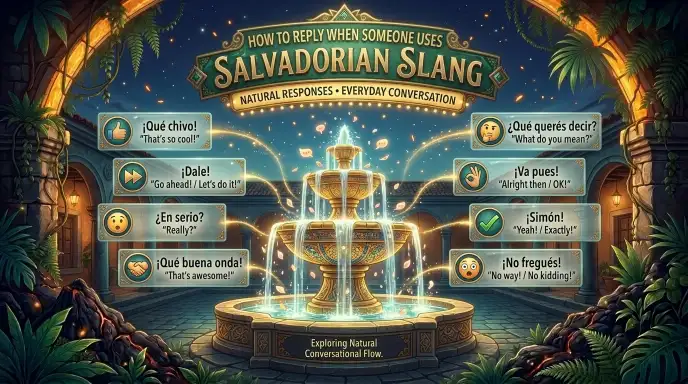
If someone uses Salvadoran slang with you, you do not need to copy every word. A simple, natural reply is often best. Here are a few options based on the situation.
5.1 Funny replies
Use these when you are joking with a friend:
- “¡Púchica, explicame pues!” : “Whoa, explain it to me!”
- “Ya aprendí, maje.” : “I’ve learned now, dude.”
- “Hablás bien salvadoreño.” : “You speak very Salvadoran.”
These are playful examples. Make sure the other person is comfortable with the joke.
5.2 Casual replies
For everyday conversation:
- “Simón, está bien.” : “Yeah, that’s fine.”
- “Cabal, nos vemos.” : “Exactly, see you.”
- “Todo bien, chero.” : “All good, buddy.”
5.3 Friendly replies
If someone greets you or calls you chero:
- “¡Qué ondas!” : “What’s up!”
- “Todo tranquilo, ¿y vos?” : “All good, and you?”
- “¡Qué buena onda!” : “That’s really nice!”
5.4 Neutral replies
If you are not sure about the meaning or tone:
- “¿Qué significa esa palabra?” : “What does that word mean?”
- “¿Lo decís en broma?” : “Are you saying that as a joke?”
- “¿Me lo podés explicar?” : “Can you explain it to me?”
Asking is better than guessing, especially if a word could be rude.
6. Is Salvadorian Slang Rude or Offensive?
Salvadoran slang is not automatically rude. Many expressions are friendly and useful in everyday conversation. However, some words can sound disrespectful, vulgar, or too familiar.
The meaning often depends on three things:
- The word itself: Some expressions are mild, while others contain profanity.
- The relationship: Close friends may use language that would be inappropriate with strangers.
- The tone: A playful word can become an insult when spoken angrily.
For example, chero is generally friendly when used to mean “buddy.” Maje can also be friendly, but it may sound insulting in a tense conversation. Vergón is vulgar, even when it is intended as praise.
Is it safe to use at school or work?
For school, work, or formal situations, it is best to use standard Spanish. You can understand slang without using it yourself.
Safer expressions include:
- “Hola, ¿cómo estás?” : “Hello, how are you?”
- “Está muy bien.” : “That’s very good.”
- “Estoy de acuerdo.” : “I agree.”
- “Muchas gracias.” : “Thank you very much.”
When speaking with someone from El Salvador, listen to how they use a word before repeating it. This helps you avoid sounding rude or unnatural.
7. Who Uses Salvadorian Slang?
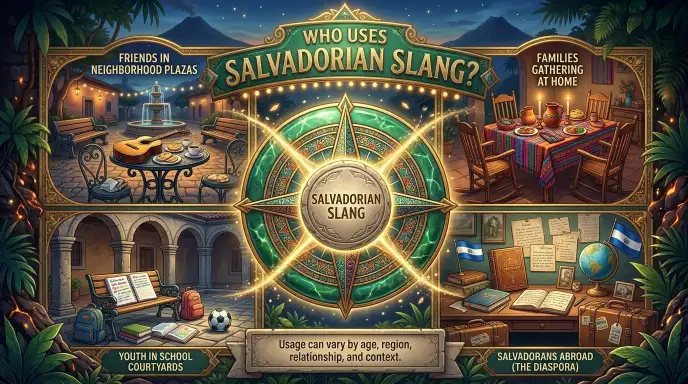
Salvadoran slang is used by people in different age groups and communities. It is not limited to teenagers or Gen Z.
1 Teenagers and Young Adults
Young people may use informal expressions in chats, social media comments, and conversations with friends. Words such as chivo, maje, and cabal can appear in casual exchanges.
That does not mean every young Salvadoran uses the same words. Personal preference, family background, and location can influence speech.
2 Adults and Older Speakers
Adults also use Salvadoran slang, particularly in informal settings. Some expressions have been part of everyday speech for a long time rather than being newly invented internet terms.
A word may feel familiar to one generation and less common to another.
3 Salvadorans Living Abroad
Salvadorans living outside El Salvador may use these expressions when speaking with family, friends, or other Salvadoran communities.
Slang can help people maintain a connection with their culture. It may also appear in messages between people who grew up in El Salvador and people who are learning about the country.
4 How Often Does It Appear Online?
There is no reliable single measurement for how often every Salvadoran slang word appears online. Some expressions are widely recognized, while others may be regional, age specific, or less common.
For that reason, it is more accurate to say that these words are used in informal communication than to claim that every term is trending on every platform.
8. Origin of Salvadorian Slang
Salvadoran slang developed through the everyday use of Spanish in El Salvador. Like other regional varieties of Spanish, it reflects local history, community life, and contact with other languages and cultures.
Many expressions are not new internet inventions. They were used in spoken conversations before TikTok, Instagram, and messaging apps became popular.
For example, words such as cipote, chero, and pisto are associated with informal speech in El Salvador and parts of Central America. Their histories may be complex, and a word can have different uses across countries.
Did social media create these expressions?
Social media did not create most traditional Salvadoran slang. Instead, it helps expressions travel beyond their original communities.
A person might hear qué ondas in a video, search for its meaning, and then use it while texting a friend. Online content makes regional language easier to discover, but it can also remove words from their original context.
Is the origin of every word clear?
No. The history of some expressions is uncertain or debated. It is better to explain a word’s current meaning and regional association than to present an unverified origin story as fact.
Language changes naturally. People may also use a familiar expression in a new way, especially online.
9. Salvadorian Slang Compared With Common Text Abbreviations
Salvadoran slang and English texting abbreviations are different kinds of informal language. Salvadoran slang often consists of Spanish words or phrases, while abbreviations such as IDK and BRB shorten English expressions.
| Term | Meaning | Type | Usage | Popularity |
| Salvadorian slang | Informal expressions associated with Salvadoran Spanish | Regional slang category | Daily speech, chats, and social media | Varies by word and community |
| IDK | I don’t know | English abbreviation | Texts and online messages | Widely recognized in English texting |
| IDC | I don’t care | English abbreviation | Casual messages | Widely recognized in English texting |
| IMO | In my opinion | English abbreviation | Comments and conversations | Widely recognized online |
| BRB | Be right back | English abbreviation | Chats and messaging | Widely recognized in English texting |
The important difference: Salvadoran slang is not one short phrase with a single meaning. It is a group of regional expressions. A word such as chivo may mean “cool,” while pisto means “money.”
10. Real World Usage Example: A Conversation Between Friends
Imagine two friends in El Salvador planning to meet after school. One wants to go out for food, but the other is unsure if they have enough money.
The conversation might sound like this:
Friend A: ¿Qué ondas, chero? ¿Vamos a comer algo?
Friend B: Simón, pero no tengo mucho pisto.
Friend A: No hay problema. Podemos ir a un lugar barato.
Friend B: Cabal, esa es buena idea.
Friend A: ¡Qué chivo!
Here is what the conversation means:
- ¿Qué ondas, chero? : “What’s up, buddy?”
- Simón : “Yeah.”
- Pisto : “Money.”
- Cabal : “Exactly” or “That’s right.”
- Qué chivo : “How cool” or “That’s great.”
The expressions make the conversation sound relaxed and familiar. They also show how slang can carry meaning without making the message difficult to understand.
This is the most useful way to learn regional slang: see the word in a sentence, understand the situation, and notice how the other person responds.
11. Common Mistakes When Learning Salvadorian Slang
Learning slang can be fun, but a few mistakes can lead to confusion.
1. Assuming Every Word Is Exclusive to El Salvador
Some expressions are strongly associated with El Salvador but are also used in other Central American countries. Avoid labeling every word as uniquely Salvadoran unless its use is clearly specific.
2 .Translating Word for Word
A slang expression may not make sense when translated literally. For example, qué ondas is a greeting, not a question about physical waves.
Learn the expression as a complete phrase.
3. Using Informal Words With Everyone
Words like maje may be comfortable between friends but inappropriate in a formal setting. Pay attention to the relationship before using them.
4. Treating Slang as a Fixed Dictionary
Language changes. A term may have more than one meaning, and people in different communities may use it differently.
5 .Copying Vulgar Expressions Without Understanding Them
Some words sound positive in a particular sentence but are still vulgar. If you are unsure, use a neutral alternative.
12. Frequently Asked Questions
Q.1 What does Salvadorian slang mean in text messages?
Salvadorian slang refers to informal Spanish expressions associated with El Salvador. In texts, words such as chero mean “friend,” chivo means “cool,” and pisto means “money.”
Q.2 What does Salvadorian slang mean on TikTok?
On TikTok, it usually refers to Salvadoran expressions used in videos, captions, or comments. The meaning depends on the specific word and the context of the clip.
Q.3 Is Salvadorian slang actually slang?
Yes. It is a broad category of informal regional language, not a single acronym or abbreviation. The more common spelling in English is “Salvadoran slang.”
Q.4 Is Salvadorian slang rude or offensive?
Most expressions are not automatically offensive, but some can be vulgar or insulting. For example, maje depends on tone, while vergón is considered vulgar.
Q.5 How should you reply to Salvadorian slang?
Reply naturally and politely. You can say simón for “yes,” cabal for “exactly,” or ask “¿Qué significa?” if you do not understand the expression.
13. Conclusion: Understanding Salvadorian Slang Naturally
Salvadorian slang is a lively part of informal Spanish used in El Salvador. Expressions like chero, maje, cipote, chivo, pisto, and cabal help people communicate in a relaxed, familiar way.
You may encounter these words in everyday conversations, TikTok videos, Instagram comments, Snapchat messages, or WhatsApp chats. Their meanings become easier to understand when you pay attention to the situation and the relationship between the speakers.
If you are learning Salvadoran slang, start by recognizing the words rather than trying to use every expression immediately. Some are friendly, some are informal, and a few can be vulgar.
The best way to use slang respectfully is to understand its meaning, listen to how Salvadoran speakers use it, and choose expressions that fit the conversation. With that approach, you can appreciate the language without sounding forced or accidentally offending someone.
🌸 More to Discover!
Wax Meaning in Slang: Definition, Uses, and Examples
Slang for Dancing: 35 Fun Words and Phrases People Actually Use

I am Masson Caldwell, a language enthusiast and content writer at SlangAura. I write about internet slang, texting trends, and modern expressions to help readers understand the evolving world of online language with simple and clear explanations.