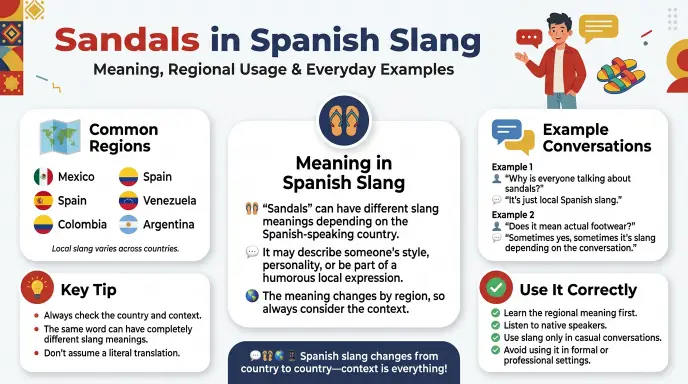
If you’re searching for sandals in Spanish slang, the short answer is simple: there isn’t one universal Spanish slang word that means “sandals.”
Instead, different Spanish-speaking countries use their own informal words for sandals or flip-flops. The standard Spanish word is sandalias, but in everyday conversation you may hear words like chanclas, ojotas, chalas, or chancletas, depending on where the speaker is from.
Many people search for sandals in Spanish slang after hearing these words in TikTok videos, movies, travel conversations, or while learning Spanish. Since regional slang varies widely, the same footwear can have different names across countries.
In this guide, you’ll learn what sandals in Spanish slang means, the most common regional slang words, where they’re used, if they’re considered rude, and how to use them naturally in conversation.
Quick Answer: Sandals in Spanish Slang
There is no single slang word for sandals that is used across the entire Spanish-speaking world. Instead, native speakers use different regional words.
| Country or Region | Common Word | Meaning |
| Mexico | Chanclas | Flip-flops or casual sandals |
| Spain | Chanclas | Flip-flops |
| Argentina | Ojotas | Flip-flops |
| Uruguay | Ojotas | Flip-flops |
| Chile | Chalas | Sandals or flip-flops |
| Caribbean | Chancletas | Sandals or flip-flops |
The safest word everyone understands is sandalias, while the slang term depends on the country.
What Does Sandals in Spanish Slang Mean?
Sandals in Spanish slang refers to the informal words people use instead of the standard word sandalias.
Unlike internet slang, these are regional vocabulary differences rather than secret code words. Native speakers naturally use them in everyday conversation with friends and family.
For example:
- A Mexican speaker may say chanclas.
- An Argentine speaker is more likely to say ojotas.
- A Chilean speaker may use chalas.
Although these words differ, they all describe similar open footwear.
Formal Word: Sandalias
Sandalias is the correct dictionary word.
It is appropriate in:
- Schools
- Books
- News articles
- Clothing stores
- Formal conversations
- Language classes
Example:
“Compré unas sandalias nuevas para el verano.”
“I bought new sandals for the summer.”
Informal Slang Words
In everyday speech, many people replace sandalias with a local slang word because it sounds more natural.
These slang words usually refer to:
- Flip-flops
- Beach sandals
- Rubber sandals
- Casual summer footwear
The exact meaning depends on the country and local dialect.
Full Form or Complete Meaning
Unlike abbreviations such as “LOL” or “BRB,” sandals in Spanish slang is not an acronym, so it has no full form.
Instead, it describes the different informal words Spanish speakers use for sandals in everyday conversation.
Think of it like this:
- Sandalias = Standard Spanish
- Chanclas, Ojotas, Chalas, Chancletas = Regional informal alternatives
Different Meanings of Sandals in Spanish Slang
Because Spanish is spoken in more than 20 countries, different slang words have developed over time. Here are the most common ones.
Chanclas
Chanclas is one of the best-known informal words for sandals.
It usually means:
- Flip-flops
- Rubber sandals
- Casual slip-on footwear
It is commonly heard in:
- Mexico
- Spain
- Guatemala
- Honduras
- El Salvador
- Spanish-speaking communities in the United States
Example:
“No olvides tus chanclas para la piscina.”
“Don’t forget your flip-flops for the pool.”
People use chanclas naturally in daily conversations, especially during summer or vacations.
Ojotas
In Argentina, Uruguay, and Paraguay, the word ojotas is much more common.
It generally refers to:
- Rubber flip-flops
- Beach sandals
- Lightweight summer footwear
Example:
“Con este calor solo quiero usar ojotas.”
“It’s so hot that I only want to wear flip-flops.”
Visitors to Argentina may rarely hear chanclas, since ojotas is the preferred local word.
Chalas
In Chile, many people say chalas instead of sandalias.
This is an everyday informal word that locals use without thinking twice.
Example:
“Ponte las chalas antes de salir.”
“Put your sandals on before going outside.”
Although visitors may not recognize the word immediately, Chileans understand it instantly.
Chancletas
In parts of the Caribbean, including countries like the Dominican Republic and Puerto Rico, people often say chancletas.
Depending on the region, it may refer to:
- Flip-flops
- House sandals
- Beach sandals
Example:
“Voy a la playa con mis chancletas.”
“I’m going to the beach wearing my flip-flops.”
In many families, chancletas is simply the everyday word for casual sandals.
Where Is It Commonly Used?
Regional slang for sandals appears in many everyday situations.
Family Conversations
Parents often remind children to put on their sandals before going outside.
Example:
“Ponte las chanclas.”
Beach Trips
People naturally use these words when talking about vacations, pools, beaches, and warm weather.
Shopping
Local clothing stores may use either the formal word sandalias or the regional slang depending on their audience.
Social Media
On platforms like:
- TikTok
- YouTube
content creators often use the slang word common in their country instead of the dictionary term.
For example:
- Mexican creators usually say chanclas.
- Argentine creators often say ojotas.
- Chilean creators commonly say chalas.
Everyday Speech
Among friends and family, these regional words sound more natural than the formal sandalias.
Using the local term can also help you sound more like a native speaker when visiting a Spanish-speaking country.
Is Sandals in Spanish Slang Rude, Offensive, or Harmless?
In almost every situation, these regional words are harmless and friendly. They are everyday vocabulary, not insults or offensive slang.
Here’s a quick guide:
| Word | Tone | Appropriate for Daily Conversation? |
| Sandalias | Formal | ✅ Yes |
| Chanclas | Casual | ✅ Yes |
| Ojotas | Casual | ✅ Yes |
| Chalas | Casual | ✅ Yes |
| Chancletas | Casual | ✅ Yes |
These words are commonly used by:
- Families
- Friends
- Students
- Travelers
- Shopkeepers
- Social media creators
Can You Use These Words at Work?
It depends on the situation.
If you’re speaking casually with coworkers, regional words like chanclas or ojotas are perfectly natural.
However, in formal settings such as:
- Business emails
- School assignments
- Official documents
- Product descriptions
it’s better to use sandalias, the standard Spanish word.
Real-Life Examples
Here are some realistic examples showing how these words are used in different situations.
Example 1: Family
Mother: “Ponte las chanclas antes de salir.”
Child: “Ya voy.”
Translation
Mother: “Put your flip-flops on before you go outside.”
Child: “I’m coming.”
Example 2: Friends
Friend 1: “¿Trajiste tus ojotas?”
Friend 2: “Sí, están en la mochila.”
Translation
Friend 1: “Did you bring your flip-flops?”
Friend 2: “Yes, they’re in my backpack.”
Example 3: Beach Vacation
“We’re going to the beach tomorrow. Don’t forget your chancletas.”
Example 4: Shopping
“I’m looking for comfortable sandalias for summer.”
Example 5: Social Media
A Chilean travel creator says:
“Estas chalas son perfectas para caminar por la playa.”
“These sandals are perfect for walking on the beach.”
Origin and History
The formal word sandalias comes from Latin and has been part of the Spanish language for centuries.
The regional words developed naturally over time as Spanish evolved in different countries.
Chanclas
Chanclas has been used in Spain and Latin America for many years. Today, it is one of the most recognized informal words for flip-flops.
Ojotas
The word ojotas has roots in South America and became especially common in Argentina, Uruguay, and Paraguay.
Chalas
Chalas developed as a regional Chilean expression and remains widely used there today.
Chancletas
Chancletas is especially popular in several Caribbean Spanish-speaking communities and is commonly heard in everyday conversations.
Because Spanish varies by region, none of these words replaced sandalias. Instead, they exist alongside the standard word.
Why Do People Use These Slang Words?
People usually choose the regional word because it’s the one they grew up hearing.
Reasons include:
- It sounds more natural.
- Friends and family use it.
- It reflects local culture.
- It’s quicker in casual conversation.
- It helps identify someone’s regional background.
For native speakers, saying chanclas instead of sandalias often feels as natural as saying “sneakers” instead of “athletic shoes.”
Similar Slang or Related Terms
Here are some other Spanish footwear words you may hear.
| Word | Meaning | Formal or Informal |
| Sandalias | Sandals | Formal |
| Chanclas | Flip-flops | Informal |
| Ojotas | Flip-flops | Informal |
| Chalas | Sandals | Informal |
| Chancletas | Flip-flops | Informal |
| Zapatos | Shoes | Formal |
| Tenis | Sneakers (many countries) | Informal/Common |
| Zapatillas | Sneakers or athletic shoes (varies by country) | Common |
Remember that many Spanish words change depending on the country, so local vocabulary is always important.
When Should You Avoid Using These Words?

Although these slang terms are friendly, there are situations where the formal word is a better choice.
Avoid regional slang when:
- Writing school assignments.
- Sending business emails.
- Preparing official documents.
- Speaking with people who may not know your regional vocabulary.
- Teaching beginner Spanish learners.
In these situations, sandalias is clearer because it is understood everywhere.
Likewise, if you’re traveling to another Spanish-speaking country, remember that locals may use a completely different word. If you’re unsure, using sandalias is always a safe option.
Polite Alternatives
If you’re unsure which regional slang word people use, choose the standard Spanish term.
Here are some safe alternatives:
| Word | Best Used For | Understood Everywhere? |
| Sandalias | Formal and general conversations | ✅ Yes |
| Calzado de verano | Formal writing | ✅ Yes |
| Zapatos abiertos | Describing open shoes | ✅ Mostly |
Using sandalias is the safest option when talking with people from different Spanish-speaking countries.
Common Misunderstandings
Many learners assume there is one Spanish slang word for “sandals.” That isn’t true.
Here are a few common misunderstandings:
“Chanclas” is used everywhere.
Not always. While chanclas is common in Mexico and Spain, people in Argentina are more likely to say ojotas, and people in Chile often say chalas.
“Sandalias” is old-fashioned.
No. Sandalias is the standard dictionary word and is still widely used in schools, stores, books, and formal conversations.
Every regional word means exactly the same thing.
Not necessarily. In some places, a slang word may specifically mean flip-flops, while in others it can include several types of casual sandals.
Understanding the local context helps you choose the most natural word.
Frequently Asked Questions
What is the Spanish slang for sandals?
There is no universal Spanish slang word for sandals. Depending on the country, people may say chanclas, ojotas, chalas, or chancletas.
What is the formal Spanish word for sandals?
The standard word is sandalias. It is understood across all Spanish-speaking countries.
Is “chanclas” a slang word?
Yes. Chanclas is an informal regional word commonly used for flip-flops or casual sandals, especially in Mexico and Spain.
Is “ojotas” the same as “chanclas”?
They usually refer to similar footwear, but ojotas is mainly used in Argentina, Uruguay, and Paraguay, while chanclas is more common in Mexico and Spain.
Are these words offensive?
No. These are everyday informal words and are not considered rude or offensive.
Which word should Spanish learners use?
If you’re unsure which regional word is appropriate, use sandalias. It is correct, polite, and understood almost everywhere.
Can I use these words while traveling?
Yes, but remember that vocabulary changes from country to country. Learning the local word can make conversations feel more natural, but sandalias is always a safe choice.
Conclusion
The phrase sandals in Spanish slang doesn’t point to one universal slang term. Instead, Spanish speakers use different regional words depending on where they live. Chanclas, ojotas, chalas, and chancletas are all common examples, while sandalias remains the standard Spanish word understood throughout the Spanish-speaking world.
If you’re learning Spanish, traveling, or chatting with native speakers online, knowing these regional differences can help you understand conversations more easily and communicate with greater confidence. When in doubt, choose sandalias for formal situations, and use the local slang naturally when speaking with people from that region.
Continue Exploring Slang:

I am Masson Caldwell, a language enthusiast and content writer at SlangAura. I write about internet slang, texting trends, and modern expressions to help readers understand the evolving world of online language with simple and clear explanations.