White boy in Spanish is usually translated as “chico blanco” or “muchacho blanco.” People search for this phrase to learn how to describe a white boy in Spanish, understand comments on social media, or find out if Spanish speakers use a different slang term.
The correct translation depends on the situation. For example, chico blanco can describe a white boy or young man, while niño blanco usually refers to a white male child. These expressions are straightforward descriptions rather than internet abbreviations.
You may encounter the phrase on TikTok, Instagram, Snapchat, WhatsApp, or in everyday conversations. You might also see words such as güero or gringo, especially in Mexican Spanish, but they do not always mean the same thing.
In this guide, you will learn the meaning of white boy in Spanish, how to use the phrase naturally, what different regional expressions mean, and how to understand it when someone uses it in a message or online comment.
Quick Answer: What Does White Boy in Spanish Mean?
The most common direct translation of “white boy” is “chico blanco.” Another option is “muchacho blanco,” while “niño blanco” is appropriate when referring specifically to a male child.
Here is a quick breakdown:
- Chico blanco: A white boy or young man.
- Muchacho blanco: A white boy, lad, or young man, depending on context.
- Niño blanco: A white male child or boy.
- Güero: A common Mexican Spanish term for someone with light colored hair or a light complexion.
- Gringo: An informal term often used for a foreigner, particularly an American in some Latin American contexts. Its meaning and tone vary.
Important: Güero and gringo are not exact translations of “white boy.” The best expression depends on if you mean a person’s appearance, age, nationality, or cultural background.
1. White Boy in Spanish: Meaning and Translation
The English phrase white boy combines two words: white, which describes skin color or racial identity, and boy, which usually refers to a male child or young male person.
Spanish expresses this idea with a noun and an adjective. The most natural choice depends on the person’s age and the context in which you are speaking.
Chico blanco
Chico blanco is a common, straightforward translation of “white boy.” The word chico can mean boy, guy, or young man, while blanco means white.
For example:
- El chico blanco está en mi clase. : The white boy is in my class.
- Conocí a un chico blanco ayer. : I met a white boy yesterday.
- Ese chico blanco juega al fútbol. : That white boy plays soccer.
Notice that Spanish adjectives often come after the noun. In English, you say “white boy,” but in Spanish, you normally say chico blanco.
This phrase is descriptive. It is not automatically an insult, a joke, or slang. The surrounding sentence and the speaker’s intention determine how it sounds.
Muchacho blanco
it is another correct translation. Muchacho can refer to a boy, lad, or young man.
For example:
- El muchacho blanco vive cerca de aquí. : The white boy lives near here.
- Vi a un muchacho blanco en la tienda. : I saw a white boy at the store.
The choice between chico and muchacho can depend on region, personal preference, and the type of conversation. Both are understandable in many Spanish speaking settings.
Niño blanco
Niño blanco is usually the better choice when you are specifically talking about a male child.
Examples:
- El niño blanco está jugando. : The white boy is playing.
- Ese niño blanco tiene cinco años. : That white boy is five years old.
In Spanish, niño commonly refers to a child, so it may sound less suitable when describing an older teenager or adult.
Is “white boy” a Spanish slang term?
No. “White boy” is an English phrase, and “chico blanco” is its direct Spanish translation. Neither expression is automatically slang.
People may use the phrase casually in a conversation, but that does not make it an acronym or a special internet expression.
Online, someone might use it to describe a person, discuss a relationship, make a joke, or talk about a video. In each case, the meaning comes from the surrounding conversation.
2. Where People Use White Boy in Spanish
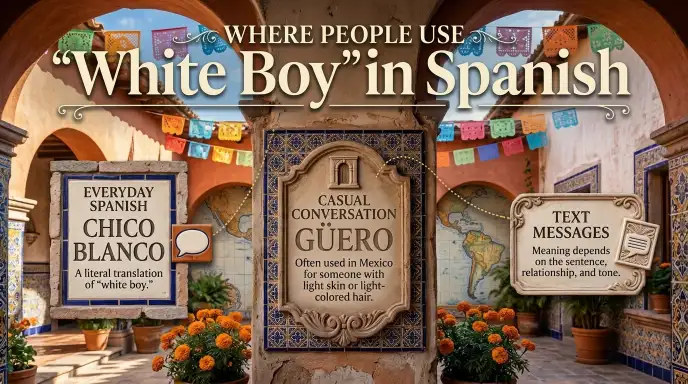
People may search for this phrase after seeing a Spanish caption, a bilingual conversation, or a social media comment. However, the wording and tone can change depending on the platform.
White Boy in Spanish on TikTok
TikTok contains videos about Spanish vocabulary, cultural differences, relationships, music, and humor. Someone might ask how to say “white boy” in Spanish because they want to understand a caption or create one of their own.
For example:
“How do you say white boy in Spanish?”
A straightforward answer would be chico blanco.
Other videos may use Mexican Spanish terms such as güero. In those cases, the creator may be describing a person’s appearance rather than translating the English phrase word for word.
Do not assume that every slang word in a TikTok video has the same meaning across all Spanish speaking countries. A joke that makes sense in one community may sound unusual elsewhere.
White Boy in Spanish on Snapchat
On Snapchat, people often use short messages, private stories, captions, and playful nicknames.
Someone might ask a friend:
“What does chico blanco mean?”
The answer is simple: it means “white boy” or, depending on context, “white young man.”
Friends may also use regional words or personal nicknames. Still, a nickname should not be assumed to be affectionate just because it appears in a casual chat.
White Boy in Spanish on Instagram
Instagram captions and comments frequently mix English and Spanish. A person might use chico blanco in a caption about a friend, a character, or someone appearing in a photo.
For example:
“El chico blanco de la foto es mi amigo.”
Translation: “The white boy in the photo is my friend.”
If you encounter a word such as güero in a comment, remember that it often refers to light coloring in Mexican Spanish. It does not necessarily mean the person is American or belongs to a particular nationality.
White Boy in Spanish on WhatsApp
WhatsApp conversations are usually more personal. Someone may ask for a translation, discuss a person they met, or message a bilingual friend.
For example:
“¿Cómo se dice white boy en español?”
Translation: “How do you say white boy in Spanish?”
A natural response would be:
“Se dice chico blanco.”
Translation: “You say chico blanco.”
In a relaxed conversation, people may shorten their sentences or mix languages. The basic translation remains the same.
White Boy in Spanish in SMS and Text Messages
Traditional SMS messages work much like WhatsApp messages. The phrase may appear when someone is learning Spanish, translating a sentence, or describing a person.
For example:
“The white boy is my neighbor.”
A Spanish translation is:
“El chico blanco es mi vecino.”
The phrase itself does not carry a hidden texting meaning. If a person uses it sarcastically or as part of a joke, the extra meaning comes from the tone and context rather than the words alone.
3. Ten Real Chat Examples of White Boy in Spanish
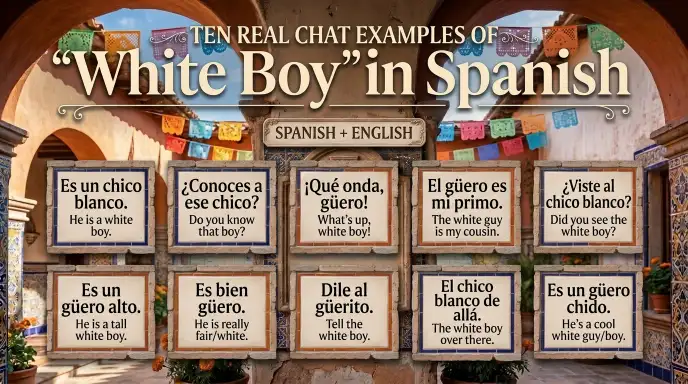
These examples show how the phrase and related Spanish expressions may appear in everyday conversations. The translations are included to help beginners understand both the words and their context.
Example 1: Asking for a translation
A: How do you say white boy in Spanish?
B: You can say chico blanco.
A: Oh, that makes sense!
Meaning: The conversation is about the direct Spanish translation.
Example 2: Talking about a classmate
A: ¿Quién es el chico blanco de tu clase?
B: Es un amigo mío.
A: Ah, ya entiendo.
Translation:
- A: Who is the white boy in your class?
- B: He is a friend of mine.
- A: Oh, now I understand.
Meaning: The phrase identifies a person in a classroom.
Example 3: Discussing a photo
A: Who is that guy in your picture?
B: Es un chico blanco que conocí en la escuela.
A: Nice, is he your friend?
Translation of B: He is a white boy I met at school.
Meaning: The phrase describes someone in a photo.
Example 4: Learning Spanish
A: My Spanish homework is confusing me.
B: What part?
A: I don’t know if to use niño blanco or chico blanco.
B: Use niño blanco for a child and chico blanco for a boy or young man, depending on context.
Meaning: The conversation explains the difference between two translations.
Example 5: Asking about Mexican Spanish
A: I heard someone say güero. Does it mean white boy?
B: Sometimes it can describe a light skinned or blond boy, but it isn’t an exact translation.
A: Got it. So it depends on the context?
B: Exactly.
Meaning: The speakers distinguish a regional expression from a literal translation.
Example 6: Talking about a neighbor
A: ¿Conoces al chico blanco que vive al lado?
B: Sí, se llama Daniel.
A: ¿Es amable?
Translation:
- A: Do you know the white boy who lives next door?
- B: Yes, his name is Daniel.
- A: Is he friendly?
Meaning: The phrase identifies a neighbor. The question is not necessarily offensive, although a person’s name or another neutral description may be more appropriate if skin color is irrelevant.
Example 7: Asking about a caption
A: What does el muchacho blanco mean?
B: It means “the white boy” or “the white young man.”
A: Is it different from chico blanco?
B: They’re similar, but usage can vary by region and context.
Meaning: Both expressions can describe a white boy or young man.
Example 8: Messaging a bilingual friend
A: I want to write “the white boy is funny” in Spanish.
B: You could say el chico blanco es gracioso.
A: Thanks! I’m learning slowly.
Translation: “The white boy is funny.”
Meaning: The phrase appears in a simple sentence about someone’s personality.
Example 9: Understanding a social media comment
A: Someone commented ese chico blanco under a video. What does it mean?
B: It means “that white boy” or “that white young man.”
A: So it isn’t automatically an insult?
B: Correct. You need the rest of the comment to understand the tone.
Meaning: The phrase can be neutral, but context matters.
Example 10: Choosing a respectful description
A: I need to describe someone in Spanish. Should I mention that he’s white?
B: Only if it’s relevant. Otherwise, you can use his name or say ese chico.
A: That sounds more natural.
Meaning: The conversation highlights an important point: a correct translation is not always the most useful wording in a real conversation.
4. How to Reply When Someone Says White Boy in Spanish
Your response depends on if the person is asking for a translation, describing someone, joking with a friend, or making a comment about race.
Funny replies
If a friend is simply discussing Spanish vocabulary, a lighthearted response can keep the conversation relaxed.
- “Spanish lesson unlocked!”
- “Today I’m learning two languages at once.”
- “Wait, now teach me five more Spanish words!”
- “My vocabulary is getting an upgrade.”
These replies are suitable for a friendly learning conversation. Avoid turning someone’s race or appearance into the punchline unless you know the context and the people involved are comfortable with that kind of humor.
Casual replies
For an ordinary conversation, you can keep the answer short.
- “It means chico blanco.”
- “That’s the direct translation.”
- “You can also say muchacho blanco.”
- “It depends on the person’s age and the context.”
Friendly replies
If someone is curious about Spanish, you can help them understand the difference between literal translations and regional vocabulary.
- “Yes, chico blanco is a common translation.”
- “I can help you with a few more Spanish phrases.”
- “Some regional words have slightly different meanings.”
- “Try using the whole sentence so the translation sounds natural.”
Neutral replies
A neutral response is useful when you do not know the speaker well or the conversation involves race.
- “It translates to chico blanco.”
- “That phrase describes a person’s appearance.”
- “The meaning depends on how it is used.”
- “You could simply use the person’s name instead.”
The safest reply is one that matches the conversation without assuming the speaker is joking, flirting, or being offensive.
5. Is White Boy in Spanish Rude or Offensive?
The phrase chico blanco is not automatically rude or offensive. It is a descriptive phrase that identifies a boy or young man as white.
However, a phrase about race can sound uncomfortable or disrespectful when it is used to mock someone, reduce them to their appearance, or make a negative generalization about a racial group.
Is it safe to use with friends?
It can be perfectly ordinary when race is relevant to the conversation. For example, someone may be describing a person in a crowded place or explaining which character appears in a video.
However, if you are talking about a friend whose name you know, using their name is often more natural than repeatedly identifying them by skin color.
Is it appropriate at school?
In a language lesson, chico blanco is a reasonable example for learning Spanish adjectives and nouns.
In a school conversation, context matters. A neutral description may be acceptable, but teasing someone about race or using a racial label to embarrass them is not appropriate.
Is it appropriate at work?
In professional communication, describe someone’s race only when it is relevant to the task or discussion. For ordinary workplace conversations, a person’s name, role, or other relevant detail is usually clearer.
For example, instead of saying “the white boy from the office,” you could say “the new employee” or use the person’s name.
Can regional Spanish terms be offensive?
Words such as güero and gringo can have different tones depending on the country, speaker, and situation.
Güero is commonly used in Mexico to describe someone with light colored hair or a light complexion. It may be affectionate or neutral in some conversations, but not everyone likes being labeled by appearance.
Gringo is often used for a foreigner, particularly an American in some Latin American settings. It may be neutral, playful, or negative depending on context. It does not simply mean “white boy.”
A useful rule is to learn the literal meaning first and consider the speaker’s intention before deciding if a phrase is offensive.
6. Who Uses This Term?
Because white boy in Spanish is a translation query rather than a specific slang abbreviation, it can interest a wide range of people.
Spanish learners
Beginners often search for basic phrases describing people, including hair color, height, age, and skin tone. They may need the translation for homework, travel, or everyday conversation.
For these learners, chico blanco is a useful starting point.
Teenagers and young adults
Younger users may encounter the phrase in bilingual memes, TikTok videos, Instagram comments, or conversations with friends. Some may be looking for a funny caption or trying to understand a Spanish expression they heard online.
That does not mean the phrase is exclusively used by Gen Z. It is an ordinary descriptive phrase that people of different ages can understand.
Bilingual speakers
People who regularly move between English and Spanish may switch languages naturally in a single conversation. They might write “white boy” in an English sentence and use chico blanco when speaking Spanish.
Bilingual speakers may also use regional expressions, but their choices depend on their background and audience.
People learning Mexican Spanish
Learners interested in Mexican Spanish may encounter güero and wonder if it is interchangeable with chico blanco.
The distinction matters: güero usually refers to light coloring, while chico blanco directly describes a white boy or young man. Neither term should be treated as a perfect substitute in every situation.
How often does it appear online?
There is no single reliable frequency figure for the exact phrase across TikTok, Snapchat, Instagram, WhatsApp, and SMS. Its visibility can change by platform, language community, and topic.
It is more accurate to describe it as a phrase people may search for when learning Spanish or interpreting bilingual content than to claim that it is a trending slang term.
7. Origin of the Term
The English phrase white boy is formed from two ordinary English words. It does not have one special internet origin.
The Spanish translation follows familiar Spanish grammar. Chico and muchacho are words for a boy or young man, while blanco is the masculine singular form of the adjective meaning white.
Spanish adjectives generally agree with the nouns they describe in gender and number. That is why you see:
- Chico blanco : white boy or young man.
- Chica blanca : white girl or young woman.
- Chicos blancos : white boys or young men.
- Chicas blancas : white girls or young women.
The phrase has not developed a single separate meaning simply because people use it online. Its meaning usually remains descriptive unless a particular comment, meme, or conversation gives it an additional tone.
How internet culture affects its meaning
Social media can bring regional expressions to a global audience. A word that someone learns from a Mexican creator may then appear in a conversation with a Spanish speaker from Spain, Argentina, Colombia, or another country.
That exposure can make different words seem interchangeable even when they are not.
For example, a video might use güero as a nickname for a blond or light skinned person. Someone unfamiliar with Mexican Spanish might assume it always means “white boy.” In reality, the word has a broader regional and cultural context.
The most reliable approach is to separate literal translation from slang, local vocabulary, and online humor. That helps you understand what a phrase means without assigning it an unsupported origin or meaning.
8. White Boy in Spanish Compared With Common Text Abbreviations
The phrase white boy in Spanish is different from common texting abbreviations such as IDK, IDC, IMO, and BRB.
Those abbreviations shorten longer English expressions to save time in digital conversations. Chico blanco, by contrast, is a Spanish phrase that describes a person.
| Term | Meaning | Type | Usage | Popularity |
| White boy in Spanish | Usually chico blanco | Translation phrase | Spanish learning and descriptions of people | Depends on search or conversation context |
| IDK | I don’t know | Text abbreviation | Expressing uncertainty | Widely recognized in English texting |
| IDC | I don’t care | Text abbreviation | Showing indifference | Widely recognized in English texting |
| IMO | In my opinion | Text abbreviation | Introducing a personal view | Widely recognized in online discussions |
| BRB | Be right back | Text abbreviation | Telling someone you will return shortly | Widely recognized in English texting |
The popularity descriptions above are general observations, not measured rankings or live usage statistics.
Why the distinction matters
If someone sends you “IDK,” you need to know the meaning of the letters. If someone asks for white boy in Spanish, they are usually looking for a translation.
The phrase is not an acronym, and it does not have a standard hidden meaning in text messages.
9. Real World Usage Example
Imagine you are visiting a Spanish speaking country and meeting a group of people at a community event. Later, your friend asks which person you spoke to.
You could say:
“Hablé con el chico blanco que estaba cerca de la puerta.”
This means:
“I spoke with the white boy who was near the door.”
The sentence is grammatically understandable, but if it is the best description depends on the situation. If the person’s clothing, name, or role makes the identification easier, that detail may be more helpful.
Another situation might involve a Spanish class. Your teacher asks you to translate the sentence “The white boy is my friend.” You could answer:
“El chico blanco es mi amigo.”
Here, the phrase is useful because you are specifically practicing the adjective blanco and learning how Spanish nouns and adjectives work together.
A third situation might involve watching a Mexican video in which someone calls another person güero. You should not automatically translate it as “white boy.” Depending on the person and context, “blond guy,” “light skinned person,” or a familiar nickname may be closer to the intended meaning.
The best translation is the one that communicates the intended meaning clearly and respectfully in that particular situation.
Frequently Asked Questions
1. What does white boy mean in text messages?
White boy usually describes a white male child or young man. In Spanish, a common translation is chico blanco. It is not a standard texting abbreviation.
2. What does white boy mean on TikTok?
On TikTok, the phrase usually has its ordinary meaning or appears in a Spanish translation question, caption, or joke. The exact tone depends on the video and surrounding comments.
3. Is white boy in Spanish slang?
No. Chico blanco is a direct Spanish translation, not a special slang expression. Regional terms such as güero may be informal, but their meanings differ.
4. Is white boy in Spanish rude or offensive?
Not automatically. It can be a neutral description, but it may sound disrespectful when used to mock someone or make unnecessary comments about race.
5. How should you reply to white boy in Spanish?
If someone asks for the translation, you can say, “It means chico blanco.” If the phrase appears in a joke or comment, consider the context before deciding how to respond.
Conclusion
White boy in Spanish is most commonly translated as chico blanco, while muchacho blanco is another option. If you are talking specifically about a male child, niño blanco may be more suitable.
The phrase can appear in Spanish lessons, everyday conversations, TikTok videos, Instagram captions, Snapchat messages, and WhatsApp chats. However, it is a descriptive phrase rather than a special texting abbreviation or a universally recognized slang term.
You may also encounter regional expressions such as güero and gringo. Remember that these words have different meanings and are not exact replacements for “white boy.”
When choosing your words, consider the person’s age, the regional context, and the reason you are describing them. Use chico blanco when a direct translation is needed, but choose a person’s name or another relevant detail when that sounds more natural and respectful.
💡 More Slang Meanings:
Punta in Spanish: Meaning, Slang Uses & Examples

I am Masson Caldwell, a language enthusiast and content writer at SlangAura. I write about internet slang, texting trends, and modern expressions to help readers understand the evolving world of online language with simple and clear explanations.