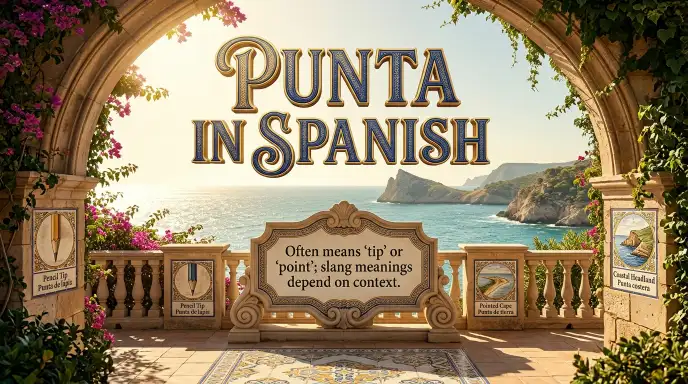
Punta is a Spanish word that usually means “tip,” “point,” or “end,” but its meaning can change depending on the sentence and the country. In some regional conversations, it also has slang meanings, so the context matters.
You might see punta in TikTok comments, Instagram captions, WhatsApp messages, Spanish songs, or conversations with Spanish speaking friends. Sometimes it refers to an ordinary object, such as the tip of a pencil. In other situations, it can appear in a regional expression or a rude phrase.
People often search for this word after hearing it in a song, watching a Spanish language video, or receiving a message they do not fully understand. A direct English translation does not always explain the intended meaning.
In this guide, you will learn what punta means in everyday Spanish, how people use it in texting, which expressions deserve extra attention, and how to understand it without confusing its normal meaning with regional slang.
Punta Meaning in Spanish and Text Messages
The Spanish word punta is a feminine noun. Its most common English translations include tip, point, end, and sometimes corner, depending on the object or situation.
For example, la punta del lápiz means “the tip of the pencil.” In another sentence, la punta de la mesa can mean “the corner of the table.”
The word is not automatically slang, an acronym, or an abbreviation. It is an ordinary Spanish word that also appears in expressions and regional slang.
What Does Punta Literally Mean?
The basic meaning of punta describes the end or pointed part of something. It can refer to physical objects, locations, or even small quantities.
Here are some simple examples:
- La punta del lápiz : The tip of the pencil.
- La punta de la nariz : The tip of the nose.
- La punta de la mesa : The corner or end of the table.
- La punta del cuchillo : The tip of the knife.
- Una punta de sal : A small pinch of salt in certain usages.
These examples show why translating the word without a complete sentence can be confusing. The English word changes according to what punta describes.
The most useful starting point is to remember that punta usually refers to a tip, point, or end. Any slang meaning needs to be understood from the surrounding words.
Is Punta Slang or a Normal Spanish Word?
Punta is a standard Spanish noun, not slang by itself. However, Spanish speakers also use it in idioms, informal expressions, and regional vocabulary.
For instance, tener algo en la punta de la lengua means “to have something on the tip of your tongue.” It describes a situation in which you almost remember a word or name but cannot quite recall it.
Consider this conversation:
A: ¿Cómo se llamaba esa película?
B: No me acuerdo. Tengo el nombre en la punta de la lengua.
English translation:
A: What was that movie called?
B: I can’t remember. I have the name on the tip of my tongue.
Here, punta is completely ordinary Spanish. There is no insult or hidden slang meaning.
Other expressions can be more regional or informal. That is why the complete phrase matters more than the individual word.
What Does Punta Mean in Everyday Chat?
In texting, the word generally keeps its normal Spanish meaning unless the conversation suggests an idiom or a regional slang use.
For example:
A: Se rompió la punta del lápiz.
B: Usa el mío.
English translation:
A: The pencil tip broke.
B: Use mine.
In another conversation, a person might write:
“Tengo esa canción en la punta de la lengua.”
This means they are trying to remember the song’s name or lyrics.
If you see punta in a message that seems rude or confusing, do not immediately assume the word itself is offensive. It may be part of a phrase with a separate meaning.
Where People Use Punta
You can encounter punta on many online platforms because it is an ordinary Spanish word. The meaning depends on if someone is talking about an object, an expression, a place, music, or a regional slang term.
Punta on TikTok
TikTok videos often include Spanish conversations, song lyrics, jokes, and language learning content. If you hear punta in a video, the surrounding sentence is the best clue to its meaning.
For example, a creator demonstrating how to sharpen a pencil might say:
“La punta está muy afilada.”
English: “The tip is very sharp.”
This is a literal use.
In a language learning video, someone might explain the expression la punta de la lengua, which refers to struggling to remember something.
Music and comedy clips can use regional expressions, too. If a video includes an unfamiliar or rude phrase, its meaning may depend on the country, tone, and words around it.
Do not assume that every TikTok use of punta is slang. Many examples involve ordinary Spanish vocabulary.
Punta on Snapchat
Snapchat messages between Spanish speaking friends may contain everyday sentences using the word.
For example:
A: ¿Dónde está la punta del cargador?
B: Está debajo de la mesa.
English translation:
A: Where is the end of the charger?
B: It’s under the table.
In this fictional example, punta refers to an end or tip. It is not a nickname or an insult.
If a friend sends you a short message containing only punta, you may need to check the earlier messages to understand what they mean. A single word does not always provide enough information.
Punta on Instagram
Instagram captions, Reels, comments, and direct messages can contain both standard Spanish and regional slang.
A travel post might use punta as part of a place name or geographical description. For example, Punta Cana is a well known place name in the Dominican Republic.
A Spanish caption might also contain the phrase de punta a punta, meaning “from one end to the other.”
For example:
“Recorrimos la ciudad de punta a punta.”
English: “We explored the city from one end to the other.”
Here, the expression describes covering the whole city. It does not have a rude meaning.
Punta on WhatsApp
WhatsApp conversations often involve family, friends, classmates, and coworkers. The word may appear in ordinary sentences, jokes, or messages using regional expressions.
For example:
A: ¿Puedes cortar la punta del papel?
B: Sí, dame las tijeras.
English translation:
A: Can you cut the tip of the paper?
B: Yes, give me the scissors.
The conversation is straightforward. The word refers to an end or pointed part.
If you receive a message where punta appears alongside unfamiliar slang, read the full sentence before deciding what it means. Different Spanish speaking communities may use the word in different ways.
Punta in SMS Text Messages
Traditional text messages use the same Spanish vocabulary as other forms of communication. The word does not become a texting abbreviation just because someone writes it in capital letters or sends it without punctuation.
For example:
A: Me corté la punta del dedo con el papel.
B: ¿Estás bien?
English translation:
A: I cut the tip of my finger on the paper.
B: Are you okay?
In this example, punta is part of a normal description.
The platform alone does not determine the meaning. The sentence, situation, and regional background are much more useful clues.
Real Chat Examples of Punta
The following fictional conversations demonstrate ordinary Spanish uses of punta and several expressions. Each example includes an English translation to make the meaning easier to understand.
Example 1: The Tip of a Pencil
A: ¿Tienes otro lápiz? Se rompió la punta del mío.
B: Sí, toma este.
A: Gracias, me salvaste.
English translation:
A: Do you have another pencil? Mine broke at the tip.
B: Yes, take this one.
A: Thanks, you saved me.
Meaning: Punta means “tip.” This is a normal, non slang use.
Example 2: The Tip of the Tongue
A: ¿Cómo se llama el cantante de esa canción?
B: No me acuerdo. Lo tengo en la punta de la lengua.
A: A ver si te acuerdas después.
English translation:
A: What’s the singer’s name in that song?
B: I can’t remember. It’s on the tip of my tongue.
A: Maybe you’ll remember later.
Meaning: The phrase describes being close to remembering something.
Example 3: The End of a Table
A: Deja las llaves en la punta de la mesa.
B: ¿Aquí, junto a la ventana?
A: Sí, exactamente.
English translation:
A: Leave the keys at the end of the table.
B: Here, next to the window?
A: Yes, exactly.
Meaning: Punta refers to the end or corner of the table.
Example 4: A Pinch of Salt
A: ¿Cuánta sal le pongo a la sopa?
B: Solo una punta, para empezar.
A: Vale, luego la pruebo.
English translation:
A: How much salt should I put in the soup?
B: Just a little to start with.
A: Okay, I’ll taste it afterward.
Meaning: In this usage, punta refers to a small quantity. Depending on the region, another expression such as una pizca de sal may sound more natural.
Example 5: Exploring a City
A: ¿Visitaron todo el centro?
B: Sí, caminamos de punta a punta.
A: ¡Debieron terminar agotados!
English translation:
A: Did you visit the whole downtown area?
B: Yes, we walked from one end to the other.
A: You must have been exhausted!
Meaning: De punta a punta means “from one end to the other.”
Example 6: Pointed Shoes
A: ¿Te gustan estos zapatos?
B: Sí, me gusta la punta.
A: Creo que quedan bien con el vestido.
English translation:
A: Do you like these shoes?
B: Yes, I like the pointed toe.
A: I think they look good with the dress.
Meaning: The word describes the pointed front of the shoes.
Example 7: A Place Name
A: ¿Adónde van de vacaciones?
B: Estamos pensando en ir a Punta Cana.
A: ¡Qué bien! Espero que disfruten el viaje.
English translation:
A: Where are you going on vacation?
B: We’re thinking of going to Punta Cana.
A: That’s great! I hope you enjoy the trip.
Meaning: Punta is part of a geographical name. It is not being used as slang.
Example 8: A Sharp Object
A: Ten cuidado con la punta de la tijera.
B: No te preocupes, la estoy guardando.
A: Gracias, no quiero que nadie se lastime.
English translation:
A: Be careful with the tip of the scissors.
B: Don’t worry, I’m putting them away.
A: Thanks, I don’t want anyone to get hurt.
Meaning: The word means “tip” or “point.”
Example 9: A Hint or Indirect Remark
A: ¿Por qué le dijiste eso a tu hermano?
B: Le lancé una indirecta, pero no se dio cuenta.
A: Tal vez deberías hablar con él directamente.
English translation:
A: Why did you say that to your brother?
B: I dropped a hint, but he didn’t notice.
A: Maybe you should talk to him directly.
Meaning: This example illustrates an indirect remark, or indirecta. In some regional Spanish usage, punta can also refer to a pointed or indirect comment, but the exact expression varies by region.
Example 10: Asking What a Word Means
A: Escuché la palabra punta en un video. ¿Qué significa?
B: Normalmente significa “tip” o “point”, pero depende de la frase.
A: Ah, entonces necesito escuchar el contexto.
English translation:
A: I heard the word punta in a video. What does it mean?
B: It usually means “tip” or “point,” but it depends on the phrase.
A: Oh, so I need to listen to the context.
Meaning: The conversation summarizes the main lesson: a word’s meaning depends on how it is used.
How to Reply When Someone Says Punta
Your response depends on the situation. If the person is talking about an object, you can answer normally. If they are using a regional expression you do not understand, it is perfectly fine to ask for clarification.
Funny Replies
If you are talking with friends and the conversation is lighthearted, you can use a playful response.
- “¡Necesito un diccionario para esta conversación! 😂” : “I need a dictionary for this conversation!”
- “Espera, mi español necesita una actualización.” : “Wait, my Spanish needs an update.”
- “Una palabra, cinco posibles significados. 😭” : “One word, five possible meanings.”
These are playful responses to confusion, not translations of punta itself.
Casual Replies
Use a simple response when the meaning is clear.
- “Ah, entiendo.” : “Oh, I understand.”
- “Gracias por explicarlo.” : “Thanks for explaining it.”
- “¿Te refieres al extremo?” : “Do you mean the end or tip?”
- “Ahora tiene sentido.” : “Now it makes sense.”
For example:
A: La punta del lápiz está rota.
B: Ah, entiendo. Te doy otro.
English:
A: The pencil tip is broken.
B: Oh, I understand. I’ll give you another one.
Friendly Replies
If someone is helping you learn Spanish, you can respond warmly.
- “¡Estoy aprendiendo español poco a poco!” : “I’m learning Spanish little by little!”
- “Gracias, cada día aprendo algo nuevo.” : “Thanks, I learn something new every day.”
- “¡Qué interesante!” : “How interesting!”
- “Gracias por ayudarme a entender.” : “Thanks for helping me understand.”
Neutral Replies
If you are unsure if the person is using slang, ask a direct question.
- “¿Qué significa en este contexto?” : “What does it mean in this context?”
- “¿Es una expresión regional?” : “Is it a regional expression?”
- “¿Lo dices literalmente o como slang?” : “Do you mean it literally or as slang?”
A short clarification is often the easiest way to avoid misunderstanding a regional expression.
Is Punta Rude or Offensive?
The word punta is not inherently rude or offensive. In standard Spanish, it usually refers to a tip, point, end, or related concept.
However, words can take on different meanings in expressions, jokes, and regional slang. If the surrounding phrase is insulting or vulgar, the overall expression may be offensive even though the word has an ordinary dictionary meaning.
Is Punta a Bad Word in Spanish?
Not by itself in its standard meaning. A sentence such as la punta del lápiz is completely ordinary.
The difficulty comes when the word appears in a regional expression or a phrase that has an additional meaning. Spanish varies across countries and communities, so an expression that sounds harmless in one setting may sound different elsewhere.
Do not treat every appearance of punta as a swear word. First, identify the complete phrase.
Can Punta Have a Vulgar Meaning?
In some contexts, words involving punta may appear in rude expressions, insults, or regional slang. The precise meaning depends on the complete wording and local usage.
If you hear the word in a song or a heated conversation, do not assume that the literal translation explains everything. A dictionary entry, the full sentence, and the country where the expression is used can all help.
If someone sends you a phrase that seems sexually explicit or insulting, it is better to check the entire phrase than to interpret the single word in isolation.
Is Punta Appropriate at School or Work?
The ordinary meaning is perfectly suitable for school, work, and everyday conversation.
For example:
- La punta del lápiz está rota. : The pencil tip is broken.
- Nos vemos en la punta de la calle. : We’ll meet at the end of the street.
- Tengo el nombre en la punta de la lengua. : I have the name on the tip of my tongue.
These are ordinary uses, although the most natural wording can vary by situation.
If you are learning Spanish for work or school, focus on standard meanings first. Learn regional slang when you encounter it, but avoid repeating an expression until you understand its tone.
Who Uses Punta?
Because punta is an ordinary Spanish word, it is used by Spanish speakers of many ages and backgrounds. It is not limited to teenagers, Gen Z, or social media users.
Do Gen Z Users Use Punta?
Younger Spanish speakers use the word in everyday conversation just as other Spanish speakers do. They may also encounter regional expressions through songs, memes, short videos, and online conversations.
However, punta is not exclusively Gen Z slang. Its standard meaning has existed independently of social media.
A young person might use it while talking about a pencil, a place, or a phrase. Another might hear it in a meme or a song. The intended meaning depends on the context.
Where Is Punta Used?
The word appears across Spanish speaking regions, including Spain and Latin America. Some regional expressions differ, and the Diccionario de americanismos records additional meanings in particular countries.
For example, the word can have specialized or colloquial meanings related to knives, a leading position, groups of people, or indirect remarks in certain regions. These meanings are not universal.
Spanish is not identical in every country. When you learn a regional expression, it helps to know where it is commonly used.
How Common Is Punta Online?
The ordinary word is part of standard Spanish vocabulary, so it can appear in everyday writing and conversation. However, that does not mean every use is a trending slang expression.
There is no need to assume that punta is currently viral or that it has one dominant meaning on TikTok. A language learning post, a travel video, a song lyric, and a private message may each use it differently.
The most helpful question is not “How popular is the word?” but “What does the whole sentence mean?”
Origin of the Word Punta
The Spanish word punta has a long linguistic history. It is not a newly invented abbreviation from TikTok or another social media platform.
Historical and etymological dictionaries connect the word to Latin puncta, associated with pointing or piercing. Its core meaning relates to a pointed end or extremity.
Over time, the word developed additional uses. It can describe the end of an object, a geographical point, a small quantity, or part of an established expression.
How Did Punta Develop Different Meanings?
Many words expand beyond their original physical meaning. A word describing a pointed end can also be used for a location, a small amount, or a figurative idea.
For example, English uses the word “point” in many ways. It can mean the tip of a pencil, a key idea in a discussion, or a score in a game.
Spanish punta works similarly in some expressions. The literal meaning provides a useful starting point, but the sentence determines the intended translation.
Did Internet Culture Create the Slang Meaning?
No single internet trend created the word itself. It was already part of Spanish vocabulary long before TikTok, Instagram, and modern text messaging.
Social media can spread regional expressions to new audiences, though. A word that someone hears in a song or short video may become a search query because the audience does not know the local meaning.
The origin of the word and the origin of a particular slang expression are not necessarily the same thing. The word has an established history, while specific informal uses may vary by region and period.
Punta vs. IDK, IDC, IMO, and BRB
The word punta is different from common texting abbreviations such as IDK, IDC, IMO, and BRB. Those abbreviations stand for English phrases, while punta is a Spanish word with several meanings.
| Term | Meaning | Type | Usage | Popularity |
| Punta | Tip, point, end; other meanings depend on context | Spanish noun | Everyday speech, descriptions, expressions, and regional slang | Standard Spanish vocabulary |
| IDK | I don’t know | English initialism | Expressing uncertainty | Widely recognized online |
| IDC | I don’t care | English initialism | Expressing indifference | Widely recognized online |
| IMO | In my opinion | English initialism | Introducing a personal opinion | Widely recognized online |
| BRB | Be right back | English initialism | Indicating a short absence | Widely recognized online |
Why Is Punta Different From Texting Abbreviations?
When someone writes IDK, the letters usually represent the same English phrase: “I don’t know.”
The word punta, however, does not have one English translation that works in every sentence.
For example:
- La punta del lápiz : The tip of the pencil.
- La punta de la mesa : The end or corner of the table.
- La punta de la lengua : The tip of the tongue.
- De punta a punta : From one end to the other.
These examples show why it is more useful to learn the word inside a phrase than to memorize a single English equivalent.
Real World Usage Example
Imagine you are learning Spanish and helping a friend prepare a school presentation. Your friend asks you to sharpen a pencil and says:
“Ten cuidado con la punta.”
You might translate this as “Be careful with the tip.” In this context, the meaning is literal, and there is nothing rude about the word.
Later, while watching a Spanish language video, you hear someone use punta in a phrase you do not recognize. This time, translating it as “tip” does not make the sentence understandable.
Instead of guessing, you write down the complete phrase and check its meaning. You discover that it is a regional expression rather than a literal description.
This is a useful way to learn Spanish: begin with the common definition, pay attention to the sentence, and investigate unfamiliar expressions when necessary.
A word becomes easier to understand when you learn how real speakers use it, not just how a dictionary translates it.
Frequently Asked Questions
Q1. What does punta mean in text messages?
Punta usually means “tip,” “point,” or “end” in Spanish. In a text message, it may also appear in an idiom or regional expression, so the complete sentence matters.
Q2. What does punta mean on TikTok?
On TikTok, punta may be used in its ordinary Spanish meaning or as part of a regional expression, joke, or song lyric. The video and surrounding words help identify the intended meaning.
Q3. Is punta slang?
Punta is a standard Spanish noun, not slang by itself. Some regional expressions and informal uses involving the word can be slang.
Q4. Is punta rude or offensive?
Not in its ordinary meaning. It generally means “tip,” “point,” or “end,” but a complete phrase may have a rude or regional meaning depending on the context.
Q5. How should you reply to punta?
If the meaning is clear, respond naturally to the sentence. If you are confused, ask “¿Qué significa en este contexto?”, which means “What does it mean in this context?”
Conclusion
Punta is a common Spanish word that usually means “tip,” “point,” or “end.” You may see it in text messages, TikTok videos, Instagram captions, Spanish songs, and everyday conversations.
It is not automatically slang or a bad word. Its ordinary meanings are suitable for daily conversation, while some expressions and regional uses may carry additional meanings.
When you encounter punta, pay attention to the complete sentence, the country or region, and the speaker’s tone. If a phrase seems confusing, ask for clarification rather than assuming the word is offensive.
The key to understanding punta is context: learn the basic meaning first, then explore the expression in which it appears.
🦋 Keep Learning:
DLC Meaning in Slang: Definition, Uses, and Examples

I am Emma Collins, a content writer at SlangAura specializing in internet slang, texting abbreviations, and online language. I create simple and accurate guides to help readers understand modern slang easily and confidently.