Opp in slang is one of those words you may see on TikTok, Instagram, Snapchat, Reddit, Discord, or in song lyrics. If someone calls another person an “opp,” you might wonder they if mean a rival, a fake friend, or something else entirely.
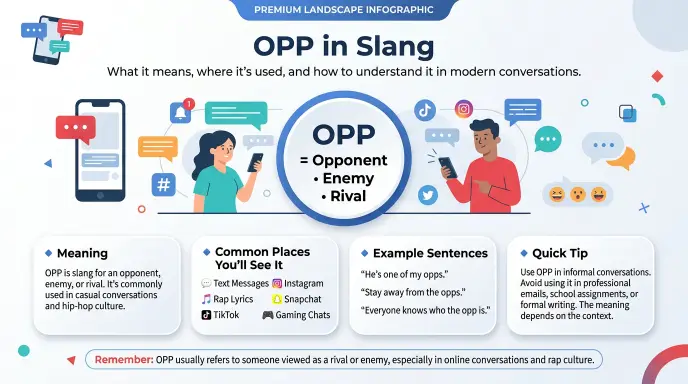
The meaning of opp depends on the conversation, but in most cases, it refers to an enemy, rival, or someone who is against you. The term became popular through hip-hop culture and has spread into everyday online conversations, memes, gaming, and texting.
Today, many people use the word casually among friends, while others use it seriously during arguments or when talking about real-life conflicts. Because of these different uses, understanding the context is important before using the slang yourself.
Quick Answer
Opp is slang for opposition or opponent. It usually means a rival, enemy, or someone who is against you. In casual online conversations, it may also refer to someone you dislike or don’t trust.
What does opp mean in text?
In texting and online slang, opp usually means an enemy, rival, or opponent.
It describes someone who is on the opposite side of a disagreement, competition, or conflict. Depending on the situation, the word can be used seriously or jokingly.
For example:
- “Don’t trust him. He’s an opp.”
- “We beat our opps again.”
- “The whole squad is watching out for the opps.”
In many online conversations, people use opp even when talking about small disagreements rather than real enemies.
Opp full form / definition of the slang
Many people search for opp full form or what does opp stand for.
Technically, opp is a shortened form of:
- Opposition
- Opponent
Over time, especially in hip-hop and internet culture, the meaning expanded to include:
- Enemy
- Rival
- Competitor
- Someone working against you
- Someone you don’t trust
Unlike many internet abbreviations, opp is not an acronym where every letter represents a different word. Instead, it’s simply a shortened version of existing words.
Different meanings of opp in slang
Although the core meaning stays similar, opp can have slightly different meanings depending on the situation.
1. Enemy or rival
This is the most common meaning.
Someone is your opp if they are against you or your group.
Example:
“We don’t hang out with our opps.”
2. Someone you dislike
Sometimes people jokingly call anyone they dislike an opp.
Example:
“My math teacher is my biggest opp this week.”
Obviously, the speaker doesn’t mean the teacher is an actual enemy.
3. Competitor
In sports or gaming, people may call the opposing team their opps.
Example:
“The opps weren’t ready for our strategy.”
4. Internet joke
Many TikTok users call everyday problems their “opps.”
Examples include:
- Alarm clock
- Monday mornings
- Homework
- Slow Wi-Fi
This playful usage has become common in memes.
Is opp rude, offensive, or neutral?
The answer depends on the context.
| Situation | Tone |
| Friendly joke | Usually harmless |
| Gaming | Neutral |
| Sports | Neutral |
| Casual social media | Mild |
| Real-life conflict | Can be offensive |
| Gang-related discussion | Serious |
If someone genuinely calls another person an opp, it often suggests distrust or hostility.
Because of this, it’s best not to use the term carelessly with people you don’t know well.
Where is opp commonly used?
The slang appears across many online platforms.
TikTok
Users often create funny videos about their “daily opps.”
Examples:
- Coffee machine
- Homework
- Monday
- Bad weather
Snapchat
Friends may jokingly text:
“You’re acting like an opp.”
Captions sometimes include:
- “Watching the opps.”
- “No love for the opps.”
Discord
Gamers use it while discussing rival teams.
Example:
“The opps are pushing left.”
Gaming
Competitive games commonly use the term for opponents.
Examples include:
- FPS games
- Battle royale games
- Team competitions
Rap and hip-hop culture
One of the biggest reasons the word became mainstream is its frequent use in rap lyrics.
Artists often refer to rivals or enemies as “opps.”
Because of this influence, younger audiences adopted the slang into everyday conversations.
Real-life examples of usage
Here are examples showing different situations.
Friendly
A: You’re eating my fries again.
B: Guess I’m your opp now.
Casual textin
“I’m avoiding the opps today.”
School
“The other basketball team is our opp.”
Social media
“My biggest opp this semester is my alarm clock.”
Gaming
“The opps captured the objective.”
Argument
“He’s been acting like an opp ever since the disagreement.”
Origin and background of the slang
The word opp comes from the words opposition and opponent. It was originally used to describe people on the opposite side of a conflict or competition.
The slang became much more popular through hip-hop and drill music, where artists often referred to rivals or enemies as their “opps.” As these songs gained millions of listeners, the term spread beyond music and became common on social media.
Today, the meaning of opp has expanded. While it can still refer to a real rival, many people now use it humorously to describe everyday frustrations or friendly competition.
For example:
- “My alarm clock is my biggest opp.”
- “Homework is my opp this week.”
In these examples, no real conflict exists. The word is simply being used for humor.
Comparison with similar slang
Although opp has its own meaning, several slang words are closely related.
| Slang Term | Meaning | Tone | Common Use |
| Opp | Enemy or rival | Neutral to negative | Social media, texting, rap |
| Hater | Someone who constantly criticizes | Negative | Instagram, TikTok |
| Enemy | Someone openly against you | Strongly negative | General English |
| Rival | Competitor | Neutral | Sports, school, business |
| Snake | Someone who betrays others | Very negative | Social media |
| Fake friend | Pretends to be your friend | Negative | Everyday conversations |
Opp vs Hater
A hater constantly criticizes or dislikes someone.
An opp is someone on the opposite side or someone you see as an enemy.
Not every hater is an opp, and not every opp is simply a hater.
Opp vs Enemy
“Enemy” is a formal English word.
“Opp” is casual internet slang.
Both describe someone against you, but opp sounds more modern and informal.
Opp vs Rival
A rival is simply someone competing with you.
An opp usually carries a stronger sense of dislike or opposition.
When to avoid using opp
Although the slang is popular, there are situations where it isn’t appropriate.
Avoid using opp in:
- Business emails
- Professional meetings
- Job interviews
- School assignments
- Academic writing
- Formal speeches
- Customer service conversations
Instead, use words like:
- Opponent
- Competitor
- Rival
- Other team
- Opposing side
These alternatives sound more professional and are easier for everyone to understand.
You should also avoid calling someone an opp if they may interpret it as an insult. While friends often use the term jokingly, strangers or coworkers may not appreciate it.
Polite alternatives
If you want to express the same idea without slang, here are some better options.
| Slang | Professional Alternative |
| Opp | Opponent |
| Opp | Competitor |
| Opp | Rival |
| Opp | Challenger |
| Opp | Opposing team |
Examples
Instead of:
“They’re our opps.”
Say:
“They’re our competitors.”
Instead of:
“He’s acting like an opp.”
Say:
“He’s acting against us.”
Why people use this slang
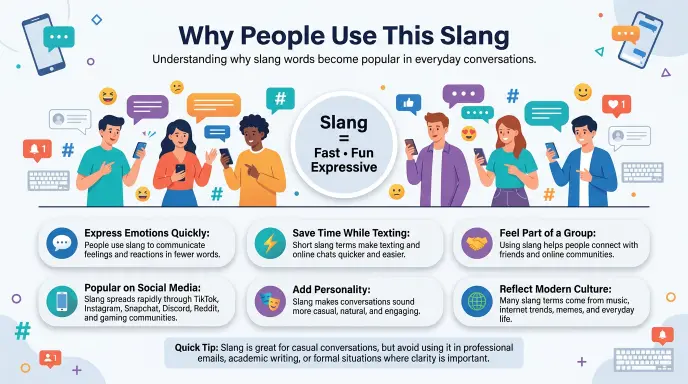
The popularity of opp isn’t random. There are several reasons why people like using it.
1. It’s short
Instead of typing “opponent” or “enemy,” people simply type opp.
This makes texting faster.
2. It sounds trendy
Internet slang changes quickly.
Many younger users enjoy using words that are popular on TikTok and social media.
3. It adds humor
People often exaggerate everyday problems by calling them “opps.”
For example:
- “Monday is my opp.”
- “My Wi-Fi is an opp today.”
These jokes make conversations more entertaining.
4. Pop culture influence
Rap music and online creators have introduced millions of people to the word.
As a result, it has become part of everyday internet language.
5. Group identity
Friends often use shared slang to create a sense of belonging.
Using words like opp can make conversations feel more relaxed and natural within certain online communities.
Impact of using slang in communication
Like all slang, opp changes the tone of a conversation.
Benefits
- Makes conversations sound relaxed.
- Helps people connect through shared language.
- Adds personality to messages.
- Fits naturally into online chats and memes.
- Makes texting faster.
Drawbacks
- Some people may not understand the meaning.
- Older audiences may find it confusing.
- It may sound rude in serious conversations.
- Using too much slang can appear unprofessional.
The best approach is to think about your audience before using slang.
Is it safe for social media?
Yes, in most cases.
People regularly use opp on:
- TikTok
- Snapchat
- Discord
- X (formerly Twitter)
- Gaming communities
Most posts use the word jokingly or casually.
However, avoid using opp in posts that encourage:
- Harassment
- Violence
- Threats
- Bullying
Using slang responsibly helps prevent misunderstandings and keeps online conversations respectful.
More real-life examples of opp in slang
The best way to understand opp in slang is by seeing how people use it in everyday conversations. Here are examples in different situations.
Friendly conversation
Friend 1: You finished the pizza without me?
Friend 2: My bad! I guess I’m your opp now.
Friend 1: You beat me again in the game.
Friend 2: Better luck next time!
Casual texting
- “I don’t talk to my opps anymore.”
- “He’s been acting like an opp lately.”
- “Ignore the opps and stay focused.”
- “The opps are watching.”
School
- “Our biggest opp in the tournament is Lincoln High.”
- “The other debate team is our opp this weekend.”
Workplace (casual)
- “The competing company is our biggest opp this year.”
Although this may be understood in casual conversations, using competitor is more appropriate in professional settings.
Gaming
- “Watch the minimap the opps are coming from the right.”
- “We eliminated all the opps before the final round.”
- “Our opps have better gear.”
Social media
- “Monday mornings are my biggest opp.”
- “My homework is acting like an opp.”
- “Sleep is my opp because I stayed up too late.”
Argumentative tone
- “He’s clearly an opp after everything that happened.”
- “Stop helping the opps.”
- “They’ve always been on the opposite side.”
These examples show that opp can range from playful to serious depending on the context.
Common mistakes people make
Many people misunderstand this slang. Here are some common mistakes to avoid.
Thinking opp always means gang-related
No. While the term has been used in some street and drill music contexts, most people today use it casually to mean a rival, competitor, or someone they dislike.
Using it in formal writing
Avoid using slang in:
- Business emails
- College essays
- Professional reports
- Official presentations
Choose words like opponent, competitor, or rival instead.
Assuming every use is serious
Many TikTok users jokingly call everyday problems their “opps.”
For example:
- Homework
- Alarm clock
- Monday mornings
- Slow internet
These are humorous expressions rather than real conflicts.
Forgetting that context matters
The same word can have different meanings depending on who is speaking and where it’s used.
Always consider the tone of the conversation before assuming someone is talking about a real enemy.
Tips for using opp correctly
If you’re new to internet slang, these tips can help.
- Use it mainly in casual conversations.
- Make sure your audience understands modern slang.
- Avoid using it in professional communication.
- Don’t call someone an opp unless you’re comfortable with the relationship.
- Remember that context changes the meaning.
Using slang naturally is more important than using it frequently.
Frequently Asked Questions
What does opp mean in slang?
Opp usually means an enemy, rival, opponent, or someone who is against you. It can also be used jokingly to describe everyday annoyances.
What does opp stand for?
It comes from the words opposition or opponent. It is a shortened form rather than a traditional acronym.
Is opp a bad word?
No. The word itself is not considered offensive. However, calling someone your opp may sound negative because it suggests they are against you.
Is opp used only in rap music?
No. Although the slang became popular through hip-hop and drill music, it is now widely used on TikTok, Instagram, Snapchat, Discord, Reddit, gaming communities, and everyday texting.
Can friends call each other opps?
Yes. Friends sometimes use the word jokingly after teasing each other or during friendly competition. In these cases, it is usually humorous rather than serious.
Should I use opp at work?
Generally, no. In professional settings, words like competitor, opponent, or rival are more appropriate and easier for everyone to understand.
Final thoughts
The opp in slang meaning is straightforward once you understand the context. In most cases, opp refers to an enemy, rival, opponent, or someone who is on the opposite side. The word originated as a shortened form of opposition or opponent, gained popularity through hip-hop culture, and is now widely used across TikTok, Instagram, Snapchat, Reddit, Discord, gaming communities, and text messages.
Like many internet slang terms, opp can be either serious or playful. Someone may use it to describe a real rival, while others jokingly call their homework, alarm clock, or even Monday mornings their “opp.” Because the tone varies, it’s important to pay attention to the situation before using or interpreting the word.
In casual conversations with friends, opp can sound modern, expressive, and relatable. In formal communication, however, it’s better to use standard words like opponent, competitor, or rival. Understanding both the meaning and the context will help you use this popular slang confidently and appropriately in any conversation.
I am Emma Collins, a content writer at SlangAura specializing in internet slang, texting abbreviations, and online language. I create simple and accurate guides to help readers understand modern slang easily and confidently.