Mexicans may use words such as güero/güera, blanco/blanca, and gringo/gringa when talking about white or light skinned people.
However, these Spanish terms have different meanings. Some describe skin tone or hair color, while others may refer to foreigners, particularly people from the United States.You may see these words in TikTok videos, Instagram comments, Snapchat messages, WhatsApp conversations, and discussions about Mexican culture.
People often search for them because they have heard a Spanish word and want to understand what it means in English.The important thing to remember is that there is no single word that every Mexican uses for every white person. The choice of word depends on the speaker, the situation, the person’s nationality, and the relationship between the people talking.
In this guide, you will learn the most common terms, their meanings, realistic Spanish conversation examples, and how to recognize if a word is being used casually, affectionately, or disrespectfully.
What Do Mexicans Call White People? Meaning and Common Terms
When discussing white people in Mexican Spanish, several words may come up. The most useful ones to understand are güero/güera, blanco/blanca, gringo/gringa, and gabacho/gabacha.
These terms are not interchangeable. Knowing the difference helps you understand conversations without making assumptions about a person’s identity or nationality.
Mexican Slang for White Person
Güero (pronounced WEH : roh) is a common Mexican Spanish term for someone with fair skin or light colored hair. It is often used as a casual nickname and is not necessarily offensive. The feminine form is güera. Its meaning depends on the context and tone.
1. Güero and Güera
Güero is a masculine Spanish term commonly associated with someone who has blond or light colored hair. In Mexican Spanish, it can also refer to a person with a light complexion. Güera is the feminine form. The Diccionario del Español de México records both the hair color meaning and its use as a way to address customers.
For example:
- Güero: A man or boy with blond hair or a light complexion.
- Güera: A woman or girl with blond hair or a light complexion.
- Güerito/güerita: Diminutive forms that can sound familiar, affectionate, or simply conversational, depending on the context.
Imagine someone saying:
“Hola, güero. ¿Cómo estás?”
This means approximately, “Hey, güero, how are you?” Depending on the situation, it might sound friendly or familiar.
An important detail is that güero does not automatically mean an American or a foreigner. A light skinned Mexican person can also be called güero or güera.
The word may be used casually, but not everyone likes being described by their appearance. The speaker’s intention and the listener’s preference both matter.
2. Blanco and Blanca
Blanco means “white” in Spanish, while blanca is its feminine form. These words can describe color, including a person’s skin tone.
For example:
- Un hombre blanco: A white man.
- Una mujer blanca: A white woman.
- Una persona blanca: A white person.
You might hear someone say:
“Él es blanco.”
That means “He is white.”
Compared with a slang term, blanco or blanca is a more direct descriptive word. Nevertheless, the way it sounds depends on the sentence and the social setting.
It is also important to understand that racial categories do not work identically in every country. Someone might describe a person’s complexion in Mexican Spanish without making exactly the same assumptions that an English speaker would make about race.
Use blanco or blanca when you want to describe someone directly, and avoid assuming that appearance tells you their nationality.
3. Gringo and Gringa
Gringo is a familiar Mexican Spanish term often associated with people from the United States. Depending on the context, it can also refer to a foreigner, particularly someone perceived as foreign and European looking.
Gringa is the feminine form.
The Diccionario del Español de México specifically associates gringo with people from the United States and also records a meaning connected to blond, foreign language speakers.
Examples include:
- Un gringo: A man referred to as a gringo.
- Una gringa: A woman referred to as a gringa.
- Los gringos: A plural form referring to a group.
For example:
“El turista es gringo.”
This can mean “The tourist is American” or, depending on the situation, “The tourist is a gringo.”
However, gringo does not simply mean “white person” in every conversation. It often carries a connection to nationality or perceived foreignness. A white Mexican person, for example, is not automatically a gringo.
Is it offensive? Not necessarily. Some speakers use the word neutrally or casually, while others may hear it as dismissive or insulting. English language dictionaries also note that it can be derogatory.
If you are unsure how someone feels about the term, using their nationality or name is usually clearer and more respectful.
4. Gabacho and Gabacha
Gabacho is another term used in Mexico for a foreigner, especially someone or something associated with the United States. It can carry a negative or dismissive tone.
The feminine form is gabacha.
The Diccionario del Español de México records gabacho as a popular term for someone from the United States, and also notes its association with light skin and blond hair in a separate sense.
For example:
“Viene de Estados Unidos; es gabacho.”
This could mean “He comes from the United States; he’s a gabacho.”
But this word requires more caution than a straightforward description such as blanco. The Association of Academies of the Spanish Language marks the Mexican use of gabacho for a foreign person as derogatory.
That does not mean every speaker intends to offend someone whenever they use it. Tone, local usage, and the relationship between the speakers still matter.
For learners, it is best to recognize gabacho when you hear it rather than use it casually to label another person.
Which Word Is Best to Know First?
If you are learning Mexican Spanish, these distinctions are a useful starting point:
| Spanish term | Basic meaning | Important detail |
| Güero/güera | Light haired or light complexioned person | Can describe a Mexican person or a foreigner |
| Blanco/blanca | White | A more direct descriptive term |
| Gringo/gringa | Often a person from the United States or a perceived foreigner | May sound neutral or negative |
| Gabacho/gabacha | Often a foreigner, especially someone associated with the United States | Can be derogatory |
The most accurate word depends on if the speaker is describing skin tone, hair color, nationality, or foreignness.
Where People Use These Terms
Mexican Spanish appears in everyday conversations, films, music, travel videos, and social media. The meaning of a word may become clearer when you understand the setting in which it appears.
Güero and Gringo on TikTok
TikTok videos about Mexican slang often introduce words such as güero and gringo. A creator might explain a funny interaction, translate a conversation, or describe what a particular word means in their region.
For example, a video could include this fictional exchange:
Person A: “¿Quién es el güero?”
Person B: “El chico de cabello rubio.”
English translation:
Person A: “Who is the fair haired guy?”
Person B: “The guy with blond hair.”
Here, güero refers to appearance, not necessarily nationality.
If you see gringo in a TikTok comment, check the surrounding conversation. It might refer to an American tourist, a foreign character, or a person’s perceived background.
Güera on Snapchat
On Snapchat, friends may use nicknames or informal expressions while sending messages and pictures.
For example:
A: “¿Ya llegó la güera?”
B: “Sí, está afuera.”
English:
A: “Has the fair haired girl arrived yet?”
B: “Yes, she’s outside.”
This example shows how a descriptive term can be used informally to identify someone.
Still, a nickname that feels friendly to one person may feel uncomfortable to another. If a friend prefers to be addressed by name, respect that preference.
Gringo and Gabacho on Instagram
Instagram posts and Reels sometimes discuss Mexican American culture, travel, food, language, and stereotypes. These conversations can include terms such as gringo and gabacho.
For example, a travel caption might say:
“Muchos turistas gringos visitan México.”
English translation: “Many American tourists visit Mexico.”
In this sentence, the word refers to tourists associated with the United States. It does not establish that every tourist is white or that every white person is American.
When reading comments, be especially careful with jokes or arguments about nationality. A word may be used sarcastically or critically rather than as a neutral description.
Mexican Spanish on WhatsApp
WhatsApp messages are usually more personal. Family members and friends may use descriptive terms, nicknames, or local expressions that are understood within their group.
For example:
A: “¿Quién viene a cenar?”
B: “Mi amiga güera y su hermano.”
English:
A: “Who’s coming to dinner?”
B: “My light skinned friend and her brother.”
This is a fictional example of how güera might be used to identify a friend.
However, it is not necessary to mention a person’s skin tone unless it is relevant to the conversation. A name is often enough.
These Terms in SMS Text Messages
Traditional text messages use the same Spanish vocabulary as other conversations. Someone might write güero, gringo, or blanco in a message, but the word itself does not become a special texting abbreviation.
For example:
A: “¿El nuevo vecino es de México?”
B: “Sí, nació aquí. Es güero.”
English:
A: “Is the new neighbor from Mexico?”
B: “Yes, he was born here. He’s light complexioned.”
This example also illustrates why güero and gringo are not synonyms. A person may be light skinned and Mexican rather than a foreigner.
Real Chat Examples: Mexican Spanish Terms for White People
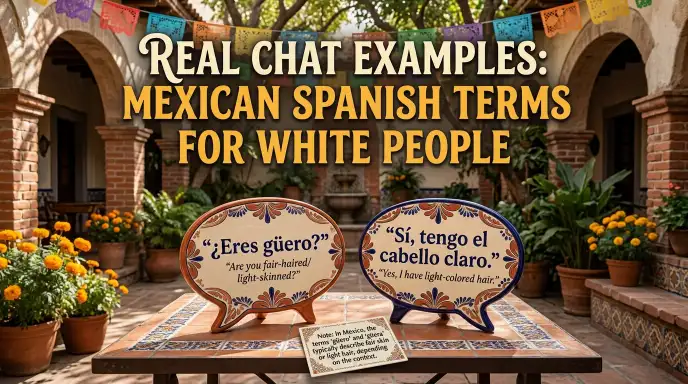
The following conversations are illustrative examples created to explain common usage. They are not quotations from real people, and the exact tone of these words can vary between speakers and regions.
Example 1: Describing Someone’s Hair
A: “¿Quién es el güero de la foto?”
B: “Es el amigo de Carlos.”
A: “Ah, ya sé quién es.”
English translation:
A: “Who’s the blond guy in the photo?”
B: “He’s Carlos’s friend.”
A: “Oh, now I know who he is.”
Meaning: Güero describes the person’s appearance.
Example 2: Talking About a Friend
A: “¿Viene tu amiga güera hoy?”
B: “Sí, llega después de las seis.”
A: “Perfecto, nos vemos entonces.”
English translation:
A: “Is your light skinned friend coming today?”
B: “Yes, she’ll arrive after six.”
A: “Perfect, see you then.”
Meaning: Güera is used as an informal description of a friend.
Example 3: Meeting an American Tourist
A: “¿De dónde es ese turista?”
B: “Es de Estados Unidos.”
A: “Ah, pensé que era gringo.”
English translation:
A: “Where is that tourist from?”
B: “He’s from the United States.”
A: “Oh, I thought he was a gringo.”
Meaning: Gringo is associated with someone from the United States. In natural conversation, the final line might sound redundant because the words can overlap in meaning.
Example 4: Asking About Nationality
A: “¿Ese chico es mexicano?”
B: “Sí, nació en Guadalajara.”
A: “Ah, pensé que era extranjero.”
English translation:
A: “Is that guy Mexican?”
B: “Yes, he was born in Guadalajara.”
A: “Oh, I thought he was a foreigner.”
Meaning: The conversation shows why appearance alone is not enough to determine nationality. It deliberately avoids labeling the person based on skin color.
Example 5: Using Blanco as a Description
A: “¿Cómo es el personaje de la película?”
B: “Es un hombre blanco, alto y de cabello castaño.”
A: “Gracias, ahora lo recuerdo.”
English translation:
A: “What is the character in the movie like?”
B: “He’s a tall white man with brown hair.”
A: “Thanks, now I remember.”
Meaning: Blanco is being used as a direct physical description.
Example 6: Hearing Gabacho in Conversation
A: “¿Qué significa gabacho?”
B: “En México puede referirse a alguien de Estados Unidos, pero puede sonar despectivo.”
A: “Entonces es mejor tener cuidado con esa palabra.”
English translation:
A: “What does gabacho mean?”
B: “In Mexico, it can refer to someone from the United States, but it can sound derogatory.”
A: “Then it’s better to be careful with that word.”
Meaning: The speakers discuss the word rather than using it to insult someone.
Example 7: Clarifying a Nickname
A: “¿Por qué le dicen güera?”
B: “Porque tiene el cabello claro.”
A: “Ah, entiendo.”
English translation:
A: “Why do they call her güera?”
B: “Because she has light colored hair.”
A: “Oh, I understand.”
Meaning: Güera is being used to describe hair color.
Example 8: Talking About Visitors
A: “¿Hay muchos turistas estadounidenses aquí?”
B: “Sí, vienen muchos durante las vacaciones.”
A: “Debe de ser una temporada muy ocupada.”
English translation:
A: “Are there many American tourists here?”
B: “Yes, many come during the holidays.”
A: “It must be a very busy season.”
Meaning: This example uses estadounidenses, a clear term for people from the United States, instead of assuming that all visitors are white.
Example 9: Choosing a Respectful Description
A: “¿Cómo describo a la persona que conocimos?”
B: “Puedes decir que es una mujer de piel clara.”
A: “Gracias, quiero describirla correctamente.”
English translation:
A: “How should I describe the person we met?”
B: “You can say she’s a light skinned woman.”
A: “Thanks, I want to describe her correctly.”
Meaning: The conversation shows how to describe someone’s complexion without using a potentially unwanted nickname.
Example 10: Correcting an Assumption
A: “Pensé que era estadounidense porque es güero.”
B: “No necesariamente. También hay mexicanos güeros.”
A: “Tienes razón, no debería asumirlo.”
English translation:
A: “I thought he was American because he’s light skinned.”
B: “Not necessarily. There are light skinned Mexicans too.”
A: “You’re right; I shouldn’t assume that.”
Meaning: Skin color does not determine nationality. This is an important distinction when learning these terms.
How to Reply When Someone Uses One of These Terms
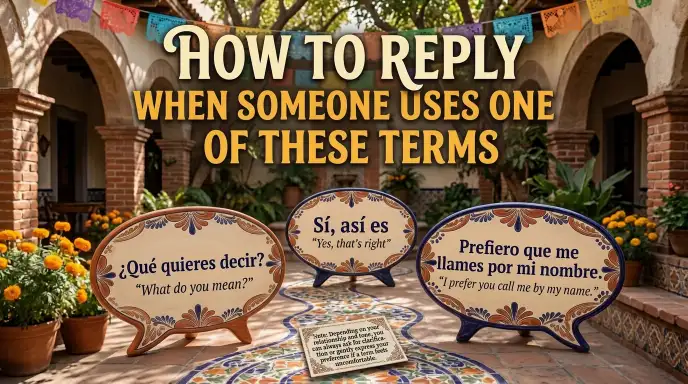
Your reply depends on the word, the tone, and if you understand what the speaker means. If someone uses a term you do not recognize, you can ask about it politely.
Funny Replies
If you are with friends and the conversation is comfortable, a lighthearted response may be appropriate.
- “¿Y eso qué significa?” : “And what does that mean?”
- “¡Estoy aprendiendo español!” : “I’m learning Spanish!”
- “Ahora necesito una clase de slang mexicano.” : “Now I need a lesson in Mexican slang.”
Use humor only when you are confident that everyone is comfortable with the conversation. Avoid turning a person’s skin color or nationality into the joke.
Casual Replies
For an ordinary conversation, keep things simple.
- “Ah, entiendo.” : “Oh, I understand.”
- “Gracias por explicarlo.” : “Thanks for explaining it.”
- “¿Te refieres a su cabello o a su nacionalidad?” : “Are you referring to their hair or their nationality?”
The final question is useful because it distinguishes a description of appearance from a comment about where someone comes from.
Friendly Replies
If someone explains a Mexican Spanish expression to you, you can respond warmly.
- “¡Qué interesante!” : “How interesting!”
- “Gracias, estoy aprendiendo.” : “Thanks, I’m learning.”
- “No sabía que podía tener varios significados.” : “I didn’t know it could have several meanings.”
These responses keep the conversation respectful while helping you learn.
Neutral Replies
If you are uncertain about a word’s tone, use a neutral question.
- “¿Qué quieres decir con esa palabra?” : “What do you mean by that word?”
- “¿Es una expresión común en México?” : “Is that a common expression in Mexico?”
- “¿Puede ser ofensiva en algunos contextos?” : “Can it be offensive in some contexts?”
Asking what a word means is often better than assuming the speaker intended an insult.
Are These Terms Rude or Offensive?
Not every term used to describe a white or light skinned person is automatically offensive. However, none should be judged without considering the word’s meaning, tone, context, and the preferences of the person being described.
Is Güero Offensive?
Güero is often used as an informal description of someone with blond hair or a light complexion. It can sound friendly or familiar in some conversations.
The word can also be used by vendors to address customers, even when the customer does not have light hair or skin. The Academia Mexicana de la Lengua explains this broader use as a form of address in commercial settings.
Still, a person may dislike being identified by their appearance. A word can be common in one setting without being welcome in every situation.
Is Gringo an Insult?
Gringo can be neutral, casual, teasing, or derogatory, depending on who says it and how it is used.
A conversation about American tourists may use the word descriptively. In a heated argument, the same word may carry hostility.
If you are speaking English with someone you do not know well, saying “American visitor” or using the person’s nationality is usually more precise.
Is Gabacho More Offensive?
Gabacho deserves extra caution because Mexican dictionary sources identify a derogatory sense when referring to foreigners.
Some people may use it jokingly, but you should not assume that everyone will interpret it as harmless.
If your goal is to communicate respectfully, avoid using gabacho as a label for a stranger.
Can You Use These Words at School or Work?
In language classes, it is appropriate to learn and discuss vocabulary accurately. In a professional or academic setting, however, there is rarely a need to label a colleague by skin color.
If appearance is genuinely relevant, use a neutral description. If nationality matters, identify the person’s nationality rather than guessing from their appearance.
For example:
- Clear: “The visitor is from the United States.”
- Clear: “She has light colored hair.”
- Less precise: “He’s a gringo because he looks white.”
The last statement makes an assumption that may be incorrect.
The safest principle is to describe what you know, not what you assume.
Who Uses These Terms?
Words such as güero, gringo, and blanco appear in different kinds of Mexican Spanish conversations. Their use is not limited to a single age group, and the meanings can vary across families, regions, and social settings.
Do Gen Z and Younger Mexicans Use Them?
Younger Spanish speakers may encounter these words in conversations, music, films, memes, and social media. That does not mean every young person uses each term or considers it acceptable.
For example, a teenager might hear güero as a familiar nickname in their community, while someone else may prefer not to be called by a description of their appearance.
There is no reason to assume that all members of Gen Z share the same vocabulary or attitudes.
Are These Words Common on Social Media?
The words are recognizable parts of Mexican Spanish vocabulary, but their frequency varies. A particular video, comment thread, or community may use one term more often than another.
Without reliable platform specific data, it would be misleading to claim that one term is the most popular word on TikTok or Instagram.
The more useful distinction is what each word communicates:
- Güero/güera: Often focuses on light hair or complexion.
- Blanco/blanca: Directly describes whiteness.
- Gringo/gringa: Often relates to the United States or perceived foreignness.
- Gabacho/gabacha: Can refer to a foreigner and may sound derogatory.
Understanding these differences is more valuable than memorizing a supposed popularity ranking.
Origin of the Terms
The words discussed here have different histories. They should not be treated as if they originated together or were invented specifically for social media.
Where Did Güero Come From?
Güero is established Mexican Spanish vocabulary. Modern Mexican dictionaries record its use for people with blond or light colored hair, as well as its role as a form of address.
Its everyday use can extend beyond a literal description of blond hair. In some settings, it may refer more broadly to a light complexion or function as a familiar way to address someone.
Because language changes through everyday interaction, the word’s practical meaning can depend on the region and the speaker.
Where Did Gringo Come From?
The word gringo has a longer history in Spanish language usage, and its exact development is not always explained consistently in popular stories.
One frequently repeated story claims that the word came from the phrase “Green Grow the Lilacs,” supposedly sung by English speaking soldiers. However, this explanation is generally treated as an unsupported folk etymology rather than an established origin.
For an article, it is better to explain the word’s current usage than to present an uncertain origin story as fact.
Today, its meaning can relate to Americans, foreigners, or people perceived as foreign, depending on the Spanish speaking community.
Where Did Gabacho Come From?
Gabacho has a history that predates modern social media. The Instituto Cervantes discusses its older Spanish usage in relation to French people and its later use in Mexico as a term sometimes synonymous with gringo.
Its meaning has changed across places and periods. This is one reason it should not be translated into a single English word in every sentence.
The origin of a word does not determine how every modern speaker uses it, so current context remains essential.
Comparison Table: Güero, Gringo, Blanco, IDK, IDC, IMO, and BRB
The requested texting abbreviations IDK, IDC, IMO, and BRB serve a different purpose from the Spanish terms. The Spanish words describe people or nationality related ideas, while the English abbreviations express common messages in online communication.
| Meaning | Type | Usage | Popularity |
| What do Mexicans call white people? | Question, not a slang term | Asks about Mexican Spanish vocabulary | Common type of language question |
| Güero/güera | Spanish descriptive term | Light hair or complexion; sometimes a form of address | Established Mexican Spanish usage |
| Blanco/blanca | Spanish adjective and noun | Describing someone as white | Standard Spanish vocabulary |
| Gringo/gringa | Informal Spanish term | Often someone from the United States or perceived as foreign | Recognizable, but tone varies |
| Gabacho/gabacha | Informal Spanish term | Often a foreigner, especially someone associated with the United States | Context dependent; may be derogatory |
| IDK | English initialism | “I don’t know” | Widely recognized online |
| IDC | English initialism | “I don’t care” | Widely recognized online |
| IMO | English initialism | “In my opinion” | Widely recognized online |
| BRB | English initialism | “Be right back” | Widely recognized online |
This comparison shows why it is important not to confuse cultural vocabulary with texting abbreviations. The words may appear online, but that does not make them the same kind of expression.
Real World Usage Example
Imagine you are visiting Mexico and meet a group of local friends. One person introduces you to a man with blond hair and says, “Él es nuestro amigo güero.”
You might understand this as “He’s our blond haired” or “light complexioned friend.” The speaker is describing his appearance, not necessarily saying that he is American.
Later, another person mentions a group of tourists from the United States and calls them gringos. In that situation, the term is connected to their perceived nationality or foreignness.
You then hear someone use gabacho in a conversation about the United States. Because the word can be derogatory, you should pay attention to the tone rather than assume it is an affectionate nickname.
If you want to clarify the distinction, you could ask:
“¿Güero describe el aspecto físico y gringo se refiere a los estadounidenses?”
English translation: “Does güero describe physical appearance, while gringo refers to Americans?”
This is a useful question because it invites an explanation rather than making an assumption.
The key lesson is that a person’s appearance, nationality, and identity are different things. Learning the vocabulary is helpful, but using it thoughtfully is just as important.
Frequently Asked Questions
Q1. What do Mexicans call white people in text messages?
Mexicans may use güero/güera, blanco/blanca, or sometimes gringo/gringa, depending on the context. These words have different meanings, so the best choice depends on if the speaker means skin tone, hair color, or nationality.
Q2. What does this question mean on TikTok?
On TikTok, people asking what Mexicans call white people are usually looking for the meanings of Mexican Spanish terms such as güero, gringo, and gabacho. Videos may simplify these meanings, so it is helpful to check reliable language references.
Q3. Is there a Mexican slang word for white people?
There is no single term used by every Mexican speaker. Güero/güera can describe a light complexioned person, while gringo/gringa often relates to Americans or perceived foreigners. Gabacho/gabacha may be derogatory.
Q4. Are these words rude or offensive?
It depends on the term and the context. Güero can be a casual description, gringo can be neutral or derogatory, and gabacho can sound dismissive. When in doubt, use a person’s name or a clear, respectful description.
Q5. How should you reply if someone calls you güero or gringo?
If you are unsure what the person means, ask politely: “¿Qué significa esa palabra?” (“What does that word mean?”). If you dislike the label, you can say, “Prefiero que me llames por mi nombre” (“I prefer that you call me by my name”).
Conclusion
Mexicans may use güero/güera, blanco/blanca, gringo/gringa, or gabacho/gabacha when talking about white or light skinned people, but these terms do not all mean the same thing. Some describe appearance, while others relate to nationality or foreignness.
The most useful distinction is that güero often refers to light hair or complexion, blanco means white, gringo often refers to Americans or perceived foreigners, and gabacho can carry a derogatory tone.
You may encounter these words in everyday conversations, movies, social media posts, and text messages. However, do not assume that a person is American because they are white, or that a term is friendly simply because it is commonly heard.
When speaking with someone, choose language that is clear and respectful. If you are unsure about a word’s meaning, ask rather than guess.
Understanding Mexican Spanish means learning not only the translation of a word but also how people use it in real life.
💬 Keep Discovering New Slang:
GRS Meaning in Text: Definition, Uses, and Examples

I am Masson Caldwell, a language enthusiast and content writer at SlangAura. I write about internet slang, texting trends, and modern expressions to help readers understand the evolving world of online language with simple and clear explanations.