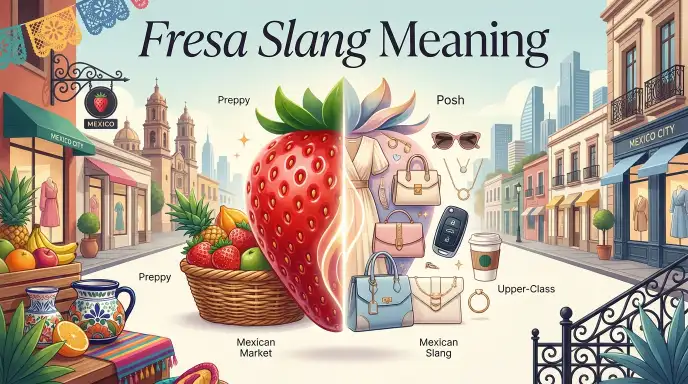
Fresa slang is a Mexican Spanish expression used for a person who is seen as preppy, posh, privileged, fashionable, or somewhat snobby. The word literally means “strawberry” in Spanish, but its slang meaning describes a social style linked with wealth, expensive tastes, polished behavior, or an upper class image.
Quick Answer: In Mexican slang, fresa means someone who acts or appears preppy, posh, wealthy, or snobby. It can describe a person, their way of speaking, their style, or even a place that feels fancy. The word is often teasing or critical, but the tone depends on who says it and how it is used.
Quick Answer: Fresa Slang Meaning
| Quick Detail | Answer |
| Fresa slang meaning | Preppy, posh, privileged, or snobby person |
| Literal meaning | Strawberry |
| Language | Spanish |
| Main slang use | Mexican Spanish |
| Pronunciation | FRES ah |
| Tone | Teasing, descriptive, or critical |
| Used for | People, styles, speech, places, and tastes |
| Gender | Used for both males and females |
| Formal or informal? | Informal |
| Can it be negative? | Yes |
| Related form | Fresita |
The word does not always mean that someone is actually rich. A person can be called fresa because of the way they dress, speak, behave, or present themselves. The social image matters as much as actual income.
What Does Fresa Mean in Slang?
In slang, fresa describes someone who has a preppy, polished, fashionable, or upper class image.
For example:
“Ella es muy fresa.”
This can mean:
“She is very preppy.”
It may also suggest that she is somewhat snobby or privileged.
The exact English translation depends on the situation. Preppy, posh, snobby, stuck up, privileged, and fancy can all capture parts of the meaning.
No single English word fully matches the cultural meaning of fresa.
What Does Fresa Literally Mean?
The Spanish word fresa literally means “strawberry.”
For example:
“Me gusta la fresa.”
This means:
“I like strawberry.”
That is the normal Spanish meaning.
The slang meaning is completely different. In Mexican Spanish, fresa can describe a person or style associated with upper class behavior and appearance.
This double meaning is important because a sentence about food and a sentence about someone’s personality can use the same word.
Why Does Fresa Mean Preppy or Snobby?
The exact origin of the slang meaning is not completely certain.
What is clear is that fresa developed as a Mexican social label for a particular upper class or aspiring upper class style. Academic research describes the term as connected with social identity, fashion, speech patterns, consumer habits, and ideas of upward mobility.
Some sources trace its wider use to Mexican youth culture in the second half of the 20th century. Accounts of its history connect the term with wealthy or privileged young people who adopted fashionable styles and certain ways of speaking.
The exact reason the word strawberry became associated with this social stereotype remains uncertain.
Is Fresa Mexican Slang?
Yes. Fresa is strongly associated with Mexican Spanish slang.
The Asociación de Academias de la Lengua Española records fresa as a Mexican and wider regional term for a person who dresses, speaks, or behaves as though they belong to a wealthy or upper social class.
The term is especially connected with Mexico.
Other Spanish speaking countries may have their own words for a similar idea. For example, pijo is commonly associated with Spain, while different regions have different expressions for someone who seems posh or snobby.
So calling fresa “Mexican slang” gives readers a useful clue about its main cultural setting.
How Do You Pronounce Fresa?
Fresa is commonly pronounced approximately like:
FREH sah
The first syllable sounds like “freh”, followed by “sah.”
In Spanish, the final a has an open sound similar to the “a” in many Spanish words.
The pronunciation is the same if fresa refers to a strawberry or to the slang meaning.
What Kind of Person Is Called Fresa?
A fresa is often stereotyped as someone who:
- Likes expensive or fashionable things
- Cares about appearance
- Comes from a wealthy background
- Acts very polished or proper
- Uses a distinctive style of speech
- Enjoys upscale places
- Seems disconnected from ordinary or less expensive lifestyles
- Wants to appear sophisticated or high class
These are social stereotypes, not rules.
Someone does not automatically become fresa because they have money or wear expensive clothes. The word can also describe someone who acts wealthy or adopts a preppy image. ASALE specifically notes that the term can apply if the person’s actual social status is wealthy or not.
Can Fresa Describe a Girl or a Boy?
Yes. Fresa can describe people of any gender.
For example:
“Ella es fresa.”
means:
“She is fresa.”
You can also say:
“Él es fresa.”
meaning:
“He is fresa.”
The word itself does not become masculine when describing a male person.
The plural form is:
fresas
So a group of people may be described as fresas.
What Does “Niño Fresa” Mean?
Niño fresa literally means “fresa boy” or “preppy boy.”
It can describe a young male who has the stereotypical fresa lifestyle, appearance, or attitude.
For example:
“Ese niño es muy fresa.”
This could mean:
“That guy is very preppy.”
The phrase does not necessarily mean the person is wealthy. It can refer to the image they present.
A similar idea can apply to niña fresa, meaning a girl with a fresa style or personality.
What Does “Fresita” Mean?
Fresita is a diminutive form of fresa.
The ending ita can make the word sound smaller, softer, cuter, or more playful.
So fresita can describe someone who has a cute, preppy, posh, or slightly snobby image.
For example:
“Ella es muy fresita.”
Depending on the speaker, this can sound affectionate, teasing, or critical.
The word is also commonly associated with young women and girls in some modern uses, although fresa itself can describe people of any gender.
Can Fresa Describe Someone Who Is Not Rich?
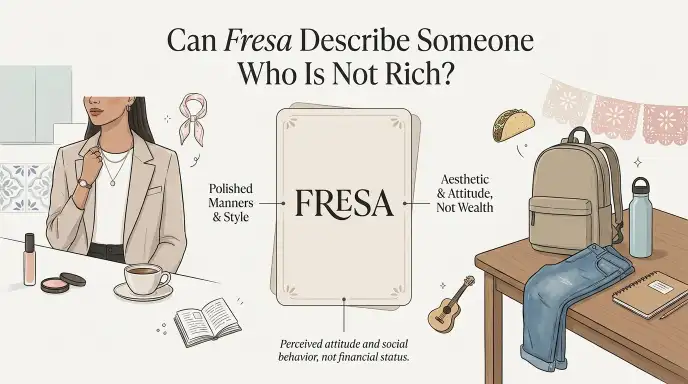
Yes.
This is one of the most important details about fresa slang.
Being called fresa does not always mean the person actually belongs to a wealthy family.
Someone may receive the label because they:
- Dress in an expensive looking style
- Prefer luxury brands
- Speak in a particular way
- Choose expensive restaurants
- Use lots of English words while speaking Spanish
- Act very selective about food or places
- Try to present themselves as upper class
ASALE specifically defines the term around appearing or behaving as though one belongs to a wealthy class, if that is actually true or not.
What Does a Fresa Accent Sound Like?
The fresa stereotype can include a particular way of speaking.
Academic research on fresa identity notes that speech patterns can combine Spanish and English, along with distinctive expressions and pronunciation.
Some descriptions also connect the stereotype with a speech style called:
“la papa en la boca”
This phrase means “the potato in the mouth.”
It is a humorous way of describing a certain affected or distinctive pronunciation.
The important point is that fresa can describe speech as well as appearance.
Does Fresa Mean Rich?
Not exactly.
Fresa can suggest wealth or privilege, but “rich” is not a complete translation.
A person can be wealthy without being called fresa.
Another person may not be wealthy but may dress, speak, or behave in a way that people associate with fresa culture.
That is why translations such as preppy, posh, snobby, privileged, or stuck up can sometimes work better than simply saying “rich.”
Is Fresa a Compliment or an Insult?
Fresa can be either playful or negative.
It depends on the speaker and situation.
For example:
“Mi prima es medio fresa, pero es buena onda.”
This means something like:
“My cousin is kind of preppy, but she is cool.”
Here, the word is not strongly insulting.
Another person might use fresa to criticize someone for acting spoiled or disconnected from ordinary life.
Academic research also notes that being labeled fresa can sometimes work as a backhanded compliment, while in other situations it carries teasing or social stigma.
Fresa Examples in Mexican Spanish
Example 1: Describing a Person
“Ella es muy fresa.”
Meaning: “She is very preppy or snobby.”
The speaker may be talking about her style, behavior, or social image.
Example 2: Describing Clothes
“Esa ropa está muy fresa.”
Meaning: “Those clothes look very preppy or fancy.”
Here, the word describes the style rather than the person.
Example 3: Describing a Place
“Ese restaurante es muy fresa.”
Meaning: “That restaurant is very posh or fancy.”
The term can describe places that have an upscale atmosphere.
Example 4: Friendly Teasing
“No seas tan fresa.”
Meaning: “Don’t be so fancy or snobby.”
The speaker may be joking with a friend.
Example 5: Describing Speech
“Habla muy fresa.”
Meaning: “He or they speaks in a very preppy or posh way.”
Here, fresa refers to the person’s way of speaking rather than their clothes or money.
How Fresa Can Describe More Than a Person
One interesting part of fresa slang is that it does not only describe people.
The word can also describe:
- Clothing
- Restaurants
- Neighborhoods
- Parties
- Schools
- Accents
- Food preferences
- Lifestyles
- Social behavior
For example:
“La fiesta estuvo muy fresa.”
This can suggest that the party had an upscale, fashionable, or preppy atmosphere.
That broader use helps explain why fresa is more than a simple translation for “rich person.” It can describe an entire social style.
Fresa vs. Preppy
Fresa and preppy are similar, but they are not exact matches.
Preppy mainly describes a fashion style, appearance, or lifestyle. It can be positive or neutral.
Fresa has a stronger cultural meaning in Mexican Spanish. It can describe someone’s style, social behavior, speech, tastes, or perceived class.
For example, someone may dress preppy without being considered fresa. A person can also be called fresa because of the way they speak or behave, even if their clothes are not traditionally preppy.
Fresa vs. Snobby
Snobby focuses mainly on an attitude of looking down on other people.
Fresa can include that idea, but it does not always mean someone is rude or arrogant.
A fresa person may simply have an upscale style, expensive tastes, or a polished way of speaking.
This difference matters when translating the word into English.
Depending on context, fresa could mean:
- Preppy
- Posh
- Fancy
- Privileged
- Snobby
- Upper class
- High class
- Spoiled
The best translation depends on what the speaker is describing.
Can Fresa Be Used as a Joke?
Yes. Friends may use fresa playfully.
For example:
“You won’t eat street tacos? You’re so fresa!”
The speaker may not seriously accuse the person of being spoiled. They could simply be teasing them for having expensive tastes.
The tone comes from the relationship between the speakers.
A close friend may say fresa jokingly, while a stranger could make it sound more judgmental.
What Does “Muy Fresa” Mean?
Muy fresa means “very fresa.”
The phrase adds emphasis.
For example:
“Ese lugar es muy fresa.”
This can mean the place feels very upscale, fancy, exclusive, or preppy.
Another example is:
“Ella es muy fresa.”
This may describe someone who strongly fits the stereotype associated with fresa culture.
The phrase does not automatically mean the person has a lot of money.
What Does “Súper Fresa” Mean?
Súper fresa is an even stronger casual expression.
It can describe someone or something that seems extremely preppy, fancy, polished, or upper class.
For example:
“Su escuela es súper fresa.”
The speaker may be saying that the school has an expensive or elite image.
The expression can be serious, humorous, or teasing depending on the conversation.
How Is Fresa Used on Social Media?
On social media, fresa can describe an online personality or aesthetic.
Someone may use the term when talking about:
- Luxury fashion
- Expensive restaurants
- Upscale travel
- Designer brands
- Polished outfits
- Private school culture
- High end events
- A polished lifestyle
A creator might even describe their own style as fresa in a playful way.
On platforms such as TikTok and Instagram, the word can therefore become part of an aesthetic rather than simply a description of someone’s wealth.
Is Fresa Always About Money?
No.
Money is one part of the stereotype, but fresa is broader than financial status.
A person may have little wealth but still be described as fresa because of their behavior, speech, clothes, social circle, or preferences.
The opposite can also happen.
A wealthy person may not be considered fresa if they do not fit the expected style or behavior.
This is why fresa describes a social image rather than a bank balance.
What Is a Fresa Lifestyle?
The phrase fresa lifestyle is usually used informally for a lifestyle associated with comfort, fashion, luxury, status, and upscale social activities.
It may include things such as:
- Designer clothing
- Trendy cafés
- Expensive restaurants
- Luxury vacations
- Exclusive events
- High end shopping
- Private schools
- Status focused social circles
These are stereotypes, not requirements.
A person does not need every one of these traits to be called fresa.
Fresa as a Personality Description
When fresa describes personality, it can suggest that someone is:
- Particular
- Polished
- Selective
- Fashion conscious
- Socially privileged
- Sheltered
- Materialistic
- Snobby
Not every use carries all these meanings.
For example, one person might use fresa to mean fashionable, while another might use it to mean spoiled.
The surrounding sentence usually tells you which meaning is intended.
Common Mistakes About Fresa Slang
Mistake 1: Thinking Fresa Only Means Rich
Fresa does not simply mean rich.
It can describe behavior, appearance, speech, or social image.
Mistake 2: Assuming It Is Always an Insult
The word can be playful or neutral.
Context and tone matter.
Mistake 3: Translating Every Fresa as Strawberry
The literal translation works when discussing the fruit.
It does not work when fresa is being used as Mexican slang.
Mistake 4: Assuming Every Mexican Uses It the Same Way
Slang can change by age, region, social group, and context.
A word may feel natural in one conversation and unusual in another.
Mistake 5: Assuming Fresa Means Female
Fresa can describe both males and females.
The meaning depends on the person’s social image, not their gender.
Fresa in Everyday Conversation
Here are a few natural examples showing how the meaning can change.
Example 1
“No quiere tomar café de aquí. Es muy fresa.”
Meaning:
“They don’t want to drink coffee from here. They’re very fancy or picky.”
Example 2
“Ese hotel está muy fresa.”
Meaning:
“That hotel is very upscale or fancy.”
Example 3
“Mi hermano es medio fresa.”
Meaning:
“My brother is kind of preppy or posh.”
Example 4
“No seas fresa, prueba la comida.”
Meaning:
“Don’t be so picky or fancy. Try the food.”
Example 5
“Su estilo es bastante fresa.”
Meaning:
“Her style is quite preppy or upscale.”
These examples show why one fixed English translation does not always work.
Is Fresa Used in Texting?
Yes. Fresa can appear in casual texting and online conversations, especially when people are talking about someone’s style, habits, or personality.
A text might say:
“Bro, eres bien fresa 😂”
This could mean:
“Bro, you’re so preppy/fancy 😂”
The emoji can make the comment feel more playful.
Another message might say:
“Ese lugar se ve súper fresa.”
That means the place looks very upscale or fancy.
Because texting is informal, the exact tone depends heavily on the conversation.
What Does “Bien Fresa” Mean?
Bien fresa is a casual way to emphasize the description.
Depending on context, it can mean:
- Very preppy
- Very fancy
- Very posh
- Very snobby
- Very upscale
For example:
“Ella es bien fresa.”
This could mean:
“She’s really preppy.”
The phrase is especially useful when someone wants to emphasize the stereotype.
Fresa and Mexican Youth Culture
The idea of being fresa has been closely connected with Mexican youth culture and social identity.
The term can involve more than fashion. It can signal differences in speech, education, lifestyle, entertainment, social groups, and ideas about class.
That is why translating fresa only as “rich” misses an important part of its cultural meaning.
In some contexts, people may even use the label to describe an identity or social group rather than one specific personality trait.
Is Fresa Still Used Today?
Yes. Fresa remains recognizable in contemporary Mexican Spanish, although the way people use it can change over time.
You may encounter it in casual conversations, social media, entertainment, jokes, and discussions about fashion or social class.
Modern speakers can also use it creatively.
For example, someone may call an expensive café muy fresa without saying anything about the people who visit it.
This flexible use helps the word remain useful in everyday slang.
Fresa vs. Fresita
The two words are closely related.
Fresa is the main slang term.
Fresita adds the diminutive ending ita, which can make the expression sound softer, cuter, younger, or more playful.
For example:
“Ella es fresa.”
describes someone as fresa.
“Ella es fresita.”
can give the description a more playful or cute tone.
The exact feeling still depends on context and the speaker.
Similar Words and Expressions
English does not have one perfect equivalent for fresa.
Depending on context, these words may come close:
| English word | What it emphasizes |
| Preppy | Fashion and lifestyle |
| Posh | Upper class style |
| Snobby | Looking down on others |
| Fancy | Expensive or upscale taste |
| Privileged | Social or economic advantages |
| Spoiled | Having an entitled attitude |
| High class | Refined or upscale image |
| Stuck up | Arrogant social attitude |
The Spanish word can combine several of these ideas at once.
What Does Fresa Mean on TikTok?
On TikTok, fresa can be used when discussing Mexican fashion, lifestyle, personality, humor, or social stereotypes.
A video may describe an outfit as fresa, joke about fresa habits, or use the word to portray a certain type of character.
The term can therefore work as both a description and a humorous identity label.
The meaning still depends on the video and caption.
Real Life Examples of Fresa Slang
Example 1: Restaurant
Daniel chooses a very expensive restaurant for dinner.
His friend says:
“Bro, this place is so fresa.”
Here, fresa describes the upscale atmosphere.
Example 2: Fashion
Sofia arrives wearing a polished designer style outfit.
Her friend says:
“Your outfit looks really fresa.”
Here, the word refers to her fashion style.
Example 3: Personality
Mateo refuses to go somewhere because he thinks it is not fancy enough.
His friend jokes:
“You’re getting too fresa.”
Here, the word suggests that Mateo is becoming too picky or accustomed to luxury.
Example 4: Social Media
A creator posts videos about luxury cafés, expensive shopping, and upscale travel.
Viewers may describe the content as fresa.
Here, the word refers to the lifestyle being presented online.
Example 5: Speech
Someone notices that a person’s Spanish has a distinctive upper class style.
They may describe the person’s way of speaking as fresa.
Here, the word refers to speech rather than money.
Key Takeaways About Fresa Slang
- Fresa literally means “strawberry” in Spanish.
- In Mexican slang, it can describe a preppy, posh, privileged, or snobby person.
- It does not always mean someone is actually rich.
- The word can describe people, clothes, speech, places, and lifestyles.
- Muy fresa means “very fresa.”
- Bien fresa adds strong casual emphasis.
- Fresita is a softer or more playful related form.
- The tone can be friendly, humorous, neutral, or critical.
- The best English translation depends on the context.
FAQs About Fresa Slang
Q1. What does “strawberry girl” mean in Spanish slang?
“Strawberry girl” is often linked to the Spanish slang idea of a “fresa” girl. It can describe a girl who seems preppy, stylish, privileged, or particular about her tastes.
Q2. What does “fresca” mean in Spanish slang?
In Spanish, “fresca” can mean different things depending on context. As slang, it may describe a girl as bold, cheeky, overly confident, or sexually forward, so the tone matters.
Q3. How do you say “girl” in Mexican slang?
In Mexican Spanish, common informal words for girl include chava, morra, muchacha, and chica. “Chava” and “morra” are especially common in casual speech.
Q4. What does “la niña fresa” mean?
“La niña fresa” literally means “the preppy girl” or “the posh girl.” In Mexican slang, “fresa” can describe someone seen as fashionable, upper class, or particular about their lifestyle.
Q5. What does fresa mean for a girl?
When “fresa” describes a girl in Mexican slang, it usually refers to someone who appears preppy, classy, privileged, fashionable, or somewhat snobby. The meaning can be playful or negative depending on how it is used.
Q6. What does fresita girl mean?
A “fresita girl” is a cute or softer way of describing a fresa girl. It can suggest a girl who is preppy, feminine, stylish, polished, or a little spoiled.
Conclusion: Fresa Slang Meaning
Fresa is a Mexican Spanish slang term with a meaning that goes far beyond its literal translation, “strawberry.” When used as slang, it can describe someone who has a preppy, posh, privileged, fashionable, or sometimes snobby image. The word can also describe clothing, speech, restaurants, neighborhoods, lifestyles, and other things associated with an upscale social style.
One of the most important points is that fresa does not simply mean rich. Someone can be called fresa because of their behavior or appearance even if they are not wealthy. The tone also matters. Friends may use it as a joke, while someone else may use it as criticism.
Understanding the context makes the meaning much easier to recognize. If you see fresa, muy fresa, bien fresa, or fresita in a Mexican Spanish conversation, look at what the speaker is describing before choosing an English translation.
What to Explore Next:
Slang for Condoms: Common Terms, Nicknames, Their Meanings

I am Masson Caldwell, a language enthusiast and content writer at SlangAura. I write about internet slang, texting trends, and modern expressions to help readers understand the evolving world of online language with simple and clear explanations.