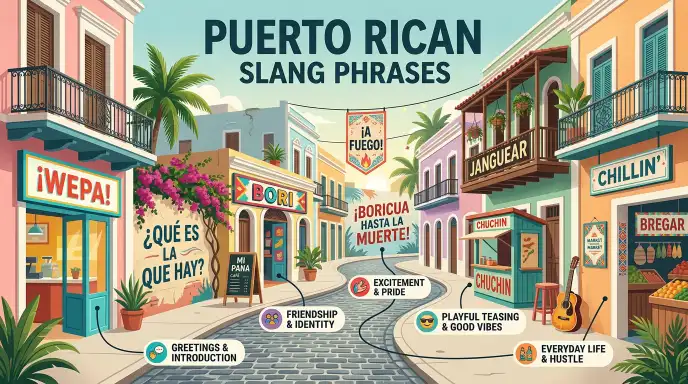
Puerto Rican slang phrases are casual expressions used across the island that often mix Spanish with English influences, known as Spanglish. Phrases like “ay bendito,” “wepa,” and “está cabrón” carry emotion, humor, and identity that standard Spanish textbooks don’t teach.
If you’ve ever watched a reggaeton video, visited San Juan, or talked with a Puerto Rican friend, you’ve probably heard words that don’t match what you learned in Spanish class. That’s completely normal. Puerto Rican slang has its own rhythm, shaped by history, music, and daily island life.
Some of these words trace back to Taíno roots. Others come from African heritage brought through the island’s history. A large chunk grew out of decades of close contact with American English, blending into what people now call Spanglish. None of this is random slang thrown together for fun; it’s a living record of Puerto Rico’s story.
This guide breaks down the most common Puerto Rican slang phrases in plain English. You’ll learn what each one means, when people use it, and how to avoid sounding awkward if you try it yourself. Knowing these phrases helps you follow real conversations, songs, and social media posts that would otherwise leave you confused.
Quick Answer Table
| Question | Answer |
| What is it? | Everyday casual expressions used across Puerto Rico |
| Language mix | Spanish plus English influence (Spanglish) |
| Tone | Warm, expressive, informal |
| Used by | People of all ages, on the island and in the diaspora |
| Where heard | Conversation, music, social media, TV |
| Offensive? | Mostly no, though a few depend heavily on tone |
Puerto Rican slang carries real cultural weight behind it. Many phrases connect to specific moments in the island’s history, so learning them teaches you more than vocabulary. It gives you a small window into how Puerto Ricans express joy, frustration, and identity.
Common Puerto Rican Slang Phrases and Their Meanings
Below are some of the most widely used phrases, grouped loosely by how they’re used.
Everyday Reactions and Emotions
¡Ay bendito!
This phrase expresses sympathy, surprise, or deep emotion, similar to saying “oh my goodness” in English. People often shorten it to “¡Dito!” and use it for almost anything, from stubbing a toe to hearing sweet news about a baby.
Wepa
Wepa is an excited shout of joy or celebration, close to yelling “woohoo” or “awesome.” You’ll hear it at parties, concerts, and any moment worth celebrating out loud.
¡Diantre!
A milder exclamation of surprise, similar to saying “wow” or “oh my.” It’s used when something unexpected happens, good or bad.
Jaleo
In standard Spanish, jaleo means a cheerful, noisy atmosphere. In Puerto Rican slang, though, it can flip to mean feeling sick, nauseated, or dizzy, so context decides the meaning here.
Words for People and Identity
Boricua
This word refers to a person from Puerto Rico and is used with real pride, if someone was born on the island or grew up in the mainland United States. It comes from “Borikén,” the original Taíno name for Puerto Rico.
Broki
Borrowed from the English word “brother,” broki simply means “friend” or “buddy.” It works for close friends of any gender.
Ganso
This word describes someone acting like a wiseguy or show off, usually in a light, teasing way rather than a serious insult.
Slang for Approval and Excitement
Está cabrón
This phrase means “that’s wild” or “that’s awesome.” A related word can sound harsh in some countries, but in Puerto Rico this version usually expresses amazement or admiration, not anger.
A fuego
This means something is “on fire” in a good way, describing something exciting or impressive, like a great concert or a fun night out.
Echa caldo
Literally “throw broth,” this phrase is used when something is cool or impressive, similar to saying something is “fire” in English slang.
Asicalao
This word describes something flawless, clean, or immaculate, often used for outfits, homes, or anything polished and put together.
Slang for Hanging Out and Daily Life
Janguear / Hanguiar
Borrowed from the English word “hang out,” this means chilling or spending relaxed time with friends. You’ll hear it constantly in weekend plans.
Pichea
This phrase tells someone to let something go or not worry about it, similar to saying “forget it” or “never mind.”
Mamey
Mamey describes something very easy to do, similar to saying “easy peasy” in English.
Chavos
While this word means “young people” in some countries, in Puerto Rico it’s slang for money.
Gufear
This word means to joke around or fool around, and it comes from the English word “goofy.”
Al garete
This phrase describes something wild, chaotic, or off the rails, often used for a wild party or a disastrous situation. It comes from an old Arabic phrase meaning “adrift.”
¿Qué es la que hay?
A casual greeting that means “what’s up,” commonly used to open a conversation with friends.
Ahora
On the island, this means “right now,” unlike some other Spanish speaking countries where a similar word can mean “later” or “in a bit.”
Slang from Music and Youth Culture
Tiraera
This word describes a diss or insult, often used playfully in music or friendly rivalry between artists.
Gas pela
A more niche phrase used to describe intense heat or attraction, often heard in casual or musical contexts rather than everyday conversation.
The meanings above come from how these phrases are actually used in daily life, not from a direct word for word translation, since slang rarely converts cleanly between languages.
Puerto Rican Slang vs Standard Spanish
Some of the biggest mix ups happen when a word exists in both standard Spanish and Puerto Rican slang, but with different meanings.
| Word | Standard Spanish Meaning | Puerto Rican Slang Meaning |
| Chavos | Young boys (in some countries) | Money |
| Jaleo | Lively, cheerful noise | Feeling sick or dizzy |
| Cabrón | Often an insult | Amazement, “that’s crazy/awesome” |
| Bembé | Not commonly slang elsewhere | A big, fun party |
This table matters because using the “textbook” meaning of these words in Puerto Rico can confuse the person you’re talking to, or send the wrong message entirely.
Formal or Informal?
All of the phrases above are informal. They belong in conversations with friends, family, social media captions, and music lyrics. In a business meeting, a school essay, or a formal letter, standard Spanish is the safer choice. Mixing in heavy slang there can come across as too casual for the setting, even if it’s completely normal at home.
Real Life Examples
Text Message
Sofía: “vamos a janguear esta noche?”
Marcus: “wepa, dale, avísame la hora”
Instagram Caption
“Este fin de semana estuvo a fuego 🔥 #boricua”
Family Conversation
Abuela: “¡Ay bendito, mira lo grande que estás!”
Nieto: “Gracias abuela, te quiero”
Friend Group Chat
Dante: “perdí las llaves otra vez”
Yaritza: “pichea, yo tengo copia”
Music and Culture Comment
Fan reply under a reggaeton video: “esa tiraera estuvo durísima 😂”
Workplace Break Room (Casual Setting)
Camila: “¿cómo estuvo la fiesta del sábado?”
Rubén: “un bembé total, no paramos de bailar”
Each example shows how naturally these phrases fit into daily situations, from texting a friend to chatting with a grandmother.
Common Mistakes People Make
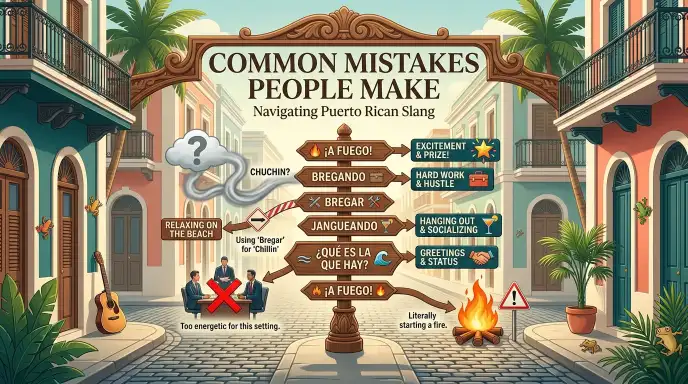
- Translating word for word. Many phrases lose their meaning if translated literally, so learn the intent behind the words, not just a dictionary definition.
- Using slang in formal writing or professional settings. Save these phrases for casual, everyday conversation.
- Assuming one meaning applies everywhere. Words like “chavos” and “jaleo” mean something different outside Puerto Rico.
- Missing the tone. Phrases like “está cabrón” depend heavily on delivery and context, not just the words themselves.
- Overusing slang with strangers. Locals often ease into slang once a conversation feels comfortable, rather than opening with it.
Key Takeaways
- Puerto Rican slang blends Spanish with English influence, known as Spanglish.
- Phrases like “ay bendito,” “wepa,” and “boricua” reflect real cultural identity, not just casual fun.
- Some words, like “chavos” and “jaleo,” mean something completely different outside Puerto Rico.
- Tone and context often decide if a phrase sounds playful, warm, or something else entirely.
- These phrases are informal and work best in casual conversation, not formal writing.
Frequently Asked Questions
Q1. What does “qué lo que” mean?
“Qué lo que” is a casual Caribbean Spanish greeting meaning “What’s up?” or “What’s going on?”. It is especially associated with Puerto Rican and Dominican speech.
Q2. How do Puerto Ricans say “let’s go”?
Puerto Ricans commonly use “¡Vamos!” for “let’s go.” In casual speech, “¡Dale!” can also mean “let’s go,” “come on,” or “go for it,” depending on context.
Q3. What are some flirty phrases in Puerto Rican?
Some casual Puerto Rican style flirty expressions include “Qué linda eres” (you’re so beautiful), “Me encantas” (I really like you), and “Tú estás buena/o” (you’re very attractive). Tone and familiarity matter when using them.
Q4. What is slang for Puerto Ricans?
There is no single slang word that all Puerto Ricans use for themselves. “Boricua” is a widely used cultural term for a Puerto Rican person and comes from Borikén, the Indigenous Taíno name associated with Puerto Rico.
Q5. How do Puerto Ricans flirt?
Puerto Rican flirting can involve compliments, playful teasing, affectionate nicknames, humor, and expressive conversation. The specific words vary by person, age, relationship, and setting.
Q6. Why do Puerto Ricans say titi?
“Titi” is an affectionate Puerto Rican and Caribbean Spanish term commonly used for an aunt, especially a familiar or beloved aunt. It can also be used as a family nickname depending on the household.
Conclusion
Puerto Rican slang phrases carry more than casual meaning. They reflect the island’s history, humor, and warmth in a way standard Spanish alone doesn’t capture. Phrases like “ay bendito,” “wepa,” and “boricua” show up everywhere, from family conversations to popular music.
Learning these phrases helps you understand real conversations, not just textbook Spanish. Start with a few common ones, pay attention to tone, and you’ll naturally pick up more the more you listen and engage with Puerto Rican culture and the people who speak it every day.
If you enjoyed learning these, exploring slang from other Spanish speaking countries is a great next step.
Related slang Terms:
YW Slang Meaning: Uses, Contexts, and Text Examples
Old English Slang: Common Words, Phrases, and Their Meanings

I am Emma Collins, a content writer at SlangAura specializing in internet slang, texting abbreviations, and online language. I create simple and accurate guides to help readers understand modern slang easily and confidently.