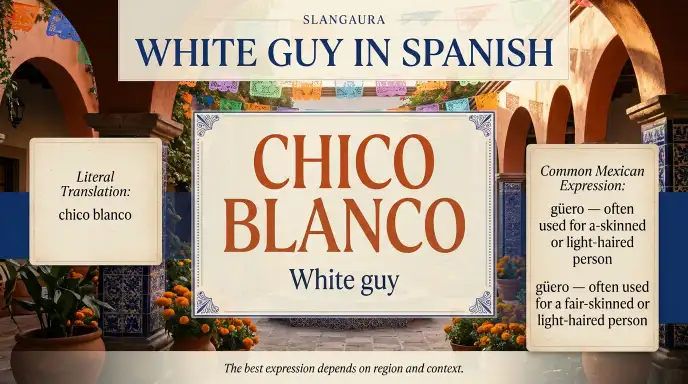
White guy in Spanish is most commonly translated as “hombre blanco.” In casual conversations, Spanish speakers may also say chico blanco or tipo blanco, depending on the person’s age and the situation. All three expressions describe a white male, but they do not sound exactly the same.
You might come across these phrases in TikTok videos, Instagram comments, Snapchat messages, WhatsApp conversations, or Spanish language discussions. Some people search for the translation because they are learning Spanish, while others want to understand a comment, caption, or message they have received.
There is also a little more to the phrase than a direct word for word translation. Spanish has several regional expressions for describing someone with light skin or light colored hair. Words such as güero and gringo sometimes appear in similar conversations, but they do not mean exactly the same thing.
This guide explores the natural Spanish translations, their differences, and the situations in which each one makes sense. You will also find realistic chat examples, useful replies, and explanations of regional expressions so you can understand the phrase without mixing up its meanings.
Quick Answer: What Does White Guy Mean in Spanish?
The most direct translation of white guy is hombre blanco.
However, Spanish speakers may choose different expressions depending on if they are describing an adult, a young man, or simply referring to a guy.
| Spanish expression | English meaning | Best used for |
| Hombre blanco | White man | An adult man |
| Chico blanco | White boy or white guy | A boy or young man |
| Tipo blanco | White guy | Informal conversation |
| Muchacho blanco | White boy or young man | Casual or regional usage |
| Señor blanco | White gentleman or white man | A more formal or polite reference |
The easiest translation to remember is hombre blanco. If you are talking casually about a young man, chico blanco may sound more natural.
One important detail: güero and gringo are sometimes used in related conversations, particularly in Latin America, but neither is a universal translation of “white guy.”
1. White Guy in Spanish: Meaning and Natural Translation
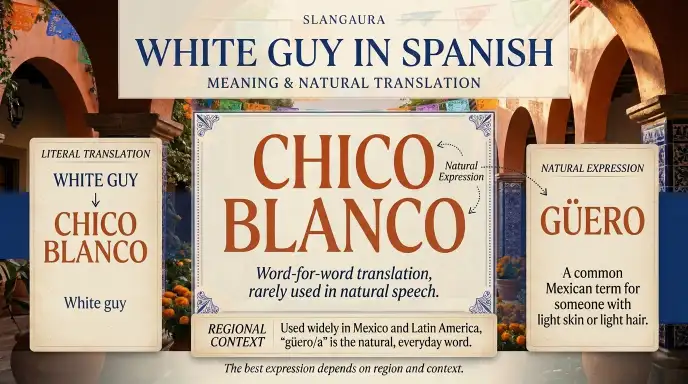
The English phrase combines two simple words: white and guy. The first describes color or racial appearance, while the second is an informal way of referring to a man.
Spanish expresses the same idea using a noun followed by an adjective. That is why the natural translation is usually hombre blanco, rather than placing the adjective before the noun as English does.
Let’s look at the most useful translations individually.
Hombre blanco: The direct translation
Hombre blanco is the clearest and most direct translation of “white man” or “white guy.”
The word hombre means man, and blanco means white. Although English speakers often use “guy” casually, hombre blanco is perfectly understandable in ordinary Spanish.
For example:
- El hombre blanco está esperando afuera. : The white man is waiting outside.
- Conocí a un hombre blanco en la reunión. : I met a white man at the meeting.
- Ese hombre blanco trabaja aquí. : That white man works here.
This expression is suitable when the person being described is an adult.
It is not automatically slang, offensive language, or a nickname. It is simply a descriptive phrase.
Chico blanco: A casual way to say white guy
This is another common option, especially when referring to a boy, teenager, or young man.
Chico can mean boy, guy, or young man, depending on the sentence and region.
Examples:
- El chico blanco es mi compañero. : The white guy is my classmate.
- Vi a un chico blanco en el parque. : I saw a white boy at the park.
- Ese chico blanco parece amable. : That white guy seems friendly.
This expression often feels more casual than hombre blanco.
If you are describing a young person in a conversation with friends, it may be the better choice.
Tipo blanco: An informal expression
Tipo blanco can also mean “white guy.” The word tipo is often used informally to mean guy, fellow, or person.
For example:
- Ese tipo blanco es mi vecino. : That white guy is my neighbor.
- Vi a un tipo blanco en la tienda. : I saw a white guy at the store.
- ¿Conoces a ese tipo blanco? : Do you know that white guy?
The tone is conversational. It can sound natural when friends are talking casually, although the exact preference varies across Spanish speaking regions.
Think of the difference this way:
- Hombre blanco sounds more neutral.
- Chico blanco often refers to a younger male.
- Tipo blanco sounds more informal.
Muchacho blanco: Another natural option
Muchacho is a Spanish word for boy or young man. Therefore, muchacho blanco can be translated as “white boy” or “white young man.”
Examples:
- El muchacho blanco vive cerca de mi casa. : The white boy lives near my house.
- Hablé con un muchacho blanco ayer. : I spoke with a white young man yesterday.
Its use depends on regional vocabulary and personal speaking style. In some places, chico may be more common in everyday conversation, while muchacho may sound more familiar.
Is white guy in Spanish a slang term?
No. Hombre blanco, chico blanco, and tipo blanco are descriptive Spanish expressions, not special internet slang or texting abbreviations.
People may use them in casual conversations, but their meanings are straightforward.
The informal word tipo gives the phrase a conversational tone. That does not turn the entire expression into a secret code or a trending slang word.
If you see the phrase in a social media comment, start with its ordinary meaning before assuming it has a hidden interpretation.
2. Where People Use White Guy in Spanish
The phrase can appear anywhere English and Spanish speakers interact. Social media makes this especially common because users often mix languages, ask translation questions, and discuss regional vocabulary.
White Guy in Spanish on TikTok
TikTok is full of Spanish learning videos, bilingual jokes, cultural discussions, and short conversations. A person might search for the translation after hearing someone use hombre blanco or chico blanco in a video.
For example, a creator might ask:
“How do you say white guy in Spanish?”
A straightforward answer would be:
“Hombre blanco, or chico blanco in a more casual context.”
You may also encounter Mexican Spanish expressions such as güero. A video might use this word to describe a light skinned or blond person.
However, it is important not to treat every regional expression as an exact translation. TikTok videos often simplify language for entertainment, and one creator’s explanation may not cover every country’s usage.
When learning from short videos, pay attention to the complete sentence rather than memorizing one word without context.
White Guy in Spanish on Snapchat
Snapchat conversations are usually relaxed and personal. Someone might ask a friend for a translation, describe a person in a picture, or discuss someone they met.
For example:
A: How do you say white guy in Spanish?
B: Hombre blanco.
A: What if he’s younger?
B: You can say chico blanco.
The conversation is about vocabulary, not a special Snapchat meaning.
If someone sends you chico blanco in a message, it generally means “white guy” or “white boy.” The picture or previous conversation may help you understand exactly whom they are describing.
White Guy in Spanish on Instagram
Instagram captions and comments often combine English and Spanish, particularly in bilingual communities.
Someone might write:
“El hombre blanco de la foto es mi amigo.”
Translation: “The white man in the picture is my friend.”
A different user might write:
“Ese chico blanco tiene un estilo increíble.”
Translation: “That white guy has an amazing style.”
The phrase can be used in a neutral description, a conversation about a photograph, or a discussion about someone’s appearance.
If a comment includes a regional nickname, such as güero, the meaning may be more specific than a direct racial description.
White Guy in Spanish on WhatsApp
WhatsApp is often used for conversations with friends, relatives, classmates, and colleagues. A person might use the phrase while describing someone they saw or asking for help with Spanish vocabulary.
For example:
A: ¿Quién es el hombre blanco de la foto?
B: Es un amigo de mi hermano.
A: Ah, ya entiendo.
Translation:
- A: Who is the white man in the picture?
- B: He is a friend of my brother.
- A: Oh, now I understand.
In this example, the phrase identifies a person. It does not carry an automatic insult or romantic meaning.
White Guy in Spanish in SMS and Regular Texting
Traditional text messages work in much the same way.
Someone learning Spanish might write:
“How do I say the white guy is my neighbor?”
A natural translation is:
“El hombre blanco es mi vecino.”
If the person is younger, chico blanco may be more appropriate.
There is no separate SMS definition for the phrase. Its meaning remains the same if it appears in a private message, an Instagram comment, or a spoken conversation.
3. Real Chat Examples: White Guy in Spanish

The best way to understand a translation is to see how people use it in complete conversations. These examples show different situations, from simple vocabulary questions to everyday descriptions.
Example 1: Asking for the translation
A: How do you say white guy in Spanish?
B: You can say hombre blanco.
A: Is there a more casual version?
Meaning: The speaker wants a direct translation and is asking about informal alternatives.
Example 2: Talking about a classmate
A: ¿Quién es el chico blanco de tu clase?
B: Es un amigo mío.
A: Ah, parece simpático.
Translation:
A: Who is the white guy in your class?
B: He is a friend of mine.
A: Oh, he seems friendly.
Meaning: Chico blanco describes a young man in a school setting.
Example 3: Describing someone in a photograph
A: Who is the man standing near the window?
B: Es el hombre blanco que trabaja con mi padre.
A: Oh, I remember him now.
Translation of B: He is the white man who works with my father.
Meaning: The phrase helps identify someone in a picture.
Example 4: Choosing between two translations
A: Should I write hombre blanco or chico blanco?
B: It depends on his age. Hombre is for a man, while chico can refer to a boy or young man.
A: Okay, that makes sense.
Meaning: The conversation explains why the person’s age and context matter.
Example 5: Asking about Mexican Spanish
A: I heard someone call a guy güero. Does that mean white guy?
B: It can describe someone with light coloring, but it isn’t an exact translation.
A: So it depends on the situation?
B: Exactly.
Meaning: The speakers distinguish a regional expression from a literal translation.
Example 6: Talking about a neighbor
A: ¿Conoces al hombre blanco que vive al lado?
B: Sí, se llama Daniel.
A: ¿Es tu vecino nuevo?
Translation:
A: Do you know the white man who lives next door?
B: Yes, his name is Daniel.
A: Is he your new neighbor?
Meaning: Hombre blanco is used as a descriptive phrase.
Example 7: Discussing someone’s appearance
A: How would I describe the guy in this picture?
B: You could say el chico blanco de la foto.
A: And that means the white guy in the picture?
B: Yes, exactly.
Meaning: The phrase identifies someone without changing the basic meaning.
Example 8: Asking about the word tipo
A: Does tipo blanco mean white guy?
B: Yes, it’s an informal way to say it.
A: So it’s more casual than hombre blanco?
B: That’s a good way to understand the difference.
Meaning: The conversation explains the informal tone of tipo.
Example 9: Learning Spanish through a video
A: I heard ese hombre blanco in a video. What does it mean?
B: It means “that white man.”
A: Is ese the same as “this”?
B: It usually means “that” when referring to a masculine singular noun.
Meaning: The example helps a beginner understand the complete phrase.
Example 10: Choosing respectful wording
A: I need to describe someone I met yesterday.
B: Do you know his name?
A: Yes, but I was going to call him el hombre blanco.
B: If you know his name, using it may sound more natural.
Meaning: The conversation shows that a correct translation is not always the best choice in every situation.
4. How to Reply When Someone Says White Guy in Spanish
Your response depends on why the person used the phrase. They might be asking for a translation, describing someone, or discussing a regional expression.
Here are some natural ways to respond.
Funny replies
If the conversation is relaxed and you are talking with friends, a little humor can make the exchange more enjoyable.
- “Spanish vocabulary unlocked!”
- “One more phrase added to my dictionary.”
- “I’m becoming bilingual one word at a time.”
- “Okay, now teach me the whole sentence.”
- “My Spanish lessons are getting interesting 😂”
These replies are about learning the language rather than making someone’s appearance the subject of a joke.
Casual replies
If someone asks for the translation, you can keep your answer simple:
- “It’s hombre blanco.”
- “You can also say chico blanco.”
- “For a more casual expression, use tipo blanco.”
- “It depends on the person’s age.”
Friendly replies
If someone is learning Spanish, you can help them understand the differences:
- “You’re close! Just remember that hombre means man.”
- “Chico sounds more casual in many situations.”
- “Spanish adjectives usually come after the noun.”
- “I can help you translate the full sentence.”
Neutral replies
If you are unsure what someone means, a neutral answer is often the best choice.
- “Are you asking for the Spanish translation?”
- “Do you mean a man or a younger guy?”
- “The direct translation is hombre blanco.”
- “Could you share the full sentence?”
A good reply focuses on the actual conversation instead of assuming the phrase is a joke, insult, or flirtatious comment.
5. Is White Guy in Spanish Rude or Offensive?
The expressions hombre blanco and chico blanco are not automatically rude or offensive. They are descriptive phrases that refer to a person’s appearance or racial identity.
However, a neutral description can become uncomfortable when someone uses it to mock a person, stereotype a group, or make unnecessary comments about race.
Is it safe to use with friends?
It can be perfectly ordinary when identifying someone or discussing a situation in which their appearance is relevant.
For example:
“El hombre blanco de la foto es mi compañero de trabajo.”
This means “The white man in the picture is my coworker.”
The sentence is descriptive. Still, if everyone knows the person’s name, using the name may be clearer and more natural.
Is it appropriate at school?
In a Spanish class, hombre blanco and chico blanco are useful examples for learning nouns, adjectives, and sentence structure.
Students can use them in translation exercises or grammar lessons.
However, using racial descriptions to tease a classmate or make them uncomfortable is not appropriate. A phrase can be grammatically correct while still being unkind in a particular situation.
Is it appropriate at work?
In professional communication, it is best to describe people by their names, job titles, or relevant roles whenever possible.
For example, instead of saying:
“The white guy from accounting sent the file.”
You could say:
“The new accountant sent the file.”
The second sentence communicates useful information without introducing an unnecessary description of race.
Are güero and gringo offensive?
These expressions need a little more care because their meanings depend on regional and social context.
Güero is commonly used in Mexico to describe someone with light colored hair or a light complexion. It can be a familiar nickname, a neutral description, or an uncomfortable label depending on the speaker and situation.
Gringo is an informal regional term often used for a foreigner, particularly an American in some Latin American contexts. It may sound neutral, playful, or negative depending on how it is used.
Neither word should automatically be translated as “white guy.”
The safest approach is to understand the local meaning before using a regional label for someone.
6. Who Uses This Term?
The phrase is ordinary descriptive language, not a slang expression belonging to one particular generation.
Spanish learners
People learning Spanish may search for this translation when studying basic vocabulary, practicing descriptions, or completing language assignments.
They may also want to understand the difference between hombre, chico, tipo, and muchacho.
These distinctions are useful because English uses the word “guy” in several situations where Spanish speakers may choose different nouns.
Teenagers and young adults
Younger users may encounter the phrase in bilingual conversations, online comments, music discussions, or social media videos.
Some might use chico blanco when talking about a classmate or someone appearing in a video. Others may use English and Spanish together in the same message.
That does not mean the phrase is exclusive to Gen Z. People of different ages can use it because it is ordinary Spanish vocabulary.
Gen Z and social media users
Gen Z users often encounter Spanish expressions through TikTok, Instagram Reels, and online entertainment.
They may search for a translation after hearing a creator use hombre blanco, güero, or gringo.
However, these terms have different meanings. A short video may not explain every regional difference, so a complete language guide can be more helpful than a quick caption.
Bilingual speakers
Bilingual people may switch between English and Spanish depending on the person they are talking to.
For example:
“Do you know that chico blanco from the party?”
This kind of mixed language sentence may appear in informal conversations. The speaker uses a Spanish description inside an otherwise English sentence.
How often does the phrase appear online?
There is no single reliable figure showing how frequently the exact phrase appears across TikTok, Instagram, Snapchat, WhatsApp, and SMS.
It is better understood as a translation query and descriptive expression rather than a new viral slang term.
People may search for it when learning Spanish, interpreting a message, or trying to understand regional vocabulary.
7. Origin of the Term
The phrase white guy does not have a special internet origin. It is an ordinary English description formed from the words white and guy.
Its Spanish translations are built from established Spanish vocabulary:
- Hombre means man.
- Chico means boy or young man.
- Tipo can mean guy or fellow.
- Blanco means white.
- Muchacho means boy or young man.
The Spanish phrase follows normal grammar rather than a special social media rule.
Why does Spanish say hombre blanco instead of blanco hombre?
English usually places adjectives before nouns. For example, English speakers say “white man.”
Spanish commonly places descriptive adjectives after nouns, so the natural expression is:
Hombre blanco.
The same pattern appears in other examples:
- Casa blanca : White house.
- Coche rojo : Red car.
- Chico alto : Tall boy.
- Perro pequeño : Small dog.
There are exceptions and special uses in Spanish adjective placement, but the noun before adjective pattern is a useful starting point for beginners.
How internet culture affects the phrase
Social media has made language learning more conversational. People no longer encounter Spanish only in textbooks or classrooms.
They hear it in music, gaming videos, livestreams, comedy clips, travel content, and everyday conversations.
This exposure can introduce learners to regional expressions that are not always explained in beginner lessons.
For example, someone might learn the word güero from a Mexican creator and assume it means exactly the same thing as hombre blanco. The expressions can overlap in certain situations, but their meanings are not identical.
Is there a hidden slang origin?
No widely established hidden meaning is attached to the phrase itself. It is not an abbreviation, secret code, or special texting expression.
The interesting part is how different Spanish speaking communities choose their own words when describing someone’s appearance, nationality, or background.
Understanding those differences is more useful than memorizing one translation and assuming it works everywhere.
8. White Guy in Spanish Compared With Common Text Abbreviations
Although people may search for this phrase alongside texting slang, it works differently from common internet abbreviations.
| Term | Meaning | Type | Usage | Popularity |
| White guy in Spanish | Usually hombre blanco | Translation phrase | Spanish learning and descriptions | Depends on search and conversation context |
| IDK | I don’t know | Text abbreviation | Expressing uncertainty | Widely recognized |
| IDC | I don’t care | Text abbreviation | Showing indifference | Widely recognized |
| IMO | In my opinion | Text abbreviation | Sharing an opinion | Widely recognized |
| BRB | Be right back | Text abbreviation | Saying you will return shortly | Widely recognized |
These descriptions are general rather than measured popularity rankings.
Why the difference matters
If someone sends you IDK, the letters represent a longer English expression.
If someone asks how to say “white guy” in Spanish, they are asking for a translation, not an abbreviation.
The most natural translation depends on the sentence:
- Hombre blanco : White man.
- Chico blanco : White boy or young man.
- Tipo blanco : White guy, in an informal tone.
Recognizing the difference helps you understand what kind of expression you are reading.
9. Real World Usage Example
Imagine you are attending a gathering with Spanish speaking friends. Later, someone asks you which person you were talking to near the entrance.
If the person is an adult man, you could say:
“Hablé con el hombre blanco que estaba cerca de la entrada.”
Translation:
“I spoke with the white man who was near the entrance.”
If you are describing a younger person, you could say:
“Hablé con el chico blanco que estaba cerca de la entrada.”
Translation:
“I spoke with the white guy who was near the entrance.”
Both sentences are understandable. The difference is the noun used to describe the person.
Now imagine you are watching a Mexican video and hear someone call a man güero. You might initially translate it as “white guy,” but the speaker may be referring more specifically to his light complexion or hair color.
This is where understanding regional language becomes important. A direct translation gives you the basic idea, but the surrounding culture helps you understand the exact meaning.
Finally, consider a workplace conversation. If you know the person’s name, saying “Daniel from accounting” is often more useful than describing his race.
Good language skills are not just about choosing the correct word. They are also about knowing when that word is actually needed.
Frequently Asked Questions
1. What does white guy mean in Spanish text messages?
The most direct translation is hombre blanco. If you are describing a younger man, chico blanco may be more suitable. The phrase is descriptive, not a texting abbreviation.
2. What does white guy mean on TikTok?
On TikTok, it usually has the same meaning as in everyday language. Users may also discuss regional expressions such as güero or gringo, which have different meanings.
3. Is white guy in Spanish slang?
No. Hombre blanco and chico blanco are ordinary Spanish descriptions. Tipo blanco sounds more informal, but the phrase is not a special internet slang term.
4. Is white guy in Spanish rude or offensive?
Not automatically. It can be a neutral description, but using racial labels unnecessarily or making fun of someone’s appearance may sound disrespectful.
5. How should you reply to white guy in Spanish?
If someone asks for the translation, say hombre blanco. You can also explain that chico blanco is suitable for a younger male and tipo blanco is more informal.
Conclusion
The most direct way to say white guy in Spanish is hombre blanco. If you are talking about a younger person, chico blanco may sound more natural, while tipo blanco offers a more informal alternative.
You may encounter these expressions in Spanish lessons, TikTok videos, Instagram comments, Snapchat messages, WhatsApp conversations, and everyday communication. They are descriptive phrases rather than special internet abbreviations.
Regional expressions such as güero and gringo may appear in similar conversations, but they do not have exactly the same meaning. Their interpretation depends on the country, speaker, and situation.
The most important thing is to choose the phrase that fits the person and context. Use hombre blanco for a direct translation, chico blanco for a younger male, and a person’s name or relevant description when that communicates your meaning more naturally.
A good translation should do more than match two words. It should sound natural, make sense to the listener, and respect the situation in which it is being used.
🎯 Find More Slang Meanings:
Twinnem Meaning in Text: Definition, Uses, and Examples

I am Emma Collins, a content writer at SlangAura specializing in internet slang, texting abbreviations, and online language. I create simple and accurate guides to help readers understand modern slang easily and confidently.