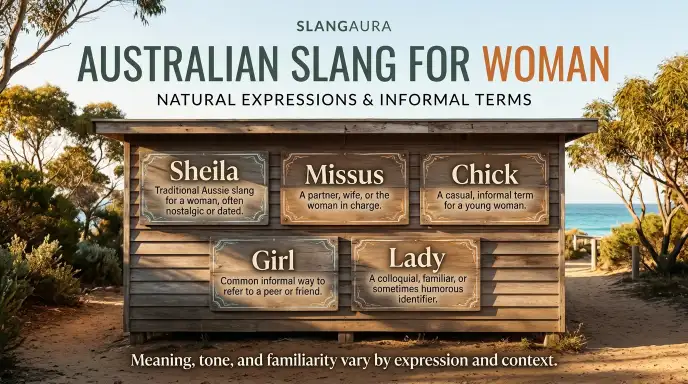
Australian slang for woman refers to the informal words Australians use when talking about a woman, girl, female friend, partner, or someone they know. Common examples include sheila, chick, missus, and girl, although each word has a slightly different tone.
You may come across these expressions in Australian TikTok videos, Snapchat stories, Instagram comments, WhatsApp messages, or everyday conversations. Some sound friendly and relaxed, while others can feel old fashioned or disrespectful.
If you have watched Australian shows, listened to local conversations, or chatted with someone from Australia, you may have noticed that Australians often use words that are unfamiliar to people from other countries.
Understanding the meaning is only half the story. Knowing when a word sounds natural, outdated, affectionate, or offensive helps you understand the conversation without accidentally using the wrong expression.
Australian Slang for Woman Meaning in Text
The phrase Australian slang for woman describes informal Australian English expressions used to refer to women. It is not one particular abbreviation, acronym, or slang word. Instead, it covers several expressions that vary by age, region, relationship, and situation.
Here are some of the words you may hear:
1. Sheila
Sheila is one of the best known traditional Australian slang words for a woman or girl.
For example:
- “That sheila at the shop was really helpful.”
- “He’s going out with a lovely sheila.”
- “I met a sheila from Melbourne last weekend.”
Although many people recognise it as classic Australian slang, it can sound old fashioned today. Some Australians use it jokingly or nostalgically, while others rarely use it in everyday conversation.
It is not automatically offensive, but calling someone a sheila may sound unusual if you are speaking to a younger Australian woman who does not use the expression herself.
2. Chick
Chick is a casual English word used for a girl or woman. Australians may use it in relaxed conversations, although it is not exclusive to Australia.
Examples:
- “She’s a cool chick.”
- “I met a few chicks at the party.”
- “That chick is really good at football.”
The word can sound friendly among people who know each other. However, some women dislike being called a chick because it can feel overly casual or dismissive.
The relationship and tone matter. Saying “She’s a lovely chick” affectionately is different from using the word to talk down to someone.
3. Missus
Missus is an informal way to refer to someone’s wife or female partner.
For example:
- “I’m going out with the missus tonight.”
- “The missus wants to visit Sydney.”
- “I need to ask the missus before making plans.”
It is commonly associated with casual speech and traditional expressions. It does not simply mean any woman; it usually refers to a person’s partner or wife.
4. Girl
Girl is a familiar word used for a female child or young woman. In casual conversation, people sometimes use it when talking about adult women, especially friends.
Examples:
- “She’s a lovely girl.”
- “The girls are meeting for lunch.”
- “I’m going shopping with the girls.”
It is widely understood in Australia and other English speaking countries. However, when referring to an adult woman in a formal or professional setting, woman may be more appropriate.
5. Lady
Lady is a polite and familiar word for a woman. It is not specifically Australian slang, but Australians use it in everyday conversation.
Examples:
- “The lady at reception helped me.”
- “She’s a very kind lady.”
- “I spoke to a lady about the appointment.”
It generally sounds more respectful than expressions such as chick or sheila.
6. Old Girl
Old girl can be an affectionate or familiar expression for a woman, depending on the relationship and context.
For example:
- “She’s a lovely old girl.”
- “The old girl still enjoys travelling.”
It can also refer to a former female student of a particular school, especially in British and Australian school contexts.
Be careful with this expression. When used about an older woman, it may sound affectionate to one person but patronising to another.
7. Gal
Gal is an informal variation of “girl.” It can refer to a woman or female friend in relaxed conversation.
Examples:
- “She’s a smart gal.”
- “Those gals are having a great time.”
- “I met a friendly gal at the event.”
It is understood in Australia, but it is not uniquely Australian. Its tone is generally casual and can sometimes sound playful or old fashioned.
Which Australian Expression Should You Use?
The best choice depends on what you want to say.
| Expression | General meaning | Tone |
| Sheila | Woman or girl | Traditional, sometimes dated |
| Chick | Girl or woman | Casual, informal |
| Missus | Wife or female partner | Familiar |
| Girl | Female child or young woman | Everyday |
| Lady | Woman | Polite |
| Old girl | Familiar reference to a woman | Affectionate or dated |
| Gal | Girl or woman | Casual, sometimes old fashioned |
One important detail: these words are not perfect substitutes for one another. For example, calling someone your missus suggests a relationship, while calling someone a chick does not.
Where People Use Australian Slang for Woman
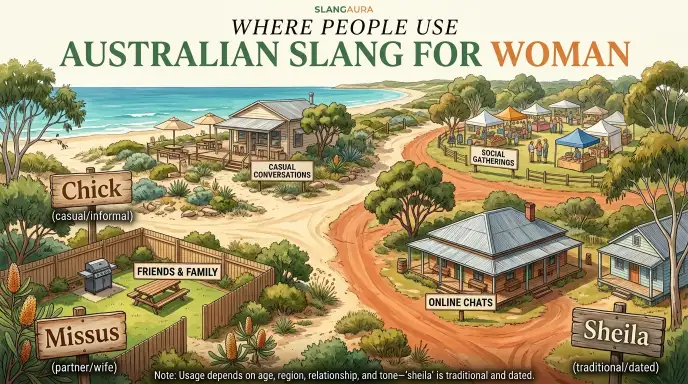
Australian expressions appear in everyday speech as well as online conversations. However, people do not necessarily use the same vocabulary on every platform.
The meaning can also change depending on if someone is joking, telling a story, complimenting a friend, or talking about a partner.
Australian Slang for Woman on TikTok
TikTok is a popular place to encounter Australian expressions because creators share local humour, lifestyle videos, comedy sketches, and conversations.
You might hear someone say:
- “She’s an absolute legend, that chick.”
- “I met this lovely sheila yesterday.”
- “The missus wasn’t impressed!”
Australian creators may also explain traditional expressions to viewers who are unfamiliar with local vocabulary.
If you see sheila in a video, remember that it is generally a traditional expression rather than a word every Australian uses regularly.
Australian Slang for Woman on Snapchat
Snapchat conversations are usually casual and personal. Friends may use words such as girl, chick, or missus when discussing someone they know.
Examples:
- “That chick from class is funny 😂”
- “Going out with the missus tonight.”
- “Where are the girls?”
The wording usually depends on the friendship and the subject of the conversation.
Australian Slang for Woman on Instagram
Instagram comments, captions, and direct messages often contain informal expressions.
For example:
- “Such a lovely girl!”
- “She’s a cool chick.”
- “The girls absolutely nailed it.”
You may also find traditional Australian vocabulary in comedy accounts, travel content, and posts about Australian culture.
Australian Slang for Woman on WhatsApp
WhatsApp is often used for conversations with family members, friends, and colleagues.
An Australian might write:
- “The missus is making dinner.”
- “I saw that girl at the shopping centre.”
- “A nice chick helped us find the place.”
These messages are informal, but the expressions are understandable in context.
Australian Slang for Woman in SMS
Traditional text messages and SMS conversations also use everyday Australian English.
For instance:
- “Ask the girls if they’re coming.”
- “I’ll be out with the missus.”
- “That chick was really helpful.”
There is no special spelling or texting abbreviation involved. These are ordinary words used in informal messages.
Real Chat Examples of Australian Slang for Woman
The following conversations show how Australians might use these expressions naturally. Each example includes the meaning so beginners can understand the tone.
Example 1: Using Sheila
A: Who was that sheila you were talking to?
B: She’s a friend from work.
A: Oh, she seemed really nice.
Meaning: Sheila refers to a woman. The conversation uses a traditional Australian expression.
Example 2: Using Chick
A: Did you meet anyone at the party?
B: Yeah, I met a really funny chick.
A: Nice! Are you going to see her again?
Meaning: Chick means a girl or woman in a casual conversation.
Example 3: Using Missus
A: Are you free this evening?
B: Not tonight. I’m taking the missus out.
A: Sounds like a good plan!
Meaning: Missus refers to someone’s wife or female partner.
Example 4: Using Girl
A: Who’s coming to the beach tomorrow?
B: The girls from my office.
A: That should be fun!
Meaning: Girls refers to a group of female friends or colleagues.
Example 5: Using Lady
A: Who helped you at the front desk?
B: A very friendly lady.
A: That’s good to hear.
Meaning: Lady is a polite way to refer to a woman.
Example 6: Using Old Girl
A: How’s your grandmother doing?
B: She’s doing great. The old girl still loves gardening.
A: That’s wonderful!
Meaning: Old girl is used affectionately here to refer to an older woman.
Example 7: Using Gal
A: Who organised the whole event?
B: A really clever gal from our team.
A: She did a fantastic job.
Meaning: Gal is an informal word for a girl or woman.
Example 8: Using Chick on Social Media
A: Did you see Mia’s new travel photos?
B: Yeah, that chick is always exploring somewhere new.
A: I wish I could travel like her!
Meaning: Chick refers casually to a woman.
Example 9: Talking About a Partner
A: Are you joining us for dinner?
B: Maybe later. The missus and I have plans first.
A: No worries, mate.
Meaning: Missus refers to the speaker’s partner or wife.
Example 10: Using Sheila in a Story
A: How was your trip to Australia?
B: Great! I met a lovely sheila who showed me around.
A: That’s so kind of her.
Meaning: Sheila is a traditional Australian word for a woman. The speaker uses it informally.
How to Reply When Someone Says Australian Slang for Woman
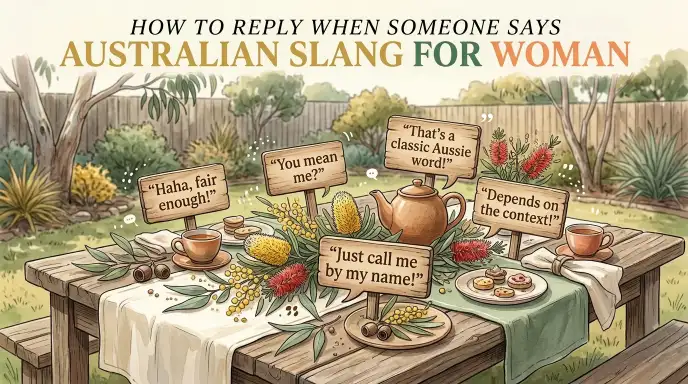
Your response depends on the actual word and the conversation. If someone calls a woman a chick, mentions their missus, or uses the word sheila, you can reply naturally without copying the expression.
Here are a few ideas.
Funny Replies
Use these when you are chatting with friends and everyone understands the joke.
- “Aussie vocabulary is getting interesting 😂”
- “That’s a proper local expression!”
- “I’m learning Australian English one word at a time.”
- “Should I start saying that too?”
Casual Replies
These responses keep the conversation relaxed.
- “Oh, I get what you mean.”
- “Yeah, that makes sense.”
- “Sounds good!”
- “Fair enough, mate.”
Friendly Replies
If someone is talking positively about a woman, you can respond warmly.
- “She sounds lovely.”
- “That’s really nice of her.”
- “She must be a great person.”
- “Good to hear that!”
Neutral Replies
If you do not know the person or want to keep your response simple, try:
- “Who are you referring to?”
- “Do you mean your partner?”
- “I understand.”
- “Thanks for explaining.”
A useful tip: If someone says “my missus,” they are usually talking about their wife or partner. You do not need to ask what the word means every time you hear it.
Is Australian Slang for Woman Rude or Offensive?
Not every Australian expression for a woman is rude. Some are friendly, some are neutral, and others can sound disrespectful depending on the situation.
The most important thing is to understand the word before using it.
Is Sheila Offensive?
Sheila is a traditional Australian expression. It is not automatically an insult, but it may sound dated or stereotypical.
Some people use it humorously, while others may dislike being described that way.
If you are unsure, using “woman” or “girl” is usually safer.
Is Chick Disrespectful?
Chick can be friendly in an informal conversation, but not everyone likes it.
For example, saying “She’s a cool chick” may sound like a casual compliment. However, using “chick” in a serious professional discussion may seem dismissive.
It is better to consider the person’s preferences.
Is Missus Rude?
Missus is generally a familiar term for a wife or female partner. It is not normally an insult.
However, it is not a general replacement for the word woman. You would not normally call an unrelated woman “the missus.”
Are Some Other Expressions Best Avoided?
Yes. Some words used to describe women can be insulting.
For example, broad can sound dismissive or disrespectful when used for a woman. Cow is an insult when directed at someone. These expressions are not good choices for polite conversation.
Also, do not assume that every word heard in an Australian comedy video is suitable for everyday use.
Is It Appropriate at School or Work?
For school, university, and professional environments, neutral language is the safest option.
Consider these alternatives:
- Woman
- Girl, when age and context make it appropriate
- Female colleague
- Friend
- Partner
- Wife
For example, instead of saying “That chick from the office helped me,” you could say “My colleague helped me.”
This sounds more professional and avoids misunderstandings.
Who Uses Australian Slang for Woman?
Australian English is used by people from different age groups and backgrounds. However, not every expression has the same level of popularity among younger and older speakers.
Older Australians
Older Australians may be more familiar with traditional words such as sheila. Some remember hearing it in older films, television shows, family conversations, or classic Australian humour.
That does not mean every older Australian uses it. Language preferences vary from person to person.
Gen Z and Younger Australians
Younger Australians are more likely to use general expressions such as:
- Girl
- Chick
- Bestie
- Girlfriend
- Mate
These expressions are not all uniquely Australian. They are part of wider English language internet and everyday communication.
A younger person may understand “sheila” without ever using it themselves.
Social Media Users
People who watch Australian creators, follow local comedy accounts, or communicate with Australians online may encounter these words regularly.
TikTok and Instagram can introduce traditional vocabulary to international audiences, while Snapchat and WhatsApp provide more personal examples of casual language.
How Often Does It Appear Online?
There is no reliable single frequency figure for all these expressions. Their use varies by platform, community, age group, and context.
Words such as “girl” and “woman” are broadly understood. “Chick” is also familiar in informal English. “Sheila” is recognisable as traditional Australian slang, but it should not be treated as the everyday choice of every Australian.
Origin of Australian Slang for Woman
Australian English developed through a mixture of British and Irish English, local expressions, migration, and the experiences of communities living in Australia.
Over time, Australians developed a distinctive style of informal speech. Shortened words, playful expressions, nicknames, and familiar terms became an important part of everyday communication.
However, the expressions in this article do not all have the same origin.
Where Did Sheila Come From?
Sheila is strongly associated with traditional Australian English.
The word is commonly linked to the Irish female name Síle, an Irish form of Cecilia. It became established as an informal word for a woman in Australian slang.
It is now widely recognised as a classic Australian expression, although its everyday use has changed over time.
Where Did Chick Come From?
Chick is a broader English slang expression rather than a word created specifically in Australia.
It has been used in informal English to refer to a girl or woman. Australians use it too, but you can also hear it in other English speaking countries.
Where Did Missus Come From?
Missus is an informal pronunciation and spelling associated with “Mrs.” It developed as a familiar way of referring to a wife or female partner.
It is used in different English speaking communities, including Australia.
How Has Internet Culture Influenced These Words?
Social media has made regional expressions easier to discover.
An Australian creator might use “sheila” in a funny video, while an international viewer searches for its meaning. Another creator might use “missus” in a story about their partner.
As these videos circulate, people outside Australia begin recognising words they may never have heard in their own communities.
Still, a word appearing in a viral video does not mean everyone in Australia uses it. Online visibility and everyday popularity are not the same thing.
Australian Slang for Woman Compared With IDK, IDC, IMO, and BRB
The following comparison helps explain how the phrase differs from common texting abbreviations.
| Term | Meaning | Type | Usage | Popularity |
| Australian slang for woman | Informal expressions such as sheila, chick, and missus | Slang category | Describing or referring to women | Varies by expression |
| IDK | I Don’t Know | Text abbreviation | Showing uncertainty | Very common |
| IDC | I Don’t Care | Text abbreviation | Showing a lack of concern | Very common |
| IMO | In My Opinion | Text abbreviation | Sharing an opinion | Common |
| BRB | Be Right Back | Text abbreviation | Saying you will return shortly | Common |
There is an important difference between these terms.
IDK, IDC, IMO, and BRB are shortened forms of longer phrases. Australian slang for woman is a category of informal vocabulary, not a single texting abbreviation.
For example, “sheila” is a slang word, while “IDK” is an abbreviation made from the first letters of a phrase.
Real World Usage Example
Imagine you are visiting Brisbane and talking to an Australian friend about a woman who helped you find a nearby café.
Your friend might say:
“That chick at the counter was really helpful, wasn’t she?”
In this situation, chick simply means a woman. Your friend is speaking casually and making a positive comment about someone.
Now imagine another conversation:
“Are you coming to the barbecue on Saturday?”
Your friend replies:
“I’ll check with the missus first.”
Here, missus refers to the person’s wife or partner. It does not mean a random woman at the barbecue.
You might also hear an older Australian use the word sheila while telling a story:
“I met a lovely sheila during my travels.”
The meaning is still woman, but the expression has a more traditional feel.
These situations show why context matters. Even though the words can all refer to women, they do not communicate exactly the same thing.
Other Australian Expressions You May Hear
If you are learning Australian English, it helps to recognise a few related expressions. Some are widely understood across English speaking countries, while others are more closely associated with Australian culture.
Mate
Mate is a familiar Australian term for a friend or companion. It is generally gender neutral.
Example: “She’s a good mate of mine.”
It does not mean woman specifically. An Australian can use it when talking about a male or female friend.
Girlfriend
Girlfriend can mean a female romantic partner or a female friend, depending on the situation.
Example: “I’m meeting my girlfriends after work.”
It is useful to pay attention to the sentence because the word can describe different relationships.
Bestie
Bestie means a best friend. It is popular in casual conversations and social media captions.
Example: “I’m going shopping with my bestie.”
It is friendly and informal, but it is not an Australian only expression.
Female Friend
Female friend is a clear, neutral expression for a woman who is your friend.
Example: “She’s a female friend from university.”
It is not slang, but it can be useful when you want to avoid ambiguity.
Güero and Gringo Are Not Australian Slang
You may encounter words such as “güero” or “gringo” when researching slang from other countries. These expressions belong to different linguistic and cultural contexts.
They should not be presented as standard Australian words for a woman. In particular, “gringo” is not a female equivalent of “sheila.”
Learning which expressions belong to which culture prevents confusion when communicating with people from different countries.
Frequently Asked Questions
What does Australian slang for woman mean in text messages?
It refers to informal words Australians may use for women, such as sheila, chick, and missus. The exact meaning depends on the expression and context.
What does Australian slang for woman mean on TikTok?
On TikTok, it usually refers to local Australian expressions for women. You may hear words such as “sheila” in comedy videos or “chick” in casual conversations.
Is Australian slang for woman actually slang?
Yes. Expressions such as “sheila” and “chick” can be informal slang. However, words such as “woman” and “lady” are standard English rather than Australian slang.
Is Australian slang for woman rude or offensive?
Not always. “Sheila” is traditional, “chick” is informal, and “missus” usually refers to a partner. Some other expressions can be insulting, so consider the context before using them.
How should you reply to Australian slang for woman?
You can respond naturally with phrases such as “Oh, I get what you mean,” “She sounds lovely,” or “That’s an interesting Aussie expression!” Choose a reply that fits the conversation.
Conclusion
Australian slang for woman includes several expressions, and each has its own meaning and personality. Sheila is a traditional Australian word, chick is a casual term for a girl or woman, and missus usually refers to someone’s wife or female partner.
You may encounter these words in everyday conversations, Australian television, TikTok videos, Instagram comments, and private messages. However, not every expression is equally common among Australians today.
If you are learning Australian English, start by understanding the context rather than memorising words without their meanings. Use neutral terms such as “woman,” “lady,” or “friend” when you are unsure.
The best way to understand local slang is to notice how people use it naturally. That way, you can recognise Australian expressions, understand the tone behind them, and communicate more confidently.
📖 Continue Your Slang Journey!
White Guy in Spanish: Meaning, Translation & Examples

I am Emma Collins, a content writer at SlangAura specializing in internet slang, texting abbreviations, and online language. I create simple and accurate guides to help readers understand modern slang easily and confidently.