Frat slang refers to the informal words, phrases, and expressions associated with American college fraternities, campus parties, and the social life surrounding them. In everyday conversations, it can describe fraternity culture, a stereotypical college lifestyle, or the way a so called frat guy talks and behaves.
You might see the phrase in TikTok videos, Snapchat stories, Instagram captions, memes, or messages about college parties. Expressions such as frat bro, frat house, rush, and pledge often appear alongside it.
However, frat slang is more interesting than a collection of party related words. It reflects a particular part of American college culture, where friendships, campus traditions, Greek letter organisations, social events, and sometimes exaggerated stereotypes all come together.
If someone calls a person “such a frat bro” or describes a party as “very frat,” they are usually referring to a recognisable college style attitude or atmosphere. The exact meaning depends on the conversation, so let’s explore how people actually use it.
Frat Slang Meaning in Text
The phrase frat slang describes informal vocabulary connected with fraternities and fraternity style college life, particularly in the United States.
The word frat is a shortened form of fraternity. A fraternity is a social organisation, often based at a college or university, whose members share traditions, activities, events, and a sense of belonging.
Frat slang is not one specific abbreviation or texting acronym. It is a broad category of informal language associated with this environment.
For example, someone might text:
- “That party was straight up frat.”
- “He’s giving major frat bro energy.”
- “Do you know what a pledge is?”
- “They’re having a rush event this weekend.”
These messages use different expressions, but they all connect to fraternity culture.
What Does Frat Mean?
Frat is an informal abbreviation of fraternity. In American college conversations, it usually refers to a fraternity organisation or the lifestyle associated with one.
For example:
- “My brother joined a frat.”
- “We’re going to the frat house.”
- “He’s involved in Greek life.”
In some conversations, frat is used more loosely to describe a particular style of behaviour, clothing, partying, or socialising.
That is why you may hear someone say, “This place looks like a frat house,” even when the building has nothing to do with an actual fraternity.
What Does Frat Bro Mean?
A frat bro is a casual expression for a male fraternity member or someone who fits the stereotypical image of a fraternity guy.
The stereotype often involves:
- A confident or loud personality.
- A strong interest in college parties and sports.
- Casual clothing such as team shirts, caps, or shorts.
- Frequent use of college related expressions.
- A social lifestyle centred around friends and campus events.
However, not every fraternity member fits this description. The phrase can be used seriously, jokingly, affectionately, or critically.
For example:
“He’s acting like a frat bro tonight.”
This might mean someone is being unusually loud, overly confident, or enthusiastic about partying.
What Does Frat Mean as an Adjective?
People sometimes use frat as an adjective to describe something that resembles traditional fraternity culture.
Examples include:
- “That’s a frat party.”
- “This music has a frat vibe.”
- “His outfit looks pretty frat.”
- “The whole event felt like a college frat scene.”
In these examples, the word describes an atmosphere or style rather than an organisation.
Is Frat Slang an Acronym or Abbreviation?
The word frat is an abbreviation of fraternity, not an acronym.
The larger phrase “frat slang” describes a group of informal expressions. It is not a single coded message with one fixed definition.
This distinction matters because people sometimes search for it after seeing a phrase online and assume it must have a hidden texting meaning. In most cases, the meaning is connected to American college life.
Common Frat Slang Words and Their Meanings
To understand this vocabulary properly, it helps to know the expressions that appear most often in conversations about fraternity culture.
Some terms are used by actual fraternity members, while others are popular among students, social media users, and people discussing American college life.
1. Frat Bro
A frat bro is a fraternity member or someone who resembles the familiar stereotype of a fraternity guy.
Example:
“That frat bro was dancing like nobody was watching.”
The phrase can be playful, but it may sound judgmental if used to mock someone’s personality.
2. Frat House
A frat house is a house or building associated with a fraternity. Members may live there, hold meetings, or organise social activities.
Example:
“We’re meeting outside the frat house at eight.”
Online, people also use the phrase jokingly to describe a messy or party filled house.
3. Greek Life
Greek life refers to the fraternity and sorority system at many American colleges and universities.
Fraternities traditionally use Greek letter names, which explains the expression.
Example:
“She’s thinking about joining Greek life next semester.”
Greek life includes more than parties. Depending on the organisation, activities may involve community service, leadership, social events, fundraising, and friendship.
4. Rush
Rush is a recruitment period when students learn about fraternities or sororities and meet their members.
Example:
“Are you going through rush this semester?”
It is not simply another word for partying. It refers to a process through which students explore membership opportunities.
5. Pledge
A pledge is a person who has been accepted into a fraternity or sorority’s membership process but has not yet become a full member.
Example:
“My friend is a pledge this semester.”
The exact process and terminology vary between organisations and universities.
6. Bid
A bid is an invitation to join a fraternity or sorority during recruitment.
Example:
“Did he get a bid from the fraternity?”
In this context, getting a bid generally means receiving an invitation to become a prospective member.
7. Greek Letters
Fraternities and sororities commonly use combinations of Greek letters as their organisation names.
Example:
“Do you know which Greek letters are on that shirt?”
These letters help identify an organisation and may appear on clothing, banners, accessories, and campus buildings.
8. Mixer
A mixer is a social event organised for members of different student organisations, often involving a fraternity and a sorority.
Example:
“Our fraternity has a mixer with another organisation on Friday.”
The word can also be used more generally for a social gathering where people meet and interact.
9. Bro
Bro is a casual word for a male friend, brother, or fellow student.
Example:
“Bro, are you coming to the game?”
Although it is common in frat style conversations, bro is not exclusive to fraternity culture. It appears throughout online and everyday English.
10. Party Animal
A party animal is someone who loves attending parties and social events.
Example:
“He’s a total party animal during college weekends.”
This expression is broader than fraternity slang, but it often appears in descriptions of the stereotypical frat lifestyle.
Where People Use Frat Slang
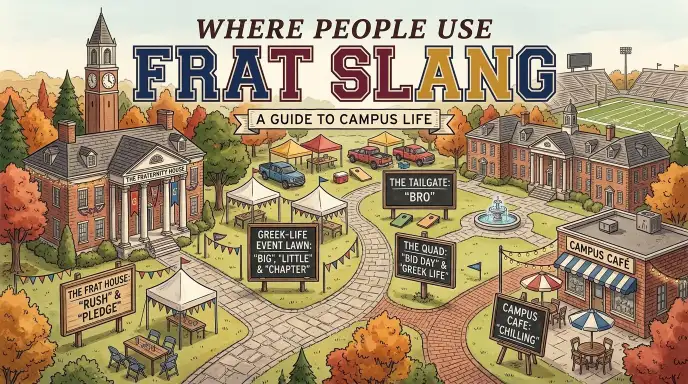
Fraternity related vocabulary appears in real conversations, college entertainment, and social media. People may use it to discuss actual university organisations or simply to describe a particular kind of personality.
Here is how you might encounter it on different platforms.
Frat Slang on TikTok
TikTok is one place where viewers encounter exaggerated versions of American college culture.
Creators post comedy sketches, campus tours, party clips, fraternity related jokes, and videos about Greek life.
You might see captions such as:
- “POV: You meet your first frat bro.”
- “The most frat party I’ve ever seen.”
- “When your roommate starts acting like a frat guy.”
- “Greek life explained in 30 seconds.”
In these videos, the expressions are often humorous. A creator might imitate a stereotypical fraternity member without actually belonging to a fraternity.
That is why it is important not to assume that every TikTok using frat slang describes a real college organisation.
Frat Slang on Snapchat
Snapchat conversations are usually personal and informal. College students may use fraternity related terms when making plans or sharing campus experiences.
Examples:
- “We’re heading to the frat house.”
- “Rush starts next week.”
- “That guy is such a frat bro.”
- “Send me the mixer details.”
Friends may also use the vocabulary as an inside joke when discussing someone’s clothes, behaviour, or party habits.
Frat Slang on Instagram
Instagram features campus photographs, college lifestyle pages, fraternity event announcements, and student content.
You might find captions such as:
- “Greek life memories.”
- “Frat weekend with the boys.”
- “A little campus chaos.”
- “Rush week highlights.”
The word frat may also appear in comments describing a particular outfit, event, or group of friends.
For example, someone might comment, “This picture has serious frat energy.”
That does not necessarily mean the people in the photograph belong to a fraternity. It may simply describe the overall look.
Frat Slang on WhatsApp
WhatsApp messages often include practical plans and casual conversations.
For example:
- “Are you going to the frat party?”
- “He got a bid!”
- “The mixer is on Saturday.”
- “Ask the boys about rush.”
These messages are especially understandable when the people involved are familiar with American university life.
Frat Slang in SMS
Traditional text messages use the same expressions without requiring any special abbreviation.
For instance:
A: Are you going to the fraternity event?
B: Yeah, my friend invited me.
A: Cool, see you there.
Someone might shorten the conversation further by saying:
“Meet me at the frat house.”
The word itself is already a shortened form of fraternity, but the message does not need additional texting code.
Real Chat Examples of Frat Slang
The best way to understand informal vocabulary is to see how it works in a conversation. These examples show different situations, from college recruitment to social media jokes.
Example 1: Talking About a Frat Bro
A: Who was that guy shouting across the room?
B: Probably one of the frat bros.
A: He definitely had a lot of energy.
Meaning: Frat bro describes a guy who belongs to or resembles the stereotypical fraternity crowd.
Example 2: Planning a Party
A: What are you doing tonight?
B: There’s a party at the frat house.
A: Sounds like the whole campus will be there.
Meaning: Frat house refers to a building associated with a fraternity.
Example 3: Discussing Rush
A: Why is everyone talking about rush?
B: Some students are checking out fraternities.
A: Oh, so it’s the recruitment period?
Meaning: Rush is a recruitment process for fraternities and sororities.
Example 4: Getting a Bid
A: Guess what happened today!
B: What?
A: I got a bid from the fraternity!
Meaning: The person received an invitation to join the organisation.
Example 5: Calling Someone a Bro
A: Bro, did you see the game last night?
B: Of course! It was amazing.
A: We need to watch the next one together.
Meaning: Bro is a casual way to address a friend. It is common in many social groups, not just fraternities.
Example 6: Talking About Greek Life
A: Are you joining any campus organisations?
B: I’m thinking about Greek life.
A: That’s interesting. Have you visited any houses?
Meaning: Greek life refers to fraternity and sorority organisations at a college.
Example 7: Describing an Outfit
A: What do you think of his outfit?
B: It looks very frat.
A: You mean the cap and oversized shirt?
Meaning: Very frat describes a style associated with the stereotypical fraternity look.
Example 8: Discussing a Mixer
A: Why is everyone getting dressed up?
B: There’s a fraternity mixer tonight.
A: Got it. That’s why the group chat is so busy!
Meaning: A mixer is a social event where members of different student organisations meet.
Example 9: Making a TikTok Joke
A: Why did you caption that video “frat energy”?
B: Because everyone was acting like they were in a college party movie.
A: Haha, now I see it.
Meaning: Frat energy describes behaviour or an atmosphere that resembles fraternity culture.
Example 10: Talking About a Stereotype
A: He thinks every college student loves parties.
B: That’s such a frat stereotype.
A: Exactly. Not everyone has the same lifestyle.
Meaning: A frat stereotype is an oversimplified image of fraternity members or college social life.
How to Reply When Someone Says “Frat Slang”

Your reply depends on if someone is explaining college vocabulary, joking about a person’s behaviour, or inviting you to an event.
You do not need to use complicated expressions. A natural response is usually best.
Funny Replies
If a friend is joking about fraternity culture, try:
- “Bro, you sound like you’re in a college movie 😂”
- “That’s some serious frat energy!”
- “Do I need to learn the whole Greek alphabet now?”
- “The campus drama never ends!”
- “Someone’s definitely enjoying college life!”
These work best when everyone understands the joke.
Casual Replies
For an ordinary conversation, you can say:
- “Oh, now I get it.”
- “That makes sense.”
- “I’ve heard that expression before.”
- “Is that common in American colleges?”
- “Sounds like a college thing.”
Friendly Replies
If someone is sharing their college experience, respond with interest:
- “That sounds like a fun experience.”
- “How does the recruitment process work?”
- “That’s interesting! Tell me more.”
- “Are you enjoying Greek life?”
- “Hope you have a great time!”
Neutral Replies
If you are unfamiliar with the subject or want to avoid assumptions, use:
- “What does that mean?”
- “Are you talking about a fraternity?”
- “Is that an actual college organisation?”
- “Do you mean the party or the group?”
- “I haven’t heard that term before.”
A simple question is often better than pretending to understand a word you have just encountered.
Is Frat Slang Rude or Offensive?
Most fraternity related vocabulary is not inherently offensive. Words such as frat, fraternity, rush, pledge, and mixer are generally descriptive terms.
However, the tone can change when people use the expressions to insult someone or make assumptions about an entire group.
Is Frat Bro an Insult?
Not necessarily.
Some people use frat bro as a playful label for a friend who enjoys college parties, sports, or fraternity activities.
Others use it critically to describe someone they consider loud, arrogant, immature, or overly confident.
For example:
“He’s a classic frat bro.”
This could be an affectionate joke or a negative comment. The speaker’s tone makes a difference.
Is Calling Something Frat Disrespectful?
Usually, describing an event or atmosphere as “frat” is not offensive.
For example, “That looks like a frat party” is generally a casual observation.
However, using the word to mock someone’s appearance, interests, or background can make the conversation unpleasant.
Is Frat Slang Safe to Use at School?
Most basic terms are fine in a school or university discussion.
For example, you can use “fraternity,” “Greek life,” or “rush” when discussing student organisations.
Still, avoid using insulting stereotypes about students or assuming that every fraternity member behaves in the same way.
Is It Appropriate at Work?
Professional conversations usually benefit from clear and neutral wording.
Instead of saying:
“He’s acting like a frat bro.”
You could say:
“He’s being overly informal during the meeting.”
The second sentence communicates the concern without relying on a stereotype.
A useful rule: Use fraternity related terms when they accurately describe an organisation or situation. Avoid turning them into personal insults.
Who Uses Frat Slang?
Fraternity vocabulary is most closely associated with American college and university culture. However, its reach extends beyond students who actually participate in Greek life.
College Students
Students at American universities may use these expressions when discussing recruitment, campus events, fraternity houses, and social activities.
Some use the vocabulary because they belong to a fraternity or know someone who does. Others use it simply because it is part of the wider campus environment.
Gen Z
Gen Z audiences may recognise frat related expressions through college memes, TikTok videos, Instagram Reels, and entertainment content.
For younger internet users, the phrase “frat energy” can describe a particular attitude even when the person being discussed has no connection to a fraternity.
Older Internet Users
Older viewers may encounter these expressions through television shows, films, college sports discussions, or conversations with younger family members.
They may understand the basic meaning without being familiar with newer online jokes.
International Audiences
People outside the United States often search for frat slang because the fraternity system is less familiar in many other countries.
For example, someone watching an American college comedy might hear “rush,” “pledge,” or “frat house” and want to understand what is happening.
How Often Does It Appear Online?
There is no single reliable frequency figure for all fraternity related expressions. Their visibility changes depending on the platform, university calendar, entertainment trends, and online communities.
General words such as “bro” appear in many different settings. More specialised terms such as “bid” and “pledge” are usually easier to understand when the conversation is specifically about Greek life.
Origin of Frat Slang
To understand the history of this vocabulary, it helps to start with the word fraternity.
Fraternities have a long history in American higher education. Many developed as student organisations built around friendship, shared values, traditions, academic interests, and social activities.
Over time, their members developed familiar ways of talking about recruitment, membership, houses, events, and campus life.
Where Did the Word Frat Come From?
Frat is a shortened form of fraternity. It became a convenient informal expression for discussing these organisations.
Instead of saying “the fraternity house,” someone might casually say “the frat house.”
The shorter version is especially common in informal American English.
How Did Fraternity Vocabulary Develop?
As fraternities and sororities became part of university life, terms connected with membership and social activities became familiar to students.
Expressions such as:
- Rush
- Pledge
- Bid
- Greek life
- Frat house
- Mixer
developed or became established within the broader vocabulary of college organisations and campus culture.
Not all these expressions originated exclusively in fraternities. Some are ordinary English words that acquired a more specific meaning in the Greek life setting.
How Did Movies and the Internet Influence Frat Slang?
American films, television shows, and online videos have helped introduce fraternity stereotypes to international audiences.
College comedies often portray fraternity houses, loud parties, confident students, and humorous campus rivalries. These portrayals have made expressions such as “frat bro” recognisable even to people who have never attended an American university.
Social media has expanded that reach.
TikTok creators use phrases such as “frat energy” in comedy videos. Instagram users add fraternity references to captions. Meanwhile, memes turn familiar college stereotypes into jokes that travel across countries.
However, entertainment often exaggerates real life. Not every fraternity is party focused, and not every member behaves like a character in a college comedy.
The vocabulary has a clear connection to fraternity culture, but the exact history of every individual expression is not always the same.
Frat Slang Compared With IDK, IDC, IMO, and BRB
Frat slang and common texting abbreviations may appear in the same online conversations, but they serve different purposes.
| Term | Meaning | Type | Usage | Popularity |
| Frat slang | Informal vocabulary connected with fraternity culture | Slang category | Discussing college organisations, parties, and campus life | Context dependent |
| IDK | I Don’t Know | Text abbreviation | Expressing uncertainty | Very common |
| IDC | I Don’t Care | Text abbreviation | Showing a lack of concern | Very common |
| IMO | In My Opinion | Text abbreviation | Introducing a personal opinion | Common |
| BRB | Be Right Back | Text abbreviation | Telling someone you will return shortly | Common |
The key difference is that frat slang is a category of vocabulary, while IDK, IDC, IMO, and BRB are shortened forms of complete phrases.
For example, “pledge” is a fraternity related term, whereas “BRB” is a texting abbreviation.
Both can appear in digital conversations, but they do not have the same purpose.
Real World Usage Example
Imagine a student named Alex has recently started university in the United States. A friend invites Alex to a campus event and mentions that several fraternities will be participating.
During the conversation, Alex hears:
“Some of the fraternities are holding rush events this week.”
Alex asks what rush means. The friend explains that it is a recruitment period when students can meet members and learn about different organisations.
Later, another friend receives a bid from a fraternity. Everyone in the group congratulates him.
That evening, Alex sees a TikTok captioned:
“POV: Your roommate has officially entered his frat bro era.”
The caption is probably a joke about the roommate becoming involved in fraternity style social life. It does not necessarily mean he has joined a particular organisation.
This situation shows how the same vocabulary can be used in two ways. Words such as rush and bid can have specific meanings in actual Greek life, while phrases such as frat bro era are often playful internet expressions.
Understanding that difference makes the language much easier to follow.
Frat Slang You Might See in Memes and Online Conversations
Some expressions have become popular because they are easy to use in jokes, captions, and short videos.
Frat Energy
Frat energy describes a person, event, or atmosphere that resembles the stereotypical fraternity lifestyle.
Example: “That group has serious frat energy.”
It can be humorous or slightly critical.
Frat Boy Era
Frat boy era is an internet style phrase used jokingly to describe someone adopting a stereotypical fraternity guy lifestyle.
Example: “He’s in his frat boy era this semester.”
The phrase is usually playful rather than a formal description.
Frat Party
A frat party is a social party associated with a fraternity.
Example: “Everyone is talking about the frat party on Saturday.”
The phrase may refer to an actual fraternity event or be used loosely in a conversation about college parties.
Frat Fit
A frat fit refers to an outfit that resembles the stereotypical clothing associated with fraternity culture.
Example: “The cap, shorts, and polo shirt are giving frat fit.”
It is an informal description, not an official clothing category.
Frat Stereotype
A frat stereotype is a simplified or exaggerated image of fraternity members.
Example: “The movie relies on the usual frat stereotypes.”
It is useful to remember that stereotypes do not accurately describe every member of a group.
Frequently Asked Questions
What does frat slang mean in text messages?
Frat slang refers to informal words connected with American fraternity and college culture. Examples include frat bro, frat house, rush, pledge, and Greek life.
What does frat slang mean on TikTok?
On TikTok, it often describes fraternity culture, college party humour, or someone behaving like a stereotypical fraternity guy. The phrase can be used jokingly.
Is frat slang actually slang?
Yes. Frat is an informal shortened form of fraternity, while expressions such as frat bro and frat energy are informal phrases associated with college culture.
Is frat slang rude or offensive?
Most terms are not offensive by themselves. However, expressions such as frat bro can sound insulting when used to mock someone’s personality or make unfair assumptions.
How should you reply to frat slang?
You can reply with “Oh, you mean fraternity culture?” or “That sounds like a college thing.” If someone is joking, a casual response such as “That’s some serious frat energy!” may fit.
Conclusion
Frat slang is a collection of informal expressions connected with American fraternity culture and college life. The word frat is a shortened form of fraternity, while terms such as frat bro, frat house, rush, pledge, and Greek life describe different parts of that environment.
You may encounter these expressions in college conversations, TikTok videos, Snapchat messages, Instagram captions, and online memes. Some have specific meanings within student organisations, while others are used more loosely for humour or describing a particular lifestyle.
Most of these terms are not rude, but context matters. A phrase that sounds funny among friends may feel judgmental in a serious conversation.
Once you understand the difference between actual fraternity vocabulary and internet stereotypes, it becomes much easier to recognise the expressions and understand what someone means. You can enjoy the language without assuming that every person or college group fits the same image.
🌐 Discover More Internet Slang!
Australian Slang for Woman: Common Words,Meanings, Examples

I am Masson Caldwell, a language enthusiast and content writer at SlangAura. I write about internet slang, texting trends, and modern expressions to help readers understand the evolving world of online language with simple and clear explanations.