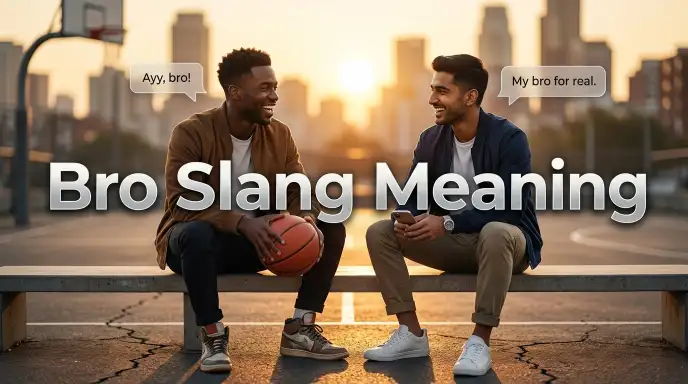
Bro slang usually means “brother,” but people often use it as a casual way to address a friend, guy, or familiar person. It can show friendship, surprise, excitement, frustration, or humor, depending on the situation.
You may see bro slang in text messages, TikTok comments, Instagram posts, gaming chats, and everyday conversations. It is especially common in casual speech and online communication.
The word is simple, but its meaning can change with tone. Someone might say “bro” to a close friend, while another person may use it with a stranger as a casual form of address. This guide explains what bro means, how people use it, where it appears, and when it may not fit.
Quick Answer: What Does Bro Slang Mean?
Bro slang is a casual form of “brother” used to address a friend, guy, or familiar person. It can also express a reaction, such as surprise, disbelief, excitement, or annoyance.
For example:
“Bro, that was amazing!”
Here, “bro” does not mean the speaker’s actual brother. It is a casual way to address someone.
What Does Bro Slang Mean?
The most common meaning of bro slang is a casual way to say “brother.”
In modern English, however, “bro” often has a wider meaning. Friends use it to address each other even when they are not related.
For example:
“Hey bro, are you coming with us?”
The speaker is likely talking to a friend.
Bro can also appear as a reaction:
“Bro, what just happened?”
In this sentence, “bro” helps express surprise or disbelief. It does not necessarily identify the person as a brother or close friend.
Bro as a Friendly Address
People often use “bro” to create a relaxed and friendly tone.
“Thanks for helping me, bro.”
The word makes the message sound informal and familiar.
Bro as a Reaction
“Bro, you actually won!”
The speaker is expressing excitement or surprise.
Bro as a Joke
Online, people sometimes use “bro” in exaggerated or humorous ways.
“Bro really thought he could win.”
This use is common in memes, comments, and casual online conversations.
Is Bro Short for Brother?
Yes. Bro is originally a shortened form of “brother.”
Today, its meaning is broader than the family relationship. A person can call a close friend “bro” even when they are not related.
The word became widely associated with informal speech and youth culture. It is now common across many English speaking communities.
This means that bro is not always a slang word for a biological brother. Context tells you what the speaker means.
| Use of “bro” | Meaning |
| Family | Actual brother |
| Friendship | Close friend |
| Casual address | Guy or familiar person |
| Reaction | Adds emotion or emphasis |
| Online humor | Meme style or playful address |
How Is Bro Used in Texting?
In texting, bro is often used at the beginning or end of a message.
Examples include:
- “Bro, are you serious?”
- “What are you doing, bro?”
- “Bro that was so funny.”
- “Thanks, bro.”
- “No way, bro!”
The word can make a message feel more casual.
It can also change the emotional tone of a sentence. Compare:
“Are you serious?”
with:
“Bro, are you serious?”
The second version often sounds more emotional or conversational.
What Does Bro Mean on Social Media?
On social media, bro is commonly used in comments, captions, replies, and memes.
People may use it to address someone directly or react to something they have seen.
For example:
“Bro posted this at 3 a.m.”
This could be a humorous comment about someone’s post.
Another example:
“Bro really did that.”
Here, bro can refer to a person without being used as a direct name.
On platforms such as TikTok, Instagram, YouTube, and Reddit, bro can also be part of meme style language.
What Does Bro Mean in Gen Z Slang?
In Gen Z slang, bro is a casual term for a friend, guy, or familiar person. It can also be used as a reaction to something funny, surprising, confusing, or frustrating.
For example:
“Bro, there’s no way.”
This may show disbelief.
Another example:
“Bro is actually good at this.”
This can express admiration or surprise.
Bro is common among younger internet users, but it is not exclusive to Gen Z. People from different age groups use the word in casual conversations.
Is Bro a Slang Word?
Yes, bro can be considered informal slang when it is used as a casual form of address.
However, the word itself comes from the standard English word “brother.” Its slang like use developed from shortening the word and expanding its meaning.
This distinction matters.
When someone says:
“My bro lives nearby.”
they may mean their brother or close friend.
When someone says:
“Bro, check this out.”
they are using it as an informal form of address.
So, bro can be both a shortened word and a slang term, depending on how it is used.
Where Is Bro Slang Commonly Used?
Bro is widely used in informal communication.
Text Messages
Friends often use bro in quick conversations.
“Bro, are you awake?”
TikTok
TikTok users may use bro in comments and captions to react to videos.
“Bro did not expect that.”
Bro appears in DMs, comments, and casual posts.
“Nice picture, bro!”
Snapchat
Friends may use it in short messages.
“Bro, send me that photo.”
Gaming and Discord
Gamers often use bro when talking to teammates or friends.
“Bro, cover me!”
Bro can appear in casual replies and humorous discussions.
Everyday Speech
The word is also common outside the internet. Friends may use it naturally when talking face to face.
This makes bro different from some internet slang that mainly exists online.
What Tone Does Bro Have?
The tone of bro depends heavily on the situation and the speaker’s voice.
| Tone | Example | Meaning |
| Friendly | “Thanks, bro.” | Appreciation |
| Excited | “Bro, we won!” | Excitement |
| Surprised | “Bro, what happened?” | Surprise |
| Frustrated | “Bro, stop doing that.” | Annoyance |
| Humorous | “Bro really thought that would work.” | Playful teasing |
| Serious | “Bro, listen to me.” | Strong emphasis |
This is why you cannot understand bro from the word alone.
The surrounding sentence and tone provide important clues.
Bro vs. Brother: What Is the Difference?
Brother is the standard word. Bro is shorter and more casual.
Use brother when talking about a family relationship in formal or neutral language.
Use bro when the situation is casual.
| Brother | Bro |
| Standard English | Informal English |
| More formal | More casual |
| Usually family related | Family, friends, or casual address |
| Suitable for formal writing | Better for casual communication |
For example:
Neutral:
“My brother is coming tomorrow.”
Casual:
“My bro is coming tomorrow.”
The second sentence sounds more relaxed.
Is Bro Used for Girls Too?
Yes, people can sometimes use bro for girls or women in casual online communication.
The meaning has expanded beyond “male friend” in many online communities. Some speakers use bro as a gender neutral casual address.
For example:
“Bro, you look amazing!”
This can be directed toward a female friend.
However, not everyone likes being called bro. Personal preference matters. If someone does not use the term themselves, a more neutral word may feel more natural.
Can Bro Mean a Close Friend?

Yes. Bro can refer to a close friend, even when there is no family relationship.
For example:
“He’s my bro.”
This can mean:
“He’s my close friend.”
The exact level of friendship depends on the speaker. Some people use bro with close friends, while others use it casually with people they barely know.
Why Do People Say “Bro”?
People use bro because it feels quick, friendly, and informal. It can make a conversation feel more relaxed.
The word can also add emotion to a sentence. A simple statement can sound more surprised, excited, or frustrated when “bro” is added.
For example:
“Bro, you scared me!”
Here, bro adds emotion rather than giving information about the person’s relationship.
Can “Bro” Be Used With Strangers?
Yes, bro can sometimes be used with strangers in casual situations.
Someone might say:
“Bro, your car is amazing.”
The speaker does not need to know the person well.
However, this depends on personality and setting. Some people enjoy casual language, while others may prefer more respectful or neutral forms of address.
When speaking to a stranger, bro is safest in relaxed situations. Avoid assuming that everyone will like it.
Is “Bro” Rude or Offensive?
Bro is usually harmless and not offensive. It is a common casual word.
Still, the tone can change its meaning.
For example:
“Thanks, bro!”
sounds friendly.
But:
“Bro, what is wrong with you?”
may sound annoyed or insulting.
The word itself is not the problem. The context, tone, and full sentence matter.
Is “Bro” Appropriate at Work?

Bro is usually best kept for casual workplace conversations with people you know well.
It may work in a relaxed team chat:
“Nice work, bro!”
However, it may not fit a formal email, interview, client message, or meeting with senior professionals.
For formal situations, use the person’s name or a neutral greeting instead.
| Situation | Is “bro” suitable? |
| Close friend | Yes |
| Casual group chat | Yes |
| Gaming chat | Yes |
| Friendly coworker | Sometimes |
| Formal email | No |
| Job interview | No |
| Client communication | Usually no |
| Academic writing | No |
The key rule is simple: match your language to the setting.
Bro vs. Brodie
Brodie is another informal term that can mean a close friend or “brother like” person.
It sounds more playful than standard “bro.”
Example:
“What’s up, brodie?”
Both terms can show familiarity, but bro is shorter and more common.
Bro vs. Bruh
Bro usually sounds friendly and casual. People often say it when talking to a friend or someone they feel comfortable with.
“Thanks, bro.”
Bruh is often used as a reaction to something surprising, disappointing, funny, or ridiculous.
“Bruh, you forgot your keys again.”
The difference is not absolute. People can use both words in many situations.
Bro vs. Buddy
Buddy is another casual word for a friend or familiar person.
“Hey buddy, how are you?”
Bro often feels more modern and internet friendly. Buddy can sound warmer, more neutral, or sometimes sarcastic depending on tone.
For example:
“Listen, buddy.”
This can sound confrontational.
That same issue can happen with bro:
“Listen, bro.”
The tone decides if the word feels friendly or challenging.
Bro vs. Dude
Dude and bro are both informal ways to address someone.
However, they can have slightly different social feels.
| Term | Common feeling |
| Bro | Friendly, familiar, energetic |
| Bruh | Reaction, disbelief, humor |
| Dude | Casual, relaxed |
| Buddy | Friendly or familiar |
| Man | Casual and broad |
There is plenty of overlap. The best choice depends on the speaker, audience, and situation.
How Is Bro Used in Memes?
Bro is very common in meme language.
Online users may place bro before a funny description of someone’s actions.
For example:
“Bro thought he could escape.”
Or:
“Bro really said that.”
These phrases do not necessarily address someone directly. Bro can become a humorous label for a person in a story, video, or meme.
This is one reason the word appears so often in modern online culture.
Can “Bro” Be Used as a Gender Neutral Term?
In some online communities, yes.
People may use bro for friends regardless of gender. The word can function more like a casual social label than a literal reference to a male person.
For example:
“Bro, you have to see this.”
The speaker may say this to a male or female friend.
Still, usage varies. Some people see bro as male coded and may not want to be addressed that way. It is best to follow the person’s normal communication style.
When Should You Avoid Using Bro?
Avoid bro when the situation requires formal or highly respectful language.
This includes:
- Job interviews
- Formal emails
- Academic papers
- Official documents
- Professional introductions
- Formal customer service
- Speaking to someone who prefers formal language
You may also want to avoid it when speaking to someone you do not know well if the relationship is unclear.
A neutral greeting is usually safer in those situations.
Real Life Examples of Bro Slang
With a Friend
Friend: “I finally passed the test.”
Reply: “Bro, congrats! I knew you could do it.”
Showing Surprise
Friend: “I finished the whole project last night.”
Reply: “Bro, you did all that in one night?”
Gaming
Teammate: “I got the final point!”
Reply: “Bro, that was chaotic!”
Online Comment
Comment: “Bro really thought nobody would notice.”
Here, bro refers to the person in the post.
Casual Greeting
Friend: “Hey bro, what’s up?”
Here, bro simply creates a friendly tone.
Frustration
Friend: “I deleted the file by accident.”
Reply: “Bro, seriously?”
Here, the word shows surprise and frustration.
Common Misunderstandings About Bro Slang
One common misunderstanding is that bro always means “male friend.” In modern online speech, people may use it more broadly.
Another mistake is assuming bro always means close friendship. Some people use it casually with acquaintances or even strangers.
It is also wrong to assume that bro always sounds friendly. Tone can change the feeling completely.
“Thanks, bro.”
sounds warm.
“Bro, stop.”
could sound annoyed.
Context gives the word its real tone.
How Common Is Bro Slang Today?
Bro remains common in casual speech and online communication.
It appears across texting, gaming, social media, memes, and everyday conversations. Younger users may use it frequently, but the word is not limited to one generation.
Its exact popularity can vary by community and platform. Some people use it naturally, while others prefer words such as dude, buddy, man, or friend.
So, bro is best understood as a widely recognized informal expression, not a word that every English speaker uses in the same way.
Frequently Asked Questions About Bro Slang
Q1. What is a bro in Gen Z slang?
“Bro” is a casual way to address a friend, guy, or close person. Gen Z often uses it for anyone, regardless of gender.
Q2. What does Gen Z say instead of bro?
Gen Z may use words like “bestie,” “dude,” “gang,” “bruh,” “fam,” or “my guy” instead of “bro.” The choice depends on the relationship and context.
Q3. What is bro slang for a girl?
“Bro” can also be used for a girl as a friendly, casual term. It does not always mean a male person in Gen Z slang.
Q4. What are Gen Z slang words?
Popular Gen Z slang includes “rizz,” “sus,” “no cap,” “bet,” “mid,” “slay,” “ate,” “delulu,” and “NPC.” These terms can change quickly as online trends evolve.
Q5. What does Gen Z call a hot guy?
Gen Z may call a good looking guy “fine,” “attractive,” “a snack,” “baddie,” or say he “has rizz.” The best term depends on the tone and situation.
Q6. How does Gen Z say “sorry”?
Gen Z may say “my bad,” “my fault,” “oops,” “mb,” or simply “sorry.” In casual texting, “my bad” and “mb” are especially common.
Conclusion
Bro slang is a casual form of “brother” that has grown into a common way to address friends, familiar people, and even strangers in relaxed settings. It can also add emotion to a statement.
The word is common in texting, gaming, TikTok, Instagram, memes, and everyday speech. Its tone can be friendly, excited, humorous, surprised, or annoyed.
The best way to use bro is to consider the situation first. It works naturally with friends and in casual chats, but formal settings call for more neutral language.
Trending Slang Meanings:
Canadian Slang Phrases: Common Words and Their Meanings
Texas Slang Phrases: 50 Words and Sayings Texans Actually Use

I am Emma Collins, a content writer at SlangAura specializing in internet slang, texting abbreviations, and online language. I create simple and accurate guides to help readers understand modern slang easily and confidently.