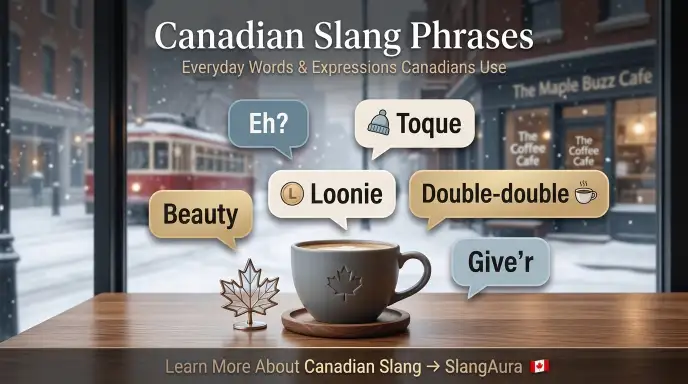
Canadian slang phrases are casual words and expressions used in everyday conversations across Canada. They include familiar terms such as “eh,” “double double,” “loonie,” “toonie,” and “give’r,” along with regional expressions that may sound unusual to visitors.
If you are searching for Canadian slang phrases, you may want to understand what Canadians actually say, what these expressions mean, and where they are used. Canadian English is mostly easy for English speakers to follow, but some local words can cause confusion.
This guide explains common Canadian slang phrases in simple English. It also looks at regional differences, tone, examples, and situations where a phrase may not fit. Usage can vary by age, province, community, and setting, so not every expression is used equally across Canada.
Quick Answer: What Are Canadian Slang Phrases?
Canadian slang phrases are informal words and expressions used in Canadian English. Common examples include “eh” for checking agreement, “loonie” for a one-dollar coin, “toonie” for a two-dollar coin, “toque” for a winter hat, and “double-double” for coffee with two creams and two sugars.
These expressions are not all “slang” in the strict linguistic sense. Some are better described as Canadianisms or regional vocabulary. That difference matters because words such as “washroom” and “toque” can be normal everyday vocabulary rather than edgy or informal slang.
What Does “Canadian Slang Phrases” Mean?
The phrase “Canadian slang phrases” refers to informal or culturally recognizable expressions associated with Canadian English.
Some are strongly associated with Canada:
| Canadian phrase | Meaning |
| Eh? | A tag used to seek agreement or confirmation |
| Loonie | A Canadian $1 coin |
| Toonie | A Canadian $2 coin |
| Toque | A knitted winter hat |
| Double-double | Coffee with two creams and two sugars |
| Give’r | Give something your full effort |
| Timmies | A casual name for Tim Hortons |
| Parkade | A parking garage |
| Pop | Soda or soft drink |
| Washroom | Bathroom or restroom |
However, Canadians do not all speak the same way. Some terms are common across the country, while others are strongly regional. A university guide from Alberta, for example, notes that Canadian slang can vary by generation and region.
This means a phrase can be Canadian without being used by every Canadian.
Common Canadian Slang Phrases
1. Eh?
“Eh?” is one of the best-known Canadian expressions. It often works as a sentence-ending tag that asks for agreement or checks if someone follows what was said.
Example:
“That was a great hockey game, eh?”
Here, “eh?” is close to “right?” or “don’t you think?”
It is also important not to overdo it. The stereotype that Canadians put “eh” after every sentence is exaggerated. Actual use varies by person and region.
2. Loonie
A loonie is the Canadian one-dollar coin.
The name comes from the common loon shown on the coin. Canada introduced the $1 coin in 1987, replacing the $1 bill.
Example:
“Do you have a loonie for the vending machine?”
Loonie is common Canadian vocabulary, so it does not necessarily feel like “slang” to Canadians.
3. Toonie
A toonie is Canada’s two-dollar coin.
The name follows the pattern of “loonie” while also suggesting “two.” The $2 coin entered circulation in 1996.
Example:
“I only have a toonie. Do you have smaller change?”
You may also see different spellings, but toonie is the standard common form.
4. Toque
A toque is a knitted winter hat. Americans often call the same type of hat a beanie.
The Canadian English word comes from French tuque, making it a good example of how French has influenced Canadian English.
Example:
“Grab your toque before you head outside.”
This word is especially useful in conversations about Canada’s cold-weather culture.
5. Double-Double
A double-double usually means coffee with two creams and two sugars.
The expression became strongly associated with Tim Hortons, although the phrase can also be understood outside that chain.
Example:
“I’m stopping for a double-double. Want one?”
If someone unfamiliar with Canadian English hears this phrase, they may think it refers to two of something else. Context makes the meaning clear.
6. Timmies
Timmies is a casual nickname for Tim Hortons, the Canadian coffee and restaurant chain.
You may also hear Tim’s or Timmy’s in casual speech.
Example:
“Let’s stop at Timmies before work.”
This expression is casual, so it fits conversations with friends and coworkers better than formal writing.
7. Give’r
Give’r means to give something your full effort, work hard, or go all out.
The expression is particularly associated with parts of central and western Canada and has also been popularized through Canadian pop culture.
Example:
“We have one hour left, so give’r!”
The tone is energetic and informal. It can work as encouragement, especially among friends or teammates.
8. Washroom
Washroom is a common Canadian term for a bathroom or restroom.
It is not really slang in the same way as “give’r.” It is better understood as a common Canadian English word.
Example:
“Excuse me, where is the washroom?”
This is a useful distinction for learners: Canadian vocabulary is broader than Canadian slang.
9. Pop
Many Canadians use pop for a carbonated soft drink.
For example, someone might ask, “Do you want a pop?” rather than “Do you want a soda?” The exact choice varies across English-speaking regions of North America.
Example:
“I’ll grab some pop for the party.”
10. Parkade
A parkade is a parking garage or multi-level parking structure.
It is especially associated with Canadian English and appears in everyday Canadian vocabulary.
Example:
“Meet me near the parkade entrance.”
This word may sound unfamiliar to someone who mainly knows American English.
Are Canadian Slang Phrases Used Everywhere in Canada?
No. Canadian slang varies by province, region, age, community, and social setting.
A phrase that sounds normal in Alberta may be less familiar in Quebec. A younger speaker may use a modern internet expression instead of an older Canadianism. Someone living in a large city may also use a mix of Canadian, American, global internet, and community-specific expressions.
For example, bunny hug is associated with Saskatchewan and means a hooded sweatshirt or hoodie. It is a good example of regional Canadian vocabulary rather than a phrase every Canadian uses daily.
This regional variation is one reason it is better to say “Canadian slang phrases” rather than assume there is one fixed Canadian vocabulary.
Are Canadian Slang Phrases Still Used Today?
Yes, many well-known Canadian expressions are still used today, but their popularity differs.
Words such as loonie, toonie, toque, washroom, and double-double remain recognizable in modern Canadian English. At the same time, some expressions are more regional, generational, or casual.
Modern Canadian speech also changes through social media, gaming, streaming, texting, and contact with American and global internet culture.
So, learning Canadian slang does not mean memorizing a fixed list. It means understanding which expressions are common, which are regional, and which depend on context.
Where Are Canadian Slang Phrases Commonly Used?

Canadian expressions can appear in many everyday settings.
Texting and Messaging
Friends may use casual expressions such as:
“Want to grab a double-double?”
“Give’r! You’ve got this.”
These phrases feel relaxed and personal.
Social Media
Canadian users may mix local expressions with global internet slang. Someone might use “eh” in a caption while also using common TikTok or Instagram slang.
Gaming and Discord
Canadian gamers may use regional Canadian expressions alongside gaming terms such as “GG,” “nerf,” or “clutch.”
For example:
“Give’r, we can still win this round.”
The Canadian phrase adds a local flavor, while the rest of the language is common gaming vocabulary.
Workplace Chats
Some Canadian expressions work well in casual workplace conversations, especially among familiar coworkers.
However, slang should be used carefully with clients, formal emails, interviews, or senior executives. A casual “Give’r!” may sound friendly in a team chat but may not fit a formal business document.
Everyday Conversation
This is where many Canadianisms feel most natural. You may hear them while talking about money, coffee, weather, clothing, transportation, sports, or daily plans.
Are Canadian Slang Phrases Rude or Offensive?
Most common Canadian slang phrases are harmless and casual.
Words such as “toque,” “loonie,” “toonie,” “double-double,” and “washroom” are not offensive. Their main purpose is to describe familiar Canadian things or situations.
The bigger issue is tone and context.
A phrase like “give’r” can sound friendly among friends but may feel too casual in a formal setting. Regional expressions can also confuse people who have never heard them.
There is no need to treat Canadian slang as automatically rude. Instead, look at who is speaking, who is listening, and where the conversation is happening.
Real-Life Examples of Canadian Slang Phrases
Here are natural examples that show how these expressions can appear in everyday conversations.
Friend: “It’s freezing outside.”
Reply: “Better grab your toque.”
Coworker: “I’m heading to Timmies.”
Reply: “Can you grab me a double-double?”
Friend: “Do you have a dollar for the machine?”
Reply: “Yeah, I’ve got a loonie.”
Teammate: “We need to finish this before dinner.”
Reply: “All right, give’r!”
Visitor: “Excuse me, where can I find the restroom?”
Canadian: “The washroom is down the hall.”
These examples show an important point: Canadian slang often works naturally inside normal English. You do not need to use several Canadian expressions in every sentence to sound Canadian.
Canadian Slang vs. Canadian English
Not every Canadian expression should be labeled slang.
This distinction is often missed in online articles.
Slang usually refers to informal language linked to a group, social setting, or casual speech.
Canadianism is a broader term for a word, meaning, or expression associated with Canadian English. Some Canadianisms are completely ordinary words.
For example:
- Give’r : informal slang
- Eh? : Canadian discourse marker
- Loonie : Canadian term for $1 coin
- Toonie : Canadian term for $2 coin
- Toque : Canadian English vocabulary
- Washroom : common Canadian English word
Canadian English includes words influenced by British English, American English, French, Indigenous languages, and Canadian regional speech.
This is why calling every Canadian word “slang” can give learners the wrong idea.
More Canadian Slang Phrases to Know
Canadian English has plenty of expressions beyond the most famous examples. Some are casual slang, while others are regional Canadianisms.
11. Canuck
Canuck is an informal word for a Canadian person.
It is widely recognized and can sound friendly or neutral. The term is also used in names connected with Canadian culture and sports.
Example:
“He’s a proud Canuck living overseas.”
12. Hang a Larry
Hang a Larry means to turn left while driving.
It is an informal direction used by some Canadian speakers. “Larry” refers to the left side, while “Roger” is used in the phrase “Hang a Roger” for a right turn.
Example:
“Go past the lights and hang a Larry.”
This expression is casual and may be unfamiliar outside Canada.
13. Hang a Roger
Hang a Roger means to turn right while driving.
It is usually used in casual spoken directions rather than formal instructions.
Example:
“Hang a Roger at the next intersection.”
These driving expressions are not universal across Canada, so they should be understood as informal regional or cultural slang rather than standard Canadian vocabulary.
14. Bud
Bud is a casual way to address a friend, acquaintance, or another person.
Its tone depends heavily on the speaker’s voice and the situation. It can sound warm, friendly, teasing, or slightly confrontational.
Example:
“Hey bud, are you coming with us?”
15. Beauty
In Canadian slang, beauty can describe someone or something excellent.
It often works as a friendly compliment.
Example:
“That was a beauty of a goal!”
The word is not always slang. Its informal Canadian use comes from the positive way it can describe a person, action, or result.
16. Keener
A keener is someone who is very eager to succeed, especially at school or work.
The word can be playful, but it may also suggest that someone is trying too hard.
Example:
“She finished the assignment early. What a keener!”
The tone determines if it sounds like praise or teasing.
17. Mickey
A mickey can refer to a small bottle of liquor in Canadian English.
This is an alcohol-related term, so context matters. It is not appropriate for every audience or situation.
Example:
“The term appeared in an old Canadian movie.”
Because the word can have other meanings in different varieties of English, context is important.
18. Pencil Crayon
Pencil crayon is a Canadian term for a colored pencil.
It is especially familiar in Canadian school settings.
Example:
“Use a blue pencil crayon for the sky.”
This is better described as Canadian vocabulary than slang.
19. Bunny Hug
A bunny hug is a regional Saskatchewan term for a hooded sweatshirt or hoodie.
It is one of the clearest examples of Canadian regional vocabulary.
Example:
“Put on your bunny hug before we leave.”
Someone from another part of Canada may know the word but may not use it regularly.
20. Two-Four
A two-four is an informal Canadian term for a case containing 24 bottles or cans of beer.
The expression is strongly associated with Canadian informal speech.
Example:
“They picked up a two-four for the weekend.”
Because it refers to alcohol, use the expression carefully around children, in professional settings, or in formal writing.
Regional Canadian Slang Phrases
Canada is huge, so regional speech can differ quite a lot.
Here are a few useful examples:
| Region | Expression | Meaning |
| Saskatchewan | Bunny hug | Hoodie |
| Atlantic Canada | Some local terms influenced by regional speech | Varies by community |
| Newfoundland and Labrador | Newfoundland English expressions | Regional vocabulary and phrases |
| Across Canada | Loonie | $1 coin |
| Across Canada | Toonie | $2 coin |
| Across Canada | Toque | Winter hat |
Regional variation is important because Canadian slang is not one fixed vocabulary. A person from Toronto may not use the same local expressions as someone from Newfoundland or Saskatchewan.
How Do Canadians Talk Differently From Americans?
Canadian and American English are very similar, so the difference is often subtle.
Some Canadian words stand out because they are used differently or are more strongly associated with Canada.
For example:
- Canadians often say washroom.
- Many Canadians use pop for soft drinks.
- Toque is common for a winter hat.
- Loonie and toonie refer to Canadian coins.
- Eh can appear as a conversational tag.
- Double-double has a strong Canadian coffee connection.
However, Canadians also use plenty of American expressions. Social media, movies, gaming, music, and online communities have made English vocabulary more shared across borders.
So, you should not expect every Canadian to sound noticeably different from an American speaker.
When Should You Avoid Using Canadian Slang Phrases?
Most Canadian slang phrases are harmless, but informal language is not suitable for every situation.
Avoid heavy slang when:
- Writing a formal business email
- Applying for a job
- Speaking during a formal presentation
- Writing an academic paper
- Communicating with someone who may not understand the expression
- Giving official instructions
- Writing for an international audience
You can still use familiar Canadian words in normal professional conversation when they fit naturally.
For example, washroom is perfectly normal in many professional settings. A highly informal phrase such as give’r may be better saved for casual conversation.
The key is not to avoid Canadian expressions completely. Instead, match your language to the audience and setting.
Canadian Slang in Texting and Social Media
Canadian slang can appear in texts, captions, group chats, and social platforms.
People may combine Canadian expressions with global internet slang.
For example:
“That game was wild, eh?”
“Heading to Timmies. Want anything?”
“Give’r, bud!”
On TikTok and Instagram, Canadian users may use local expressions for humor or identity. On Discord, Canadian slang can appear alongside gaming terms and abbreviations.
This creates a mix of local Canadian language and global internet language.
A phrase does not need to be uniquely Canadian to be used by Canadians. Words such as bro, dude, LOL, fr, and OMG are widely used across English-speaking online communities.
Canadian Slang vs. Gen Z Slang
Canadian slang is connected to Canadian English, culture, geography, or local usage.
Gen Z slang is mainly connected to a generation and its social communication. It can spread quickly through TikTok, Instagram, gaming, and other online communities.
There is overlap.
For example, a young Canadian might say:
“Bro, that was actually baffling, eh?”
Here, bro is broad informal slang, while eh adds a recognizable Canadian touch.
This shows why modern Canadian speech can contain several layers of slang at once.
Is Canadian Slang Appropriate at Work?
Some Canadian expressions are completely acceptable at work. Others are better kept for casual conversations.
Usually Fine
- Washroom
- Toque
- Loonie
- Toonie
- Pop
More Casual
- Eh?
- Bud
- Give’r
- Timmies
- Beauty
Best Used Carefully
- Alcohol-related slang
- Strong regional expressions
- Expressions that may sound overly familiar
- Slang that could confuse international clients
A useful rule is simple: use standard English when the situation is formal, and use casual slang when the relationship and setting allow it.
Common Misunderstandings About Canadian Slang
Canadian slang is often surrounded by stereotypes.
One common idea is that Canadians say “eh” after every sentence. Real Canadian speech is much more varied. People use the expression differently depending on region, personality, and context.
Another misconception is that all Canadian slang is completely different from American English. In reality, Canadian and American English share a large amount of vocabulary.
It is also incorrect to assume that every expression listed online is used equally across Canada. Some terms are regional, old-fashioned, playful, or less common among younger speakers.
That distinction makes a Canadian slang guide more useful than a simple list of unusual words.
Canadian Slang Phrases: What Should You Learn First?
If you are new to Canadian English, start with the expressions you are most likely to encounter.
| Phrase | Simple meaning | Usage |
| Eh? | Right? / Don’t you agree? | Casual |
| Loonie | $1 coin | Everyday |
| Toonie | $2 coin | Everyday |
| Toque | Winter hat | Everyday |
| Double-double | Coffee with 2 creams and 2 sugars | Casual |
| Timmies | Tim Hortons | Casual |
| Give’r | Give it your best effort | Informal |
| Bud | Friend / casual address | Informal |
| Canuck | Canadian person | Informal |
| Bunny hug | Hoodie | Regional |
| Hang a Larry | Turn left | Informal |
| Hang a Roger | Turn right | Informal |
Learning these first gives you a useful foundation without making Canadian English seem more complicated than it is.
Frequently Asked Questions About Canadian Slang Phrases
Q1. What Do Canadians Famously Say?
Canadians are often associated with words like “eh,” “sorry,” “toque,” and “double-double.” These expressions are strongly linked with Canadian speech and culture, although their use varies by person and region.
Q2. What Are Some Slang Terms for Canadians?
Canuck is the best-known informal term for a Canadian. Canuckian also appears occasionally, but it is far less common than Canuck.
Q3. What Does “Hang a Larry” Mean in Canada?
“Hang a Larry” is informal Canadian slang for turning left while driving. “Hang a Roger” is used to mean turning right.
Q4. How Do Canadians Say Bro?
Canadians use casual words such as “bro,” “buddy,” “bud,” and “dude.” “Bud” can sound especially natural in informal Canadian conversations, but it is not uniquely Canadian.
Q5. How Do Canadians Say “Sorry”?
Canadians simply say “sorry,” often with a polite and friendly tone. Phrases such as “Sorry about that” and “I’m sorry” are also common.
Q6. What Is a Bro in Gen Z Slang?
In Gen Z slang, “bro” is a casual way to address a friend, guy, or familiar person. Online, it can also be used humorously, even when the speakers are not close friends.
Conclusion
Canadian slang phrases are a mix of informal expressions, regional terms, and everyday Canadian vocabulary. Famous examples include eh, loonie, toonie, toque, double-double, Timmies, give’r, bud, and Canuck.
The most important thing to remember is that not every Canadian uses every phrase. Usage changes by region, age, community, and situation. Some terms are common nationwide, while others are strongly regional.
If you are learning Canadian English, focus on meaning and context rather than trying to sound stereotypically Canadian. Knowing when an expression is casual, regional, or formal will help you use Canadian slang naturally and confidently.
Related Slang Terms:
Texas Slang Phrases: 50 Words and Sayings Texans Actually Use
CEI Slang Meaning: What Does “CEI” Really Mean Online?
Irish Slang for Pretty Girl: Common Terms and Their Meanings

I am Masson Caldwell, a language enthusiast and content writer at SlangAura. I write about internet slang, texting trends, and modern expressions to help readers understand the evolving world of online language with simple and clear explanations.