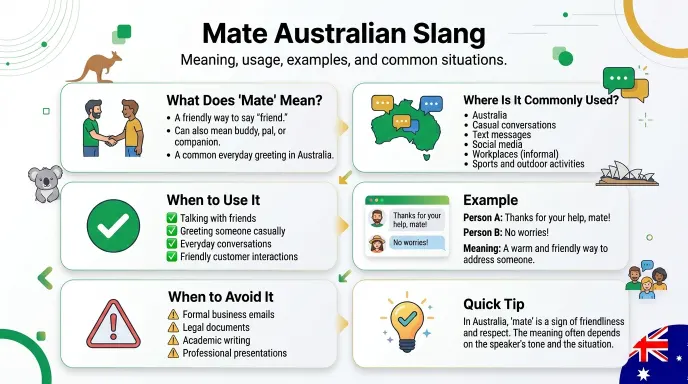
Mate in Australian slang means “friend,” “buddy,” or “companion.” Australians commonly use mate as a casual way to address someone, even if they are not close friends.
The word can show friendliness, respect, support, or sometimes even frustration depending on the tone and situation.People search for mate Australian slang because the word appears often in Australian movies, conversations, sports, online comments, and social media. While mate simply means friend in many places, Australians use it much more widely in daily communication.
Quick Answer: What Does Mate Mean in Australian Slang?
Mate is an Australian slang word that means “friend” or “someone you know.” It is used as a friendly way to address another person and is common in everyday Australian speech.
Example:
“Thanks, mate.”
Meaning:
“Thanks, friend.”
However, the meaning of mate depends heavily on tone. A warm “Thanks, mate” shows appreciation, while an angry “Listen, mate” may sound like a warning.
What Does Mate Australian Slang Mean?
Mate Australian slang is a casual expression used to refer to another person in a friendly or familiar way.
Unlike the standard meaning of “mate,” which usually describes a close friend, Australians often use mate with:
- Friends
- Family members
- Work colleagues
- Strangers
- People they have just met
For many Australians, mate is not only about friendship. It can also communicate a sense of friendliness, equality, and respect.
Examples:
“Good job, mate.”
“You alright, mate?”
“Cheers, mate.”
These phrases are common in everyday Australian conversations.
Why Do Australians Say Mate So Often?
Australians use mate because it creates a relaxed and friendly tone. The word fits with the informal communication style that is common in Australian culture.
Mate can make conversations feel:
- More personal
- Less formal
- More welcoming
- More casual
For example, a shop worker might say:
“Here you go, mate.”
They may not know the customer personally, but the word creates a friendly connection.
Mate is often used to show that someone is approachable and easy to talk to.
Different Meanings of Mate in Australian Slang
The meaning of mate can change depending on the situation and the speaker’s tone.
Mate Meaning as Friend
The most common meaning of mate is a friend or someone you trust.
Example:
“I’m meeting my mates this weekend.”
Meaning:
“I’m meeting my friends this weekend.”
This use is very common among Australian friends and social groups.
Mate Meaning as a Friendly Greeting
Australians often use mate when speaking to someone casually.
Example:
“How are you going, mate?”
Meaning:
“How are you?”
The person may not be a close friend. It is simply a friendly way to speak.
Mate Meaning as Respect or Support
Mate can show encouragement or appreciation.
Example:
“You did really well, mate.”
This means the speaker respects or supports the person.
In sports, workplaces, and social situations, mate can create a feeling of teamwork.
Mate Meaning With an Angry Tone
Mate is not always positive. The tone changes the meaning.
Example:
“Listen, mate, that’s not okay.”
Here, mate may sound serious or confrontational.
The word itself is not rude, but the emotion behind it changes how people understand it.
Where Is Mate Commonly Used?
Mate is strongly connected with Australian English, but it is also used in other English-speaking countries.
It commonly appears in:
- Daily conversations
- Australian workplaces
- Sports communities
- Social gatherings
- Online discussions
- Text messages
Mate in Everyday Australian Speech
Australians may use mate many times during a normal conversation.
Examples:
“Morning, mate.”
“See you later, mate.”
“Thanks for helping me, mate.”
It is a natural part of informal Australian communication.
Mate in Australian Workplaces
In many Australian workplaces, mate can be used between coworkers to create a relaxed environment.
Example:
“Can you send me that file, mate?”
This sounds friendly among colleagues.
However, some formal workplaces may prefer more professional language, especially when speaking with clients or senior officials.
Mate on Social Media and Online Chats
Mate appears often in Australian comments, gaming chats, and online communities.
Examples:
“Great match, mate.”
“That was funny, mate.”
“Nice work, mate.”
Online, it usually keeps the same friendly meaning as spoken Australian English.
Is Mate Australian Slang Rude or Offensive?
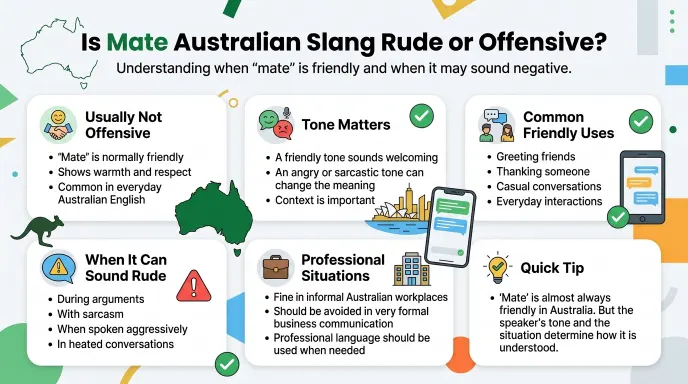
Mate is generally harmless and friendly. It is one of the most common casual expressions in Australian English.
However, context matters.
Mate can sound:
- Friendly when used with a warm tone
- Casual when used with strangers
- Serious when used during an argument
For example:
Positive:
“Thanks, mate. I appreciate it.”
Negative:
“Mate, you need to calm down.”
The second example may sound less friendly because of the situation and tone.
Origin and History of Mate Australian Slang
The word “mate” has a long history in English and originally meant a companion, partner, or someone connected to another person. It comes from an older English word related to friendship and companionship.
The use of mate became especially strong in Australian English because of the country’s social culture and informal communication style. Over time, Australians adopted mate as a common way to speak with friends, coworkers, and even strangers.
Mate became closely linked with the idea of “mateship,” an Australian cultural value that focuses on friendship, loyalty, helping others, and standing together during difficult situations.
What Is Australian Mateship?
Mateship refers to the idea of friendship, loyalty, and supporting others. The word mate is connected to this idea because it represents more than just a friend.
In Australian culture, calling someone mate can suggest:
- Trust
- Equality
- Support
- Team spirit
- Friendly connection
For example:
“Don’t worry, mate. I’ll help you.”
This sentence shows support, not just friendship.
Mateship is often seen in situations where people help each other, such as sports teams, workplaces, emergencies, or community events.
Mate Usage Across Different Situations
The meaning of mate changes depending on who says it and why they say it.
| Situation | Meaning of Mate | Example |
| Talking with friends | Close friend | “My mates are coming over.” |
| Speaking with strangers | Friendly address | “Excuse me, mate.” |
| Workplace conversation | Friendly coworker | “Can you check this, mate?” |
| Sports | Team connection | “Great game, mate.” |
| Argument | Serious warning | “Listen, mate.” |
This shows why tone and context are important when understanding mate.
Real-Life Examples of Mate Australian Slang
Mate is used naturally in many everyday situations.
Talking With Friends
Friend 1: “Are you coming to the game tonight?”
Friend 2: “Yeah, mate. I wouldn’t miss it.”
Meaning:
The person is speaking casually to a friend.
Helping Someone
Person 1: “Thanks for carrying those boxes.”
Person 2: “No worries, mate.”
Meaning:
The person is showing friendliness and willingness to help.
Workplace Conversation
Coworker 1: “Can you check this report?”
Coworker 2: “Sure, mate. I’ll look at it now.”
Meaning:
The coworker is using mate to keep the conversation relaxed.
Online Gaming Chat
Player 1: “Nice move!”
Player 2: “Thanks, mate.”
Meaning:
The player is showing appreciation.
Sports Conversation
Fan 1: “That was an amazing goal.”
Fan 2: “Yeah, mate. What a match!”
Meaning:
Mate creates a friendly connection between people sharing an interest.
Is Mate Used Outside Australia?
Yes, mate is also used in other English-speaking countries, but the style and frequency can be different.
Mate is common in:
- United Kingdom
- New Zealand
- Some parts of Ireland
- Online English-speaking communities
In Australia, however, mate is much more deeply connected with everyday identity and communication.
For example, a British speaker may use mate mainly for close friends, while an Australian speaker may use it with friends, coworkers, or strangers.
Is It Okay for Non-Australians to Use Mate?
Yes, non-Australians can use mate, especially when speaking casually. However, it should feel natural and should not be forced.
Using mate occasionally is usually fine.
Examples:
“Thanks, mate.”
“Good job, mate.”
These phrases are widely understood.
However, using too many Australian expressions together may sound unnatural or like someone is copying an accent.
The best approach is to use mate naturally rather than trying to imitate Australian speech.
When Should You Avoid Using Mate?
Although mate is friendly, there are situations where it may not be appropriate.
Avoid using mate in:
- Formal business emails
- Official documents
- Job interviews
- Academic writing
- Very serious professional situations
For example:
Less suitable:
“Dear manager, thanks, mate.”
Better:
“Thank you for your help.”
You should also be careful when speaking with someone who prefers more formal communication.
Similar Australian Slang Words Related to Mate
Australian English has several other casual words that are connected with friendship and conversation.
| Word | Meaning | Example |
| Buddy | Friend | “He’s my buddy.” |
| Bloke | Man or guy | “He’s a good bloke.” |
| Cobber | Friend or companion | “How are you, cobber?” |
| Pal | Friend | “Thanks, pal.” |
| Legend | Someone admired or helpful | “You’re a legend.” |
Mate remains the most common and widely recognized Australian friendship term.
Is Mate Still Popular Today?
Yes, mate is still widely used in Australia. Unlike some slang terms that become outdated quickly, mate remains a normal part of everyday speech.
It is used by different age groups, including:
- Older Australians
- Adults
- Younger people
However, the way people use mate can change. Younger speakers may combine it with modern internet language, emojis, and casual online expressions.
Mate continues to survive because it is simple, friendly, and connected with Australian communication culture.
Common Misunderstandings About Mate Australian Slang
Mate is a simple word, but people outside Australia sometimes misunderstand how Australians use it.
Mistake 1: Thinking Mate Always Means a Close Friend
Many people assume mate only refers to someone’s best friend. In Australian English, this is not always true.
Australians may call a stranger mate, such as a person helping them in a shop or someone they meet casually.
Example:
“Thanks, mate.”
The speaker may not know the person personally. They are simply being friendly.
Mistake 2: Thinking Mate Always Sounds Friendly
The word mate is usually positive, but tone changes the meaning.
A warm voice:
“Good work, mate.”
This shows appreciation.
An angry voice:
“Listen, mate.”
This may sound like a warning or disagreement.
The situation and emotion behind the word matter more than the word itself.
Mistake 3: Believing Mate Is Only Used by Older Australians
Mate is used by many Australians across different age groups. Young people, adults, and older generations all use it in everyday conversations.
However, younger Australians may mix mate with newer online expressions depending on the situation.
How to Use Mate Naturally
If you want to use mate correctly, focus on the situation and tone.
Good examples:
- “Thanks, mate.”
- “How are you going, mate?”
- “Good job, mate.”
- “No worries, mate.”
These phrases sound natural in casual conversations.
Avoid using mate in every sentence because it can feel forced.
For example:
“Hello mate, how are you mate, can you help me mate?”
This does not sound natural.
Using mate occasionally creates a more authentic casual style.
Mate vs Friend: What Is the Difference?
Although mate and friend are similar, they are not exactly the same.
| Word | Meaning | Common Use |
| Friend | Someone you have a personal relationship with | General English |
| Mate | Friend, companion, or friendly address | Casual Australian English |
A friend is usually someone you know well. Mate can be used for both friends and people you have just met.
Example:
“My mate Tom is coming over.”
Meaning:
“My friend Tom is coming over.”
“Thanks, mate.”
Meaning:
“Thanks, friend.”
Mate in Australian Culture and Communication
Mate represents a relaxed and friendly style of communication. It often reflects the Australian preference for informal conversations and treating people equally.
The word is commonly connected with ideas such as:
- Helping others
- Being supportive
- Staying loyal
- Creating friendly relationships
For many Australians, saying mate is not just about friendship. It can also show a sense of connection with another person.
Frequently Asked Questions About Mate Australian Slang
Q1. What does mate mean in Australian slang?
Mate means friend, buddy, or someone you are speaking to in a friendly way. Australians use it with both people they know and people they meet casually.
Q2. Why do Australians say mate so much?
Australians use mate because it creates a relaxed and friendly tone. It is a common way to show friendliness, respect, and connection.
Q3. Is mate only used in Australia?
No, mate is also used in countries like the United Kingdom and New Zealand. However, it is especially associated with Australian English.
Q4. Is calling someone mate rude?
No, calling someone mate is usually friendly and harmless. However, the tone and situation can change how it sounds.
Q5. Can women use the word mate?
Yes, anyone can use mate. It is not limited to men and is commonly used by all genders in casual Australian conversations.
Q6. Can I call an Australian person mate?
Yes, you can use mate when speaking casually with an Australian person. Use it naturally and avoid forcing it into every sentence.
Q7. What is the difference between mate and buddy?
Both words mean friend, but mate is strongly connected with Australian and British English, while buddy is more common in American English.
Q8. Is mate formal or informal?
Mate is informal. It is suitable for casual conversations but should usually be avoided in formal writing or professional situations.
Q9. What does mate mean in Australian slang?
Mate in Australian slang means friend, companion, or a friendly way to address someone. It can show kindness, respect, or support depending on the context.
Q10. What does mate mean in Aussie slang?
Mate means “friend,” “buddy,” or a friendly way to address someone in Australian slang. Australians use it with friends, coworkers, and even strangers.
Q11. Do Australians say “oi mate”?
Yes, some Australians say “oi mate” as a casual way to get someone’s attention or start a conversation. The tone decides if it sounds friendly or serious.
Q12. Is it hooroo or ooroo?
Both “hooroo” and “ooroo” are Australian slang words for goodbye. “Hooroo” is the more traditional spelling, while “ooroo” is a shorter casual version.
Q13. What do Aussies call their girlfriends?
Australians may call their girlfriends “missus,” “partner,” “girlfriend,” or affectionate names like “darling” and “love.” The choice depends on the person and situation.
Conclusion:
Mate Australian slang means friend, buddy, or a friendly way to address another person. It is one of the most recognizable parts of Australian everyday language.
Australians use mate with friends, coworkers, strangers, and online communities to create a relaxed and friendly connection. While it usually has a positive meaning, the speaker’s tone and situation can change how it is understood.
For casual conversations, mate is a natural and friendly expression. However, formal situations are better suited to standard words like “friend,” “thank you,” or a person’s name.
The key to understanding mate is context. It is not only about friendship; it is also about friendliness, respect, and social connection.

I am Masson Caldwell, a language enthusiast and content writer at SlangAura. I write about internet slang, texting trends, and modern expressions to help readers understand the evolving world of online language with simple and clear explanations.