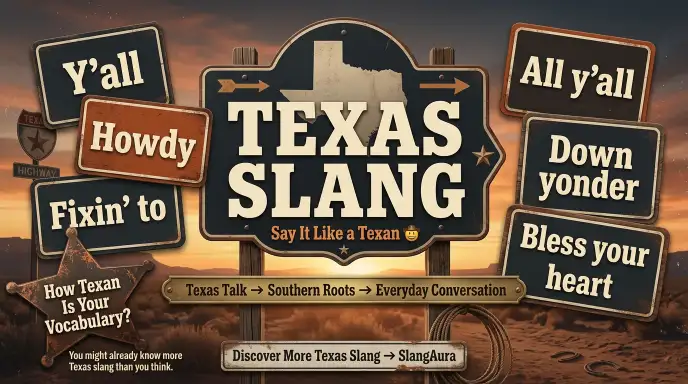
Texas slang phrases are informal words and expressions linked with Texas speech, culture, and Southern English. Common examples include “y’all,” “fixin’ to,” “all y’all,” “might could,” and “down yonder,” although not every phrase is exclusive to Texas.
If you are searching for Texas slang phrases, you may want to know what Texans actually say, what these expressions mean, and how they sound in real conversations. Some phrases remain common today.
While others are older expressions that are less common among younger speakers.Texas is also a large and diverse state, so people do not all speak the same way. Age, location, background, and social setting can affect which expressions someone uses.
This guide explains popular Texas phrases in simple English while also showing which expressions are strongly associated with Texas and which are shared with the wider South.
Quick Answer: What Are Texas Slang Phrases?
Texas slang phrases are casual expressions associated with Texas speech and culture. Popular examples include “y’all” for a group of people, “fixin’ to” for being about to do something, and “down yonder” for a place farther away. Some are strongly linked with Texas, while others are common across the American South.
What Does “Texas Slang” Mean?
Texas slang refers to informal words, phrases, contractions, and expressions heard in Texas conversations. These expressions can reflect regional speech, Southern English, local culture, and the history of the state.
There is no single list that every Texan follows.
Someone from a large city may speak differently from someone in a small rural community. Younger Texans may also use fewer traditional expressions than older generations. Social media, migration, and contact with other varieties of English have also influenced modern Texas speech.
That is why Texas slang is better understood as a collection of regional expressions, not a fixed vocabulary.
Popular Texas Slang Phrases
Here are some well-known expressions associated with Texas speech.
1. Y’all
Meaning: You all; a casual way to address two or more people.
Example:
“Are y’all coming with us?”
“Y’all” is one of the best-known Southern expressions and is strongly associated with Texas. It is also used far beyond Texas today, so using it does not automatically mean someone is Texan.
2. All Y’all
Meaning: Everyone in a particular group.
Example:
“All y’all need to come over for dinner.”
“All y’all” can add extra emphasis when the speaker means the entire group rather than only a few people.
3. Fixin’ To
Meaning: About to do something or planning to do something soon.
Example:
“I’m fixin’ to head home.”
This is one of the most recognizable expressions associated with Texas and Southern speech. It usually suggests that an action is about to happen.
4. Howdy
Meaning: Hello; a friendly greeting.
Example:
“Howdy, y’all!”
“Howdy” has a strong connection with Texas and the American West. It is casual and friendly, although people outside Texas may use it when joking about cowboy or Western culture.
5. Down Yonder
Meaning: A place farther away or somewhere in the general area being discussed.
Example:
“The store is down yonder.”
“Down yonder” has an older regional feel. It is strongly associated with traditional Southern and rural speech and may sound old-fashioned to some younger Texans.
6. Might Could
Meaning: Might be able to do something.
Example:
“I might could help you tomorrow.”
“Might could” is a Southern English construction that can also be heard in Texas. It is not used equally by everyone and may sound unusual to people from other parts of the United States.
7. Thank You Kindly
Meaning: A warm or friendly way to say thank you.
Example:
“Thank you kindly for helping me.”
This phrase is not unique to Texas, but it can have a traditional Southern or Western feel. It may sound more old-fashioned than a simple “thanks” in some situations.
8. Mosey
Meaning: To walk or move somewhere in a relaxed, unhurried way.
Example:
“We can mosey over there after lunch.”
“Mosey” has a strong Western and cowboy flavor. It can also be used outside Texas, especially when someone wants to create a relaxed or playful tone.
9. Y’all’s
Meaning: The possessive form of “y’all.”
Example:
“Is this y’all’s truck?”
This informal form shows how “y’all” can work naturally in different parts of a sentence.
10. Brung
Meaning: An informal form of “brought.”
Example:
“You brung everything we need.”
“Brung” can appear in informal regional speech, but it is not considered standard formal English. You are more likely to hear it in casual conversation than see it in formal writing.
Are Texas Slang Phrases the Same as Southern Slang?
Not exactly. Texas slang overlaps with Southern English, but not every Southern expression is uniquely Texan.
Texas shares many speech patterns with other Southern states. Expressions such as “y’all” and “fixin’ to” can be heard across the South.
At the same time, Texas has its own regional identity and speech patterns. Certain expressions, pronunciation styles, and combinations of words may strongly remind listeners of Texas.
This distinction is important because calling every Southern phrase “Texas slang” would be misleading.
Texas Slang vs. Southern Slang
| Texas-associated phrase | Also found elsewhere? |
| Y’all | Yes |
| Fixin’ to | Yes |
| Howdy | Yes |
| Down yonder | Yes |
| Might could | Yes |
| Y’all’s | Yes |
| Cowboy-style expressions | Often |
So, “associated with Texas” does not always mean “exclusive to Texas.”
Do All Texas Use These Phrases?
No. Texas speech varies by region, age, background, and social setting.
A person from Houston may not sound exactly like someone from a rural town. Someone from Dallas may use different expressions from someone who grew up in a small West Texas community.
Age also matters. Older speakers may use traditional expressions that younger Texans rarely use.
The same person may even change their speech depending on who they are talking to. A casual conversation with friends can sound very different from a job interview or formal presentation.
Are Texas Slang Phrases Still Used Today?
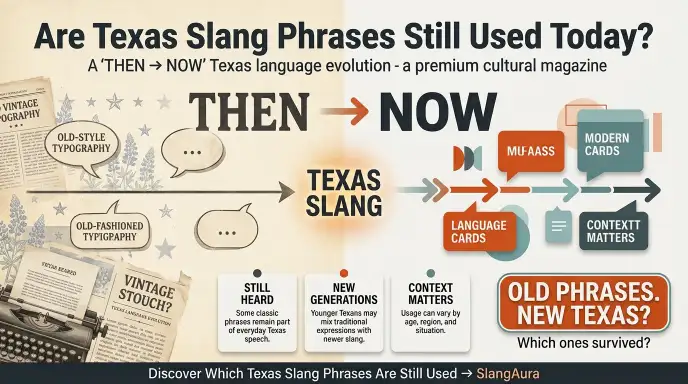
Yes, but some expressions are much more common than others.
“Y’all” remains widely recognized and commonly used. “Fixin’ to” also remains a familiar Southern and Texas expression.
Other phrases, such as “down yonder” or “might could,” may sound more regional or traditional. Some younger urban Texans may understand these expressions without using them regularly.
This creates an interesting mix of old and modern Texas speech:
- Very familiar: “y’all,” “howdy”
- Still common in casual speech: “fixin’ to”
- More regional: “might could,” “down yonder”
- Traditional or less common: older cowboy and rural expressions
So, a good Texas slang guide should explain how common a phrase is, not simply put every expression into one giant list.
Can Texas Slang Sound Different in Cities and Rural Areas?
Yes. Location can affect how strongly traditional Texas speech appears.
Large cities attract people from many different regions and countries. As a result, urban speech can contain a wider mix of language styles.
Rural communities may preserve more traditional regional expressions. However, this does not mean every rural Texan speaks with a strong “Texas accent” or uses cowboy slang.
Texas speech exists on a spectrum.
A speaker can have a noticeable Texas accent while using very little traditional slang. Another person may use phrases such as “y’all” regularly without having a strong Texas accent.
Why Do Texans Use These Expressions?
Texas slang can make conversation feel casual, friendly, local, or familiar.
Expressions such as “y’all” can also make speech shorter and more natural. “Fixin’ to” communicates that someone plans to do something soon without needing a longer explanation.
Some phrases also carry cultural associations. Words connected with ranching, cowboys, Western life, and rural communities can create a distinctly Texan feel.
However, not every phrase is used to sound “Texan.” Many people simply use the expressions they grew up hearing.
More Texas Slang Phrases You Should Know
Texas has plenty of expressions beyond the most famous ones. Some are tied to everyday Southern speech, while others have a stronger Texas, ranching, or Western flavor.
The phrases below add more depth to the topic without treating every Southern expression as uniquely Texan.
11. Reckon
Meaning: Think, suppose, or believe.
Example:
“I reckon we should leave early.”
“Reckon” has long been associated with Southern and rural American speech. In Texas, it can give a sentence a relaxed, traditional feel.
12. Yonder
Meaning: A place over there or at some distance.
Example:
“The truck is parked over yonder.”
“Yonder” often appears in phrases such as “down yonder.” It has an old regional feel and is more likely to appear in casual or traditional speech than formal conversation.
13. Tump
Meaning: To tip, knock over, or spill something.
Example:
“Be careful not to tump that bucket over.”
This is a regional word that may sound unfamiliar to people outside parts of the South and Texas.
14. Fixing
Meaning: Preparing or getting ready to do something.
Example:
“She’s fixing dinner for everyone.”
In Texas speech, “fixing” can also appear in the expression “fixin’ to,” which means someone is about to do something.
15. Git
Meaning: An informal pronunciation or spelling of “get.”
Example:
“Git over here and take a look.”
You may see this spelling in humorous writing, memes, fictional cowboy dialogue, or exaggerated Southern speech. It should not be treated as a standard spelling used by all Texans.
16. Big Ol’
Meaning: A casual way to emphasize that something is large or notable.
Example:
“He brought home a big ol’ barbecue plate.”
“Big ol’” is not exclusive to Texas, but it fits naturally into casual Southern speech and is common in playful descriptions.
17. Y’all Come Back Now
Meaning: A friendly way to tell visitors they are welcome to return.
Example:
“Thanks for stopping by. Y’all come back now.”
The expression is strongly associated with Southern hospitality and is often used in Texas-themed speech.
18. Bless Your Heart
Meaning: A phrase that can express sympathy, affection, surprise, or gentle criticism.
Example:
“Bless your heart, you forgot your keys again.”
This phrase is especially interesting because tone changes its meaning. It can be genuinely kind, but it can also sound sarcastic when someone is being criticized indirectly.
Texas Slang Phrases With Cowboy and Western Roots
Texas is strongly connected with ranching and cowboy culture, so some expressions have become part of the state’s popular language and identity.
However, a phrase appearing in a cowboy movie does not automatically mean modern Texans use it every day.
Partner
Meaning: A friendly way to address another person.
Example:
“Thanks for helping me, partner.”
“Partner” has a strong Western association. In modern Texas-themed speech, it can sound friendly and informal.
Ride Herd
Meaning: To supervise, control, or keep watch over someone.
Example:
“My manager has been riding herd on the new project.”
The phrase comes from the idea of managing cattle, but it can now be used more broadly.
Buckaroo
Meaning: A cowboy or ranch worker.
Example:
“That old buckaroo knows the ranch better than anyone.”
This is more strongly connected with Western culture than ordinary everyday Texas slang. It may appear more often in cowboy-themed writing than in casual modern conversation.
Pardner
Meaning: A playful or stylized form of “partner.”
Example:
“Take it easy, pardner.”
The spelling is often used to create a Western or cowboy voice. It is not a standard spelling Texans use in ordinary writing.
Texas Slang vs. Texas Accent
These two ideas are related, but they are not the same thing.
Texas slang refers to particular words and expressions. A Texas accent refers to pronunciation and speech patterns.
Someone can have a noticeable Texas accent without using much Texas slang.
Likewise, someone may use “y’all” or “fixin’ to” without having a strong Texas accent.
Simple comparison
| Feature | What it describes |
| Texas slang | Words and expressions |
| Texas accent | Pronunciation and speech patterns |
| Texas dialect | A broader pattern of language use |
| Texas culture | Traditions, identity, and local customs |
This distinction helps explain why a person can sound Texan without constantly using stereotypical Texas phrases.
Texas Slang in Texting and Social Media
Texas expressions do not stay limited to spoken conversations. People may bring them into texts, captions, comments, and memes.
For example:
“Y’all ready for the weekend?”
or:
“I’m fixin’ to head out.”
Online, these phrases can also help communicate a person’s regional identity.
A person may use “howdy” in a social media caption because it feels friendly or playful. Another person may write “y’all” simply because it is part of their normal vocabulary.
Does using Texas slang online make someone Texan?
Not necessarily.
People outside Texas may use these expressions because they like Southern culture, Western themes, country music, or Texas-style humor.
Context matters more than one word.
Texas Slang in Different Generations
Texas expressions can sound different across age groups.
Older speakers may be more familiar with traditional regional expressions such as “down yonder,” “reckon,” or “might could.”
Younger Texans may use more widely recognized expressions such as:
- “Y’all”
- “All y’all”
- “Fixin’ to”
- “Howdy”
They may also mix regional expressions with internet slang, texting shortcuts, and language picked up from social media.
This means Texas slang is not frozen in time. Some expressions stay strong, while others become less common or take on a more playful meaning.
Texas Slang That Outsiders May Misunderstand
Some expressions can confuse people who did not grow up around Southern or Texas English.
“I reckon.”
A visitor may hear this as old-fashioned. In casual regional speech, it can simply mean “I think” or “I suppose.”
“I’m fixin’ to go.”
Someone unfamiliar with the expression might think “fixing” means repairing something. Here, it means “I’m about to go.”
“It’s over yonder.”
“Yonder” may sound vague to outsiders. The speaker generally means somewhere over there.
“All y’all.”
People unfamiliar with the phrase may think it is unnecessary. In casual speech, it can emphasize that the speaker means the whole group.
Are Texas Slang Phrases Appropriate at Work?
Most Texas expressions are not offensive, but their suitability depends on the setting.
Words such as “y’all” can work perfectly well in casual workplace conversations. However, formal documents, business proposals, academic writing, and official emails usually call for standard English.
For example:
Casual:
“Are y’all ready for the meeting?”
Formal:
“Is everyone ready for the meeting?”
Neither sentence is wrong. The second simply fits a more formal setting.
The same principle applies to expressions such as “howdy” or “fixin’ to.” They may sound friendly in casual speech but can feel too informal in a serious professional setting.
When Should You Avoid Texas Slang?
You do not need to avoid Texas slang completely. The key is to match the expression to the audience and situation.
Be more careful with regional slang when you are:
- Writing a formal report
- Applying for a job
- Speaking at a formal event
- Writing academic work
- Communicating with a customer
- Addressing someone you do not know well
In casual conversations, these expressions can add warmth and personality.
If you are writing for a broad audience, choose familiar phrases and explain regional ones when needed.
Is Texas Slang the Same Across the Whole State?
No. Texas has major regional differences in speech.
People in East Texas may have different speech patterns from people in West Texas. Communities near the Mexican border can also show different linguistic influences from those found farther north.
Large metropolitan areas bring together speakers from many backgrounds, which can create even more variation.
Because of this, saying “all Texans talk like this” would be inaccurate.
A better description is that these expressions are associated with different parts and communities within Texas and the broader Southern United States.
Why Do People Outside Texas Use Texas Slang?
Texas has a strong cultural presence in movies, television, music, sports, social media, and popular culture.
As a result, expressions such as “howdy” and “y’all” are familiar to people who have never lived in Texas.
Some people also use Texas-style expressions because they want to sound:
- Friendly
- Relaxed
- Southern
- Western
- Playful
- Informal
That does not necessarily mean they are trying to imitate Texans. Sometimes the expression has simply become part of their everyday vocabulary.
A Useful Difference: Real Texas Speech vs. Stereotypes
One of the biggest mistakes people make is assuming every Texan talks like a cowboy in a Western movie.
Real Texas speech is much more varied.
A modern Texan might say:
“Y’all want to grab lunch?”
and then switch into completely standard English for a business meeting.
Another Texan may rarely use traditional expressions at all.
So, phrases such as “pardner,” “buckaroo,” and exaggerated cowboy language can be useful for understanding Texas culture, but they should not be presented as everyday vocabulary for every Texan.
Famous Texas Sayings You May Hear
Texas has many sayings that have become popular far beyond the state. Some describe Texas culture, while others are everyday expressions.
Everything Is Bigger in Texas
Meaning: A playful saying about Texas being known for its large size, bold personality, and bigger-than-life reputation.
Example:
“Of course the barbecue plate is huge. Everything is bigger in Texas!”
This phrase is strongly connected with Texas identity, but it is better understood as a Texas slogan or saying than everyday slang.
All Hat, No Cattle
Meaning: Someone who talks or acts like they are impressive but does not have the experience or ability to prove it.
Example:
“He keeps bragging about being a ranch expert, but he’s all hat, no cattle.”
The expression uses cowboy imagery. It can be humorous, but calling someone this directly can sound insulting.
Texas-Sized
Meaning: Extremely large, impressive, or excessive.
Example:
“They served us a Texas-sized breakfast.”
The phrase is often used playfully to connect something unusually large with Texas culture.
Texas Slang Words vs. Texas Sayings
These terms are related, but they are not exactly the same.
Texas slang words are informal terms such as “y’all,” “reckon,” or “mosey.”
Texas sayings are longer expressions such as “all hat, no cattle” or “everything is bigger in Texas.”
A phrase can also become so popular that people outside Texas recognize it immediately. That does not necessarily mean Texans use it constantly in everyday speech.
How Texas Slang Changes Meaning With Tone
Context matters a lot with regional expressions.
Take “bless your heart.”
It can be sincere:
“Bless your heart. I’m sorry you had such a difficult day.”
It can also be sarcastic:
“He thinks he knows everything. Bless his heart.”
The words stay the same, but the speaker’s tone changes the message.
The same idea applies to phrases such as “howdy,” “partner,” and “all hat, no cattle.” A friendly voice can make them playful, while a sharp tone can make them sound mocking.
Can You Use Texas Slang If You Are Not From Texas?
Yes. Most Texas slang is not restricted to Texans.
People across the United States use expressions such as “y’all,” and many people recognize “howdy” because of Western and Southern popular culture.
Still, there is a difference between using a phrase naturally and exaggerating a Texas stereotype.
If you did not grow up using regional expressions, there is no need to force them into every sentence. Use them when they fit the conversation.
Texas Slang in Everyday Conversation
Here are a few natural examples:
“Are y’all coming to the game?”
“Yeah, we’re fixin’ to leave.
”“Where’s your brother?”
“He’s down yonder by the truck.”
“Thanks for helping me.”
“No problem, partner.”
Friend: “That guy keeps talking about his ranching skills.”
Reply: “Sounds like he’s all hat, no cattle.”
These examples show that Texas expressions can appear naturally without making the conversation sound like a movie script.
Texas Slang in Texting and Social Media
Texas expressions can also appear in texts, captions, comments, and memes.
For example:
“Y’all ready for the weekend?”
“I’m fixin’ to head out.”
“Howdy from Texas!”
On social media, these phrases can communicate regional identity or create a friendly Southern tone.
However, seeing “y’all” in a post does not prove the writer is from Texas. The word is used widely across the South and has spread into other parts of the United States.
When Should You Avoid Texas Slang?
Texas slang is generally harmless, but some expressions can become inappropriate depending on the situation.
Avoid forcing slang into:
- Formal business documents
- Academic assignments
- Job applications
- Official communication
- Professional presentations
Also be careful with expressions that can sound insulting.
For example, “all hat, no cattle” may be funny among friends but could offend someone if used seriously.
Similarly, “bless your heart” can sound kind in one situation and sarcastic in another.
Frequently Asked Questions
Q1. What Is Texas’ Most Popular Saying?
One of the most famous Texas sayings is “Everything is bigger in Texas.” It reflects the state’s reputation for big ideas, big places, and a bold personality.
Q2. What Slang Do Texans Use?
Texans commonly use words and phrases like y’all, fixin’ to, howdy, reckon, yonder, and all hat, no cattle. These expressions are associated with Texas speech, Southern English, and Western culture.
Q3. What Are 10 Common Texas Slang Words?
Ten familiar Texas-related words and phrases include y’all, howdy, fixin’ to, reckon, yonder, mosey, bless your heart, big ol’, all hat, no cattle, and partner. Their popularity and meaning can vary by region and context.
Q4. What Do Texans Say Differently?
Texans often say “y’all” instead of “you all” and “fixin’ to” instead of “about to.” Expressions such as “howdy” and “reckon” can also appear in casual speech.
Q5. How Do You Say “Hi” in Texas?
A classic Texas way to say “hi” is “Howdy!” It is a friendly greeting associated with Texas and the wider American West.
Q6. What Are Some Texan Insults?
Some playful Texas-related insults include “all hat, no cattle,” “bless your heart,” and “he thinks he’s ten feet tall.” They can sound humorous among friends, but tone and context determine how insulting they feel.
Final Takeaway: Texas Slang Phrases
Texas slang phrases are a mix of regional expressions, Southern English, Western vocabulary, and everyday informal speech. Famous examples include “y’all,” “fixin’ to,” “howdy,” “reckon,” “yonder,” and “all hat, no cattle.”
The biggest thing to remember is that Texas slang is not one fixed language. Usage changes across cities, rural communities, generations, and social situations. Some expressions are genuinely common, while others are better known through Texas culture and popular media.
If you want to sound natural, focus on understanding the meaning and context instead of trying to add a Texas phrase to every sentence. That is the best way to understand how Texans actually communicate.
Keep Exploring New Slang:
CEI Slang Meaning: What Does “CEI” Really Mean Online?

I am Emma Collins, a content writer at SlangAura specializing in internet slang, texting abbreviations, and online language. I create simple and accurate guides to help readers understand modern slang easily and confidently.