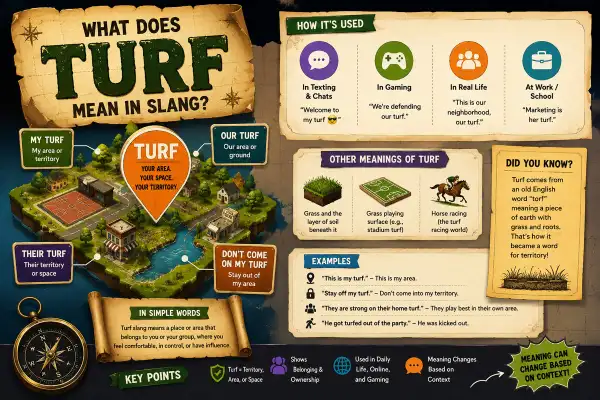
Turf meaning slang usually refers to a person’s area, neighborhood, or territory. People use “turf” in casual speech when talking about a place they know well.
It can also describe an area linked to a person or group. The meaning depends on the context .You may see “turf” in conversations, social media posts, sports, music, and movies. It can sound casual and friendly. In some situations, it can also suggest ownership or control of an area.
Quick Answer: What Does Turf Mean in Slang?
In slang, “turf” means an area, neighborhood, territory, or familiar place.
For example:
“This is my turf.”
This means:
“This is my area.”
The word does not always mean that someone owns the place. It can simply show that they know the area well or feel connected to it.
What Does Turf Mean in Slang?
The slang use of “turf” is common in casual English. It often describes a place that feels familiar to someone.
For example, a person may call their neighborhood their “turf.” A sports team may also call its home location its “turf.”
The word can have a few related meanings:
- An area someone knows well
- A neighborhood
- A familiar place
- A local area
- A group’s territory
- A place where someone feels comfortable
The exact meaning comes from the sentence.
Simple Meaning of Turf
The easiest way to understand “turf” is:
“Turf” means an area or territory.
It is an informal way to talk about a place. The word can sound more personal than the word “area.”
For example:
“This is my area.”
“This is my turf.”
Both sentences can share the same basic meaning. However, “my turf” sounds more casual.
What Does “My Turf” Mean?
“My turf” means “my area” or “my usual place.”
It can describe a neighborhood, workplace, sports location, hangout, or another familiar place.
For example:
“Let’s meet on my turf.”
This means:
“Let’s meet in my area.”
The speaker may know the place well. They may also feel comfortable there.
What Does Home Turf Mean?
“Home turf” means a familiar place where someone feels comfortable.
The phrase is common in sports.
For example:
“The team won on home turf.”
This means the team won at its usual home location.
People also use “home turf” outside sports.
For example:
“I feel confident on my home turf.”
This means the person feels confident in a place they know well.
Home Turf in Everyday Speech
“Home turf” does not always mean someone’s home.
It can refer to any familiar place.
For example:
“That café is my home turf.”
The speaker may visit the café often. They feel comfortable there.
This is why context matters when you see the phrase.
What Does Stay Off My Turf Mean?
“Stay off my turf” means “stay away from my area.”
The phrase can have different tones.
Someone may use it seriously when talking about territory. A person may also use it as a joke with friends.
For example:
“Stay off my turf. That’s my favorite seat!”
Here, the speaker is probably being playful.
The phrase becomes more serious when the conversation involves conflict over an area.
Is Turf a Slang Word?
“Turf” can be slang when it means an area or territory. However, the word also has regular meanings.
In its literal sense, “turf” can refer to grass and the layer of soil beneath it.
The word is also common in sports.
For example:
“The players are training on artificial turf.”
Here, “turf” refers to the playing surface.
Now compare it with:
“They are back on their turf.”
Here, “turf” means their area or territory.
Both sentences use the same word. The context changes the meaning.
Where Is Turf Used in Slang?
“Turf” appears in many types of casual communication.
You may see it in:
- Text messages
- Social media
- Sports conversations
- Music
- Movies
- TV shows
- Online discussions
- Everyday speech
The word is not limited to one platform.
In casual speech, it often means an area or familiar place. In sports, it can describe a playing surface or home location.
Turf in Everyday Conversations
People may use “turf” when talking about a local area.
For example:
“Welcome to my turf.”
This means:
“Welcome to my area.”
The phrase can sound friendly and casual.
Turf in Sports
Sports use “turf” in a few ways.
It can mean the surface of a field. It can also mean a team’s home area.
For example:
“The players are ready for their home turf.”
The phrase suggests that the team is playing in a familiar location.
Turf in Online Conversations
People can also use “turf” in posts and messages.
For example:
“Back on my turf!”
This may mean someone has returned to their neighborhood, city, favorite place, or usual space.
The context tells you what the person means.
Does Turf Mean Neighborhood?
Yes, “turf” can mean neighborhood.
For example:
“This is my turf.”
A person may use this sentence to mean:
“This is my neighborhood.”
Still, “turf” has a broader meaning than “neighborhood.”
A neighborhood is usually a local residential area. Turf can describe many types of places.
For example:
“That gym is my turf.”
Here, “turf” means a familiar place.
So, turf can mean a neighborhood, but it does not always mean one.
Does Turf Mean Territory?
Yes, “turf” can also mean territory.
This use appears when an area is connected to a person or group.
For example:
“They want to protect their turf.”
Here, “turf” means their territory.
This use can sound more serious than the casual meaning.
Still, the word itself is not automatically negative. The surrounding conversation determines the tone.
How Is Turf Used in Different Contexts?
The meaning of “turf” can change with the situation. The basic idea stays connected to an area, place, or territory.
Understanding the context makes the meaning easier to identify.
Turf in Casual Conversations
In daily speech, “turf” often means someone’s local area.
For example:
“I know this turf pretty well.”
The speaker means they know the area well.
Another example is:
“Come hang out on my turf.”
This means:
“Come spend time in my area.”
The tone is usually casual.
Turf in Sports
Sports use the word “turf” quite often.
It can describe the surface of a field.
For example:
“The players are used to this turf.”
Here, the word refers to the playing surface.
Sports also use “home turf” to describe a team’s home location.
For example:
“They are stronger on home turf.”
This means the team often performs well at its home location.
Turf in Music
The word “turf” can appear in songs and music discussions.
In this setting, it may describe a neighborhood, local area, or territory.
For example:
“This is our turf.”
The speaker may be referring to an area connected to their community or group.
The exact meaning depends on the song and its context.
Turf in Movies and TV Shows
Characters may use “turf” when discussing an area.
For example:
“You are walking into our turf.”
This may mean:
“You are entering our area.”
The phrase can sound serious in a dramatic scene.
In a light scene, it may simply be a playful way to describe a familiar place.
What Does On My Turf Mean?
“On my turf” means “in my area.”
The phrase can describe a physical place.
For example:
“You are on my turf now.”
This may mean the person is visiting an area that the speaker knows well.
It can also have a figurative meaning.
For example:
“She is on her turf when she talks about science.”
Here, “turf” means an area of knowledge or expertise.
The person feels comfortable because they know the subject well.
What Does On Their Turf Mean?
“On their turf” means “in their area.”
The phrase often suggests that someone is in a place where another person feels comfortable or has an advantage.
For example:
“We are playing on their turf.”
In sports, this means the other team is playing at home.
In everyday speech, it can mean entering another person’s familiar environment.
For example:
“I visited her on her turf.”
This means the visit happened in a place she knows well.
What Does Back on My Turf Mean?
“Back on my turf” means returning to a familiar area.
For example:
“After a long trip, I am back on my turf.”
The speaker means they have returned to a place they know well.
The phrase can also describe returning to a familiar activity.
For example:
“He is back on his turf at the new job.”
This can mean he is working in an area where he has strong knowledge or experience.
So, “turf” can describe both a physical place and a familiar field.
What Does Defend Your Turf Mean?
“Defend your turf” means protecting your area, position, or interests.
The phrase does not always mean physical defense.
For example:
“She had to defend her turf during the debate.”
Here, “turf” can mean her area of knowledge or expertise.
In sports, the phrase can have a more direct meaning.
For example:
“The team needs to defend its home turf.”
This means the team needs to protect its home advantage.
The phrase can also appear in business and work settings.
For example:
“Two teams are defending their turf.”
Here, it may mean they are protecting their roles or responsibilities.
What Does Turf War Mean?
A “turf war” is a conflict over an area, position, or control.
The phrase can have a literal meaning.
For example:
“The two groups entered a turf war.”
Here, the phrase suggests a dispute over territory.
It can also have a figurative meaning.
For example:
“The departments had a turf war over the project.”
This means the departments disagreed about who should control the project.
So, “turf war” does not always involve a physical location.
It can describe competition over control or responsibility.
Is Turf the Same as Territory?
“Turf” and “territory” can have similar meanings.
Both words can describe an area linked to someone.
However, their tone is different.
“Turf” sounds more casual.
“Territory” can sound more formal or serious.
Compare these examples:
“This is my turf.”
“This is my territory.”
The first sentence sounds informal.
The second sentence sounds stronger.
In casual conversations, “turf” often feels more natural.
Is Turf the Same as Area?
“Turf” and “area” can also have similar meanings.
“Area” is more general.
“Turf” often adds a sense of familiarity or connection.
For example:
“This is my area.”
This simply identifies a place.
“This is my turf.”
This can suggest that the speaker knows the place well.
The second sentence sounds more personal.
Is Turf Offensive?
“Turf” is not an offensive word by itself.
Most uses are neutral or casual.
Still, some phrases can sound stronger.
For example:
“Stay off my turf.”
This can sound like a warning.
Another example is:
“They are fighting over their turf.”
This suggests a conflict.
The meaning comes from the full sentence.
You should not assume that every use of “turf” is negative.
When Should You Use Turf?
“Turf” works best in casual settings.
You can use it in:
- Friendly conversations
- Casual texts
- Social media posts
- Sports discussions
- Creative writing
- Informal content
For formal writing, a clearer word may work better.
For example, use “area” when you need a neutral term.
Use “territory” when you need a more precise term.
The best choice depends on your audience.
When Should You Avoid Turf?
Avoid slang when the meaning needs to be very clear.
For example, a formal report may be easier to understand with “area” instead of “turf.”
Instead of:
“The company expanded into new turf.”
You could write:
“The company expanded into a new area.”
This version is more direct.
You should also avoid unclear slang when writing for people who may not know the expression.
Clear language is usually better in formal communication.
Where Did the Slang Meaning of Turf Come From?
The word “turf” has a long history in English.
Its original meaning was linked to land covered with grass and roots. Over time, the idea of land became linked with a person’s area or territory.
This led to the informal use of “turf” for a place connected to someone.
Today, “turf” can mean a neighborhood, local area, familiar place, or territory.
The word also remains common in its original sense. For example, people use “turf” when talking about grass and sports fields.
Why Do People Use Turf in Slang?
People use “turf” because it is short and casual.
It can show that someone knows an area well. It can also show a strong connection to a place.
For example:
“This is my turf.”
This sounds more casual than:
“This is my area.”
The word can also make speech sound more natural in friendly conversations.
What Are Some Similar Slang Words for Turf?
Several words can have a similar meaning to “turf.”
Area
“Area” is a simple and neutral word.
Example:
“This is my area.”
Territory
“Territory” can describe an area linked to a person or group.
Example:
“They returned to their territory.”
Zone
“Zone” can describe a specific place or area.
Example:
“This is our zone.”
Neighborhood
“Neighborhood” works when “turf” refers to a local community.
Example:
“He knows the neighborhood well.”
Home Ground
“Home ground” is close in meaning to “home turf.”
Example:
“The team is playing on its home ground.”
The best replacement depends on the sentence.
Can Turf Be Used as a Verb?
Yes, “turf” can also be used as a verb.
This use has a different meaning from “turf” as an area.
For example:
“He got turfed out.”
This means he was removed or forced to leave.
The phrase “turfed out” is informal. It can mean that someone was asked to leave a place.
Another example is:
“They turfed him out of the building.”
This means they removed him from the building.
So, “turf” can work as both a noun and a verb.
What Does Turfed Mean in Slang?
“Turfed” can mean removed, kicked out, dismissed, or forced to leave.
For example:
“She got turfed out of the club.”
This means she was forced to leave the club.
The meaning can change slightly based on the situation.
This use is different from:
“This is my turf.”
In that sentence, “turf” means an area.
Is Turf Common in Texting?
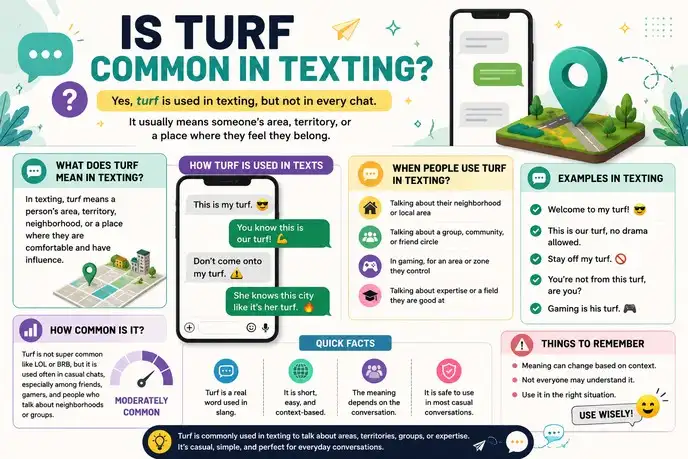
Yes, people can use “turf” in texts.
A message may say:
“Come to my turf later.”
This means:
“Come to my area later.”
Another message could say:
“Back on my turf!”
This may mean the person has returned to a familiar place.
The meaning is usually easy to understand from the rest of the conversation.
What Does Turf Mean in Chat?
In chat, “turf” usually means an area, territory, neighborhood, or familiar space.
For example:
“This is my turf.”
The person may be talking about their neighborhood.
They may also be talking about a game, workplace, or favorite location.
The conversation gives you the clue.
When Should You Avoid Using Turf?
“Turf” works well in casual speech.
It may not be the best choice for formal writing.
For example, a business report may sound clearer with “area” instead of “turf.”
Instead of:
“The company entered new turf.”
You could write:
“The company entered a new area.”
Clear words work better when the audience may not know slang.
You should also avoid using “turf” when the meaning could be unclear.
Real-Life Examples of Turf Meaning Slang
Here are some simple examples of how people may use “turf.”
“Welcome to my turf.”
Meaning: Welcome to my area.
“This neighborhood is my turf.”
Meaning: This is an area I know well.
“Let’s meet on your turf.”
Meaning: Let’s meet in your area.
“The team is back on home turf.”
Meaning: The team is playing at its usual home location.
“Stay off my turf.”
Meaning: Stay away from my area.
“He knows this turf well.”
Meaning: He knows this area well.
“She is on her home turf.”
Meaning: She is in a place where she feels comfortable.
“They are defending their turf.”
Meaning: They are protecting their area, position, or interests.
“He got turfed out.”
Meaning: He was removed or forced to leave.
FAQs About Turf Meaning Slang
Q1. What is turf slang for?
Turf slang usually means a person’s territory, neighborhood, or familiar area. It can also mean a place where someone has influence or feels comfortable.
Q2. What does “my turf” mean?
“My turf” means my area, territory, neighborhood, or familiar place. For example, “This is my turf” means “This is my area.”
Q3. What does turfed mean in slang?
“Turfed” can mean removed, kicked out, dismissed, or forced to leave. For example, “He got turfed out” means he was kicked out.
Q4. What is the definition of turf?
Turf means grass and the layer of soil beneath it. It can also mean a particular area or territory connected to someone.
Q5. What is turf in chat?
In chat, turf usually means someone’s area, territory, neighborhood, or familiar space. Its exact meaning depends on the conversation and context.
Q6. What is the other meaning of turf?
Besides territory, turf can mean grass-covered soil or a grass playing surface. It can also refer to horse racing in some contexts.
Q7. What is turf in English?
In English, turf commonly means a layer of grass and soil. It can also describe a territory, area, or place associated with someone.
Q8. Why is it called turf?
Turf originally referred to a piece of earth covered with grass and roots. Over time, the idea of land became linked with territory and personal areas.
Q9. What is turf also called?
When turf means grass and soil, it is also commonly called sod. For the territory meaning, similar words include area, zone, domain, and territory.
Conclusion
The slang meaning of “turf” is usually an area, neighborhood, territory, or familiar place.
“My turf” means “my area.” “Home turf” means a familiar place. “On their turf” means being in another person’s area.
The word can also have a literal meaning. It can refer to grass and the soil beneath it. In sports, it can describe a playing surface.
“Turf” can also appear as a verb. “Turfed out” means removed or forced to leave.
The best way to understand “turf” is to check the context. In casual speech, it usually refers to a place, area, or territory connected to someone.
Related Slang Terms:
Illinois Slang: Common Words, Meanings, and Examples

I am Masson Caldwell, a language enthusiast and content writer at SlangAura. I write about internet slang, texting trends, and modern expressions to help readers understand the evolving world of online language with simple and clear explanations.