GOT meaning in text usually depends on the conversation, but it most commonly means “got,” the past tense of “get.” People use it in messages to say they received something, understood an idea, obtained something, or experienced an event. For example, “I got your message” means the person received your message, while “Got it” means “I understand.”
The word GOT is common in everyday texting, social media comments, online chats, and casual conversations. Unlike many internet abbreviations, GOT is not always an acronym. Its meaning often comes from the sentence around it, so understanding the context helps you interpret it correctly.
Quick Answer: What Does GOT Mean in Text?
GOT usually means “received,” “obtained,” “understood,” or “became,” depending on the sentence. It is the past tense of “get” and is widely used in informal digital communication.
Examples include:
- “Got your text” : I received your message.
- “Got it” : I understand.
- “I got a new phone” : I obtained or bought a new phone.
- “You got this!” : You can do it.
- “What have you got?” : What do you have?
In most conversations, GOT has its ordinary English meaning rather than a special slang definition.
What Does GOT Stand For in Texting?
GOT does not have one standard full form in everyday texting. It is generally a regular English word written in capital letters for emphasis, convenience, or stylistic reasons.
Its meaning changes according to how someone uses it.
1. GOT Means Received
People often use GOT to confirm that they received a message, photo, file, or other information.
For example:
- “Got your email.”
- “I got the pictures.”
- “Got your message, thanks!”
These sentences tell the other person that something arrived successfully. In casual texting, people may leave out the subject to make the message shorter.
2. GOT Means Understood
GOT can also show that someone understands an instruction, explanation, or request.
For example:
- “Got it.”
- “Got what you mean.”
- “Okay, got it now.”
In this context, the word communicates understanding. It may also signal that the conversation can move forward because the person understands what was said.
3. GOT Means Obtained or Acquired
When someone talks about getting a possession, opportunity, or item, GOT can mean obtained or acquired.
Examples:
- “I got new shoes.”
- “She got a job.”
- “We got tickets for the concert.”
The exact meaning depends on the situation. A person might have purchased something, received it as a gift, or obtained it another way.
4. GOT Means Experienced or Became
GOT can describe a change in condition or an experience.
Examples:
- “I got tired.”
- “He got angry.”
- “She got sick yesterday.”
Here, GOT describes a change in someone’s state or condition. It does not mean that the person received an object.
How People Use GOT in Text Messages
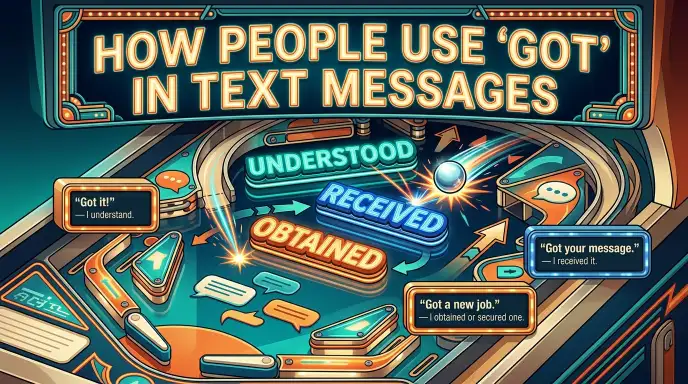
GOT appears in many kinds of conversations because it is a common English verb. People use it to answer questions, confirm information, describe events, and encourage friends.
In Everyday Conversations
Friends and family members may use GOT to confirm plans or share information.
Example:
Person A: “Did you get the address?”
Person B: “Yeah, got it.”
The reply means the person received the address and understands what was sent.
In Short Replies
Sometimes, people use GOT as part of a short response instead of writing a complete sentence.
Examples:
- “Got it.”
- “Gotcha.”
- “Got your point.”
- “Got the details.”
These replies are informal and convenient. However, “gotcha” can sound playful or slightly sarcastic depending on the tone and relationship.
In Emotional Conversations
GOT can also appear when people describe feelings or changes in a relationship.
Examples:
- “I got worried when you didn’t reply.”
- “You got me smiling.”
- “I got upset about what happened.”
These phrases describe emotional reactions. Their meaning comes from the complete sentence rather than from GOT alone.
GOT Meaning on TikTok, Snapchat, and Instagram
GOT does not have one special meaning across every social media platform. Its usual English meanings remain common in comments, captions, direct messages, and videos.
GOT Meaning on TikTok
On TikTok, GOT may appear in comments about a video, a creator’s explanation, or a personal experience.
Examples:
- “Got me laughing.”
- “I got the reference.”
- “You got this!”
The first example means the content made someone laugh. The second means the person understood a reference, while the third offers encouragement.
Some videos may use GOT as part of a meme, quote, or trend. In those cases, the surrounding content helps explain the intended meaning.
GOT Meaning on Snapchat
On Snapchat, people may use GOT in direct messages or when confirming that they received a Snap or other information.
Examples:
- “Got your snap.”
- “Got it, thanks.”
- “Got the streak reminder.”
These are ordinary conversational uses, not official Snapchat specific definitions. GOT itself does not automatically indicate a streak, secret message, or romantic interest.
GOT Meaning on Instagram
On Instagram, GOT can appear in comments, Reels discussions, captions, and DMs.
Examples:
- “Got the reference 😂”
- “You got this!”
- “Got your message.”
Depending on the context, it may express understanding, encouragement, or confirmation that a message was received.
Different Meanings of GOT Based on Context
The easiest way to understand GOT is to examine the words around it.
| Text message | Meaning |
| “Got it” | I understand. |
| “Got your message” | I received your message. |
| “I got a gift” | I received or obtained a gift. |
| “I got tired” | I became tired. |
| “You got this” | You can do it. |
| “You got me” | You caught me, understood me, or affected me, depending on context. |
| “Got caught” | Was caught doing something. |
| “I’ve got time” | I have time. |
Notice that the same word can express different ideas. Therefore, avoid assuming that GOT always means “received” when you read it in a message.
Is GOT an Acronym or Slang Word?
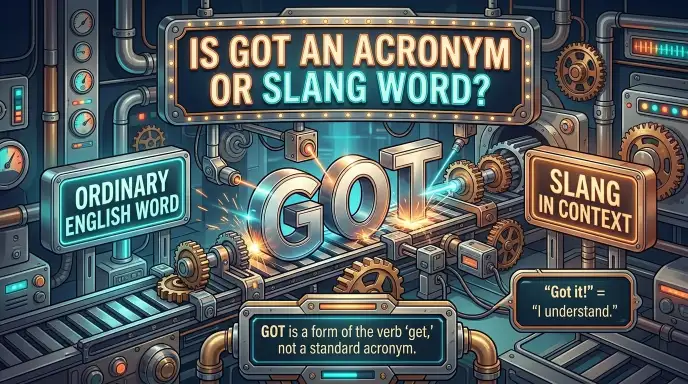
GOT is usually an ordinary English word, not a texting acronym. People may capitalize it because they are typing in uppercase, emphasizing a point, or using a particular writing style.
However, GOT can have specialized meanings outside everyday texting. For example, GOT is widely used as an abbreviation for Game of Thrones, the fantasy television series. In a conversation about television, books, characters, or entertainment, this may be the intended meaning.
The context makes the difference:
- “Got your message” : the ordinary verb.
- “I love GOT” : possibly Game of Thrones, especially in an entertainment discussion.
- “You got this!” : an encouraging expression.
Capitalization alone does not prove that a word is an acronym. Read the complete message before deciding what the sender means.
How to Reply When Someone Texts GOT
Your response depends on the message that contains GOT. In many cases, no additional reply is necessary because “Got it” already confirms understanding.
If Someone Says “Got It”
You can respond naturally with:
- “Perfect!”
- “Thanks for confirming.”
- “Great, let me know if you need anything.”
- “Okay 😊”
If Someone Says “Got Your Message”
You could reply:
- “Thanks for letting me know.”
- “Great, I’ll wait for your response.”
- “Perfect, talk soon!”
If Someone Says “You Got This!”
This phrase is usually encouraging. You might answer:
- “Thank you! I appreciate it.”
- “I’ll give it my best.”
- “Thanks for believing in me!”
If Someone Says “You Got Me”
Check the context before replying. It could mean that the person caught you in a mistake, understood your point, surprised you, or made you laugh.
Possible responses include:
- “Haha, you caught me!”
- “Exactly!”
- “What do you mean?”
If the message is unclear, asking a simple follow up is better than guessing.
Common Mistakes When Understanding GOT
Although GOT is a familiar word, readers can misunderstand it when they ignore the sentence around it.
Assuming GOT Always Means Received
GOT can mean received, but it can also mean understood, obtained, became, or experienced something.
For example, “I got nervous” means “I became nervous,” not “I received nervousness.”
Treating GOT as a Universal Acronym
GOT does not have one universally accepted texting full form. It is normally the past tense of “get.” In entertainment discussions, it may refer to Game of Thrones, but that interpretation depends on context.
Confusing “Got It” With “Got You”
“Got it” generally means “I understand” or “I received it.” “Got you” may mean “I understand you,” “I caught you,” or “I’ll help you,” depending on the conversation.
Reading Too Much Into a Short Reply
A message such as “got it” is not automatically rude, cold, or angry. Some people simply prefer short replies. Consider the person’s usual texting style and the conversation before interpreting their tone.
Real Life Examples of GOT Meaning in Text
These realistic examples show how GOT works in different conversations.
Example 1: Confirming a Message
Friend A: “I sent you the homework notes.”
Friend B: “Got them, thanks!”
Meaning: Friend B received the notes.
Example 2: Understanding Instructions
Person A: “Submit the form before Friday.”
Person B: “Got it.”
Meaning: Person B understands the instruction.
Example 3: Talking About a Purchase
Friend A: “Is that a new laptop?”
Friend B: “Yeah, I got it yesterday.”
Meaning: Friend B obtained or purchased the laptop.
Example 4: Expressing a Feeling
Person A: “Why did you leave the party early?”
Person B: “I got tired.”
Meaning: Person B became tired.
Example 5: Encouraging Someone
Friend A: “I’m nervous about my exam.”
Friend B: “You got this! Just stay calm.”
Meaning: Friend B believes the person can succeed.
Example 6: Discussing a TV Show
Person A: “Have you watched GOT?”
Person B: “Yes, I finished the series.”
Meaning: In this entertainment context, GOT likely refers to Game of Thrones.
Example 7: Reacting to a Joke
Friend A: “You believed that story? 😂”
Friend B: “Okay, you got me.”
Meaning: Friend B admits that the other person fooled or caught them.
Example 8: Describing a Sudden Change
Person A: “Why are you so quiet?”
Person B: “I got upset earlier.”
Meaning: Person B became upset because of something that happened.
Frequently Asked Questions About GOT Meaning in Text
Q1. What does GOT mean in text messages?
GOT usually means “received,” “obtained,” or “understood.” It is the past tense of “get,” and the exact meaning depends on the sentence.
Q2. What does “got it” mean in texting?
“Got it” generally means “I understand” or “I received the information.” People use it to acknowledge instructions, messages, or explanations.
Q3. What does “you got this” mean in a text?
“You got this” is an encouraging phrase that means “You can do it.” People use it to support someone who feels nervous or faces a challenge.
Q4. Is GOT a slang abbreviation?
Usually, no. GOT is commonly the ordinary English word “got,” rather than an abbreviation. It may stand for Game of Thrones in entertainment related conversations.
Q5. What does GOT mean on Snapchat?
On Snapchat, GOT generally has the same meaning it has elsewhere, such as receiving a Snap or understanding a message. It is not a universal Snapchat specific abbreviation.
Q6. What does GOT mean on TikTok?
On TikTok, GOT may mean received, understood, or became, depending on the sentence. For example, “got me laughing” means that something made the person laugh.
Q7. Does GOT mean “Game of Thrones”?
Yes, GOT can stand for Game of Thrones, especially when people discuss the television series, its characters, or its story. In ordinary messages, it is often just the verb “got.”
Q8. Is “got it” rude?
Not necessarily. “Got it” is usually a neutral way to acknowledge information. It may sound abrupt in some situations, but the sender’s tone and usual communication style matter.
Q9. What is the difference between GOT and GET?
GET is the base form of the verb, while GOT is its past tense form in many varieties of English. For example, “I get your messages” describes a general situation, while “I got your message” refers to a past event.
Q10. How can I understand GOT in an unclear message?
Read the complete sentence and consider the conversation topic. If the meaning is still uncertain, ask the sender what they mean instead of assuming that GOT is an acronym.
Conclusion
GOT meaning in text usually relates to receiving something, understanding information, obtaining an item, or experiencing a change. It is a common English word that appears in everyday messages, social media comments, captions, and online conversations.
The phrase surrounding GOT determine its meaning. “Got it” usually confirms understanding, “got your message” confirms receipt, and “you got this” encourages someone to succeed. In discussions about television, GOT may also refer to Game of Thrones.
Remember that GOT is not generally a texting acronym with one fixed full form. To understand it accurately, consider the context, read the entire message, and look at how the sender uses the word.
💬 Keep Discovering New Slang:
GOS Meaning in Text: Definition, Uses, and Examples
Gooning Meaning in Text: Definition, Uses, and Examples
Goon Meaning in Text: Uses, Examples, and Social Media Context

I am Masson Caldwell, a language enthusiast and content writer at SlangAura. I write about internet slang, texting trends, and modern expressions to help readers understand the evolving world of online language with simple and clear explanations.