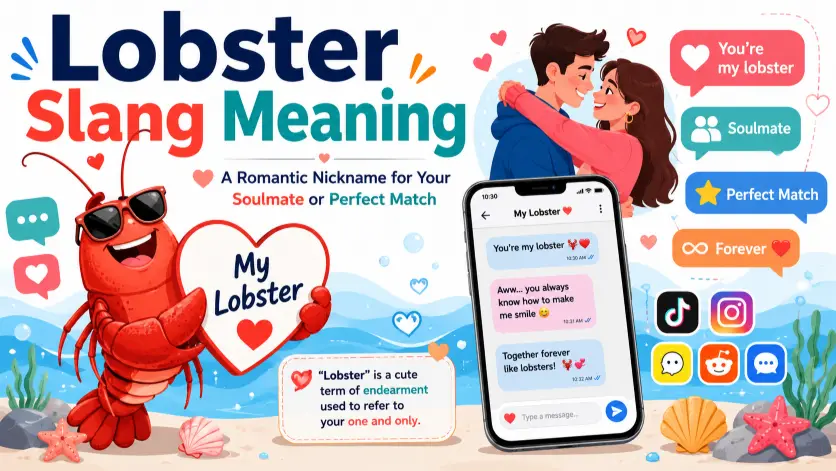
Lobster slang is an informal expression that can have different meanings depending on the conversation. Most commonly, “lobster” is used as a nickname for someone believed to be a person’s perfect life partner or soulmate.
If you are searching for lobster meaning slang, the term can have different meanings depending on the context.In other situations, it can simply refer to a person’s appearance, behavior, or become an inside joke among friends. Because the meaning changes with context, it is important to understand how the word is being used before responding.
Many people search for lobster slang after seeing it on TikTok, Instagram, Reddit, Snapchat, or in text messages. They want to know if it is romantic, funny, or something else entirely. This guide explains the different meanings of lobster slang, where it is commonly used, if it is offensive, and how to use it correctly in everyday conversations.
Quick Answer: Lobster Slang
Lobster slang usually refers to a soulmate or perfect romantic match. The idea became widely known through pop culture and social media, although the exact origin of the belief is debated. In other contexts, “lobster” may simply be a playful nickname or an inside joke, so the intended meaning depends on the conversation.
What Does Lobster Slang Mean?
The meaning of lobster slang is not always the same. Unlike many internet abbreviations, it does not have one fixed definition.
The most common meanings include:
| Meaning | Tone | Common Context |
| Soulmate or lifelong partner | Romantic | Dating, relationships, TikTok |
| Cute nickname | Affectionate | Couples, close friends |
| Funny comparison | Humorous | Social media, memes |
| Inside joke | Casual | Friend groups, texting |
Most people today recognize lobster because of its connection to romance.
For example:
- “I think she’s finally found her lobster.”
- “He’s been my lobster since college.”
In these examples, lobster means someone who is considered a lifelong romantic partner.
Different Meanings of Lobster Slang
Because context matters, here are the main ways people use the word.
1. Lobster as a Soulmate ❤️
This is the best-known meaning.
Calling someone your lobster means you believe they are the person you are meant to be with for life.
This meaning became especially popular after it appeared in popular television and later spread across social media. Although people often repeat the claim that lobsters mate for life, marine scientists note that this is an oversimplification rather than a proven biological fact. Today, the phrase survives mainly as a romantic metaphor rather than a scientific statement.
Examples
- “After ten years together, they’re definitely each other’s lobster.”
- “I hope everyone finds their lobster someday.”
Tone
- Romantic
- Sweet
- Positive
- Affectionate
2. Lobster as a Cute Nickname
Some couples use lobster as a personal pet name.
Like “honey,” “babe,” or “love,” it becomes a unique nickname shared between two people.
Examples:
- “Morning, lobster!”
- “Miss you already, lobster.”
This meaning is less common but easy to understand when used between partners.
3. Lobster as a Joke or Meme
Online, people sometimes call someone a lobster just to be funny.
The joke may relate to:
- Bright red skin after sunburn
- Clumsy movements
- Funny costumes
- Random internet humor
Examples:
- “You forgot sunscreen you look like a lobster!”
- “That Halloween lobster costume was amazing.”
Here, the word is playful rather than romantic.
4. Lobster as an Inside Joke
Friend groups often create their own meanings.
Someone may be called lobster because of:
- A memorable event
- A funny nickname
- A gaming username
- A shared joke
Unless you know the story behind it, the meaning may not be obvious.
Where Is Lobster Slang Commonly Used?
You’ll mostly see lobster slang in informal conversations rather than formal writing.
| Platform | How It’s Used |
| TikTok | Romantic videos about finding “your lobster” |
| Couple captions and relationship posts | |
| Snapchat | Casual chats between friends or partners |
| Relationship discussions and pop culture conversations | |
| Text Messages | Nicknames, jokes, and flirting |
| Discord | Mostly humorous or inside jokes |
Relationship Posts
Many users write captions like:
- “Found my lobster ❤️”
- “Life is better with my lobster.”
These captions express commitment and affection.
Everyday Texting
Examples:
Person A: “How’s your lobster doing?”
Person B: “She’s great! We had dinner together.”
Here, “lobster” simply means boyfriend, girlfriend, husband, wife, or long-term partner.
Is Lobster Slang Rude, Offensive, or Harmless?
In most situations, lobster slang is harmless.
It is generally viewed as:
- Friendly
- Romantic
- Funny
- Lighthearted
Unlike many slang words, lobster is not considered offensive on its own.
However, context still matters.
For example:
- Calling your partner “my lobster” is usually sweet.
- Calling someone a lobster because of a painful sunburn may embarrass them, even if you mean it as a joke.
- Using the nickname with someone who does not understand the reference may cause confusion.
Is It Appropriate at Work?
Usually no, unless you’re joking with close coworkers who understand the context.
In professional emails, meetings, or formal communication, it is better to use clear and respectful language instead of relationship slang or playful nicknames.
Overall, lobster slang is best reserved for casual conversations, social media, close friendships, and romantic relationships rather than professional or academic settings.
Origin and History of Lobster Slang
The romantic meaning of lobster slang became widely known through popular culture, especially after the TV sitcom Friends used the idea that two people are “each other’s lobster.” In the episode, the phrase suggests that two people are destined to end up together.
Although many people believe the expression comes from the idea that lobsters mate for life, marine researchers say the claim is not entirely accurate. Lobsters do not form lifelong monogamous pairs in the way the saying suggests. Because of this, the phrase should be understood as a romantic metaphor, not a scientific fact.
How the Meaning Spread
The phrase continued to grow in popularity through:
- Romantic TV shows
- Social media posts
- TikTok relationship videos
- Instagram captions
- Online memes
- Everyday texting
Today, many younger users recognize “my lobster” without even knowing where the phrase originally became popular.
Why Do People Use Lobster Slang?
People use lobster slang because it expresses affection in a fun and memorable way. It often sounds warmer and more personal than simply saying “partner” or “boyfriend.”
Common reasons include:
- Showing love for a partner
- Referring to a soulmate
- Creating a unique nickname
- Sharing relationship jokes
- Joining online trends
- Referencing pop culture
The phrase also feels playful, making it popular in captions, comments, and casual conversations.
Real-Life Examples of Lobster Slang
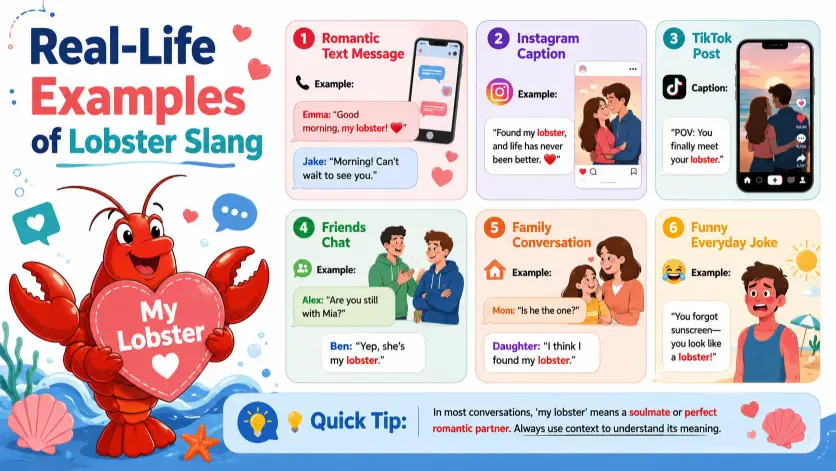
Here are realistic examples showing how the slang appears in different situations.
Text Message
Emma: Have you talked to your lobster today?
Jake: Yes! We’re meeting after work.
TikTok Caption
“POV: You finally found your lobster. ❤️”
Instagram Post
“Three years together and still my lobster.”
Conversation Between Friends
Alex: Are you still dating Mia?
Ben: Of course. She’s my lobster.
Family Conversation
Mom: Is that the person you always talk about?
Daughter: Yep. That’s my lobster.
Funny Example
Friend: You stayed in the sun too long.
Friend 2: I know I look like a lobster now.
Similar Slang and Related Terms
If you hear lobster slang, you may also come across these similar expressions.
| Term | Meaning | Tone |
| Soulmate | A perfect romantic match | Romantic |
| Better half | Your life partner | Affectionate |
| My person | Someone you deeply trust and love | Warm |
| Ride or die | Someone who always supports you | Loyal |
| Partner | Romantic companion | Neutral |
| Significant other | Romantic partner | Formal |
| Love of my life | Deep romantic affection | Emotional |
| Boo | Boyfriend or girlfriend | Casual |
| Bae | Romantic partner | Informal |
| Honey | Affectionate nickname | Friendly |
While these expressions have similar meanings, “my lobster” stands out because it carries a unique pop culture connection.
When Should You Avoid Using Lobster Slang?
Although lobster slang is usually harmless, it is not suitable in every situation.
Avoid using it when:
Professional Communication
Business emails and workplace meetings should use clear, formal language.
Instead of:
“I’ll bring my lobster to the company dinner.”
Say:
“I’ll bring my partner.”
School Assignments
Teachers generally expect standard English in essays and reports.
Formal Events
Wedding speeches, presentations, and official documents usually sound more natural with words like:
- spouse
- partner
- husband
- wife
When Someone Doesn’t Know the Expression
Not everyone understands the slang.
Using “lobster” without explanation may confuse older relatives or people unfamiliar with internet culture.
Polite Alternatives
Depending on the situation, you can replace lobster slang with more widely understood expressions.
| Informal | More Neutral |
| My lobster | My partner |
| My lobster | My spouse |
| My lobster | My boyfriend |
| My lobster | My girlfriend |
| My lobster | My significant other |
| My lobster | My fiancé or fiancée |
These alternatives work better in professional and formal settings.
Common Misunderstandings
Because lobster slang has more than one meaning, people sometimes misunderstand it.
“Does it always mean soulmate?”
No.
Sometimes it simply refers to:
- a funny nickname
- an inside joke
- a romantic partner
- someone with a sunburn
The surrounding conversation usually makes the meaning clear.
“Is it an official dating term?”
No.
It is an informal expression rather than an official relationship label.
“Is everyone familiar with it?”
Not necessarily.
People who have never watched relationship-focused shows or followed social media trends may not recognize the phrase.
“Does it have a negative meaning?”
Generally, no.
Most uses are positive, affectionate, or humorous. The only exception is when it is used to tease someone about looking red after too much sun, which is usually intended as lighthearted humor.
Frequently Asked Questions
Q1:What does lobster slang mean?
Lobster slang most commonly means a soulmate or lifelong romantic partner. The phrase “my lobster” is used to describe someone you believe you’re meant to be with. In other contexts, it can also be a playful nickname or part of an inside joke.
Q2:Does lobster slang have a full form?
No. Lobster is not an acronym or abbreviation, so it does not have a full form. It is simply a slang term whose meaning depends on the context.
Q3:Why do people call someone their lobster?
People call someone their lobster to show love, commitment, and a deep emotional connection. It’s a fun and affectionate way to say that someone is your perfect match or soulmate.
Q4:Is lobster slang used on TikTok?
Yes. You’ll often see lobster slang on TikTok, especially in videos about relationships, dating stories, and couple trends. Creators use it in captions like:
- “I finally found my lobster.”
- “POV: Your lobster walks into your life.”
Q5:Is lobster slang used in texting?
Yes. Friends and couples may use lobster in text messages as a nickname or romantic reference.
Example:
Alex: “How’s your lobster doing?”
Sam: “Great! We’re going out tonight.”
Q6:Is lobster slang appropriate for work?
Usually not.
While the term isn’t offensive, it’s very informal. In professional settings, it’s better to use words like partner, spouse, or significant other instead of lobster.
Q7:Is lobster slang offensive?
No. Lobster slang is generally considered harmless and affectionate. However, if it’s used to joke about someone’s appearance such as comparing a sunburn to a lobster it may come across as insensitive depending on the situation.
Q8:Is lobster slang still popular?
Yes, although it’s more common in relationship-related conversations than in everyday slang. It continues to appear in social media posts, memes, and videos, especially among people who enjoy romantic expressions and pop culture references.
Q9. What Does Lobster Mean in Slang?
“Lobster” can have different slang meanings depending on the context. In some conversations, it can describe a person, relationship, or situation in a playful or symbolic way, so the surrounding words help determine the intended meaning.
Conclusion
Lobster slang is a lighthearted expression that most often refers to a soulmate or lifelong romantic partner. Over time, it has grown beyond its pop culture roots and become a familiar phrase in texting, social media, and casual conversations.
Like many slang terms, its meaning depends on the context. It can be romantic, playful, or simply an inside joke between friends. Because of this, it’s always a good idea to consider who you’re speaking with and if they’ll understand the reference.
If you’re chatting with friends, posting on TikTok, Instagram, Snapchat, or sending a casual text, calling someone “my lobster” can be a warm and memorable way to express affection. In formal settings, however, choosing clearer terms like partner or spouse is usually the better option.
Understanding lobster slang helps you recognize its meaning wherever you see it and use it naturally when the moment is right.
Discover more articles:

I am Masson Caldwell, a language enthusiast and content writer at SlangAura. I write about internet slang, texting trends, and modern expressions to help readers understand the evolving world of online language with simple and clear explanations.