Cops slang is a common search because people often hear the word “cops” in movies, TV shows, rap lyrics, social media, and everyday conversations.
Someone might say, “The cops are outside,” or “Call the cops,” and you may wonder if it’s slang, rude, or simply another word for police officers.The term has been part of English for well over a century and is now widely recognized in many English-speaking countries. While it’s informal, most people use it without intending to offend anyone.
However, the tone and situation matter. In some contexts, it sounds completely natural, while in others, a more formal word like police officer is a better choice.This guide explains what cops slang means, where it came from, when to use it, and how people use it in real-life conversations.
Quick Answer:cops slang
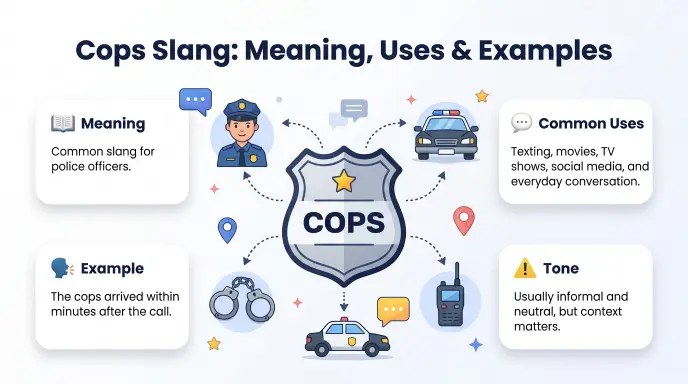
Cops is an informal slang term for police officers. It is commonly used in everyday speech, movies, texting, and social media and is generally considered neutral rather than offensive.
What Does Cops Slang Mean in Text?
In text messages and online conversations, cops simply means police officers or the police.
People use the word because it is shorter, more casual, and sounds natural in everyday English.
For example:
- The cops just arrived.
- Someone called the cops.
- The cops blocked the street.
- We saw two cops near the stadium.
Unlike many internet abbreviations, cops is not an acronym or texting abbreviation. It is simply an informal word that has become part of everyday language.
Different Meanings Depending on Context
The meaning stays almost the same, but the tone can change depending on the situation.
1. Referring to Police Officers
This is the most common meaning.
Example:
The cops responded quickly to the accident.
2. Movies and TV Shows
Crime dramas frequently use the word.
Example:
The cops are searching for the suspect.
3. Social Media and Texting
People often use “cops” when talking about police activity.
Examples:
- The cops closed the road.
- The cops showed up after the party.
4. Song Lyrics
Many rap, hip-hop, and country songs use “cops” because it sounds more conversational than “police officers.”
The tone depends on the artist and the message of the song.
Cops Full Form / Definition of the Slang
Many people search:
- Cops full form
- What does cops stand for?
- Cops meaning slang
The answer is simple:
Cops does not have a full form.
It is not an acronym like GOAT or LOL.
Instead, cops is an informal English word used to refer to police officers.
| Term | Meaning |
| Cops | Police officers |
| Police | Official law enforcement agency |
| Officer | Individual member of the police |
So if someone asks, “What does cops stand for?”, the correct answer is that it doesn’t stand for anything it’s simply a slang or informal word for police.
Is Cops Slang Rude, Offensive, or Neutral?
In most situations, cops is considered neutral and informal.
Most native English speakers use it naturally without any negative meaning.
Tone Guide
| Situation | Tone |
| Talking with friends | Neutral |
| Text messages | Casual |
| Movies | Common |
| News articles | Usually avoided |
| Professional writing | Too informal |
| Court or legal documents | Avoid |
Although the word itself is not offensive, the way someone says it can make it sound respectful or disrespectful.
For example:
Respectful:
The cops helped direct traffic.
Negative:
The cops ruined everything.
The word stays the same, but the attitude changes.
Where Is Cops Slang Commonly Used?
“Cops” is widely used both online and offline.
You’ll often see or hear it in:
- Everyday conversations
- Text messages
- TV shows
- Movies
- Crime documentaries
- YouTube videos
- Reddit discussions
- TikTok videos
- Instagram captions
- Facebook posts
- Podcasts
- News interviews (especially quotations)
It is much less common in formal government announcements or official police statements, where terms like police or police officers are preferred.
Origin and Background of Cops Slang
The exact origin of the word “cop” is not completely certain, but language experts generally agree that it has been used for more than 150 years.
One popular explanation is that it comes from the old English verb “to cop,” meaning “to catch” or “to seize.” Since police officers catch lawbreakers, the nickname gradually became associated with them.
Another theory links the word to the Latin capere, which also means “to seize.” While the exact history is debated, there is broad agreement that “cop” was not originally an acronym and has long been part of informal English.
Today, cop and cops are recognized around the world through movies, television, music, books, and everyday conversation.
Why Do People Use Cops Slang?
People use cops because it is:
- Short and easy to say
- Common in everyday English
- Widely understood
- Natural in casual conversations
- Frequently heard in entertainment and social media
Instead of saying:
“The police officers arrived.”
Many people naturally say:
“The cops arrived.”
The meaning stays the same, but the sentence feels more conversational.
Real-Life Examples of Cops Slang
Here are examples showing how people use cops in different situations.
Friendly Conversation
- The cops helped us find our lost dog.
- We asked a cop for directions.
- The cops were really helpful after the accident.
Casual Texting
Alex: Why is traffic stopped?
Sam: The cops closed the highway.
Text Message
Emma: Did you hear those sirens?
Jake: Yeah, I think the cops are nearby.
Social Media Examples
Instagram:
Saw the cops directing traffic after the concert.
TikTok:
The cops showed up five minutes after the fireworks started.
Reddit:
The cops handled the situation professionally.
Movie or TV Dialogue
- Call the cops!
- The cops are on their way.
- The cops caught the suspect before he escaped.
News-Style Conversation
- Witnesses said the cops arrived within minutes.
- Several cops responded to the emergency call.
Comparison with Similar Terms
| Term | Meaning | Tone | Common Use |
| Cops | Informal word for police officers | Neutral | Everyday conversation |
| Police | Official law enforcement | Formal | News, government, legal documents |
| Police Officers | Individual members of the police | Formal | Professional settings |
| Officers | Short for police officers | Neutral | Everyday speech |
| Law Enforcement | Police and related agencies | Formal | News and official writing |
| The Police | Police department or force | Neutral | General communication |
Among these, cops is the most casual and conversational.
What Does Cops Stand For?
Many people search online:
- Cops full form
- What does cops stand for?
- Cops meaning slang
The answer is straightforward:
Cops does not stand for anything.
Unlike abbreviations such as:
- LOL
- GOAT
- BRB
- IMO
Cops is simply an informal English word that means police officers.
Is Cops Always Neutral?
Usually, yes.
Most people use cops without any negative meaning.
Examples:
- The cops helped everyone leave safely.
- Two cops were directing traffic.
- The cops solved the case quickly.
However, depending on the speaker’s tone, it can sound critical or disrespectful.
For example:
“The cops never listen.”
Here, the negative feeling comes from the sentence—not from the word cops itself.
Always pay attention to the surrounding words and the speaker’s attitude.
When Should You Avoid Using Cops Slang?
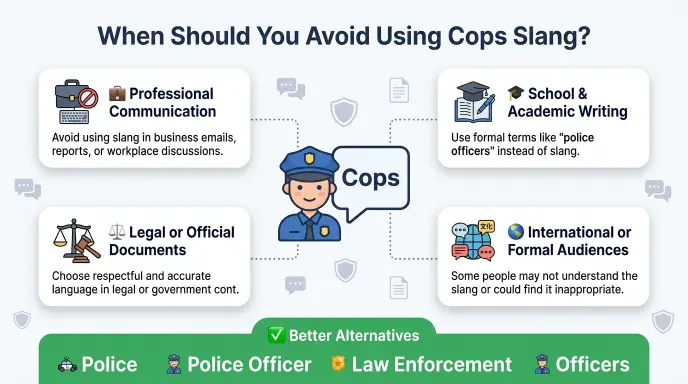
Although cops is widely understood and generally acceptable, it isn’t appropriate in every situation. In formal or professional settings, using the official term police officers is usually a better choice.
Professional Emails
When writing to a government office, law enforcement agency, or employer, avoid informal slang.
Instead of:
The cops responded quickly.
Write:
The police officers responded quickly.
or
The police responded quickly.
Academic Writing
Research papers, essays, and school assignments should use formal language.
Instead of:
The cops investigated the case.
Write:
The police investigated the case.
Legal or Official Documents
Legal reports, witness statements, and official records should always use the formal term police or police officers.
Speaking with People Who Prefer Formal Language
Some people, especially in professional environments, may consider cops too casual. In those cases, using the formal term shows respect and professionalism.
Polite Alternatives to Cops
If you want a more formal or respectful option, consider these alternatives.
| Alternative | Best Used For |
| Police | General formal communication |
| Police Officer | Professional writing |
| Law Enforcement | News and official reports |
| Officer | Everyday respectful conversation |
| Police Department | Referring to the organization |
| Authorities | Official announcements |
These alternatives work well in situations where slang may not be appropriate.
Impact of Using Slang in Communication
Using cops instead of police officers can make a conversation sound more natural and relaxed.
Positive Effects
- Makes conversations feel casual.
- Easier to say and type.
- Common in movies and TV shows.
- Familiar to most English speakers.
- Fits naturally in texting and social media.
Possible Drawbacks
- May sound too informal in professional settings.
- Not ideal for legal or academic writing.
- Some readers may prefer more formal language.
Choosing the right word depends on your audience and the context.
Is Cops Safe for Social Media?
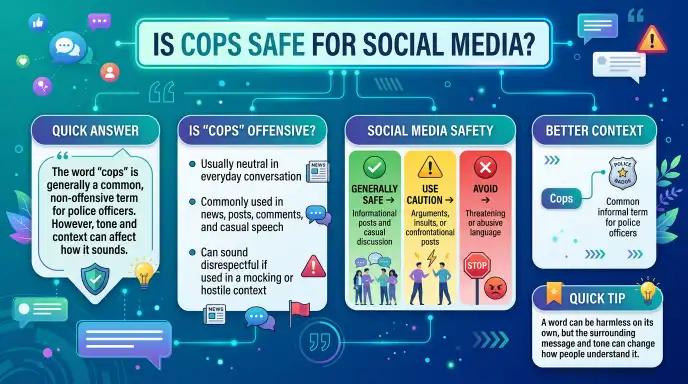
Yes. Cops is generally considered safe to use on social media.
It is commonly used on:
- TikTok
- Discord
- Snapchat
- X (formerly Twitter)
- YouTube
The word itself is not offensive. However, the tone of the post matters. Respectful discussions about police are very different from posts that use insulting or hostile language.
Common Mistakes People Make
Here are some common misunderstandings about cops slang.
Mistake 1: Thinking “Cops” Is an Acronym
Many people search for a cops full form, but cops is not an abbreviation. It does not stand for anything.
Mistake 2: Using It in Formal Writing
While “cops” is common in conversation, official documents should use police or police officers instead.
Mistake 3: Assuming It’s Always Offensive
Some people believe the word is disrespectful, but in most everyday conversations, cops is simply an informal and widely accepted term for police officers.
Tips for Using Cops Correctly
To use the term naturally and appropriately:
- Use it in casual conversations.
- Choose police in formal writing.
- Consider your audience before using slang.
- Avoid using it in legal or academic documents.
- Keep your tone respectful, especially when discussing serious topics.
Examples in Different Contexts
Friendly
Liam: I lost my wallet.
Emma: Ask one of the cops nearby. They might be able to help.
Casual Conversation
Alex: Why is everyone stopping?
Sam: The cops are directing traffic ahead.
Argumentative
Person 1: I think the cops handled the situation well.
Person 2: I see it differently, but everyone has their own opinion.
Social Media
The cops arrived within minutes and helped everyone stay safe.
Huge thanks to the cops for managing traffic after the event.
Text Message
Chris: Why is the road closed?
Jordan: The cops are investigating an accident.
Frequently Asked Questions (FAQs)
Q1.What does cops mean in slang?
Cops is an informal slang term for police officers. It is commonly used in everyday conversations, text messages, movies, and social media.
Q2.What does cops stand for?
Nothing. Cops is not an acronym and does not have a full form. It is simply an informal English word that means police officers.
Q3.Is “cops” a rude word?
No. In most situations, cops is considered neutral and informal, not rude. However, the tone of the conversation can make it sound respectful or disrespectful.
Q4.Is it okay to say “cops” in everyday conversation?
Yes. Many native English speakers use cops naturally when talking with friends, family, or coworkers in casual settings.
Q5.Should I use “cops” in professional writing?
No. In formal writing, business communication, legal documents, and academic work, it’s better to use police or police officers instead.
Q6.Is “cop” the same as “police officer”?
Yes. Cop refers to one police officer, while cops refers to two or more police officers or the police collectively.
| Term | Meaning |
| Cop | One police officer |
| Cops | More than one police officer or the police in general |
| Police Officer | Formal term for one officer |
| Police | Official law enforcement organization |
Key Takeaways
Here are the main things to remember about cops slang:
- Cops is an informal word for police officers.
- It does not have a full form or stand for anything.
- The term is widely used in movies, TV shows, texting, and social media.
- It is generally neutral, not offensive.
- Context and tone determine if it sounds respectful.
- Use police or police officers in formal, legal, or academic settings.
- Most English speakers understand and use the word naturally in casual conversation.
Conclusion
The term cops slang simply refers to the informal word “cops,” which means police officers. It has been part of everyday English for many years and is commonly heard in conversations, movies, television, news interviews, social media, and text messages.
Although cops is casual rather than formal, it is generally not considered rude or offensive. Most people use it as a convenient and familiar way to refer to law enforcement. As with any slang, context is important. It’s perfectly suitable in everyday conversations, but in professional, academic, or legal settings, using police or police officers is the better choice.
Now that you understand the cops meaning slang, its background, common usage, and appropriate contexts, you can recognize and use the term confidently while choosing the right wording for every situation.
Descover more articles!

I am Masson Caldwell, a language enthusiast and content writer at SlangAura. I write about internet slang, texting trends, and modern expressions to help readers understand the evolving world of online language with simple and clear explanations.