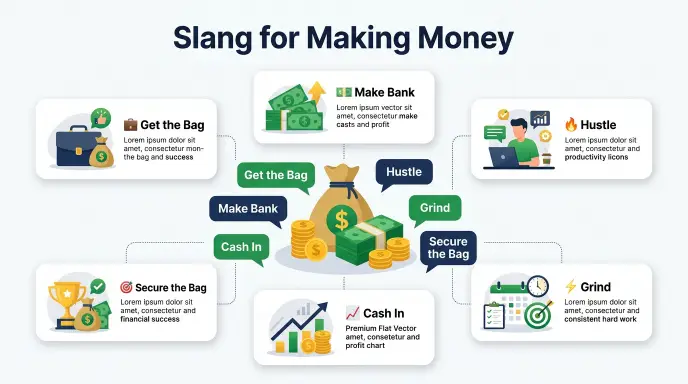
Slang for making money refers to informal words and phrases people use to talk about earning cash, getting paid, or building income.
You may hear these expressions in everyday conversations, social media posts, rap music, movies, or online communities.Many people search for slang for making money because they want to understand what someone means in a text message, TikTok video, or casual conversation.
Some money-related slang has been around for decades, while newer terms have become popular through internet culture and social media. Understanding these expressions can help you follow conversations more easily and avoid misunderstandings.
In this guide, you’ll learn the most common slang terms for making money, where they’re used, if they’re appropriate in professional settings, and how to use them naturally.
Quick Answer
Slang for making money includes informal expressions such as getting the bag, stacking paper, securing the bag, hustling, cashing in, raking it in, and bringing home the bacon. These phrases all describe earning money, although each has its own tone and context.
What Does Slang for Making Money Mean?
Gen Z slang for making money includes casual words people use to talk about earning cash, making profits, and getting paid.The earn meaning slang is often linked to making money, especially when talking about work, income, or financial success.
At its simplest, slang for making money refers to casual words or expressions that describe earning income instead of using formal phrases like earning money or making an income.
People often use slang because it sounds:
- More conversational
- More expressive
- More relatable
- More modern
- Better suited for casual conversations
For example, instead of saying:
“I’m working hard to earn more money.”
Someone might say:
“I’m hustling to get the bag.”
Both sentences talk about earning money, but the second uses modern slang that is common on social media and in popular culture.
Does “Slang for Making Money” Have a Full Form?
No.
Unlike abbreviations such as LOL, BRB, or IMO, slang for making money is not an acronym and does not have a full form.
Instead, it is a collection of informal expressions people use to describe earning money in different ways.
Different Meanings of Slang for Making Money
Not every slang term means exactly the same thing. Some focus on hard work, while others describe success, business growth, or simply receiving payment.
1. Earning a Regular Income
Many expressions simply mean making money through a job or business.
Examples include:
- Making bank
- Bringing home the bacon
- Cashing in
- Getting paid
These are usually used in everyday conversations.
Example:
“She’s making bank at her new job.”
2. Working Hard to Earn Money
Some slang highlights the effort behind earning money.
Popular examples include:
- Hustling
- Grinding
- On the grind
- Working the hustle
These phrases often describe someone putting in extra hours or working toward financial goals.
Example:
“I’ve been grinding all week to save for a new laptop.”
3. Earning a Large Amount of Money
Other slang focuses on financial success rather than the work itself.
Examples include:
- Raking it in
- Rolling in cash
- Swimming in money
- Loaded
These expressions suggest someone is earning or has earned a lot of money.
Example:
“Their online business is really raking it in this year.”
4. Building Wealth or Success
Modern internet slang often connects earning money with achieving personal goals.
Common phrases include:
- Getting the bag
- Securing the bag
- Chasing the bag
Here, the bag symbolizes money, success, or financial opportunity.
Example:
“She’s focused on securing the bag before taking a vacation.”
These expressions are especially popular among younger audiences and on platforms like TikTok, Instagram, and X.
Most Popular Slang for Making Money
Popular phrases for making money include casual expressions for earning cash, making a profit, and getting paid.
| Slang Term | Meaning | Common Tone |
| Get the Bag | Earn money or achieve financial success | Modern |
| Secure the Bag | Successfully make money or reach a financial goal | Motivational |
| Making Bank | Earning a lot of money | Casual |
| Hustling | Working hard to earn money | Positive |
| Grinding | Consistently working toward financial goals | Motivational |
| Cashing In | Making money from an opportunity | Informal |
| Raking It In | Earning large amounts of money | Positive |
| Bringing Home the Bacon | Supporting yourself or your family financially | Traditional |
| Stacking Paper | Saving or earning money | Urban slang |
| Getting Paid | Receiving money for work | Everyday conversation |
“Slang synonyms for making money include casual terms for earning cash, making a profit, and getting paid.”Each of these expressions has a slightly different meaning, so choosing the right one depends on the situation and the tone you want to convey.
Where Is Slang for Making Money Commonly Used?
Slang for making money is most common in casual conversations, social media, music, and online communities. While many of these expressions are widely understood, they are usually best suited for informal settings rather than professional communication.
Here’s where you’re most likely to see or hear these terms.
Social Media
Platforms like TikTok, Instagram, X, and Facebook are full of money-related slang. Creators often use phrases like “get the bag” or “secure the bag” when talking about careers, side hustles, investing, or business success.
Examples:
- “This side hustle helped me get the bag.”
- “Stay focused and secure the bag.”
These phrases are often motivational and encourage financial growth.
Text Messages
Friends frequently use money slang in text conversations because it sounds relaxed and natural.
Example:
Alex: Want to hang out tonight?
Jordan: I can’t. I’m hustling this weekend to make some extra cash.
TikTok and Short Videos
Money slang is especially popular in videos about:
- Side hustles
- Freelancing
- Small businesses
- Online income
- Investing
- Entrepreneurship
- Personal finance
Creators often use catchy expressions to make their content more engaging.
Reddit and Online Communities
Communities focused on careers, business, entrepreneurship, and personal finance sometimes use informal money slang.
For example:
“I’m grinding every weekend until my business becomes profitable.”
Although discussions can become technical, casual expressions help conversations feel more personal.
Discord and Gaming Communities
Gamers sometimes use money slang while discussing:
- Streaming income
- Tournament prizes
- Selling in-game items
- Content creation
Example:
“He’s making bank from streaming every night.”
Music and Pop Culture
Many money-related slang terms became popular through hip-hop, rap, movies, and television. Expressions like “get the bag”, “paper”, and “stacking paper” are especially common in song lyrics.
Some of these terms have roots in African American Vernacular English (AAVE) before becoming widely used in mainstream internet culture. Recognizing that background helps explain why some phrases became popular long before they appeared on social media.
Is Slang for Making Money Rude, Offensive, or Harmless?
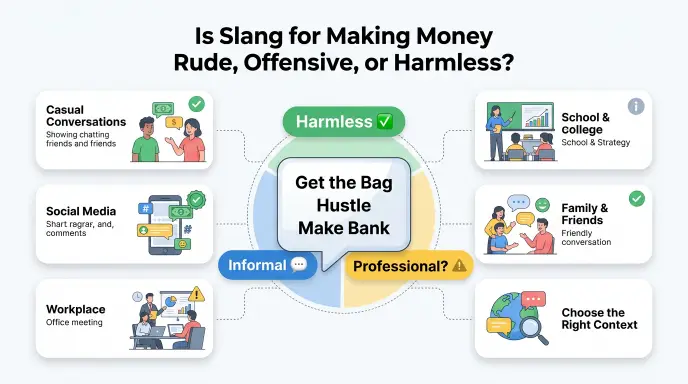
In most cases, slang for making money is harmless.
These expressions usually describe working, earning income, or achieving financial success. Unlike some internet slang, they are not offensive or inappropriate by themselves.
However, the tone can vary depending on the phrase.
Generally Safe Expressions
These are widely accepted in casual conversations:
- Getting paid
- Making bank
- Hustling
- Grinding
- Cashing in
- Bringing home the bacon
Most people understand these expressions without finding them offensive.
Expressions That May Sound Too Casual
Some slang may feel too informal in professional settings.
Examples include:
- Get the bag
- Secure the bag
- Stacking paper
While these phrases are common online, they may sound unprofessional during job interviews, business meetings, or academic presentations.
Workplace Appropriateness
Here’s a quick guide.
| Situation | Appropriate? |
| Friends | ✅ Yes |
| Family | ✅ Yes |
| Social Media | ✅ Yes |
| Text Messages | ✅ Yes |
| School Projects | ⚠️ Sometimes |
| Business Emails | ❌ No |
| Job Interviews | ❌ No |
| Professional Reports | ❌ No |
When speaking with clients, teachers, or employers, it’s usually better to say:
- Earn money
- Increase income
- Generate revenue
- Receive payment
Origin and History of Slang for Making Money
People have used informal expressions for money for hundreds of years. However, many of today’s popular phrases developed much more recently.
Older expressions include:
- Bringing home the bacon
- Cashing in
- Rolling in money
These sayings have been part of everyday English for generations.
Newer expressions, such as get the bag and secure the bag, became widely recognized through hip-hop culture and later spread across social media platforms.
Likewise, words like grind and hustle originally referred to hard work or persistent effort before becoming popular slang for earning money.
Because slang constantly changes, some expressions remain popular for decades, while others fade as new trends emerge.
Why Do People Use Slang for Making Money?
People often choose slang because it feels more personal and energetic than formal language.
Instead of saying:
“I’m trying to increase my income.”
Someone might naturally say:
“I’m grinding to get the bag.”
The second sentence sounds more conversational and reflects modern internet culture.
Here are some common reasons people use money slang:
To Sound More Casual
Friends usually prefer relaxed language over formal business terms.
To Show Motivation
Words like grind and hustle suggest determination and hard work rather than simply earning a paycheck.
To Fit Internet Culture
Many expressions become popular because influencers, musicians, gamers, and creators use them regularly.
To Add Personality
Slang often makes conversations feel more expressive and memorable.
Instead of simply saying someone earns a lot of money, saying they are making bank paints a more vivid picture.
Platform-by-Platform Usage
Different online platforms tend to favor different money-related slang.
| Platform | Common Expressions | Typical Tone |
| TikTok | Get the bag, side hustle, grind | Motivational |
| Secure the bag, making bank | Lifestyle | |
| Hustle, passive income, cashing in | Discussion | |
| Discord | Making bank, grind | Casual |
| Text Messages | Getting paid, hustling | Friendly |
| Workplace Chat | Earn revenue, increase income | Professional |
Understanding the platform helps you choose language that fits naturally.
For example, “secure the bag” may sound perfectly normal in a TikTok caption but out of place in a business email.
Real-Life Examples of Slang for Making Money
Understanding the meaning is only part of the picture. Seeing how people use these expressions in real conversations makes them much easier to remember.
Friendly Conversation
Example 1
Emma: Are you free this weekend?
Noah: Not this time. I’m hustling to save for a new car.
Example 2
Sophia: Your new business seems busy.
Liam: Yeah, we’re finally making bank.
Text Messages
Example 1
Alex: How’s the new job going?
Chris: Pretty good! I’m getting paid a lot better now.
Example 2
Taylor: Want to grab dinner?
Jordan: After work. I’m on the grind today.
Social Media
Money-related slang is common in captions and motivational posts.
Example 1
“Wake up. Stay focused. Secure the bag. 💼”
Example 2
“Hard work today means more opportunities tomorrow.”
Workplace Conversation
In professional settings, it’s better to avoid slang.
Instead of saying:
❌ “We’re making bank this quarter.”
Use:
✅ “Our company performed very well this quarter.”
Or:
✅ “Revenue has increased significantly this quarter.”
School Conversation
Students sometimes use money slang when talking with friends.
Example
“I’m working part-time after school to make some extra cash.”
This sounds natural without being overly informal.
Gaming Community
Players sometimes talk about earning money through streaming, esports, or content creation.
Example
“He’s making bank from his gaming channel.”
Similar Slang for Making Money
English has many informal expressions related to earning money. Some emphasize hard work, while others focus on financial success.
| Slang | Meaning | Best Used In |
| Get the Bag | Earn money or reach a financial goal | Social media, casual chats |
| Secure the Bag | Successfully earn money | Internet culture |
| Make Bank | Earn a lot of money | Everyday conversation |
| Hustle | Work hard for income | Business, social media |
| Grind | Keep working consistently | Motivational conversations |
| Cash In | Profit from an opportunity | Casual speech |
| Bring Home the Bacon | Support yourself or your family financially | Everyday English |
| Stack Paper | Save or earn money | Informal slang |
| Rack Up | Build up earnings over time | Casual conversations |
| Pull In | Earn a certain amount of money | General English |
Each phrase has a slightly different tone, so choosing the right one depends on the audience and situation.
When Should You Avoid Using Slang for Making Money?
Although most money slang is harmless, it isn’t suitable everywhere.
During Job Interviews
Professional language leaves a stronger impression.
Instead of:
“I want to make bank.”
Say:
“I want to build a successful career.”
Business Emails
Clients and managers usually expect formal wording.
Choose:
- Increase revenue
- Generate income
- Improve sales
- Earn additional income
instead of slang expressions.
Academic Writing
Teachers generally expect standard English in essays and reports.
Using formal language makes your writing clearer and more professional.
Formal Presentations
Business meetings, conferences, and presentations are usually not the right place for internet slang.
Speaking with People Who May Not Know the Slang
Older family members, international English learners, or people unfamiliar with internet culture may not understand phrases like get the bag or stacking paper.
Choosing simple language helps avoid confusion.
Polite Alternatives
If you’re in a professional setting, these alternatives work much better.
| Slang Expression | Professional Alternative |
| Get the Bag | Earn money |
| Make Bank | Earn a high income |
| Hustle | Work hard |
| Grind | Work consistently |
| Cash In | Benefit financially |
| Stack Paper | Save money |
| Getting Paid | Receive payment |
| Raking It In | Earn substantial income |
These alternatives sound natural in workplaces, schools, and formal communication.
Common Misunderstandings
Some money slang can confuse people because the words don’t always mean exactly what they seem to.
“Hustle” Doesn’t Always Mean Something Illegal
Many people think hustle refers to scams or dishonest behavior.
Today, it usually means:
- Working hard
- Running a business
- Building a side hustle
- Pursuing financial goals
The intended meaning depends on the conversation.
“Get the Bag” Doesn’t Mean a Physical Bag
The bag symbolizes money, success, or opportunity.
When someone says:
“I’m getting the bag.”
They simply mean they’re focused on earning money or achieving financial success.
“Making Bank” Doesn’t Involve a Bank
This phrase has nothing to do with a financial institution.
It simply means:
Earning a lot of money.
Slang Changes Over Time
Some expressions remain popular for years, while others gradually become less common.
For example, bringing home the bacon is still understood by many English speakers, but younger generations are more likely to say get the bag or secure the bag on social media.
Understanding both older and newer expressions makes it easier to follow conversations across different age groups and online communities.
Frequently Asked Questions
What is the most common slang for making money?
Some of the most popular slang terms for making money include get the bag, secure the bag, make bank, hustle, grind, cash in, stack paper, and bring home the bacon. The best choice depends on the situation and the tone you want to use.
Is “get the bag” the same as making money?
Mostly, yes. Get the bag means earning money or achieving financial success. In some situations, it can also refer to reaching an important goal or taking advantage of a good opportunity.
Is slang for making money appropriate at work?
Usually not. While these expressions are common in casual conversations, professional settings call for more formal language such as earn income, increase revenue, or generate profit.
Which slang for making money is most popular on social media?
On platforms like TikTok, Instagram, and X, you’ll often see phrases such as:
- Get the bag
- Secure the bag
- Hustle
- Grind
- Making bank
These terms are frequently used in posts about careers, entrepreneurship, investing, and side hustles.
Is “hustle” always a positive word?
Not always. In modern conversations, hustle usually means working hard to achieve financial goals. However, in some contexts, it can still refer to dishonest or illegal activities. The intended meaning depends on the conversation.
What’s the difference between “making bank” and “getting paid”?
Making bank suggests earning a lot of money, while getting paid simply means receiving money for work, regardless of the amount.
Conclusion
Understanding slang for making money can make everyday conversations, social media posts, and online content much easier to follow. Expressions like get the bag, make bank, hustle, and grind have become part of modern English because they describe earning money in a simple, memorable, and conversational way.
At the same time, context matters. While these phrases sound natural among friends, on TikTok, or in casual text messages, they are not always suitable for workplaces, school assignments, or professional communication. Choosing the right expression for your audience helps you communicate clearly and respectfully.
Slang also changes over time. Some expressions become more popular through music and social media, while others gradually fade. By learning both classic and modern money-related slang, you’ll be better prepared to understand conversations across different generations, online communities, and everyday situations.
if
you’re reading a social media caption, watching a video about side hustles, or chatting with friends, knowing these expressions will help you recognize what people really mean and when it’s best to use a more formal alternative.
Read more :
Corn Emoji Meaning Slang: What DoesMean?
CTFU Meaning in Text: What Does CTFU Mean?

I am Masson Caldwell, a language enthusiast and content writer at SlangAura. I write about internet slang, texting trends, and modern expressions to help readers understand the evolving world of online language with simple and clear explanations.