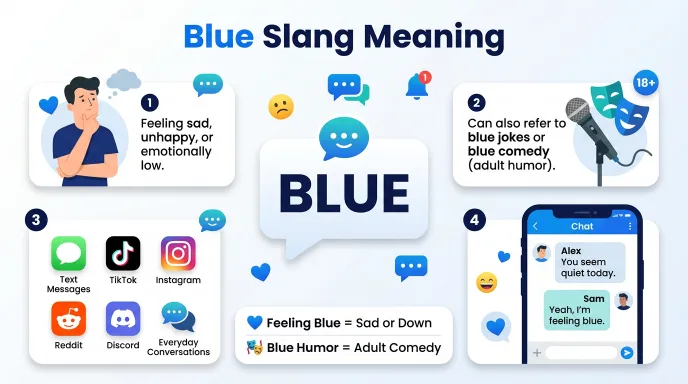
Blue slang meaning usually refers to feeling sad, unhappy, or depressed. However, depending on the conversation, blue can also describe something rude or sexually suggestive, especially in phrases like “blue joke” or “blue humor.” The correct meaning depends on the context.
Many people search for the blue slang meaning after seeing it in text messages, social media posts, songs, movies, or everyday conversations. Since the word has more than one slang meaning, it can sometimes be confusing.
In this guide, you’ll learn what blue means in slang, where people use it, its different meanings, whether it’s offensive, real-life examples, its history, and when you should avoid using it.
Quick Answer: Blue Slang Meaning
The blue slang meaning most commonly describes someone who feels sad, down, or emotionally low.
It can also mean:
- Feeling unhappy or depressed
- Using sexually explicit or adult humor (such as blue jokes)
- Describing content meant for mature audiences
The intended meaning depends on the conversation.
| Context | Blue Slang Meaning | Tone |
| Everyday conversation | Sad or unhappy | Neutral |
| Text messages | Feeling down | Casual |
| Movies and comedy | Adult or dirty humor | Informal |
| Books and media | Emotionally low | Neutral |
What Does Blue Mean in Slang?
In slang, blue is most often another way of saying that someone feels sad, disappointed, lonely, or emotionally low.
Instead of saying:
“I’m feeling sad today.”
Someone might simply say:
“I’m feeling blue.”
This expression has been part of English for many years and is still common today. Although it isn’t new internet slang, it remains popular in everyday speech, text messages, song lyrics, and social media captions.
For example:
- “I’ve been a little blue since moving away.”
- “She sounded blue after the exam.”
- “He’s feeling blue because his team lost.”
In these examples, blue does not refer to the color. Instead, it describes an emotional state.
Does Blue Stand for Anything?
No. Blue is not an acronym or abbreviation.
Unlike internet slang such as:
- LOL
- BRB
- IMO
- SMH
Blue is simply a regular English word that has developed additional slang meanings over time.
People sometimes search for a “full form” of blue, but there isn’t one.
Different Meanings of Blue in Slang
The word blue has several meanings. Understanding the context helps you know which one someone intends.
1. Feeling Sad or Unhappy (Most Common Meaning)
This is by far the most common slang meaning.
When someone says they’re blue, they usually mean they’re feeling:
- Sad
- Lonely
- Heartbroken
- Disappointed
- Emotionally low
Examples
- “I’ve been feeling blue all week.”
- “Don’t worry—you won’t stay blue forever.”
- “He’s a little blue after losing his job.”
Tone
- Gentle
- Emotional
- Respectful
- Common in everyday English
2. Adult or Dirty Humor
Another well-known slang meaning appears in phrases like:
- Blue joke
- Blue comedy
- Blue humor
- Blue material
Here, blue means the jokes contain:
- Sexual references
- Adult language
- Crude humor
- Topics meant for mature audiences
For example:
“That comedian is famous for blue humor.”
This doesn’t necessarily mean the jokes are offensive, but they are generally not suitable for children or formal settings.
Common Places You’ll Hear This Meaning
- Comedy clubs
- Podcasts
- Stand-up comedy
- Movie reviews
- TV discussions
3. Feeling Low Because of a Situation
Sometimes people use blue to describe temporary disappointment rather than deep sadness.
For example:
- “I’m blue because my vacation ended.”
- “She’s blue after missing the concert.”
In these situations, the feeling is usually temporary and connected to a specific event.
Can Blue Have More Than One Meaning?
Yes. That’s why context is important.
For example:
| Sentence | Meaning |
| “I’m feeling blue today.” | Sad |
| “That movie has some blue jokes.” | Adult humor |
| “The comedian performs blue material.” | Mature comedy |
| “She looked blue after hearing the news.” | Emotionally upset |
Reading the surrounding conversation usually makes the intended meaning clear.
Is “Feeling Blue” the Same as Being Depressed?
Not always.
When people say they’re feeling blue, they usually mean they’re sad or having a difficult day. It often describes a temporary emotion.
However, depression is a medical condition that lasts longer and can affect many parts of a person’s life. Because of this difference, it’s best not to assume that someone saying they’re “blue” is referring to clinical depression.
If someone repeatedly says they’re feeling hopeless or deeply distressed, it’s kinder to take their feelings seriously rather than treating the phrase as casual slang.
Why Does “Blue” Mean Sad?
The exact origin isn’t fully certain, but the expression “feeling blue” has been used in English for centuries.
Language experts generally agree that it became associated with sadness long before social media existed. Over time, writers, musicians, and everyday speakers continued using it until it became a familiar expression around the world.
Today, you’ll still see it in:
- Text messages
- Song lyrics
- Books
- Movies
- Everyday conversations
- Social media captions
Unlike many internet slang terms, blue has remained popular across multiple generations because its meaning is easy to understand and widely recognized.
Where Is “Blue” Commonly Used?
The slang word blue appears in many places, both online and offline. While newer internet slang often comes and goes, blue has stayed popular because it is simple and easy to understand.
The meaning changes slightly depending on where it is used.
| Platform or Setting | Common Meaning | Typical Tone |
| Text messages | Feeling sad or down | Personal |
| Social media | Sharing emotions | Casual |
| TikTok | Emotional captions or videos | Informal |
| Mood updates | Casual | |
| Talking about feelings or life events | Conversational | |
| Discord | Chatting with friends | Relaxed |
| Gaming | Feeling disappointed after losing | Informal |
| Everyday speech | Sad or unhappy | Neutral |
| Comedy shows | Adult or sexual humor (“blue comedy”) | Mature audiences |
In Text Messages
When someone texts, blue almost always refers to their mood.
Examples:
- “I’ve been feeling blue lately.”
- “You sound a little blue today.”
- “Hope tomorrow is a better day.”
This use is friendly and natural. Friends often use it to express emotions without sounding overly dramatic.
On Social Media
On platforms like Instagram, TikTok, Facebook, and X (formerly Twitter), people use blue in captions, comments, or quotes about emotions.
Examples:
- “Feeling a little blue today.”
- “Rainy days always make me blue.”
- “Trying to shake off the blues.”
Sometimes creators also use blue-colored images or sad music to match the emotional meaning.
In Gaming Communities
Gamers don’t usually use blue as a gaming-specific slang term, but they may use it in normal conversation.
Example:
“I’m feeling blue after that tough loss.”
Here, it simply means the player is disappointed.
On Reddit and Online Forums
People on Reddit and discussion forums often use blue when talking about personal experiences.
Examples include:
- Feeling lonely
- Missing someone
- Having a difficult week
- Recovering from disappointment
The phrase is usually sincere rather than humorous.
In Comedy
Comedy is one place where blue has a completely different meaning.
If someone says:
- “That’s blue comedy.”
- “He tells blue jokes.”
They mean the comedian uses:
- Sexual jokes
- Adult language
- Crude humor
- Mature topics
This meaning has existed for many decades and is still common in entertainment.
Is Blue Rude, Offensive, or Harmless?
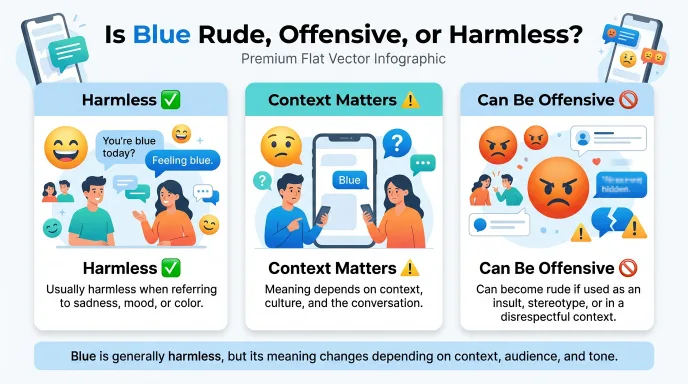
Most of the time, blue is completely harmless.
If someone says:
“I’m feeling blue.”
There is nothing rude or offensive about it. It simply means they feel sad.
However, when people talk about blue jokes or blue humor, the situation changes.
“Feeling Blue”
Tone: Safe and respectful
Suitable for:
- Family conversations
- School discussions
- Workplace conversations
- Social media
- Everyday texting
“Blue Humor”
Tone: Adult
May include:
- Sexual references
- Crude language
- Mature jokes
Because of this meaning, phrases like blue comedy are generally not appropriate for children, classrooms, or professional workplaces.
Can You Use “Blue” at Work?
It depends on the meaning.
Appropriate
- “I’ve been feeling a little blue this week.”
This is polite and professional enough in many workplaces, especially if you’re speaking with someone you know well.
Avoid
- Talking about blue jokes or blue comedy during professional meetings.
Adult humor rarely belongs in formal settings.
Is Blue Safe for Kids?
Yes, when it means feeling sad.
Many children’s books even use colors to explain emotions, so this meaning is easy to understand.
However, children may not understand that blue can also refer to adult humor. If they hear someone mention blue comedy, the meaning is entirely different.
Real-Life Examples of Blue in Slang
Here are realistic examples from different situations.
Friendly Conversation
Sarah: You seem quiet today.
Emma: Yeah, I’m feeling a little blue.
Text Message
Alex: Everything okay?
Ryan: Just feeling blue after my interview.
Family Conversation
Mom: You don’t seem yourself.
Son: I’m just a little blue today.
School
Friend: Why weren’t you smiling earlier?
Student: I was feeling blue after getting my test results.
Instagram Caption
“Some days are brighter than others. Feeling a little blue today 💙”
TikTok Captio
“POV: You’re trying to smile even though you’re feeling blue.”
Discord Chat
Player 1: Good game!
Player 2: Thanks. Still feeling blue after losing the final round.
Reddit Post
“Has anyone else been feeling blue since moving to a new city?”
Comedy Discussion
“That comedian is famous for blue humor, so don’t expect family-friendly jokes.”
Notice how the same word has different meanings depending on the topic.
Origin and History of Blue
The slang meaning of blue is much older than the internet.
The expression “feeling blue” has been part of the English language for centuries. While the exact reason the color became linked with sadness is uncertain, language historians agree that the phrase became well established long before texting or social media existed.
Over time, writers, poets, and musicians helped make the expression even more popular.
Many songs, novels, and films have used blue to represent:
- Sadness
- Loneliness
- Heartbreak
- Emotional pain
This long history explains why people of different ages still understand the phrase today.
Where Did “Blue Humor” Come From?
The entertainment meaning developed separately.
By the early 20th century, blue was being used to describe material that was considered:
- Risqué
- Indecent
- Sexually suggestive
- Too adult for general audiences
Eventually, phrases like blue jokes, blue comedy, and blue material became common in theaters, comedy clubs, television, and film reviews.
Although standards have changed over time, the phrase is still widely recognized when talking about mature comedy.
Is Blue Still Popular Today?
Yes but its different meanings have different levels of popularity.
- Feeling blue remains a timeless expression used by people of all ages.
- Blue humor is still common in comedy and entertainment discussions, though younger audiences may be more likely to describe the same content as “adult,” “NSFW,” or “explicit.”
Unlike many internet slang terms that quickly become outdated, blue has stayed relevant because it has been part of everyday English for generations.
Similar Slang and Related Expressions
Several words and phrases have meanings close to blue, but they are not always interchangeable. Some describe sadness, while others simply express disappointment or a bad mood.
| Term | Meaning | Tone | Can Replace “Blue”? |
| Down | Feeling sad or discouraged | Casual | ✅ Often |
| Bummed | Disappointed or upset | Informal | ✅ Sometimes |
| Low | Feeling emotionally tired or sad | Neutral | ✅ Often |
| Gloomy | Feeling unhappy or pessimistic | Neutral | ⚠️ Depends |
| Heartbroken | Deep emotional sadness | Strong | ❌ More intense |
| Depressed | May refer to a medical condition or a very low mood | Serious | ⚠️ Use carefully |
“Blue” vs. “Down”
These expressions are similar, but there is a slight difference.
- Feeling blue often sounds softer and more reflective.
- Feeling down is more common in everyday speech and texting.
Example:
- “I’ve been feeling blue lately.”
- “I’ve been feeling down lately.”
Both are natural, though down is heard more often in casual conversations.
“Blue” vs. “Depressed”
These terms are not the same.
- Feeling blue usually describes a temporary emotion.
- Depression is a medical condition that can last much longer and may require professional support.
Because of this, it’s better not to use the words as if they mean exactly the same thing.
Related Expressions
You may also hear these common phrases:
- Feeling blue – Feeling sad.
- The blues – A period of sadness.
- Monday blues – Feeling unmotivated or unhappy at the start of the work or school week.
- Winter blues – Feeling less energetic or cheerful during colder, darker months.
- Blue mood – A sad emotional state.
- Blue comedy – Comedy with adult or sexual humor.
- Blue joke – A joke meant for mature audiences.
Each phrase uses the same word but in a slightly different way.
When Should You Avoid Using “Blue”?
Although blue is generally a safe and polite expression, there are situations where another word may communicate your message more clearly.
1. When Talking About Serious Mental Health
If someone has been diagnosed with depression or is struggling with a long-term mental health condition, saying they’re simply “blue” may unintentionally minimize what they’re are experiencing.
Instead, be respectful and use the words they use to describe their situation.
2. In Professional Writing
If you’re writing:
- A business report
- Academic paper
- News article
- Formal email
It’s often clearer to use words like:
- Sad
- Disappointed
- Discouraged
- Concerned
These words are more direct and less idiomatic.
3. When Your Audience May Not Understand the Idiom
People learning English may not recognize feeling blue as an expression.
For example, someone could mistakenly think you’re talking about the color blue.
If clarity is important, simply say:
- “I’m feeling sad.”
- “I’m disappointed.”
- “I’m having a difficult day.”
4. When Discussing “Blue Humor” in Formal Settings
The phrase blue humor refers to adult comedy.
Avoid bringing it up in:
- School presentations
- Job interviews
- Professional meetings
- Conversations with young children
If you need to describe the content, terms like adult humor or mature comedy are often clearer and more appropriate.
Why Do People Use “Blue”?
People continue using blue because it expresses emotion in a simple, gentle way.
Instead of saying:
“I’m deeply unhappy today.”
Someone might simply say:
“I’m feeling blue.”
The phrase often sounds:
- Softer
- More natural
- Less dramatic
- Easy for others to understand
It lets people share their feelings without giving a long explanation.
It Creates an Emotional Connection
Many people recognize the phrase immediately.
If someone says:
“I’ve been feeling blue.”
Others often understand that the person may need kindness, encouragement, or simply someone to listen.
It’s Timeless
Unlike internet slang that becomes outdated after a few years, feeling blue has remained popular for generations.
You’ll hear it from:
- Teenagers
- Adults
- Parents
- Teachers
- Authors
- Musicians
- News presenters
This broad use is one reason the phrase has lasted so long.
It Works Across Many Platforms
The expression appears naturally in:
- Text messages
- Instagram captions
- TikTok videos
- Reddit discussions
- Blogs
- Books
- Movies
- Everyday conversations
Because it isn’t tied to one app or online community, it remains widely understood.
Common Misunderstandings About “Blue”
Since blue has multiple meanings, people sometimes misunderstand what someone is trying to say.
Here are the most common misconceptions.
Misunderstanding 1: It Always Refers to the Color
Not true.
In slang, blue often has nothing to do with color.
When someone says:
“I’m blue.”
They usually mean they’re sad.
Misunderstanding 2: It Is Internet Slang
Only partly.
People frequently use blue online, but the expression feeling blue existed long before the internet.
It is better described as an English idiom that is also commonly used in digital communication, rather than slang that originated online.
Misunderstanding 3: It Is Always About Sadness
No.
Sometimes blue refers to:
- Blue jokes
- Blue comedy
- Blue material
In these cases, the meaning is about adult humor, not emotions.
Always look at the surrounding conversation before deciding what the word means.
Misunderstanding 4: It Is Offensive
Usually, it isn’t.
Saying:
“I’m feeling blue.”
is completely polite.
However, blue humor may contain explicit jokes that some people find inappropriate.
The word itself isn’t offensive—the context determines whether the content is suitable.
Misunderstanding 5: Young People Use It the Same Way as Older Generations
Not always.
Older adults are often more likely to say “I’m feeling blue.”
Younger speakers may instead say:
- “I’m feeling down.”
- “I’m not okay.”
- “I’m having a rough day.”
- “Today’s been exhausting.”
Even so, most people still understand what feeling blue means because it appears in books, songs, movies, and everyday English.
By understanding these different meanings and contexts, you’ll be able to recognize whether blue refers to an emotional state, a style of comedy, or simply the color itself.
Frequently Asked Questions
What does blue mean in slang?
The blue slang meaning most commonly refers to feeling sad, unhappy, or emotionally low. In some contexts, especially in entertainment, blue can also describe adult or sexually suggestive humor, as in blue jokes or blue comedy.
What does “I’m feeling blue” mean?
When someone says “I’m feeling blue,” they mean they feel sad, disappointed, lonely, or emotionally down. It is a common English expression and does not refer to the color blue.
Example:
“I’ve been feeling blue since my best friend moved away.”
Is blue an internet slang term?
Not exactly.
Although people use blue in text messages, social media posts, and online chats, the expression “feeling blue” has existed for centuries. It is an English idiom that continues to be widely used online.
Does blue have a full form?
No.
Blue is not an acronym or abbreviation, so it does not have a full form. It is a regular English word with several meanings depending on the context.
Is blue offensive?
Usually, no.
If someone says they’re feeling blue, the phrase is polite and harmless.
However, blue humor, blue jokes, or blue material refer to adult comedy that may include sexual references or crude language. Those expressions are intended for mature audiences.
Can I use “blue” in a text message?
Yes.
Using blue to describe sadness is common and natural in casual conversations.
Examples:
- “I’ve been feeling blue lately.”
- “Sorry you’re feeling blue.”
- “Hope things get better soon.”
What does “the blues” mean?
The blues usually refers to a period of sadness or low spirits.
Examples include:
- “I’ve got the Monday blues.”
- “She was fighting the winter blues.”
The phrase often describes temporary feelings rather than a long-term condition.
Is “blue” the same as depression?
No.
Feeling blue usually means someone is temporarily sad or discouraged.
Depression is a medical condition that can last much longer and often requires professional support. While both involve sadness, they are not the same thing.
What is blue comedy?
Blue comedy is comedy intended for adults. It often contains:
- Sexual jokes
- Strong language
- Crude humor
- Mature themes
This meaning is different from feeling blue, which refers to sadness.
Is “feeling blue” still popular
Yes.
Although many modern slang terms come and go, feeling blue remains a widely recognized expression. It appears in books, movies, songs, news articles, text messages, and everyday conversations across many English-speaking countries.
Conclusion
The blue slang meaning most often describes someone who feels sad, unhappy, or emotionally low. It’s a long-standing English expression that remains common in everyday conversations, texting, and social media.
At the same time, blue can have another meaning in phrases like blue jokes or blue comedy, where it refers to adult or sexually suggestive humor. Because the word has more than one meaning, context is always important.
If you see someone write, “I’m feeling blue,” they’re almost certainly talking about their emotions—not the color. And if you hear someone mention blue comedy, they’re referring to mature entertainment.
Knowing these different meanings will help you understand conversations more accurately and use the term with confidence in the right situations.
Disscover more:
Welding Terms Slang Meaning in Text

I am Masson Caldwell, a language enthusiast and content writer at SlangAura. I write about internet slang, texting trends, and modern expressions to help readers understand the evolving world of online language with simple and clear explanations.