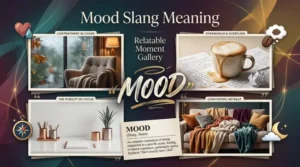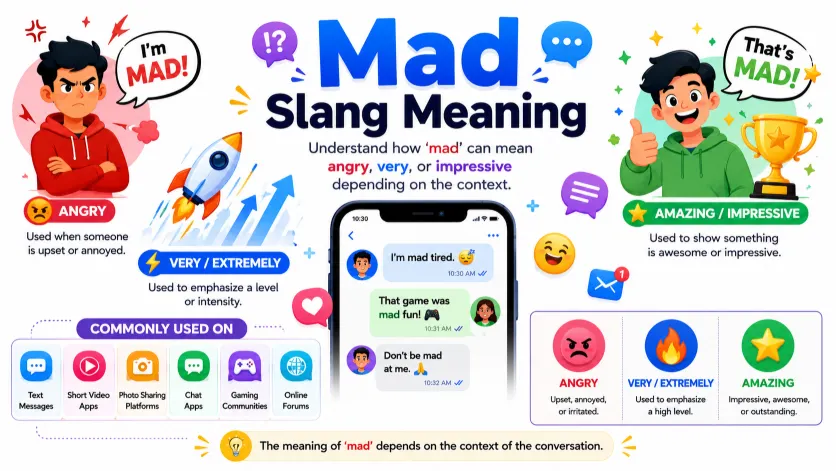
Mad slang can have several meanings depending on the conversation. While many people know mad as another word for angry, it has developed different slang meanings in texting, social media, and everyday speech. In casual conversations, mad can describe someone who is upset, emphasize that something is very intense, or even mean that something is impressive or exciting.
Because the meaning changes with context, it’s easy to misunderstand if you’re unfamiliar with modern slang. if you spotted mad in a text message, a TikTok comment, a gaming chat, or a social media post, understanding how it’s being used helps you respond correctly.
This guide explains the mad slang meaning, its different definitions, common usage, examples, and when it’s appropriate to use.
Quick Answer
Mad is a versatile slang word that can mean angry, very or extremely, or impressive, depending on the context. The intended meaning usually becomes clear from the surrounding conversation.
What Does Mad Mean in Text?
In texting and online conversations, mad doesn’t always mean someone is angry. Instead, it can express different ideas based on how it’s used.
The three most common slang meanings are:
- Angry or upset
- Very or extremely
- Impressive, exciting, or intense
Because of these multiple meanings, reading the entire sentence is important before deciding what someone means.
For example:
“She’s mad because her phone died.”
Here, mad clearly means angry.
Now compare it with:
“That movie was mad good.”
In this sentence, mad means very or extremely, not angry.
Another example:
“Those basketball skills are mad!”
Here, mad means amazing, impressive, or really cool.
Different Meanings of Mad in Slang
Unlike many internet slang terms that have only one definition, mad has several widely accepted meanings.
1. Mad = Angry or Upset
This is the traditional and still the most common meaning.
People use mad to describe someone who feels annoyed, frustrated, or angry.
Examples
- “Mom is mad because I came home late.”
- “Don’t get mad it was just a joke.”
- “He’s still mad about yesterday.”
Tone
- Emotional
- Serious
- Everyday conversation
2. Mad = Very or Extremely
In many regions, especially in casual American English, mad works as an intensifier. Instead of describing anger, it simply means very, really, or extremely.
Examples
- “That pizza was mad good.”
- “It’s mad cold outside today.”
- “She runs mad fast.”
Tone
- Casual
- Friendly
- Informal
This usage is especially common among younger speakers and in online conversations.
3. Mad = Amazing or Impressive
Sometimes mad describes something exciting, impressive, or unusually good.
Examples
- “That skateboard trick was mad!”
- “Your new gaming setup looks mad.”
- “Those dance moves are mad.”
Tone
- Positive
- Enthusiastic
- Complimentary
In this context, mad is similar to words like:
- Awesome
- Incredible
- Sick
- Dope
- Fire
Mad Slang Definition
The slang definition of mad depends on context, but it usually falls into one of these categories:
| Meaning | Example | Tone |
| Angry | “She’s mad at me.” | Negative |
| Very / Extremely | “That’s mad funny.” | Casual |
| Amazing / Impressive | “That car is mad.” | Positive |
This flexibility is one reason the word remains popular in both spoken and written English.
Does Mad Have a Full Form?
No.
Unlike abbreviations such as LOL, SMH, or CTFU, mad is not an acronym and does not have a full form.
It is a regular English word that has developed additional slang meanings over time through everyday speech and internet culture.
When people search for “mad full form”, they’re usually trying to find out if it’s an abbreviation. The answer is no its slang meaning comes from how the word is used, not from a shortened phrase.
Why Does Context Matter?
The same word can have completely different meanings depending on the sentence.
Consider these examples:
- “My brother is mad.” → He is angry.
- “That burger was mad good.” → The burger was extremely good.
- “Those speakers are mad loud.” → The speakers are very loud.
- “Your artwork is mad!” → Your artwork is impressive.
Understanding the surrounding words helps you identify the correct meaning without confusion.
Is Mad Rude, Offensive, or Neutral?
In most situations, mad is a neutral slang word. It is not considered offensive on its own and is widely used in everyday conversations. However, its tone depends on the context and how it’s said.
For example:
- “I’m mad at you.” → Expresses anger but isn’t offensive.
- “That’s mad cool!” → A positive compliment.
- “It’s mad hot outside.” → Means “very hot.”
Because mad has several meanings, the surrounding words determine if it sounds negative, positive, or simply descriptive.
When Mad Is Appropriate
You can comfortably use mad in:
- Text messages
- Conversations with friends
- Family chats
- Social media comments
- Gaming communities
- Casual online discussions
These settings are informal, so slang feels natural.
When to Avoid Using Mad
Although the word itself isn’t rude, avoid using slang meanings like “mad good” or “mad cool” in formal communication such as:
- Business emails
- Job applications
- Academic essays
- Professional presentations
- Official reports
In professional writing, it’s better to use words like very, extremely, excellent, or impressive.
Where Is Mad Commonly Used?
The slang word mad appears across many online platforms and everyday conversations. While the meaning stays similar, the way people use it can vary depending on the platform.
Mad on TikTok
TikTok creators often use mad in captions and comments to emphasize something.
Examples:
- “That transition is mad smooth.”
- “This recipe looks mad good.”
Here, mad means very or extremely.
Mad on Instagram
On Instagram, users often use mad to compliment photos, videos, and Reels.
Examples:
- “Your vacation pictures are mad beautiful.”
- “That outfit is mad stylish.”
The word adds excitement without needing longer descriptions.
Mad on Snapchat
Snapchat conversations are casual, making mad a common choice in private chats.
Example:
Friend: “Are you still mad?”
Meaning:
The friend is asking if someone is still angry.
Another example:
“That filter is mad funny!”
Here, it means very funny.
Mad on Discord
Gaming communities on Discord often use mad to describe:
- Amazing gameplay
- Powerful weapons
- Difficult challenges
- Funny moments
Examples:
- “That boss is mad strong.”
- “Your aim is mad good.”
Mad on Reddit
Reddit users frequently write mad in comments and discussions.
Examples include:
- “That’s a mad theory.”
- “Those prices are mad expensive.”
- “This story is mad interesting.”
Depending on the sentence, mad can mean very, extremely, or impressive.
Mad in Text Messages
Texting is one of the most common places you’ll see mad used in different ways.
Examples:
“I’m mad tired.”
Meaning:
Very tired.
“Dad is mad at me.”
Meaning:
Dad is angry
“That movie was mad funny!”
Meaning:
The movie was extremely funny.
Real-Life Examples of Mad Slang
Understanding real conversations makes slang much easier to recognize.
Friendly Conversation
Sarah: “I finally passed my driving test!”
Emma: “That’s mad exciting! Congratulations!”
Meaning:
Very exciting.
Casual Text Message
Jake: “I’m mad hungry.”
Meaning:
Jake is extremely hungry.
Argument
Friend 1: “Why didn’t you answer my calls?”
Friend 2: “Don’t be mad I was driving.”
Meaning:
Don’t be angry.
Gaming Chat
Player 1: “Did you see that sniper shot?”
Player 2: “Bro, that was mad!”
Meaning:
The shot was amazing.
Social Media Comment
Post:
“Finished my first marathon today!”
Comment:
“That’s mad impressive!”
Meaning:
The achievement is outstanding.
Family Conversation
Mom: “Your room is still messy.”
Teen: “Please don’t be mad. I’ll clean it now.”
Meaning:
The teen doesn’t want their mom to be angry.
How to Tell Which Meaning Is Intended
Because mad has multiple meanings, these clues help identify the correct definition:
| Sentence | Meaning |
| “He’s mad at me.” | Angry |
| “That’s mad funny.” | Very funny |
| “This game is mad hard.” | Extremely difficult |
| “Those shoes are mad.” | Amazing or stylish |
| “I’m mad excited.” | Very excited |
Reading the entire sentence usually removes any confusion.
Does Everyone Use Mad the Same Way?
Not always.
The slang meaning of mad varies by region, age group, and local culture.
- In some places, people mostly use mad to mean angry.
- In many parts of the United States, especially in casual speech, mad often means very or extremely.
- Younger speakers are generally more likely to use mad as an intensifier in texting and social media.
Because of these differences, context remains the most reliable way to understand what someone means.
Origin and Background of Mad Slang
The word mad has been part of the English language for centuries. Traditionally, it meant angry or, in older usage, mentally unstable. Over time, however, people began using it in new ways during casual conversations.
One of the biggest changes happened in parts of the United States, especially in cities along the East Coast. By the late 20th century, younger speakers started using mad as an intensifier, meaning very or extremely.
For example:
- “That’s mad expensive.”
- “She’s mad talented.”
- “This game is mad fun.”
This slang usage gradually spread through music, television, online forums, texting, and social media. Today, it’s widely recognized in internet culture, although its popularity varies by region.
Unlike many internet acronyms, mad didn’t begin online—it evolved from spoken English before becoming common in digital communication.
Mad vs Similar Slang Words
Several slang words have meanings similar to mad, but they’re not always interchangeable.
| Slang Word | Meaning | Example |
| Mad | Very, extremely, or amazing | “That’s mad funny.” |
| Super | Very | “That’s super cool.” |
| wild | Extremely or unbelievable | “That’s crazy good.” |
| Fire | Excellent or impressive | “That song is fire.” |
| Dope | Cool or awesome | “Your shoes are dope.” |
| Sick | Amazing or impressive | “That trick was sick.” |
Although these words all add emphasis, mad is especially flexible because it can also mean angry.
When Should You Avoid Using Mad?
Even though mad is generally harmless slang, there are situations where more formal language is a better choice.
1. Professional Communication
Avoid phrases like:
- “That’s mad good.”
- “I’m mad busy.”
Instead, write:
- “That’s excellent.”
- “I’m very busy.”
Professional writing should be clear and polished.
2. Academic Writing
School essays, reports, and research papers usually require standard English.
Instead of:
“The results were mad impressive.”
Write:
“The results were very impressive.”
3. Business Emails
Clients and colleagues may not expect casual slang.
Formal alternatives help maintain a professional tone.
4. International Communication
Not everyone understands regional slang.
Someone learning English may know mad only as angry, which could lead to confusion.
For example:
“That cake is mad good.”
A non-native speaker might wonder why the cake is “angry.”
Polite Alternatives to Mad
If you’re speaking in a formal setting, these words often work better.
| Instead of Mad | Use |
| Mad good | Very good |
| Mad funny | Extremely funny |
| Mad busy | Very busy |
| Mad talented | Highly talented |
| Mad cool | Really cool / Excellent |
| Mad expensive | Very expensive |
These alternatives sound more natural in professional and academic communication.
Why Do People Use Mad as Slang?
There are several reasons why mad remains popular.
1. It Adds Emphasis
Instead of saying:
“The movie was good.”
People say:
“The movie was mad good.”
The sentence feels stronger and more expressive.
2. It’s Short and Easy
One simple word can replace longer phrases like:
- Very
- Extremely
- Really
That makes conversations faster, especially in texting.
3. It Sounds Natura
Among friends, slang helps conversations feel relaxed.
Using words like mad can make messages sound more personal and conversational
4. It Reflects Online Culture
Many social media users enjoy expressive language.
Words like:
- Mad
- Fire
- Dope
- Sick
have become part of everyday internet vocabulary.
Impact of Using Slang in Communication
Slang changes how people connect online and offline.
Benefits
- Makes conversations more engaging.
- Adds personality.
- Shows emotion quickly.
- Helps people fit into online communities.
- Keeps messages short and expressive.
Drawbacks
- Can confuse people unfamiliar with the slang.
- May sound unprofessional in formal settings.
- Some meanings vary by region.
- Older audiences may interpret the word differently.
Using slang appropriately means thinking about who you’re talking to.
Is Mad Safe for Social Media?
Yes. Mad is generally safe to use on social media because it isn’t considered offensive by itself.
You’ll commonly see it on:
- TikTok
- Snapchat
- Discord
- X (formerly Twitter)
Examples include:
- “That video is mad funny.”
- “This game looks mad fun.”
- “Your artwork is mad impressive.”
However, if your content targets a professional audience, it’s usually better to use standard words like very, extremely, or excellent instead of slang.
Overall, mad is one of the safest and most widely accepted slang terms in modern English, as long as the context makes your meaning clear.
Comparison Table: Mad vs Similar Slang
| Slang Term | Meaning | Tone | Common Usage |
| Mad | Angry, very, or impressive (depends on context) | Casual | Texting, social media, everyday speech |
| wild | Extremely surprising or unbelievable | Casual | Conversations, memes, comments |
| Fire | Excellent, exciting, or high quality | Positive | Music, fashion, gaming, social media |
| Dope | Cool, impressive, or stylish | Positive | Youth culture, texting, gaming |
| Sick | Amazing or impressive | Positive | Sports, gaming, online chats |
| Super | Very or extremely | Neutral | Casual and semi-formal conversations |
The table shows that mad is one of the most flexible slang words because its meaning changes with context. Always read the full sentence before deciding if it means angry, very, or amazing.
Frequently Asked Questions
What does mad mean in slang?
In slang, mad can mean angry, very or extremely, or impressive, depending on how it is used in the sentence.
What does mad mean in a text message?
In texting, mad often means very or extremely.
Example:
- “I’m mad excited.” = I’m very excited.
- “She’s mad at me.” = She’s angry with me.
The surrounding words determine the meaning.
Is mad a rude slang word?
No. Mad is generally not rude or offensive. It is considered informal slang and is suitable for casual conversations with friends, family, or online communities.
Can mad mean something positive?
Yes. Many people use mad to describe something impressive or exciting.
Examples:
- “That concert was mad!”
- “Your artwork is mad good.”
In these examples, mad expresses admiration.
Is mad used on social media?
Yes. You’ll frequently see mad on:
- TikTok
- Snapchat
- Discord
- X (formerly Twitter)
People use it in captions, comments, memes, gaming chats, and private messages.
Does mad have a full form?
No. Mad is a regular English word, not an acronym or abbreviation. It does not stand for another phrase.
Key Takeaways
Here are the most important things to remember about mad slang:
- Mad has multiple meanings depending on the context.
- It can mean angry, very or extremely, or amazing/impressive.
- The slang meaning is common in texting, social media, gaming, and casual conversations.
- Mad is generally neutral and not offensive.
- It is best avoided in formal writing, business emails, and academic work.
- Reading the complete sentence helps you understand the intended meaning.
Conclusion
The mad slang meaning is more flexible than many people realize. While the traditional definition is angry, modern slang has expanded the word to also mean very, extremely, or even impressive. That’s why you might see phrases like “mad funny,” “mad talented,” or “mad good” across social media, text messages, and gaming chats.
Because the meaning depends on context, it’s important to read the whole sentence before interpreting it. In casual conversations, mad is a natural and widely accepted slang term. However, in professional or academic settings, using standard words like very, extremely, or excellent is usually a better choice.
By understanding these different meanings, you’ll be able to recognize mad in conversations and use it naturally when the situation is appropriate.

I am Emma Collins, a content writer at SlangAura specializing in internet slang, texting abbreviations, and online language. I create simple and accurate guides to help readers understand modern slang easily and confidently.