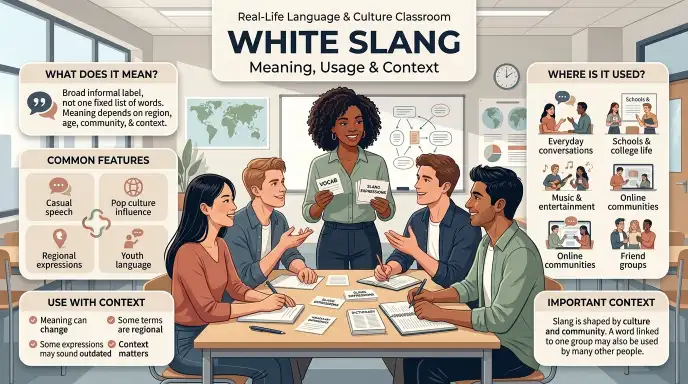
White slang usually refers to informal words, phrases, or expressions that people associate with white communities or white culture.
However, “white slang” is not one fixed type of slang, and the meaning can change based on the speaker, country, and context. If you search for white slang, you may also be looking for slang used to describe white people.The phrase white slang appears in online discussions with different meanings.
Some people use it to describe expressions they associate with white American or British speakers. Others use it as a casual label for speech they see as common among white people. Because of this, white slang can be a broad and informal term rather than a standard linguistic category.
Quick Answer: What Does White Slang Mean?
White slang is an informal phrase for slang or casual expressions associated with white people or white culture. It can also refer to specific slang used to describe white people. The exact meaning depends on the conversation and the speaker.
What Does White Slang Mean?
The phrase white slang has no single official definition. People often use it online as a broad label for expressions they connect with white speakers.
For example, someone might call a phrase “white slang” because they hear it often among white Americans. Another person may use the phrase when talking about expressions linked to a certain age group, region, or social group.
This makes the term different from a standard slang word. A slang word usually has a recognizable meaning and usage. White slang is more of a category label that people create around language and culture.
White slang can refer to different things
The phrase may be used to describe:
- Casual expressions linked to white American culture
- Informal phrases linked to white British culture
- Expressions associated with a certain social group
- Internet jokes about the way some white people speak
- Words that people believe are common among white speakers
- Language that someone personally connects with white culture
These uses are not universal. A phrase that one person calls white slang may sound completely normal to another person.
Why Is White Slang Hard to Define?
White slang is hard to define because white people do not share one single way of speaking.
Language changes with location, age, family, community, and social setting. A teenager in the United States may use very different slang from a middle-aged person in the United Kingdom. People in different cities can also use different expressions.
The same issue appears online. Social media allows words to spread across groups very quickly. A phrase may start in one community and later become common among many different users.
Because of this, calling a phrase “white slang” does not prove that the phrase came from white communities.
Slang can cross cultural groups
Many popular expressions move between communities.
A phrase can begin in one group, spread through music or entertainment, and later become common online. Once that happens, people may forget where it started.
This is especially important when discussing slang connected to race. Some expressions commonly associated with white speakers may have mixed histories. Others may have roots in regional dialects, youth culture, music, or other communities.
So it is better to look at the actual history of a phrase instead of assuming its origin from the people who use it today.
Is “White Slang” a Real Linguistic Category?
Not in the strict sense. White slang is not a standard linguistic category used to describe one shared form of English.
Linguists usually look at factors such as region, social group, age, identity, and community when studying language. Race can influence language and cultural identity, but it does not create one universal vocabulary.
For example, white English speakers in the United States can speak with very different accents and use different slang. The same is true in Britain, Australia, Canada, and other English speaking places.
That is why the phrase is best understood as an informal label used in everyday or online discussion.
How Is White Slang Used Online?
Online, white slang can appear in jokes, memes, social posts, and casual discussions about language.
Someone may describe a phrase as white slang because they think it sounds strongly connected with a certain white social group. The label may be serious, playful, or critical.
On TikTok and Instagram
On platforms such as TikTok and Instagram, people may use the phrase while discussing stereotypes about speech, fashion, habits, or culture.
These posts are often humorous. Still, a joke does not make the label an objective fact.
In Reddit discussions
Reddit users may discuss white slang while comparing regional expressions or talking about differences between cultural groups.
These discussions can contain useful personal observations, but they should not be treated as proof that every phrase belongs to one racial group.
In texting and chat
In private messages, a person may use white slang as a casual description of someone’s vocabulary.
For example:
“Is that white slang? I have never heard it before.”
Here, the speaker is asking about a phrase they associate with a particular group. The sentence does not establish that the phrase actually belongs to that group.
Is White Slang Offensive?
The phrase white slang is not automatically offensive. Its tone depends on how the speaker uses it.
A neutral discussion about language may use the phrase simply as a description. A joke can also use it casually. However, the phrase can become uncomfortable when it relies on racial stereotypes or is used to mock people.
Context matters most.
If someone is using the label to study language, the discussion may be neutral. If someone uses it to insult a racial group, the meaning becomes more negative.
A useful rule is simple: focus on the actual expression and its history instead of making broad claims about an entire group.
White Slang vs. Slang Used by White People
These ideas may sound similar, but they are not always the same.
| Phrase | What it may mean |
| White slang | A broad informal label for slang associated with white culture |
| Slang used by white people | Slang that happens to be used by some white speakers |
| Regional slang | Slang connected to a particular place |
| Youth slang | Informal language linked to a younger age group |
| Internet slang | Informal language spread through online communication |
This difference matters because a person can use a slang word without that word being specific to their race.
For example, a popular internet phrase may be used by millions of people from many backgrounds. Calling it white slang simply because many white users say it can give an incomplete picture.
Real Life Examples of White Slang
The phrase can appear in different conversations. The examples below show how people may use it without treating it as a fixed language category.
Example 1: Casual conversation
“Is ‘that’s so random’ considered white slang?”
Here, the speaker is asking if the phrase is commonly linked with white speakers. They are not using it as an official language term.
Example 2: Text message
“I heard that phrase from my cousin. Is it white slang?”
The person is trying to understand why a phrase sounds familiar to a certain group.
Example 3: Social media
“That sounds like white slang to me.”
This can be a casual comment about how a phrase sounds. The statement reflects the speaker’s view, not a proven fact about the phrase.
Example 4: School discussion
“Our class talked about how slang changes between groups.”
In this setting, it is better to discuss the actual language, region, and community instead of labeling all slang as white slang.
Example 5: Online discussion
“I thought that word was common everywhere. I did not know people linked it to one group.”
This shows why context matters when people attach cultural labels to slang.
Origin and History of White Slang
The phrase white slang does not have one clear origin date. It is a broad description rather than the name of one slang term with a known creator.
People have long used labels based on race, region, class, age, and culture when talking about speech. Online communities later made these labels easier to spread through memes, jokes, and casual discussions.
The phrase can also change meaning over time. A term that sounds strongly linked to one group in one period may become common across many groups later.
Why the history can be unclear?
Slang rarely has one simple starting point.
People often hear an expression from friends, music, television, films, local communities, or online posts. They then repeat it in new settings. This makes it difficult to say that one racial group created every phrase associated with it.
For that reason, claims about the origin of specific “white slang” should be checked phrase by phrase.
Similar Terms and Related Language
Several terms may appear in discussions about white slang, but they do not all mean the same thing.
Regional slang
Regional slang comes from a particular area. It may be common among people who live in that region, regardless of race.
Youth slang
Youth slang refers to informal expressions that become popular among younger speakers. These expressions can spread quickly through social media.
Internet slang
Internet slang includes words and phrases that become popular through online communities, chats, forums, and social platforms.
Cultural slang
Cultural slang is language strongly connected with a particular cultural community. Its history can be important when explaining where a phrase came from.
Social slang
Social slang develops within a particular group or social setting. The group may be based on shared interests, location, age, or community.
These terms can overlap. A phrase may be regional, internet-based, and popular among a certain age group at the same time.
When Should You Avoid Using White Slang?
You should avoid the phrase when it would turn a complex language issue into a racial stereotype.
Be careful in these situations:
- When you do not know where a phrase came from
- When you are labeling an entire racial group
- When the phrase is being used to mock someone
- When discussing another person’s speech in a formal setting
- When a more accurate label, such as regional slang, would work better
- When the term could make a conversation about language sound like a judgment about people
In many cases, a more specific description is clearer.
Instead of saying “That is white slang,” you could say:
“That is common among some young American speakers.”
You could also say:
“That phrase is popular in this online community.”
These descriptions give the reader more useful information.
Can You Use White Slang at Work?
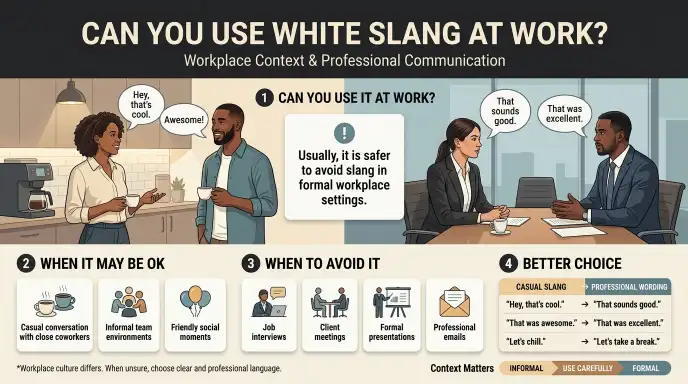
The phrase is usually not the best choice in formal workplace writing.
A professional conversation should focus on the actual language, region, or community involved. A racial label may sound too broad and can distract from the point you are trying to make.
For example, instead of writing:
“This is white slang.”
You could write:
“This is an informal American expression.”
That wording is more specific and easier to understand.
Common Misunderstandings About White Slang
Misunderstanding 1: All slang used by white people is white slang
That is not correct.
People from many backgrounds use the same slang. A person’s race does not automatically determine the words they use.
Misunderstanding 2: White slang has one fixed vocabulary
It does not.
The phrase can refer to different expressions depending on the speaker, location, age group, and online community.
Misunderstanding 3: Every phrase linked to white culture started there
That cannot be assumed.
Slang often moves between communities. A phrase may have a long history before it becomes strongly associated with another group.
Misunderstanding 4: The phrase always means something negative
Not necessarily.
The phrase can appear in neutral language discussions. Its tone depends on the situation and the speaker’s intention.
Misunderstanding 5: A social media post proves a slang origin
A viral post can show how people use a phrase today. It does not automatically prove where that phrase started.
Why Do People Use the Phrase White Slang?
People may use the phrase because they notice a pattern in the way certain groups speak.
It can also be used as a quick way to describe a cultural or social association. Online, people sometimes use broad labels because they make jokes and discussions shorter.
However, broad labels can hide important details.
A better approach is to ask:
- Who uses the phrase?
- Where is it common?
- What does it mean?
- When did it become popular?
- Does it have a known cultural or regional history?
These questions give a much clearer picture of the language.
Frequently Asked Questions About White Slang
Q1. What does white slang mean?
White slang usually means informal language that people associate with white communities or white culture. The phrase has no single fixed definition.
Q2. Is white slang an official language category?
No. White slang is an informal label, not a standard linguistic category.
Q3. Is white slang the same as slang used by white people?
No. A person can use a slang word without that word being specific to their race or culture.
Q4. Is white slang offensive?
The phrase is not automatically offensive. However, it can sound disrespectful when someone uses it to mock or stereotype a racial group.
Q5. Is white slang used on TikTok?
Yes, people may use the phrase on TikTok while discussing language, culture, jokes, or stereotypes. Its meaning depends on the post and context.
Q6. Can I use the phrase white slang at work?
It is better to use a more specific description in professional settings. Mention the region, community, or type of language when that detail is known.
Q7. Does white slang have one fixed list of words?
No. There is no universal list. Different people may use the phrase for different expressions.
Conclusion
White slang is a broad and informal phrase for language that people associate with white communities or white culture. It does not describe one fixed group of words, and it is not an official linguistic category.
The safest way to understand the phrase is to look at context. Consider who uses the expression, where it is common, and what its actual history shows.
When a more specific label is available, such as regional slang, youth slang, or internet slang, that label usually gives a clearer answer. Most importantly, avoid treating language as proof of what an entire racial group is like.
You May Also Like:
Fortnite Slang: Meaning, Terms, and Common Examples

I am Emma Collins, a content writer at SlangAura specializing in internet slang, texting abbreviations, and online language. I create simple and accurate guides to help readers understand modern slang easily and confidently.