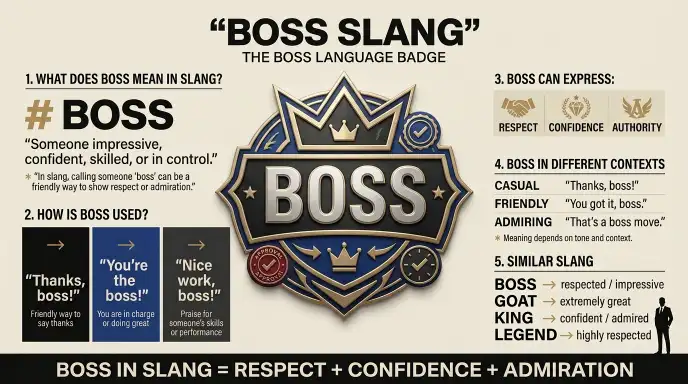
Boss slang usually means a person who is highly respected, confident, skilled, or in control. In casual speech, calling someone “boss” can be a friendly compliment.
It can show respect, approval, or admiration for how someone handles a situation.The word boss has a standard meaning too. It can refer to a manager or person in charge at work. In slang, however, boss often has a broader meaning.
Someone can be called boss even when they have no job title or authority.People may use boss slang in texts, social media comments, gaming chats, and everyday conversations. The tone can range from friendly and respectful to playful.
Quick Answer: Boss Slang Meaning
Boss in slang is a casual way to call someone confident, capable, respected, or impressive. It can also be a friendly way to address someone, similar to “man,” “mate,” or “bro,” depending on the speaker and context.
What Does Boss Mean in Slang?
In slang, boss often describes someone who handles things well.
A person may be called boss because they are confident, skilled, successful, or respected. The word can work as a compliment.
For example:
“You fixed that problem in five minutes. Boss!”
Here, boss means the person did something very well.
Boss as a compliment
Calling someone boss can show admiration.
It may suggest that the person is:
- Confident
- Skilled
- Successful
- Strong
- Respected
- In control
The exact meaning depends on the situation.
Boss as a friendly address
Boss can also be used when speaking directly to someone.
For example:
“Thanks, boss.”
This does not always mean the person is your manager. It can simply be a friendly way to show respect.
This use is common in casual conversations and everyday speech.
Boss Slang vs. Boss at Work
The slang meaning and the standard meaning are different.
| Use | Meaning |
| Boss at work | A manager or person in charge |
| Boss as slang | A respected, capable, or impressive person |
| “Thanks, boss” | A casual way to show respect |
| “You’re a boss” | A compliment about someone’s ability |
Context usually makes the meaning clear.
If someone says, “My boss called me into the office,” they mean their manager.
If someone says, “You handled that like a boss,” they are praising the person’s confidence or skill.
Different Meanings of Boss Slang
Boss can have several related slang meanings. These meanings should be understood separately.
Boss means impressive
Someone may call a person boss when they do something impressive.
Example:
“You finished the whole project alone? Boss!”
The speaker is praising the person’s ability.
Boss means confident
Boss can describe someone who acts with confidence.
Example:
“She walked into the meeting like a boss.”
This means she appeared confident and in control.
Boss means respected
A person may also be called boss because others respect them.
Example:
“Everyone listens when he speaks. He’s a boss.”
Here, boss suggests respect and influence.
Boss means excellent
In some casual speech, boss can simply mean very good or successful.
Example:
“That was a boss move.”
The phrase means that the action was smart, confident, or impressive.
Where Is Boss Slang Commonly Used?
Boss slang appears in many casual settings. It is especially common when people want to praise someone or speak in a friendly way.
Boss in texting
Friends may use boss in short messages.
For example:
“Nice work, boss!”
The message is a casual compliment.
Boss on social media
People may use boss in comments or captions to praise someone’s success, confidence, or achievement.
For example:
“Looking like a boss!”
This usually means the person looks confident or successful.
Boss in gaming
Gamers may use boss when someone performs well.
For example:
“You carried the whole team. Boss!”
The speaker is praising the player’s skill.
Boss on Discord
On Discord, boss can appear in casual group chats. It may be used as a compliment or friendly form of address.
Boss in everyday conversation
People may say “Thanks, boss” after receiving help.
The word sounds friendly and respectful in this context. It does not mean the other person is actually their employer.
Is Boss Slang Positive or Negative?
Boss slang is usually positive.
When someone calls you boss, they may be showing respect, admiration, or friendly approval.
However, tone matters. A person can also use boss sarcastically.
For example:
“Nice job, boss. You deleted the wrong file.”
Here, boss is not a serious compliment. The speaker is using the word jokingly.
The surrounding words and tone help you understand the intended meaning.
Is Boss Slang Rude?
Boss slang is usually not rude.
It is often friendly and respectful. Still, it may sound too casual in some situations.
For example, “Thanks, boss” can sound natural with a friend or coworker. It may sound less suitable when speaking to a senior official in a very formal setting.
If you are unsure, use the person’s name or a polite title instead.
Can You Use Boss Slang at Work?
You can use boss casually with some coworkers, but it depends on the workplace.
“Thanks, boss” may sound friendly in a relaxed workplace. However, formal emails and professional documents should use clearer language.
For example, instead of:
“Thanks, boss.”
You could write:
“Thank you for your help.”
The second option works in almost any professional setting.
Real-Life Examples of Boss Slang
Boss can sound different depending on the situation. These examples show how people may use it in casual conversations.
Example 1: Friendly compliment
“You handled that problem perfectly, boss.”
Here, boss shows respect and admiration.
Example 2: Text message
“Thanks for helping me today, boss.”
The word is a friendly way to show appreciation.
Example 3: Gaming chat
“You won that round by yourself. Boss!”
Here, boss praises the player’s skill.
Example 4: Social media
“Looking like a boss in that suit.”
This means the person looks confident and impressive.
Example 5: Everyday conversation
“Sure thing, boss.”
This can be a friendly way to agree with someone.
Similar Slang for Boss
Several casual terms can have meanings close to boss.
| Slang | Common meaning |
| Chief | Friendly way to address someone |
| Boss man | Respectful or friendly address |
| Big boss | Important or powerful person |
| Top dog | Person with the most authority |
| Captain | Person leading a group |
| King | Someone admired or highly respected |
These terms are not exact replacements in every situation. The right choice depends on the conversation and tone.
Why Do People Use Boss Slang?
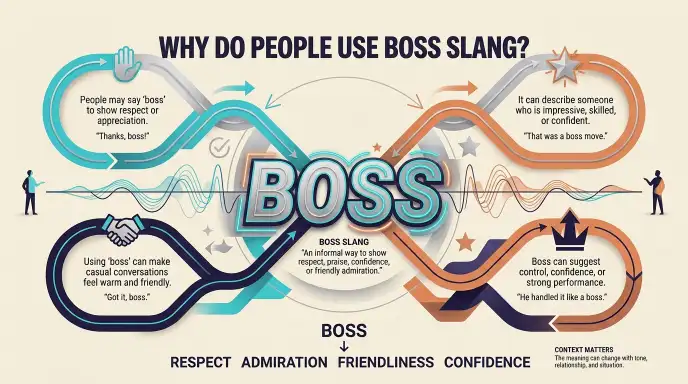
People use boss because it is short, friendly, and easy to understand.
It can show respect without sounding too formal. It can also make a conversation feel relaxed.
The word is useful when someone wants to praise another person’s confidence, skills, or leadership.
In phrases such as “Thanks, boss,” it can simply make a polite reply sound more casual.
When Should You Avoid Using Boss Slang?
Boss slang is best avoided when the situation requires formal language.
This includes:
- Formal emails
- Job applications
- Academic writing
- Official documents
- Formal meetings
- Messages to people you do not know well
You should also be careful with phrases such as “big boss” and “top dog.” They can sound playful, but they may not fit every professional setting.
When in doubt, use the person’s name or a polite title.
Polite Alternatives to Boss
You can use different words when you want to show respect without slang.
Sir or Ma’am
These are polite forms of address in formal situations.
Manager
Use manager when you mean the person who supervises a team or workplace.
Leader
Use leader when someone guides a group or organization.
Chief
Chief can be friendly in casual speech, but it can also have a formal meaning in some roles.
Supervisor
Supervisor is useful when referring to someone who manages your work.
Common Misunderstandings About Boss Slang
Boss always means a manager
Not in slang.
Someone can be called boss even when they have no management role.
Boss is always a serious compliment
Not always.
People can use boss playfully or sarcastically. The tone of the conversation helps show the meaning.
Boss is an acronym
No.
Boss is a regular word. It is not normally formed from separate words in slang.
Boss and boss man always mean the same thing
They are similar, but the tone can differ.
Boss man often sounds more personal and casual. Boss can be used in more situations.
Frequently Asked Questions About Boss Slang
Q1. What is slang for boss?
Common slang for “boss” includes “chief,” “boss man,” “big boss,” and “top dog.” These terms can show respect, leadership, or authority.
Q2. What is a boss in Gen Z slang?
In casual Gen Z speech, “boss” can describe someone confident, successful, or in control. It can also be used to praise someone’s skills or attitude.
Q3. What does it mean to call someone boss in slang?
Calling someone “boss” is often a friendly way to show respect or admiration. It can also mean that the person is confident, capable, or in charge.
Q4. What does boss stand for in slang?
“Boss” is not normally an acronym in slang. It is a regular word that can describe someone powerful, skilled, successful, or respected.
Q5. Is “boss man” a racist term?
No. “Boss man” is not inherently a racist term. It is commonly used as a casual form of address or respect, although tone and context can affect how it sounds.
Q6. What is the slang big boss?
“Big boss” can refer to an important person, leader, or someone with authority. It can also be used playfully for someone who acts confident or powerful.
Q7. What does “thanks, boss” mean?
“Thanks, boss” is usually a friendly way to thank someone. It does not necessarily mean that the person is your actual boss.
Conclusion
Boss slang can describe someone who is confident, skilled, respected, or in control. It can also be a friendly way to address someone without meaning that they are actually your manager.
The meaning depends on the sentence and tone. “Thanks, boss” can simply show friendly respect, while “You handled that like a boss” praises someone’s confidence or ability.
Boss is natural in casual conversations, texts, gaming chats, and social media. For formal communication, a clear word such as manager, leader, or supervisor is usually a better choice.
Other Slang Meanings to Know!
Nurse Slang Meaning: Definition, Uses, and Common Contexts

I am Masson Caldwell, a language enthusiast and content writer at SlangAura. I write about internet slang, texting trends, and modern expressions to help readers understand the evolving world of online language with simple and clear explanations.