
When people talk about a $100 bill, they may use different slang terms instead of saying “one hundred dollars.” Common names include a Benjamin, a C note, a bill, and a hundred. Some terms are linked to the design of the U.S. $100 note, while others come from older money slang.
These expressions are common in casual speech, music, movies, texting, and online conversations. The exact term can also vary by region and context. If you hear someone say, “That’ll cost you a Benjamin,” they simply mean that something costs $100.
Quick Answer:Slang for $100 Bill
The most common slang for a $100 bill is “Benjamin.” It comes from Benjamin Franklin, whose portrait appears on the U.S. $100 note.
Other common terms include C note, hundred, bill, and big face. Some terms are more common in certain regions or contexts.
What Is Slang for a $100 Bill?
A $100 bill has several informal names in American English.
The most well known terms include:
- Benjamin
- Benji
- C note
- C
- Hundred
- Bill
- One hundred
- Big face
These terms are often used in casual conversations. You may also hear them in songs, movies, and social media posts.
Why Is a $100 Bill Called a Benjamin?
Benjamin is one of the most popular slang terms for a $100 bill.
The name comes from Benjamin Franklin. His portrait appears on the front of the U.S. $100 note.
For example:
“I spent a Benjamin on dinner.”
This means the person spent $100.
The plural form is often Benjamins.
“He had three Benjamins in his wallet.”
That means he had $300 in $100 bills.
What Does “Benji” Mean in Money Slang?
Benji is a shorter, more casual version of Benjamin.
It refers to a $100 bill because Benjamin Franklin appears on the note.
For example:
“Can you lend me a Benji?”
This means:
“Can you lend me $100?”
The term is informal. It is more likely to appear in casual speech than in formal writing.
What Does “C Note” Mean?
C note is another common slang term for a $100 bill.
The C comes from the Roman numeral for 100. The word note refers to paper money.
So, a C note literally points to a $100 note.
For example:
“The jacket cost me a C note.”
This means the jacket cost $100.
What Does “C” Mean in Money Slang?
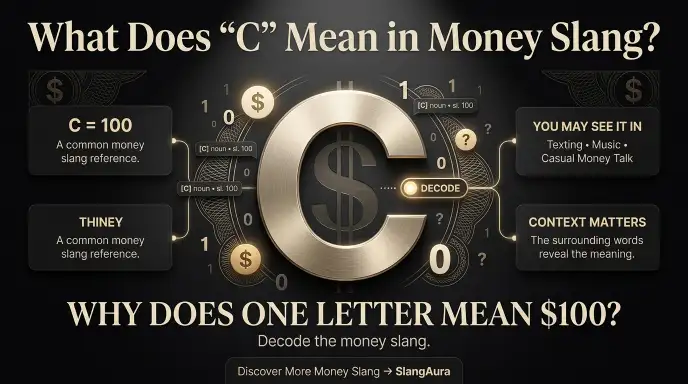
In some casual conversations, people use C to mean $100.
This usage comes from the Roman numeral C, which represents 100.
For example:
“I made a C today.”
Depending on the context, this can mean the person made $100.
The meaning should be clear from the conversation because C can have many other meanings.
What Does “A Hundred” Mean in Slang?
People often shorten $100 to “a hundred.”
This is not highly specific slang. It is simply a casual way to refer to the amount.
For example:
“That phone cost me a hundred.”
The speaker means the phone cost $100.
You may hear this phrase often in everyday conversations.
What Does “A Bill” Mean in Slang?
In some contexts, a bill can refer to a $100 bill.
For example:
“He handed me a bill.”
The exact value depends on the conversation. The speaker may need to provide more context.
Because bill can refer to many types of U.S. paper currency, it is less specific than Benjamin or C note.
What Does “Big Face” Mean?
Big face is an informal term sometimes used for a $100 bill.
The phrase refers to the large portrait of Benjamin Franklin on the note.
For example:
“I only have a big face.”
The speaker may mean they only have a $100 bill.
This term is less universal than Benjamin or C note, so context matters.
What Are Other Slang Terms for a $100 Bill?
Several informal terms can refer to a $100 bill. Some are common across the United States, while others appear more often in music, movies, or casual speech.
Here are some terms you may hear:
- Benjamin
- Benji
- C note
- C
- Hundred
- Big face
- One hunnid
- Hundo
The most widely understood choices are Benjamin, Benji, and C note.
What Does “Hundo” Mean?
Hundo is casual slang for one hundred dollars.
It does not always mean a physical $100 bill. The term can simply describe an amount of $100.
For example:
“The tickets were a hundo each.”
This means each ticket cost $100.
What Does “One Hunnid” Mean?

One hunnid is a stylized slang spelling of “one hundred.”
You may see it in music, lyrics, social media, and casual online writing.
For example:
“I got one hunnid in my pocket.”
Here, the speaker means they have $100.
The spelling is informal and should not be used in formal writing.
What Is a $100 Bill Called in Rap Slang?
Rap and hip hop culture often use terms such as Benjamin, Benji, C note, and hunnid when talking about $100.
These terms can describe cash, earnings, spending, or wealth.
For example:
“He pulled out a couple of Benjamins.”
This means he pulled out several $100 bills.
The exact wording depends on the artist and context.
What Does “Stack” Mean in Money Slang?
A stack is slang for a group of money.
In many contexts, a stack means $1,000. It does not normally mean one $100 bill.
For example:
“He saved ten stacks.”
That usually means $10,000.
So, do not confuse stack with Benjamin. A Benjamin is $100, while a stack often refers to $1,000.
What Does “Band” Mean in Money Slang?
Band is another money slang term. It commonly refers to $1,000, not $100.
The word comes from the way people may bundle or band groups of cash together.
For example:
“He made five bands.”
This usually means he made $5,000.
Therefore, band should not be used as a direct synonym for a $100 bill.
Is “Benjamin” the Same as “C Note”?
Yes. Both can refer to a $100 bill.
The terms come from different features of the currency:
- Benjamin refers to Benjamin Franklin.
- C note comes from the Roman numeral C, meaning 100.
Both are informal ways to describe $100.
Is “Benji” Formal or Informal?
Benji is informal.
It works well in casual conversations, texts, social media posts, and entertainment. It is not suitable for formal financial documents.
In formal writing, simply use $100 or one hundred dollars.
How Do You Use $100 Slang in a Sentence?
Here are some natural examples:
“I only need a Benjamin.”
“That shirt cost me a C note.”
“He gave me a Benji for the job.”
“The meal was a hundo.”
Each sentence refers to $100, but the terms have different levels of familiarity.
When Should You Use Slang for a $100 Bill?
Use these terms in relaxed settings.
They work well in:
- Casual conversations
- Text messages
- Social media
- Movies and TV dialogue
- Music
- Fiction
- Informal discussions
Choose a simple term like Benjamin when you want the meaning to be easy to understand.
When Should You Avoid $100 Bill Slang?
Avoid money slang in formal situations.
This includes:
- Business documents
- Bank forms
- Legal documents
- Financial reports
- Academic writing
- Professional emails
Use $100 or one hundred dollars instead. These forms are clear and precise.
Are These Terms Used for Other Amounts?
Some money slang can describe different amounts.
For example, Benjamin specifically points to $100. C note also means $100.
Terms such as stack and band usually describe larger amounts, often $1,000.
Always check the context before assuming the value.
FAQs About Slang for a $100 Bill
Q1. What is a 100 in money slang?
In money slang, 100 often means $100. Common terms include “a Benjamin,” “a bill,” “a hundred,” and “a C.”
Q2. What’s another way to say $100?
You can say a Benjamin, a C note, a hundred bucks, a hundred dollars, or a bill. “Benjamin” comes from Benjamin Franklin’s image on the $100 bill.
Q3. How do you say 100 in slang?
Common slang for 100 includes a C, a Benjamin, a bill, a hundred bucks, and a hundred. The exact term can vary by region and context.
Q4. What are US dollar bills called in slang?
US dollar bills can be called bucks, bills, bread, cash, dough, or paper. Some terms refer to money in general rather than one specific bill.
Q5. What is Gen Z slang for money?
Gen Z may use terms such as bands, racks, stacks, bread, bag, and cash for money. These words are common in texting, social media, music, and casual conversation.
Q6. What is the nickname for a $100 bill?
The most common nicknames are Benjamin, Benji, C note, and a bill. “Benjamin” and “Benji” refer to Benjamin Franklin, who appears on the US $100 bill.
Conclusion
There are several names for a $100 bill, but Benjamin, Benji, and C note are among the best known terms. You may also hear hundo, hundred, or hunnid in casual settings.
These expressions are useful for understanding conversations, music, movies, and online slang. For formal situations, stick with $100 or one hundred dollars.
Slang Terms to Know Next:
Ratio Slang Meaning: What Does “Ratio” Mean in Slang?

I am Masson Caldwell, a language enthusiast and content writer at SlangAura. I write about internet slang, texting trends, and modern expressions to help readers understand the evolving world of online language with simple and clear explanations.