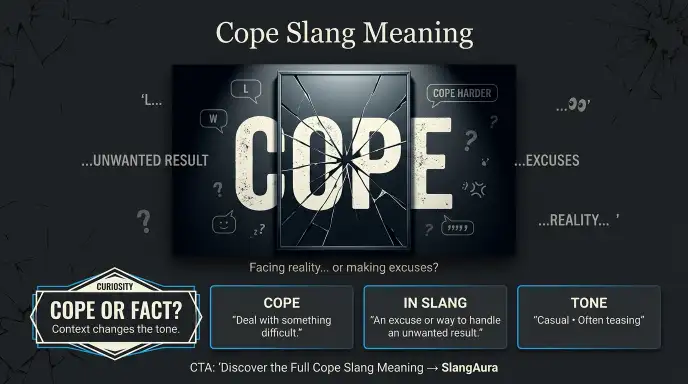
Cope slang means trying to deal with a difficult, disappointing, or stressful situation. Online, people often use “cope” in a teasing way when someone is struggling to accept an outcome they dislike.
You may see “cope” in TikTok comments, gaming chats, memes, Reddit posts, and group messages. It can describe a real way of handling stress. It can also be used as a short insult or joke.
The meaning depends on the context. A person saying “I need time to cope” is talking about dealing with a real problem. Someone commenting “cope” after another person loses a game is usually teasing them.
This guide explains what cope slang means, how people use it, where it appears, and how its tone can change online.
Quick Answer: What Does Cope Slang Mean?
Cope slang means trying to deal with something difficult or disappointing. Online, “cope” is often used to tease someone who seems unable to accept an outcome they do not like.
For example:
“You lost the match. Cope.”
Here, “cope” is not a serious offer of support. It is a short, mocking response.
What Does Cope Mean in Slang?
In everyday English, cope means to deal successfully with a difficult situation.
Online slang gives the word a more sarcastic use.
Someone may say:
“Cope harder.”
This usually means:
“You are upset about the result, so deal with it.”
The speaker may be joking. They may also be trying to dismiss the other person’s complaint.
This is why cope can sound playful in one conversation and rude in another.
Serious Use of Cope
The normal meaning is still common.
“I’m trying to cope with the stress.”
Here, the speaker is talking about managing a difficult feeling or situation.
Slang Use of Cope
The slang use is often directed at another person.
“Your team lost. Cope.”
Here, the word is used to tease the person rather than discuss emotional well being.
What Does “Cope” Mean on the Internet?
On the internet, cope often describes a person’s attempt to justify an outcome they dislike.
It is especially common during arguments, competitions, sports discussions, gaming, and online debates.
For example:
“You only lost because your controller was broken.”
Someone might reply:
“Cope.”
The reply suggests that the excuse is being seen as an attempt to avoid accepting the loss.
This use is often brief. A single word can communicate the whole idea.
What Does “Cope” Mean on TikTok?
On TikTok, cope is often used in comments and captions to mock a person’s reaction.
For example:
“He says the video was fake. Cope.”
The commenter is suggesting that the person does not want to accept what happened.
TikTok users may also use phrases such as “coping” or “cope harder.”
The tone is usually humorous or sarcastic, but it can become insulting when aimed at someone during a serious argument.
What Does “Cope” Mean in Gaming?
Gaming is one of the places where cope slang is easy to spot.
Players may say “cope” after a win or loss.
For example:
“You said the game was unfair because I won? Cope.”
The speaker is teasing the other player for giving a reason for the loss.
You may also see:
- “Cope harder.”
- “Just cope.”
- “You’re coping.”
- “Pure cope.”
- “That’s cope.”
These phrases are usually informal and competitive.
What Does “Coping” Mean in Slang?
Coping means trying to deal with something difficult. In online slang, it can also mean making excuses or convincing yourself that an unwanted outcome is not as bad as it seems.
For example:
“He keeps saying his team deserved to win. He’s coping.”
The speaker believes the person is struggling to accept the result.
The normal meaning is different:
“She is coping with a stressful week.”
Here, coping means managing stress.
The surrounding context tells you which meaning is intended.
What Does “Cope Harder” Mean?
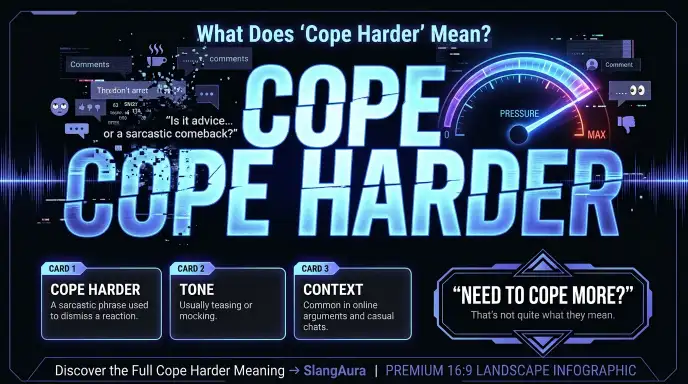
“Cope harder” is a sarcastic internet phrase.
It usually means:
“You are not accepting the result, so keep trying to deal with it.”
For example:
“They only won because of luck.”
Reply:
“Cope harder.”
This response is usually meant as a joke, taunt, or dismissal.
It is more aggressive than simply saying “cope,” so it may not be suitable for polite conversations.
What Does “Copium” Mean?
Copium is internet slang based on the words “cope” and “opium.”
It is a humorous imaginary substance that represents someone’s emotional coping after disappointment.
For example:
“That prediction was pure copium.”
The speaker means that the prediction seems like a way to stay hopeful despite evidence pointing the other way.
Copium became popular in online meme culture and gaming communities. It is usually playful, but it can still be used to mock someone.
Is Cope a Bad Word?
No. “Cope” is not a swear word or inherently offensive.
The normal word is completely neutral.
The slang use can be dismissive or insulting, depending on how it is directed at someone.
For example:
“I’m learning to cope with the change.”
This is a normal statement.
But:
“Cope, loser.”
is clearly insulting.
So, the word itself is not offensive. The way it is used can make the message rude.
Where Is Cope Slang Commonly Used?
Cope appears mostly in informal online spaces.
TikTok
People use it in comments and videos to react to someone’s opinion or reaction.
It can appear during debates, sports discussions, gaming threads, and meme conversations.
Discord
Gaming communities may use “cope” after a player loses or complains about a match.
X
Users may reply with “cope” when disagreeing with another person’s reaction or argument.
Gaming Forums
Competitive communities often use the term as a quick taunt.
Texting
Friends may use “cope” jokingly after a small disappointment.
For example:
“They picked your favorite restaurant without you.”
“Cope 😭”
The meaning is playful in this context.
Cope vs. Deal With It
“Cope” and “deal with it” can have similar meanings, but their tone is different.
| Phrase | Meaning | Tone |
| Cope | Deal with the situation | Casual or sarcastic |
| Deal with it | Accept the situation | More direct |
| Cope harder | Keep trying to accept it | Mocking |
| You’re coping | You are making excuses | Teasing or dismissive |
| I’m coping | I am managing the situation | Neutral |
“Deal with it” can sound blunt. “Cope” can sound more like internet slang.
Is Cope Always Used as an Insult?
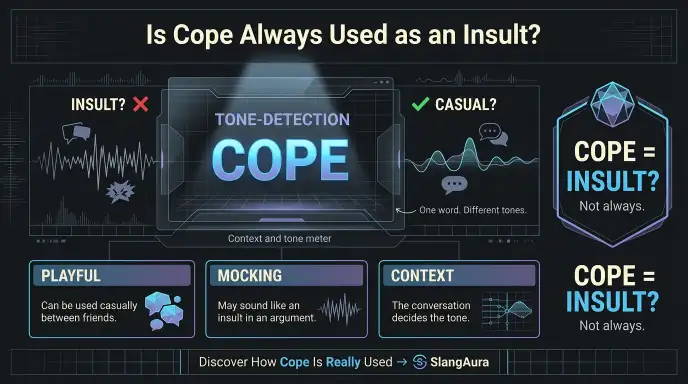
No. This is an important distinction.
Cope has a normal meaning outside internet slang. People use it when talking about stress, grief, change, disappointment, and other difficult experiences.
The mocking meaning comes from online culture.
For example:
“Everyone copes with stress differently.”
This is not slang.
But:
“Your favorite player lost. Cope.”
This is clearly internet slang.
Do not assume every use of “cope” is an insult. Context matters.
Where Did Cope Slang Come From?
The word cope is much older than internet slang. It has been used in English for centuries to describe dealing with a difficult situation.
Its modern slang use developed through online meme culture and communities where people debate, compete, and react to wins and losses. The short reply “cope” became a simple way to mock someone for making excuses or refusing to accept an outcome.
The exact point when this slang use became popular is difficult to pin down. It became especially visible in online forums, gaming spaces, meme communities, and social media.
How Is Cope Used in Different Online Spaces?
The meaning stays similar across platforms, but the tone can change.
| Platform | Common use | Typical tone |
| TikTok | Reacting to opinions or outcomes | Playful or mocking |
| Debates and discussions | Sarcastic | |
| Discord | Gaming and group chats | Teasing |
| X | Arguments and reactions | Often blunt |
| Gaming | Losses and excuses | Competitive |
| Texting | Joking with friends | Casual |
A comment such as “cope” may be harmless between friends. The same comment can feel insulting during a serious argument.
What Are Some Examples of Cope Slang?
Here are some natural examples of how people may use the term online.
After a Game
“You lost the final round. Cope.”
The speaker is teasing the other player.
During an Argument
“You only say that because you know I’m right.”
“Cope.”
The reply dismisses the person’s argument.
In a Sports Discussion
“Our team would have won if the referee had made the right call.”
“That’s some serious cope.”
Here, the speaker thinks the explanation is an excuse.
Among Friends
“They sold out of my favorite snacks.”
“Cope 😭”
This can be a light joke because the problem is minor.
What Does “Pure Cope” Mean?
“Pure cope” means an excuse, explanation, or reaction that the speaker believes is mainly an attempt to avoid accepting an unwanted result.
For example:
“He says he lost because his keyboard was too loud. Pure cope.”
The phrase is usually sarcastic.
It is common in gaming, sports discussions, memes, and online arguments.
What Does “You’re Coping” Mean?
“You’re coping” means the speaker thinks someone is trying to make themselves feel better instead of accepting reality.
For example:
“He keeps saying his team is better even after losing.”
“He’s coping.”
This does not always mean the person is actually making excuses. It is often just the speaker’s opinion.
That is why the phrase can sound dismissive during a serious conversation.
Is Cope Toxic Slang?
Cope can become toxic when it is used to shut someone down or mock genuine feelings.
In competitive spaces, it may be harmless banter between people who understand the joke. In a serious discussion, repeatedly telling someone to “cope” can come across as rude.
For example, using “cope” after someone loses a video game may be lighthearted.
Using “cope” toward someone discussing a serious personal problem would be insensitive.
The same word can have very different effects depending on the situation.
When Should You Avoid Using Cope?
Avoid using cope as a taunt when the other person is discussing a serious problem.
It is also better to avoid it in:
- Formal work conversations
- Professional emails
- Academic writing
- Serious personal discussions
- Customer service
- Sensitive conversations
If someone is genuinely upset, a supportive response is usually better.
Instead of:
“Just cope.”
you could say:
“I understand why you’re upset.”
This keeps the conversation respectful.
What Are Polite Alternatives to Cope?
If you want to express the idea without mocking someone, choose softer wording.
You could say:
- “I understand.”
- “You’ll get through it.”
- “It’s okay to be disappointed.”
- “Give yourself some time.”
- “Try to look at the positive side.”
- “I know that was frustrating.”
These phrases work better when the person is dealing with a real problem.
If you are simply talking about accepting an outcome, you can say:
“Sometimes we just have to accept the result.”
That gives the same general idea without the sarcastic tone.
Why Do People Use Cope as Slang?
People use cope because it is short and easy to understand in online arguments.
It can quickly suggest that someone is:
- Making excuses
- Refusing to accept a result
- Trying to stay positive after losing
- Defending an unpopular opinion
- Reacting emotionally to disappointment
The word also fits meme culture well. A single word can turn a long argument into a short joke.
This makes it useful in fast moving online conversations.
Common Misunderstandings About Cope
Cope Always Means Something Negative
Not true.
The standard word cope is neutral.
“He is coping well with the change.”
This is a normal use.
Cope Always Means Making Excuses
Not always.
Someone can cope with stress without making excuses. The excuse related meaning mainly comes from its online slang use.
Everyone Who Says “Cope” Is Being Serious
Not necessarily.
Friends may use it as playful banter. Emojis, memes, and the relationship between speakers can make the tone lighter.
Cope Is Only Used in Gaming
No. Gaming helped spread the slang, but it is also common in sports discussions, memes, social media, and online debates.
Cope vs. Copium vs. Coping
These terms are related but not identical.
| Term | Meaning |
| Cope | Deal with something; online, often a taunt |
| Coping | The act of dealing with a situation |
| Copium | A humorous term for unrealistic or hopeful coping |
For example:
“I’m coping with the loss.”
This uses the normal meaning.
“Cope.”
This is often a sarcastic online response.
“He’s running on copium.”
This is a meme style way to say someone is holding onto hope despite an unwanted result.
Frequently Asked Questions About Cope Slang
Q1. What does cope mean in Gen Z?
In Gen Z slang, “cope” means trying to accept or deal with something disappointing, often by making excuses or convincing yourself that things are better than they are.
Q2. What is meant by cope?
“Cope” means to deal with a difficult or disappointing situation. In slang, it can be used sarcastically to suggest that someone is making excuses instead of accepting reality.
Q3. What does cope mean on TikTok?
On TikTok, “cope” is often used when someone refuses to accept an unfavorable result. A person may comment “cope” to tease someone who is making excuses after losing or being proven wrong.
Q4. What is the cope meme?
The cope meme usually mocks someone who is struggling to accept an unwanted outcome. It often appears in reaction images, captions, and comments to mean “keep making excuses” or “deal with it.”
Q5. What is cope in slang?
In slang, “cope” describes excuses, denial, or mental efforts used to handle an unpleasant reality. It is often used humorously or as an insult in online conversations.
Q6. Is cope a swear word?
No, “cope” is not a swear word. It is a normal English word that has developed a sarcastic or mocking meaning in internet slang.
Conclusion
Cope slang is a popular internet use of the word “cope.” It often appears when someone is teasing another person for struggling to accept a loss, disappointment, criticism, or unwanted result.
The word also has a normal meaning. To cope simply means to deal with a difficult situation. This meaning is neutral and is not limited to internet culture.
Online expressions such as “cope,” “cope harder,” “you’re coping,” and “copium” are often found in gaming, memes, sports discussions, and social media.
The key is context. “Cope” can be a harmless joke among friends, but it can sound rude when used against someone who is dealing with a serious problem. Use it carefully and choose supportive language when the situation calls for empathy.
Slang Terms to Know Next:
Slang for $100 Bill: 25 Common Names and What They Mean

I am Masson Caldwell, a language enthusiast and content writer at SlangAura. I write about internet slang, texting trends, and modern expressions to help readers understand the evolving world of online language with simple and clear explanations.