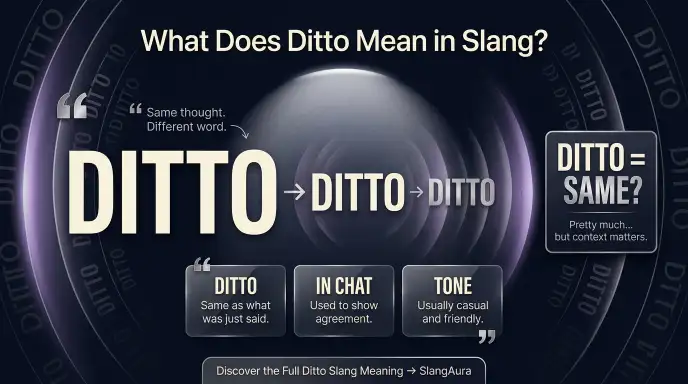
“Ditto” means “same here” or “I agree” in casual slang. People use it when they want to say that they feel, think, or want the same thing as someone else.
You may see ditto in texts, chats, social media comments, and everyday conversations. It is a quick way to avoid repeating the same words.For example, if a friend says, “I’m so tired today,” you can reply, “Ditto.” You are saying that you feel the same way.
The word is not new internet slang. Ditto has been used in English for a long time. Its casual use remains common because it is short, clear, and easy to use.This guide explains what does ditto mean in slang, where the word comes from, how people use it, and what it means in different situations.
Quick Answer: What Does Ditto Mean in Slang?
Ditto means “same,” “same here,” or “I agree” in casual conversation. It is used when someone wants to show that they have the same feeling, opinion, or experience without repeating the other person’s words.
Example:
“I could really use a vacation.”
“Ditto.”
The second person means, “I could really use a vacation too.”
What Does Ditto Mean?
Ditto is a short way to say that something just mentioned also applies to you.
It can show agreement with another person’s:
- Feeling
- Opinion
- Experience
- Preference
- Statement
For example:
“I love this song.”
“Ditto!”
The reply means:
“I love this song too.”
Ditto can make a conversation faster. Instead of repeating a full sentence, the speaker uses one word to show the same idea.
Is Ditto a Slang Word?
Ditto is often used informally, but it is not strictly modern slang.
The word has a long history in English. Its casual meaning of “same” or “me too” has made it popular in everyday speech and online conversations.
This is an important difference.
Words such as “rizz” and “delulu” are strongly linked to modern internet slang. Ditto is older and more established. People can use it in casual speech without treating it as trendy slang.
What Does Ditto Mean in Texting?
In texting, ditto usually means “same here” or “me too.”
It works well as a short reply.
For example:
Friend: “I’m ready for the weekend.”
Reply: “Ditto.”
This means:
“I’m ready for the weekend too.”
Another example:
Friend: “I don’t feel like cooking tonight.”
Reply: “Ditto.”
The speaker is saying that they feel the same way.
What Does Ditto Mean on Social Media?
On social media, ditto can be used in comments, replies, captions, and direct messages.
Someone may use it when they strongly agree with another person’s statement.
For example:
“This is the best movie I’ve watched all year.”
“Ditto.”
The reply means that the second person has the same opinion.
It can also be used humorously:
“I need coffee before I talk to anyone.”
“Ditto 😂”
Here, the word shows shared agreement in a light way.
What Does Ditto Mean in a Conversation?
In a conversation, ditto tells someone that you share the same thought or feeling.
It can replace phrases such as:
- “Me too.”
- “Same here.”
- “I agree.”
- “I feel the same.”
- “That goes for me too.”
For example:
“I’m excited about the trip.”
“Ditto.”
The reply is short, but the meaning is clear.
How Do You Use Ditto in a Sentence?
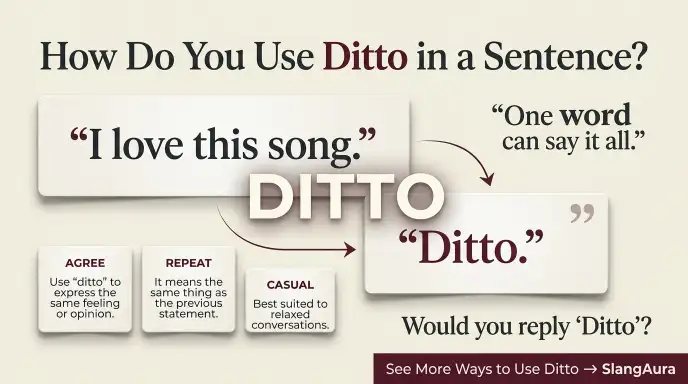
You can use ditto by itself as a reply.
“I’m exhausted.”
“Ditto.”
You can also place it before another statement.
“Ditto for me.”
This means that the same thing applies to you.
Another common pattern is:
“I feel the same way. Ditto.”
However, using ditto alone is often the simplest option in casual conversation.
Does Ditto Mean I Agree?
Yes, ditto can mean “I agree,” but its meaning is slightly broader.
It can show agreement with an opinion:
“That restaurant is amazing.”
“Ditto.”
It can also show the same feeling without agreeing with an argument.
“I’m nervous about tomorrow.”
“Ditto.”
Here, the second speaker is not agreeing with an opinion. They are sharing the same feeling.
So, “same” is often a better general meaning than simply “I agree.”
What Is the Tone of Ditto?
Ditto usually has a casual, friendly, or neutral tone.
The word itself is not rude.
The tone can change based on the situation and delivery.
| Context | Example | Tone |
| Friendly | “I love pizza.” “Ditto!” | Warm |
| Casual | “I’m tired.” “Ditto.” | Neutral |
| Humorous | “I need coffee.” “Ditto 😂” | Playful |
| Agreement | “That was a great movie.” “Ditto.” | Positive |
| Formal | “The report needs changes.” “Ditto.” | Less natural |
A short “ditto” can sometimes sound dry if the conversation is serious.
Is Ditto Positive or Negative?
Ditto is neither positive nor negative by itself.
Its meaning depends on what comes before it.
For example:
“I’m having a great day.”
“Ditto!”
This has a positive feeling.
But:
“I’m having a terrible day.”
“Ditto.”
This shows that the second person is having the same bad experience.
The word simply mirrors the previous statement.
Who Uses the Word Ditto?
People of many ages use ditto.
It is not limited to Gen Z, teenagers, or internet users. You may hear it in everyday conversations, read it in messages, or see it in online comments.
Because the word is easy to understand, it can work across different age groups.
Younger users may also choose shorter alternatives such as “same,” “me too,” or “fr.” Older speakers may be more familiar with “ditto” because of its long history.
Still, usage varies from person to person.
Where Is Ditto Commonly Used?
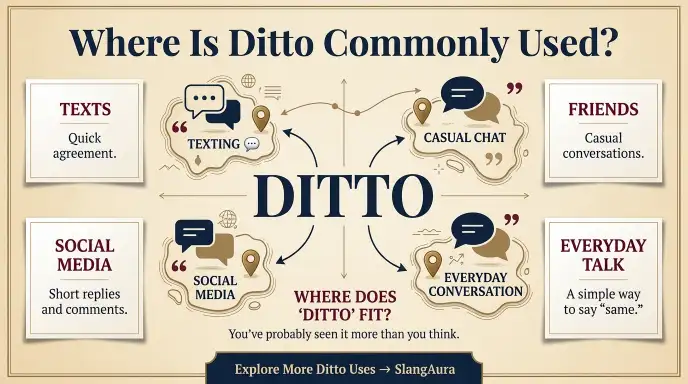
You can find ditto in many casual settings.
Text Messages
“I need a break.”
“Ditto.”
Group Chats
“Who else wants pizza?”
“Ditto!”
Social Media
“This song never gets old.”
“Ditto.”
Everyday Conversation
“I’m ready to go home.”
“Ditto.”
Online Comments
Someone may simply comment “Ditto” to show that they share another user’s opinion.
The word is flexible because it does not require a specific topic.
Ditto vs. Same
Ditto and same often have the same basic meaning, but they have a slightly different feel.
| Word | Meaning | Style |
| Ditto | Same here | Casual, sometimes playful |
| Same | I feel the same | Very casual |
| Me too | I feel or think the same | Natural and clear |
| I agree | I share your opinion | More direct |
For example:
“I’m so hungry.”
“Same.”
and:
“I’m so hungry.”
“Ditto.”
both communicate the same basic idea.
“Same” is more common in modern internet slang, while “ditto” can feel more traditional or playful.
Where Did the Word “Ditto” Come From?
The word ditto is much older than modern internet slang. It came into English from Italian, where detto means “said” or “the said.”
The word was used in writing to show that something above it should be repeated. Over time, ditto became a general way to mean “the same.”
That older meaning is still connected to how people use the word today. When someone says “ditto,” they are telling you that the same idea applies to them.
What Does Ditto Mean in Different Situations?
The meaning stays close to “same”, but the context can change what is being shared.
| Situation | Example | Meaning |
| Feelings | “I’m exhausted.” “Ditto.” | I’m exhausted too |
| Opinion | “That movie was great.” “Ditto.” | I agree |
| Preference | “I want pizza.” “Ditto.” | I want pizza too |
| Experience | “I missed the bus.” “Ditto.” | I missed it too |
| Complaint | “This weather is awful.” “Ditto.” | I feel the same |
The key idea is simple: ditto refers back to something already said.
Can You Use Ditto in Texting?
Yes. Ditto works well in casual texting when the other person’s meaning is clear.
For example:
Friend: “I’m counting down to Friday.”
You: “Ditto!”
The reply shows that you feel the same way.
It can also make a conversation feel quick and natural. You do not need to repeat the full sentence.
Is Ditto Used on TikTok?
Yes, but ditto is not mainly a TikTok specific slang term.
Someone may use it in a TikTok comment when they agree with another person’s statement.
For example:
“This is exactly how I feel.”
“Ditto.”
The word works in the same way it does in other casual conversations.
Is Ditto Used on Instagram?
Yes. Instagram users may use ditto in comments, replies, or DMs.
For example:
“I could watch this show forever.”
“Ditto.”
It is a simple way to show shared enthusiasm.
The word does not have a special Instagram meaning. Its meaning comes from the context.
Is Ditto Used on Snapchat?
Yes. Ditto can appear in Snapchat chats when someone wants to say “same here.”
For example:
“I’m so ready for summer.”
“Ditto ☀️”
The emoji can make the reply feel warmer or more playful.
Is Ditto Common in Gaming?
Ditto can be used in gaming chats, but it is not a gaming specific term.
A player might say:
“I need a better team.”
Another player could reply:
“Ditto.”
The response means that they feel the same way.
Gaming communities may use shorter terms such as “same” more often, but ditto is still easy to understand.
Can Ditto Be Used at Work?
Yes, but it depends on the situation.
Ditto is informal and conversational. It may work in a relaxed team chat when coworkers already communicate casually.
For example:
“I think we should review the numbers again.”
“Ditto.”
Still, a clearer response may be better in a formal email:
“I agree. I think we should review the numbers again.”
This is especially useful when communicating with clients, managers, teachers, or people outside your usual team.
Is Ditto Appropriate for Formal Writing?
Usually, ditto is not the best choice for formal writing.
The word is understandable, but repeating the exact idea can make your meaning clearer.
Instead of:
“Ditto.”
you could write:
“I agree with this point.”
or:
“I feel the same way.”
This matters when the reader needs a clear record of what you mean.
Is Ditto Rude?
No, ditto is not rude or offensive.
It is normally a harmless way to show agreement or a shared feeling.
However, saying only “ditto” during a serious discussion may sound too brief.
For example:
“I’m worried about what happened.”
“Ditto.”
This shows the same feeling, but it may sound cold.
A warmer response could be:
“I feel the same way. I hope things get better.”
The problem is not the word itself. The amount of detail and the situation affect how the reply feels.
When Should You Avoid Using Ditto?
You may want to avoid ditto when the meaning could be unclear.
It is better to explain your point when:
- The conversation is serious
- You are writing a formal email
- You are answering an important question
- The reader may not know what you are agreeing with
- You need to give a clear professional response
- The original statement contains several different ideas
For simple casual conversations, “ditto” is usually easy to understand.
What Are Some Alternatives to Ditto?
Several expressions can replace ditto.
Same
“I’m tired.”
“Same.”
This is very common in casual internet language.
Me Too
“I love this song.”
“Me too.”
This is clear and natural.
Same Here
“I’m ready for the weekend.”
“Same here.”
This directly shows that the feeling applies to you.
I Agree
“This plan makes sense.”
“I agree.”
This works better in more serious or professional situations.
I Feel the Same Way
“I’m nervous about tomorrow.”
“I feel the same way.”
This is useful when the conversation is more personal.
Ditto vs. Me Too
Ditto and “me too” often communicate the same idea.
The main difference is style.
Me too is very common and sounds natural in everyday speech.
Ditto is shorter and can feel playful, casual, or slightly old fashioned.
For example:
“I want ice cream.”
“Me too.”
or:
“I want ice cream.”
“Ditto.”
Both replies mean that the second person also wants ice cream.
Common Misunderstandings About Ditto
Ditto Does Not Mean Only “I Agree”
It can mean agreement, but it can also mean “I feel the same” or “the same applies to me.”
Ditto Is Not New Gen Z Slang
The word is much older than Gen Z internet culture. Its modern casual use continues an older meaning.
Ditto Is Not a Special TikTok Word
TikTok users can use it, but the word does not have a unique TikTok definition.
Ditto Is Not Always Formal
Although the word has a long history, using it as a short reply is usually casual.
Why Do People Say Ditto?
People say ditto because it saves them from repeating the same thought.
It can make a conversation shorter while still showing agreement or shared feelings.
For example:
“I’m excited for the concert.”
Instead of:
“I’m excited for the concert too.”
the person can simply say:
“Ditto!”
The meaning is clear from the previous sentence.
Frequently Asked Questions About Ditto Slang
Q1. What does ditto mean in a text?
In a text, “ditto” means “same here,” “me too,” or “I feel the same.” It shows that you agree with or share the feeling in the previous message.
Q2. When a girl says ditto?
When a girl says “ditto,” she usually means she feels the same way as you. The meaning depends on the message before it, so it can be friendly, playful, or romantic.
Q3. Is Ditto a good response?
Yes, “ditto” can be a good response when you want to agree in a short, casual way. It works best when the other person will clearly understand what you are agreeing with.
Q4. Why do some people say Ditto?
People say “ditto” because it is a quick way to say “same” without repeating the whole message. It can also sound playful or lighthearted.
Q5. Does ditto mean “I love you”?
Not always. If someone says “I love you” and you reply “ditto,” it can mean “I love you too,” but the word itself simply means “same.”
Q6. Is saying ditto disrespectful?
No, “ditto” is not inherently disrespectful. However, it may sound too casual or impersonal in a serious conversation, especially when someone is sharing deep feelings.
Conclusion
What does ditto mean in slang? In most casual conversations, it means “same,” “same here,” or “me too.” People use it to show that another person’s statement also applies to them.
Ditto is not a new internet term. It has a much older history and has kept its basic idea of meaning the same. Today, you can still see it in texts, social media, chats, and everyday speech.
The word is usually friendly and harmless. Still, a short “ditto” can feel too brief during a serious conversation, so a fuller reply may be better when the topic needs care.
For casual use, ditto is a simple way to agree without repeating yourself.
Your Next Slang Read:
Cope Slang Meaning: Definition, Uses, and Examples

I am Masson Caldwell, a language enthusiast and content writer at SlangAura. I write about internet slang, texting trends, and modern expressions to help readers understand the evolving world of online language with simple and clear explanations.