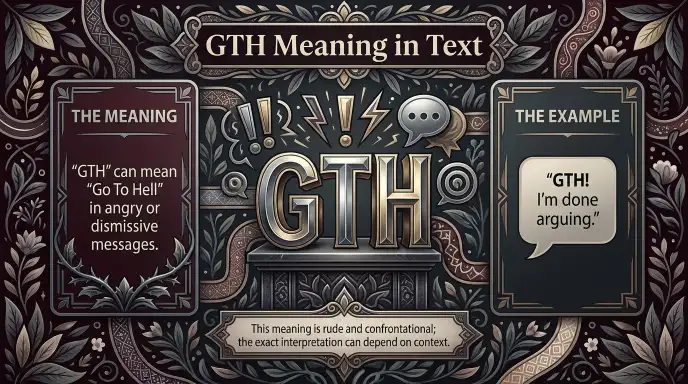
GTH stands for “Go To Hell.” It’s a blunt, slang way to tell someone off. You might see it in TikTok comments, Snapchat DMs, Instagram captions, or text messages. People often search for it to decode slang and understand what someone is really saying.
It’s common among teens and young adults who use quick abbreviations online. When someone types GTH, they usually mean “go to hell,” showing they are angry or annoyed. As with other online acronyms, context matters it’s usually not meant for polite conversation.
This guide explains exactly what GTH means, where you might see it, how it’s used, and how to respond if you encounter it. We’ll also compare it to similar abbreviations and give you real life examples. That way, you can understand GTH in everyday chatting and social media.
1. GTH Meaning in Text
GTH is an internet slang abbreviation meaning “go to hell.” It’s not a formal word or acronym from any official source; it arose from people shortening speech in texting and online chat. In everyday chat, saying “GTH” is a harsh way to tell someone to leave or to express anger at them.
As with many chat abbreviations, you won’t see GTH in books or formal writing. It’s an informal slang term. People use it when they want a quick way to say “go to hell” without typing it all out. For example, if a friend is bothering you, you might see someone text “GTH” instead of typing the full phrase.
Because it’s a slang abbreviation, GTH usually carries a strong negative tone. It’s similar to saying “get lost” or worse in a conversation. When you see GTH, think of it as the shorthand for a rude dismissal or strong frustration in a chat.
2. Where People Use GTH

TikTok
On TikTok, GTH might appear in video captions or comments. Young users often use slang in comments. For instance, if someone insults another person, a bystander might type “GTH!” to express “go to hell” as a comeback. You may also see it in text overlays or subtitles of comedic skits. The short format of TikTok videos encourages quick slang.
Snapchat
Snapchat is about quick, casual messaging. If a friend texts something annoying, the reply could be a Snap with text “GTG, GTH.” Here GTH means “go to hell,” implying the sender is frustrated and needs to end the conversation. Since Snapchats disappear, people might use stronger language more freely.
On Instagram, GTH can appear in direct messages or in comments under posts. For example, if a caption or story has someone bragging, a follower might comment “GTH” to show annoyance. It’s less common in public comments because it’s rude, but it can happen among friends or in heated discussions.
WhatsApp chats, like group chats or one on one messages, often use texting slang. If a group discussion becomes heated, someone might write “Alright, GTH!” meaning “okay, go to hell!” It’s a quick way to shut down an annoying conversation without typing full words. WhatsApp also makes it easy to use voice or text so slang flows naturally.
SMS
In old fashioned SMS texting (the green bubble texts), GTH still sees use. For example, if someone says something that makes you angry over text, you might reply with “GTH” as a quick retort. It serves the same purpose of telling someone off, just in mobile text form.
Across all these platforms, the meaning of GTH doesn’t really change: it means “go to hell.” The style and context might differ on TikTok it might be a comment, on WhatsApp a text message but the idea is always a blunt dismissal.
3. Real Chat Examples
Below are 10 sample conversations that show how people might use GTH in real texting contexts. The tone is informal and matches everyday chat among friends or acquaintances:
- A: Ugh, forgot my homework again!
B: Seriously? GTH, dude. You need to do your work.
A: Fine, I will. - A: You ate all the pizza I was saving!
B: GTH, it was just sitting there.
A: Not cool, I was hungry. - A: You never listen to me.
B: Oh yeah? GTH then. Whatever.
A: I’m trying to help you, man. - A: That movie was terrible, thank you for forcing me to watch it.
B: GTH with your complaints. It’s just a movie.
A: Fine, I get it, I’m done. - A: Don’t you start arguing with me!
B: What do you want from me? GTH already.
A: Sorry, I just got upset. - A: I hate how you always leave a mess!
B: GTH! I’m not your maid.
A: That was rude, but maybe I overreacted. - A: You ruined my game!
B: GTH. I was trying to help you.
A: Help? You made it worse. - A: Ugh, stop texting me, I’m busy.
B: Wow, okay. GTH if you don’t want to talk.
A: I said I’m busy. Right now, peace. - A: You never do your part of the group work.
B: GTH, maybe if you were nicer, I’d help.
A: Sorry, let’s just finish this. - A: Can you stop complaining about everything?
B: Alright, fine. GTH, I’m going offline.
A: Okay, talk later.
In these examples, GTH is used to show irritation or anger. It’s usually followed by a short justification or an argument. Notice how GTH often shifts the conversation: the person saying it is upset and wants to end or escalate the dispute.
4. How to Reply When Someone Says “GTH”
If someone uses GTH toward you, your response depends on your relationship and the tone:
- Funny reply: Use humor to defuse. For example, “😂 Wow, tone it down, I was just kidding!” or “Going to hell? Let me pack my bags!”. This shows you recognize the joke and you’re not taking it too seriously.
- Casual reply: Keep it light. Try “Alright, moving on then.” or simply “Okay, understood.” This shows you accept their frustration and won’t argue further.
- Friendly reply: Stay calm. Say something like “Sorry, I didn’t mean to upset you.” or “My bad, didn’t realize it bothered you.” This shows understanding and deescalates the conflict.
- Neutral reply: If unsure, ask for clarification. “What do you mean by that?” or “Why are you upset?” This is straightforward and can help explain the situation without confrontation.
In any case, don’t respond with more insults. GTH is an insult itself, so replying with more anger often makes things worse. Instead, aim to clarify or cool things down.
5. Is GTH Rude or Offensive?
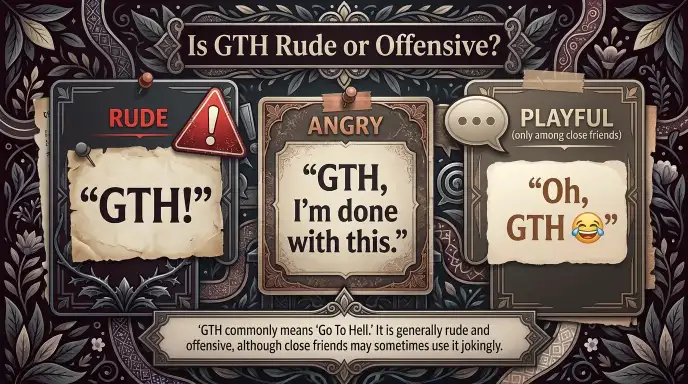
Yes, GTH is considered rude or offensive. It contains an implied curse (“go to hell” means literally telling someone to go to a bad place) and is used angrily. Here’s what to keep in mind:
- Rude tone: People often use GTH when they are very irritated or upset. It’s stronger than just saying “no” or “leave me alone.” It tells someone off bluntly.
- Safety: GTH is not a mild expression. It’s not safe to use with teachers, bosses, or unfamiliar people. Using GTH with strangers or in professional settings is very inappropriate.
- Appropriateness: It’s generally only acceptable among close friends (if they understand your humor) or in very heated arguments. Even then, it can hurt feelings. In schools, workplaces, or polite company, avoid it entirely.
Because of its harsh meaning, if someone uses GTH, they are probably very frustrated. Use context: if they meant it jokingly among friends it might be more acceptable, but if it’s serious, it’s like being told off in anger. Always consider the setting and your audience before using such language.
6. Who Uses This Term?
Age groups: GTH is most often used by teenagers and young adults. It’s common in online conversations where people feel comfortable using strong language. Younger kids or adults in formal roles rarely use it.
Gen Z usage: Gen Z (roughly those born mid 1990s to early 2010s) is very familiar with texting slang and acronyms. They might use GTH among friends during an argument or as a meme. However, not all Gen Z use such harsh terms; it varies by person.
Platforms: GTH can appear on any casual chat platform (messaging apps, social media). Teens might say it on Snapchat or Instagram Direct Messages. Gamers might use it in chat if someone is annoying. You won’t see it in professional emails or formal posts.
Online presence: GTH isn’t as trending as some acronyms (like IDK or LOL), because it’s offensive. It appears mainly in personal chats or comments where someone is angry. It’s not something people search for every day, but those looking up slang might find it when they encounter it.
In summary, GTH is used informally by people who are comfortable with strong language usually younger, casual chat users. It’s part of the edgy or rude side of internet slang.
7. Origin of the Term
Slang origin: GTH likely evolved naturally as Internet slang. It’s an acronym of a common phrase (“go to hell”), so it doesn’t have a clear inventer. People always looked for shortcuts to say things quickly, and this phrase got shortened in texting.
Internet culture influence: On forums and chat rooms, users often create and spread acronyms. “GTH” would come from users wanting a quick way to say “go to hell” without typing everything. It’s similar to other acronyms like GTFO (“get the f*** out”). As texting and early internet chat grew, these shorthand terms spread among groups.
Clear or uncertain origin: There’s no definitive story of who first used GTH. It’s just something that appeared as young people chatted online. Over time, people outside those chats noticed it, so dictionaries like NoSlang included it.
We know GTH means “go to hell,” which suggests it came from normal speech and was just abbreviated. There’s no evidence it started on one site or app. It’s just part of the general trend of making acronyms from phrases (like IDK, BRB, BTW).
8. GTH Compared With IDK, IDC, IMO, and BRB
| Term | Meaning | Type | Usage | Popularity |
| GTH | Go To Hell (rude dismissal) | Slang abbreviation | Used to tell someone off or show anger | Less common, used in angry chats |
| IDK | I Don’t Know | Text abbreviation | Shows uncertainty or lack of knowledge | Very common |
| IDC | I Don’t Care | Text abbreviation | Shows lack of interest | Very common |
| IMO | In My Opinion | Text abbreviation | Introduces personal opinion | Common |
| BRB | Be Right Back | Text abbreviation | Indicates short break from chat | Very common |
Explanation: Unlike IDK/IDC/IMO/BRB, which are neutral, everyday chat abbreviations, GTH is an offensive slang term. IDK, IDC, IMO, BRB are used by almost everyone online, but GTH is used mainly in heated or rude conversations. This table highlights that GTH’s meaning and tone are very different from neutral abbreviations.
9. Real World Usage Example
Imagine two friends texting while hanging out:
Friend 1: Did you finish your game on time?
2: Nah, I took too long.
Friend 1: I already started dinner and you’re supposed to help.
2: Crap, I forgot. I’ll come help now.
Friend A: You better. If you don’t hurry, GTH!
Friend B: Okay, okay, I’m on my way.
Here, Friend A was annoyed that Friend B wasn’t helping with dinner on time. In frustration, they teased “GTH” (go to hell) as a joke, not meant seriously. Friend B realizes they need to hurry. In this real life chat, GTH shows mild frustration but the friends likely know each other well. It’s used humorously rather than as a deep insult.
In a classroom setting, however, if a classmate said GTH to another, it would sound very rude and mean. Therefore, people usually use GTH with friends or online, not in formal real life situations.
Frequently Asked Questions
What does GTH mean in text messages?
It means “go to hell.” It’s an internet abbreviation used to tell someone off.
What does GTH mean on TikTok?
On TikTok, it still means “go to hell.” You might see it in comments or captions when someone is criticizing childish or annoying behavior.
Is GTH slang?
Yes. GTH is a slang acronym. It’s informal and rude, not a part of standard English.
Is GTH rude or offensive?
Yes. GTH is considered rude and offensive. It’s a harsh way to dismiss someone. It’s not appropriate in polite conversation or formal settings.
How should you reply to GTH?
You can keep calm and say something like “Okay, I get it,” or “No need to be rude.” You might also ask, “Why are you upset?” A friendly reply would be “I’m sorry, I didn’t mean to upset you.” Avoid insulting back and try to understand the issue.
Conclusion
In summary, GTH stands for “go to hell.” It’s a blunt, rude acronym used in texting and social media to express anger or frustration. People use it mostly among friends or in heated exchanges, not in polite or professional contexts.
When you see GTH, know that the speaker is upset or jokingly dismissing someone. It’s best to avoid using it yourself unless you’re sure it’s okay with friends, because it can easily offend. As with any slang, understanding the tone and context is key. Use respectful language instead of GTH to avoid hurting feelings.
🌷 You May Also Like:
GTG Meaning in Text: What It Means & How to Use It

I am Emma Collins, a content writer at SlangAura specializing in internet slang, texting abbreviations, and online language. I create simple and accurate guides to help readers understand modern slang easily and confidently.