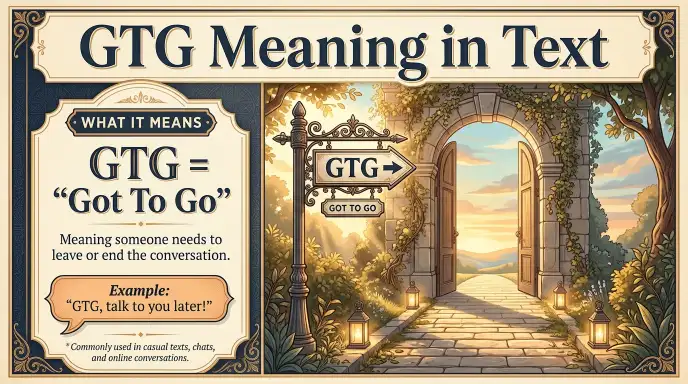
GTG is short for “Got To Go.” In text messages and chats, it simply tells the other person that you need to leave the conversation.
You might see it on TikTok, Snapchat, Instagram, WhatsApp, or in SMS. People search for it to understand casual chat language.
When someone texts GTG, they are usually signing off. It is a quick way of saying goodbye or that they must stop chatting.
The abbreviation comes up in social media captions, comments, and everyday chats where friends or acquaintances are communicating. It helps people end a conversation quickly without typing a long sentence.
You might encounter GTG when watching TikTok videos about texting slang, reading Instagram comments, or in articles about online abbreviations. It’s a common internet slang that many people use daily. If you see GTG and wondered what it means, this guide will explain it clearly with examples and tips.
1. GTG Meaning in Text
GTG stands for “Got To Go.” It is an internet slang abbreviation. People use it in texting and online chat to indicate they need to leave or stop the conversation.
- Type of term: Internet slang, specifically an abbreviation of “got to go.”
- Usage: Common in casual digital conversations to say goodbye or that something else requires attention.
- Everyday meaning: In a chat, “GTG” means the sender will be leaving soon. For example, if your friend says “GTG, dinner’s ready,” they mean they have to stop chatting because they are needed at dinner.
“GTG” is not a formal word; it’s a shorthand that saves typing. It is very straightforward and widely understood in online communities. Unlike some acronyms that are hard to guess, GTG’s meaning is clear once you know it.
2. Where People Use GTG
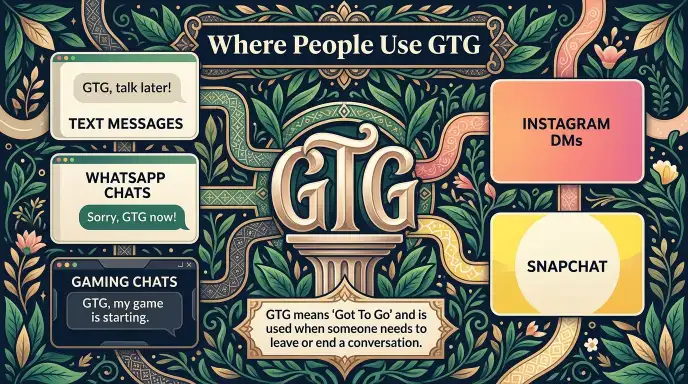
GTG appears on almost all messaging platforms and social media. It’s not limited to one app.
TikTok:
People often use GTG in captions or comments when they’re signing off. For example, a TikTok creator might say, “Sorry, gtg!″ at the end of a live stream or video where they’re going offline.
Snapchat:
In Snapchat chats, GTG is common to say goodbye. You might see someone send “gtg 💨” if they have to leave a Snap conversation quickly.
Instagram:
GTG can show up in Instagram DMs or comments. If you ask someone a question in a comment and they need to leave, they might reply “GTG, ttyl (talk to you later).”
WhatsApp:
Friends on WhatsApp use GTG to end group chats or individual chats. For example, “Hey guys, gtg for dinner. Catch you later.”
- SMS (Text Messaging):
Even in standard text messages, people use GTG. It’s just a quick way to say “I have to go.” For instance, “Ok I’ll meet you at 5, gtg now.”
No matter the platform, GTG always means that the sender needs to leave the conversation. The style (chat, text, comment) may vary, but the meaning stays the same.
3. Real Chat Examples
Here are 10 realistic texting conversations. They show how GTG appears in everyday chats. Each snippet includes the abbreviation naturally.
- A: Are you coming to the movie tonight?
B: Yep, just finishing up my homework. GTG now, be there in 5!
A: Cool, see you soon. - A: Did you see this funny meme I sent?
B: Haha, yes that’s hilarious. GTG for dinner, but that’s great!
A: No problem, talk later. - A: How’s the project going?
B: It’s done. GTG — my mom’s waiting. TTYL (talk to you later).
A: Good job! See you. - A: Wanna join the Zoom call?
B: I would but GTG. My friend is here. Maybe later?
A: Sure thing, maybe next time. - A: The lecture is so boring…
B: Lol, I know. GTG now, the professor just noticed me.
A: Haha, good luck! - A: Can you pick up milk on your way home?
B: I have to run out now, GTG. I’ll grab it on the way back.
A: Thanks! - A: Are you still at the party?
B: No, I had to leave early. GTG texted me as I was walking out.
A: Wish I could have said bye! - A: We should finish this game sometime.
B: Definitely. Need to study now, GTG. Let’s play this weekend.
A: Sounds good, good luck on studies! - A: This is fun!
B: Agreed. Oops, GTG battery is dying.
A: Okay, catch up later! - A: How do I solve this math problem?
B: Let me show you, wait… GTG in class. I’ll explain later.
A: Alright, see you at lunch.
These examples show GTG used naturally. It appears by itself or at the end of a sentence, often followed by a reason or an excuse. You can replace “GTG” with “got to go” and it means the same thing in each conversation.
4. How to Reply When Someone Says “GTG”
If someone texts you “GTG,” they are indicating they need to leave. Here are different ways you could reply, depending on the tone.
- Funny replies:
- “Run Forrest, run!” (if the context is joking and both people understand the humor)
- “Save the chat, I’ll be back soon!” (playful)
- “Ok, teleport back when you can!” (lighthearted and fun)
- Casual replies:
- “Okay, see you later.”
- “No problem, catch you later.”
- “Alright, talk soon!”
- Friendly replies:
- “Bye! Stay safe.”
- “Have fun and ttyl!” (ttyl = talk to you later)
- “Take care, chat later!”
- Neutral replies:
- “Got it.”
- “👍” (just an emoji)
- “Okay, bye.”
Most replies are polite and short. The key is to match the mood. If the conversation was casual, you might add a smiley or a friendly note. If someone said GTG abruptly or out of frustration, a neutral “OK” might be appropriate. It’s usually not taken personally; the person just has to go do something.
5. Is GTG Rude or Offensive?

GTG is not rude or offensive by itself. It simply means “got to go.” It’s a polite way to say goodbye, similar to “I have to go now.”
However, context matters. If someone uses GTG in a short, abrupt message (like just “GTG.”), it could come off as a bit curt. But it’s still not an insult. Most people understand it just means you have other things to do.
Rudeness:
GTG is not a curse word or insult. It’s safe to use in everyday chatting with friends, family, or acquaintances.
Appropriateness:
It’s fine for school or work chats (if texting is allowed), because it’s just a sign off. For example, a co worker might text “gtg to a meeting.” That’s normal.
Not for formal writing:
Don’t use GTG in formal emails, documents, or with people you don’t know well. In those cases, “I have to go” is more appropriate.
In short, GTG is a friendly, casual expression for leaving a chat. It’s not offensive or rude, and you don’t have to avoid it—unless you are in a formal situation or with someone who doesn’t know texting slang.
6. Who Uses This Term?
GTG is widely used by various groups of people online and in texts. Its usage crosses different ages but is most common among younger generations who text frequently.
- Age groups:
Teenagers and young adults use GTG a lot, since they text and chat online regularly. Many adults also use it, especially if they are comfortable with texting slang. It’s not limited to any one age, but it’s definitely prevalent in the under 30 crowd.
- Gen Z usage:
Gen Z (roughly those born after 1996) grew up with texting and social media, so they commonly use abbreviations like GTG. They might use it in quick conversations on phones and on platforms like Snapchat or TikTok live streams.
- Common platforms:
People use GTG on almost every platform that allows texting. Snapchat, WhatsApp, Facebook Messenger, Discord, gaming chat, etc. If the platform has typing, GTG can appear. It even shows up in voice chats (“I gotta go”) as the spoken equivalent.
- Online presence:
GTG has been around since the early internet chatrooms (1990s). It remains popular because it’s simple and useful. It appears frequently in messaging, so you’ll see it often if you chat online.
It’s worth noting that GTG is very common. You’ll run into it on social media comments, quick messages, and even memes about conversation endings. Its popularity is similar to other texting acronyms like IDK (I don’t know) or BRB (be right back).
7. Origin of the Term
The phrase “got to go” has been used by people for a long time to express a need to leave. Abbreviating it to “GTG” is a convenience of typing in digital communication.
- Early chatrooms:
The abbreviation GTG dates back to early internet chatrooms in the 1990s, when people started using quick shortcuts to type faster.
- Online gaming:
It became popular in online gaming and instant messaging as a quick way to say “I must sign off.” Gamers, who often needed to end sessions quickly, used it a lot.
- Text messaging:
As smartphones and texting grew, GTG moved into SMS and instant messaging apps. It’s essentially the same meaning it always had.
- Unknown originator:
We don’t know who first said GTG. It was never trademarked or created by a company. It simply emerged among internet users. So its origin is uncertain beyond “internet slang.”
In summary, GTG came from the natural habit of abbreviating “got to go” in fast typing. The internet and mobile messaging culture made it stick around. It has not changed meaning; it’s always meant leaving the conversation.
8. Comparison Table
| Term | Meaning | Type | Usage | Popularity |
| GTG | Got To Go (I need to leave) | Texting abbreviation | Informal chats, messaging apps | Very common |
| IDK | I Don’t Know | Texting abbreviation | Expressing uncertainty | Very common |
| IDC | I Don’t Care | Texting abbreviation | Showing indifference | Very common |
| IMO | In My Opinion | Texting abbreviation | Giving personal opinion | Common |
| BRB | Be Right Back | Texting abbreviation | Temporarily leaving chat | Very common |
- Meaning: Each term stands for a short phrase. For example, GTG = got to go.
- Type: All five terms are abbreviations used in casual online language. GTG, IDK, IDC, IMO, and BRB.
- Usage: These are used in texting and social media among friends or online contacts. They help people save time writing.
- Popularity: All of these are widely used. IDK, IDC, and BRB are extremely common. GTG and IMO are also common. Teens and adults both use them frequently.
This table helps show that GTG is just one of several common texting shortcuts. It means leaving, while the others have different meanings (uncertainty, opinion, etc.), but they’re all part of digital shorthand.
9. Real World Usage Example
Imagine a typical day at school or college. Two friends, Sarah and Jason, are texting about meeting up after classes.
Sarah: Hey Jason, you ready to grab lunch after math?
Jason: Just finishing this assignment. GTG soon though.
Sarah: Ok, no problem. Text me when you’re out!
Jason: Will do. Chat later!
In this example:
- Jason uses “GTG soon” to mean “I will have to leave soon,” specifically to go do something else (finish the assignment or leave class).
- Sarah understands and responds naturally.
This shows a common situation: someone is busy, says GTG, and the other person acknowledges it. The term helps communicate clearly and quickly that Jason must leave the conversation to handle something important.
10. Frequently Asked Questions
What does GTG mean in text messages?
GTG stands for “Got To Go.” It means the sender needs to leave or end the conversation.
What does GTG mean on TikTok?
On TikTok, GTG still means “got to go.” You might see it in comments or when someone is ending a live stream or video.
Is GTG slang?
Yes. GTG is an internet slang abbreviation. It’s a casual way to say you have to go. It’s not formal language.
Is GTG rude or offensive?
No, GTG is not rude. It’s a normal sign off. It just means someone needs to go. It’s fine to use with friends or family.
How should you reply to GTG?
You can reply politely, for example:
- “Okay, talk to you later!”
- “No problem, see you!”
- “Bye! Take care.”
- “Alright, catch you later.”
These show you understand they need to go and you’re ending the chat nicely.
11. Conclusion
GTG is a common internet slang meaning “got to go.” People use it in texts and online chats to quickly say they have to leave. It’s friendly and simple, not offensive.
You might use GTG when you need to sign off from a conversation, like if your ride arrived or you’re late for something. Friends, classmates, and coworkers text it all the time.
It’s easy to remember: when someone says GTG, they are leaving, so you can say goodbye back. Just be mindful not to overuse it in very formal contexts (like important work emails).
👀 Curious About More Slang?
GTFU Meaning in Text: Real Meaning, Examples & Usage
GTFOH Meaning in Text: What It Means & How to Use It
What Does Solulu Mean in Text? Meaning, Examples & Slang Use

I am Masson Caldwell, a language enthusiast and content writer at SlangAura. I write about internet slang, texting trends, and modern expressions to help readers understand the evolving world of online language with simple and clear explanations.