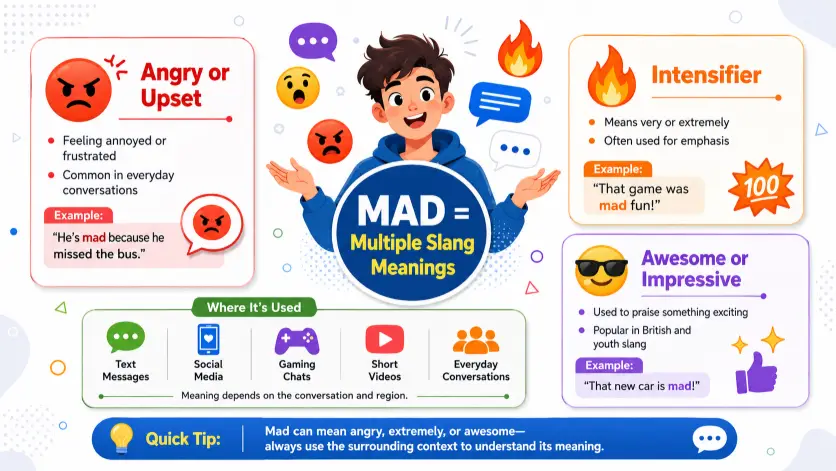
Mad meaning slang is one of the most searched slang terms because its meaning changes depending on where you live, who you’re talking to, and the situation.
You may see someone comment, “That’s mad funny,” text “I’m wild at you,” or say, “He’s gone wild.” While the same word is used in each sentence, the meaning is completely different.
On social media platforms like TikTok, Instagram, Reddit, Discord, Snapchat, and in everyday texting, mad is often used as slang to describe strong emotions, excitement, intensity, or anger. Because it has several meanings, understanding the context is important before using it yourself.
Quick Answer
Mad is a slang word that can mean very, angry, wild or extremely impressive, depending on the sentence and regional English. The intended meaning always depends on context.
What Does Mad Mean in Text?
The slang word mad has several meanings in modern English, and the correct interpretation depends entirely on context. Unlike abbreviations such as LOL or BRB, mad is a regular English word that has evolved into a flexible slang term over time.
In text messages, online chats, and social media posts, it commonly means:
- Angry or upset
- Very or extremely
- wild
- Amazing or impressive (especially in British English)
For example:
- “Why are you mad?” means someone is angry.
- “That pizza is mad good.” means the pizza is extremely good.
- “That trick shot was mad!” means it was incredible or impressive.
Understanding the surrounding words makes it easy to recognize which meaning is intended.
Mad Full Form / Definition
Many people search for mad full form, but the answer is simple.
Mad does not have a full form.
It is not an acronym or internet abbreviation. Instead, it is an ordinary English adjective that has taken on several slang meanings in casual speech.
Common Slang Definitions
| Meaning | Explanation | Example |
| Angry | Feeling upset or annoyed | “She’s mad at me.” |
| Very | Used to add emphasis | “That’s mad expensive.” |
| shocking | Wild or unbelievable | “That’s a mad idea.” |
| Amazing | Extremely impressive | “The concert was mad.” |
Different Meanings of Mad Slang
One reason the word remains popular is that it can express different emotions without changing spelling.
1. Mad = Angry
This is the meaning most American English speakers recognize first.
When someone says they’re mad, they usually mean they’re angry or upset about something.
Tone
- Serious
- Emotional
- Sometimes playful between friends
Examples
- “Don’t be mad. I didn’t mean it.”
- “My sister is still mad about yesterday.”
- “He got mad after losing the game.”
2. Mad = Very or Extremely
In many parts of the United States, especially in casual speech, mad works as an intensifier. Instead of saying very, people simply say mad.
Tone
- Casual
- Friendly
- Youth slang
Examples
- “That movie was mad funny.”
- “This burger is mad good.”
- “She’s mad smart.”
- “Your new shoes are mad cool.”
Here, mad simply strengthens the adjective that follows it.
3. Mad = Wild
Sometimes the word describes something unbelievable, risky, or unusual.
This usage appears frequently in British English and informal conversations.
Examples
- “You’re mad if you think that’s easy.”
- “The traffic today is mad.”
- “That challenge is absolutely mad.”
Here, the speaker isn’t necessarily insulting anyone. They simply mean something is wild or extreme.
4. Mad = Amazing or Impressive
British slang often uses mad as a compliment.
Instead of meaning angry, it means exciting, awesome, or incredible.
Examples
- “That football match was mad.”
- “Your dance moves are mad.”
- “The party last night was mad.”
In these examples, mad has a completely positive meaning.
Is Mad Rude, Offensive, or Neutral?
For most conversations, mad is considered a neutral slang word.
However, context still matters.
Generally Acceptable
- Casual texting
- Friends
- Family conversations
- Gaming chats
- Social media comments
Better to Avoid
- Business emails
- Academic assignments
- Professional presentations
- Customer service communication
Some people also avoid using mad to describe mental illness because it may sound insensitive. In those situations, use respectful and specific language instead.
Where Is Mad Commonly Used?
The slang word appears across almost every major online platform.
You’ll often see it on:
- TikTok
- Snapchat
- Discord
- X (Twitter)
- YouTube comments
- Gaming communities
- Text messages
People use it because it’s short, expressive, and easy to understand.
Examples
TikTok
“That transition is mad smooth.”
Discord
“Your build is mad strong.”
“This outfit is mad stylish.”
Text Message
“I’m mad excited for tomorrow.”
These examples show how flexible the slang has become.
Why Does Mad Have So Many Meanings?
Language naturally changes over time.
Originally, mad mainly referred to insanity or mental illness. Later, speakers began using it for anger. Eventually, younger generations started using it to emphasize excitement or intensity.
Today, internet culture has mixed these meanings together, allowing one word to express several ideas.
Because people from different countries communicate online every day, you’ll often see American and British meanings used side by side.
Origin and Background of Mad Slang
The word mad has been part of the English language for centuries. In older English, it was mainly used to describe someone who was mentally unstable or behaving irrationally. Over time, its meaning expanded, and people began using it in everyday conversations to express different emotions and levels of intensity.
Today, mad meaning slang varies depending on the country and context:
- American English: Most commonly means angry or very/extremely.
- British English: Often means wild, or amazing.
- Internet Slang: Can mean angry, impressive, exciting, or simply add emphasis to a sentence.
Social media platforms have helped spread these different meanings worldwide, so it’s common to see people using mad in multiple ways online.
Why Do People Use Mad Slang?
People continue to use mad because it makes conversations feel more natural and expressive. Instead of using longer words like “extremely” or “very,” a single word can communicate the same idea.
Some reasons why it’s so popular include:
- It adds emphasis.
- It sounds casual and modern.
- It’s easy to type in text messages.
- It fits naturally in social media captions.
- It works in both positive and negative situations.
For example:
Instead of saying:
“That video is extremely funny.”
Many people simply say:
“That video is mad funny.”
Likewise, instead of saying:
“I’m very excited.”
Someone might text:
“I’m mad excited.”
This shorter style is one reason the slang remains popular.
Impact of Using Slang in Communication
Slang helps conversations feel more relaxed and personal. It can make people sound approachable and connected to current language trends.
Benefits
- Makes conversations sound natural.
- Builds friendly relationships.
- Adds emotion and personality.
- Makes texting quicker.
Possible Drawbacks
- Some people may misunderstand the meaning.
- Older readers may interpret it differently.
- Regional differences can cause confusion.
- It isn’t suitable for every audience.
For example, an American might read:
“He’s mad.”
and assume someone is angry.
A British reader could interpret the same sentence as:
“He’s wild.”
This is why context is always important.
Mad Meaning Slang vs Similar Slang
Several slang words express emotions or excitement in similar ways, but each has its own meaning.
| Slang | Main Meaning | Common Usage |
| Mad | Angry, very, shocking, amazing | General texting and social media |
| Shocking | Strange or unbelievable | Casual conversations |
| Wild | Shocking or extreme | Social media and storytelling |
| Fire | Excellent or impressive | Music, fashion, gaming |
| Sick | Amazing or cool | Youth slang |
| Lit | Exciting or fun | Parties and entertainment |
| Heated | Angry or emotional | Arguments and debates |
Although these words overlap slightly, mad is one of the most flexible because it can express both positive and negative meanings.
When Should You Avoid Using Mad?
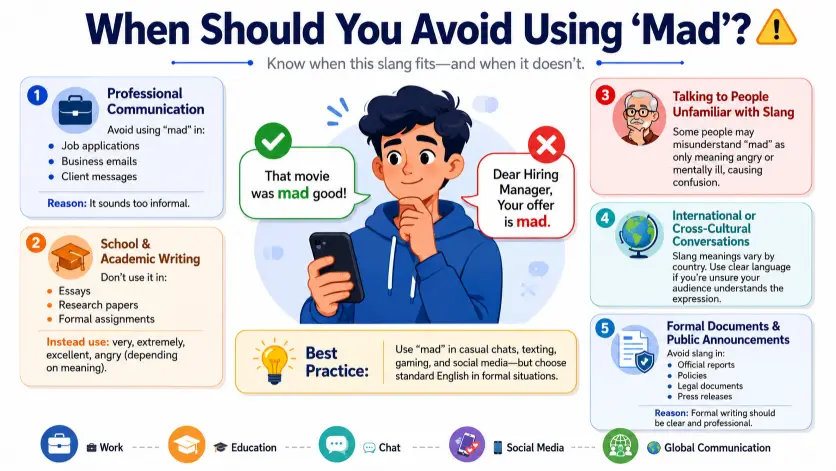
Even though mad is common slang, there are situations where more formal language is a better choice.
Avoid using it in:
- Professional emails
- Job interviews
- School essays
- Business presentations
- Legal or official documents
You should also be careful when discussing mental health. Saying someone is “mad” to describe a medical condition can sound outdated or insensitive.
Instead, choose respectful and accurate language when talking about health-related topics.
Polite Alternatives to Mad
If you’re writing speaking in a professional setting these alternatives may work better.
Angry
- Upset
- Annoyed
- Frustrated
- Irritated
- Disappointed
Very
- Very
- Extremely
- Highly
- Really
- Incredibly
Amazing
- Excellent
- Incredible
- Outstanding
- Fantastic
- Impressive
Choosing the right alternative depends on your audience and the situation.
Is Mad Safe for Social Media?
Yes. In most situations, mad is perfectly safe to use on social media platforms.
People frequently use it on:
- TikTok
- Snapchat
- Discord
- X (formerly Twitter)
Because the word isn’t considered profanity or offensive on its own, it’s generally acceptable in captions, comments, and conversations.
Safe Examples
- “This recipe is mad good!”
- “That goal was mad!”
- “I’m mad excited for the weekend.”
- “Your artwork is mad talented.”
The only caution is to make sure your audience understands the intended meaning.
What Does Mad Stand For?
A common search query is:
What does mad stand for?
The answer is simple:
It doesn’t stand for anything.
Unlike abbreviations such as:
- LOL
- OMG
- BRB
- SMH
Mad is simply an English word that has developed additional slang meanings over time.
Tips for Understanding Mad in Text Messages
When you see mad in a message, don’t focus only on the word itself. Instead, look at the entire sentence.
Ask yourself:
- Is someone expressing anger?
- Are they emphasizing something?
- Are they describing something exciting?
- Is the conversation using American or British English?
Examples
“She’s mad at me.”
Meaning: She is angry.
“That’s mad expensive.”
Meaning: It is very expensive.
“That concert was mad.”
Meaning: The concert was amazing.
“You’re mad!”
Meaning: You’re wild or jokingly adventurous.
The surrounding words almost always reveal the intended meaning.
Real-Life Examples of Mad Usage
Friendly Tone
- “Your new haircut looks mad good.”
- “That movie was mad funny.”
- “You’re mad talented.”
- “Your cooking has improved a lot.”
Casual Conversation
- “I’m mad tired after work.”
- “She’s mad excited for the concert.”
- “This coffee is mad strong.”
- “That song is mad catchy.”
Argumentative Tone
- “Why are you so mad?”
- “He’s still mad about losing.”
- “Don’t get mad over something small.”
- “She looked mad after reading the message.”
Gaming Context
- “That sniper shot was mad.”
- “Your reflexes are mad fast.”
- “This update is mad good.”
- “That boss fight was mad difficult.”
Social Media Context
- “This edit is mad clean.”
- “That dance challenge is mad fun.”
- “Your content is mad creative.”
- “That meme is mad relatable.”
These examples show how one simple word can express different meanings depending on context.
Frequently Asked Questions
1. What does mad mean in slang?
The mad meaning slang depends on the context. It can mean angry, very or extremely, wild, or amazing, especially in British English. Reading the entire sentence helps you understand the intended meaning.
2. Does mad have a full form?
No. Mad is not an acronym and does not have a full form. It is a regular English word that has gained additional slang meanings through everyday conversation.
3. Is mad a bad word?
No. Mad is generally not considered a bad or offensive word. However, using it to describe someone’s mental health may be viewed as insensitive. In those situations, it’s better to use respectful and accurate language.
4. Can mad mean “very”?
Yes. In American slang, mad is often used to mean very or extremely.
Examples:
- “That movie is mad funny.”
- “This restaurant is mad expensive.”
- “She’s mad talented.”
5. Is mad popular on TikTok and social media?
Yes. The word mad is commonly used on TikTok, Instagram, Snapchat, Reddit, Discord, and other social media platforms. People often use it to emphasize emotions or describe something exciting or impressive.
6. Is mad different in American and British English?
Yes.
- American English: Usually means angry or very.
- British English: Often means wild, or amazing.
Because both versions are widely used online, context is the key to understanding the correct meaning.
7. What does “mad good” mean?
Mad good means very good or extremely good. Here, mad works as an intensifier rather than meaning angry.
Example:
“That pizza is mad good.”
8. Can I use mad in professional writing?
It’s best to avoid using mad as slang in formal emails, business documents, academic writing, or professional presentations. Instead, use clearer words like very, extremely, excellent, or upset, depending on what you mean.
Key Takeaways
Here are the most important things to remember about mad meaning slang:
- Mad has multiple meanings depending on the context.
- It commonly means angry, very or amazing.
- It is not an acronym and has no full form.
- American and British English use the word differently.
- The slang is widely used in texting, gaming, and social media.
- It is generally safe to use in casual conversations but should be avoided in formal communication.
- Always read the surrounding words to understand the intended meaning.
Conclusion
The mad meaning slang is more flexible than many people realize. Depending on the conversation, it can describe someone who is angry, emphasize that something is very good or intense, refer to something wild, or even praise something as amazing, particularly in British English. This variety of meanings is one reason the word remains so popular in texting, gaming, and social media.
If you’re ever unsure what mad means in a message, don’t look at the word alone pay attention to the sentence, the speaker’s tone, and the platform where it’s being used. Context almost always reveals the correct interpretation.
Whether you’re chatting with friends, scrolling through TikTok, reading Reddit discussions, or sending text messages, understanding mad meaning slang will help you communicate more naturally and avoid misunderstandings. As with any slang, use it appropriately, know your audience, and switch to more formal alternatives when the situation calls for professional language.
Learn more articles:
Lobster Slang Meaning: What It Means and How to Use It
Cops Slang Meaning in Text:Cops Slang: Meaning & Examples

I am Emma Collins, a content writer at SlangAura specializing in internet slang, texting abbreviations, and online language. I create simple and accurate guides to help readers understand modern slang easily and confidently.