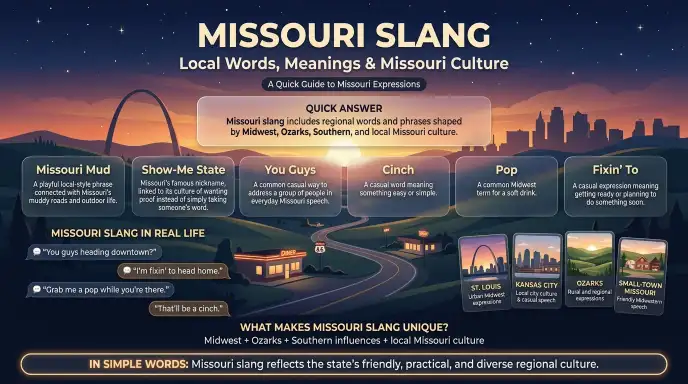
Missouri slang is the casual language you may hear in Missouri. It includes local words, short phrases, and speech styles linked to different parts of the state.
Missouri has many regional voices. St. Louis, Kansas City, and the Ozarks can sound different. This makes Missouri slang varied and interesting.
Quick Answer: What Is Missouri Slang?
Missouri slang means informal language used by some people in Missouri. Some terms are local. Others come from nearby regions and older speech.
What Makes Missouri Slang Unique?
Missouri sits between the Midwest and the South. Because of this, its speech has several influences.
People in different areas may use different words. Family, age, and local culture can also shape the way someone speaks.
This means there is no single list that covers every Missouri speaker.
Common Missouri Slang Words
T-Rav
“T-Rav” is a short name for toasted ravioli. The term is strongly linked to St. Louis.
Example: “Let’s get T-Ravs after the game.”
Fixin’ To
“Fixin’ to” means getting ready to do something soon. You may hear it in parts of Missouri with Southern influence.
Example: “I’m fixin’ to leave.”
Yonder
“Yonder” means a place that is over there. It is an older regional word.
Example: “The barn is over yonder.”
Ope
“Ope” is a short sound used after a small surprise. It is common in Midwestern speech.
Example: “Ope, I almost dropped that.”
Hoosier
“Hoosier” has a special local use in parts of Missouri, especially St. Louis. In that setting, it can describe someone in a negative way.
Example: “He used the word as an insult.”
The meaning depends on the speaker and situation.
Missouri Slang and Local Speech
Local speech is not always about slang words. Pronunciation can also show where someone comes from.
Some Missourians say “Missour-ee.” Others say “Missour-uh.” Both forms have been used in the state.
The difference can depend on family, location, and personal habit.
St. Louis Slang
St. Louis has several terms that stand out in Missouri speech.
The city has its own food culture and local vocabulary. Some expressions are less familiar outside the area.
“T-Rav” is one clear example. It shows how a local food can create its own casual name.
Missouri Slang by Region
Missouri slang can change from one area to another.
St. Louis has distinct local speech. Kansas City has strong Midwestern features. The Ozarks also has a long history of regional language.
This regional mix gives Missouri a wide range of expressions.
Why Do People Use Missouri Slang?
People use local language because it feels natural.
Slang can also show where someone grew up. It can connect people with their town, family, or local culture.
You may hear these words in casual talks, local businesses, social media, and everyday conversations.
Is Missouri Slang Still Used?
Yes. Some regional terms are still used today.
Other words have become less common. Younger speakers may also mix local terms with modern American slang.
Language changes over time. Missouri slang changes with it.
More Missouri Slang and Regional Expressions
Missouri has many speech patterns beyond the most common local terms. Some words come from older Missouri culture. Others are linked to food, rural life, and local communities.
Sack
“Sack” can mean a grocery bag in some Missouri speech. The word is also heard in other parts of the Midwest.
Example: “Put the apples in the sack.”
Soda Pop
Some Missourians use “soda pop” for a soft drink. Others say “soda” or “pop.”
Example: “Can I have a soda pop?”
Slinger
A “slinger” is a filling diner meal linked to St. Louis. It often includes eggs, potatoes, meat, chili, and cheese.
Example: “I ordered a slinger after my night shift.”
Missouri Mule
“Missouri mule” connects with the state’s long history of mule farming. The phrase can also describe a stubborn person.
Example: “He is stubborn like a Missouri mule.”
You’s Guys
“You’s guys” is a regional way to address a group. It has been heard in parts of Missouri and nearby areas.
Example: “Are you’s guys coming with us?”
Missouri Slang in Everyday Speech
People often use local expressions without thinking about them. These words can sound natural in casual talks with friends and family.
The meaning can also change with context. A word may sound friendly in one situation and rude in another.
This is why tone matters when using regional slang.
Missouri Slang and Food Culture
Food has a strong place in Missouri culture. Local dishes have also shaped the way people talk about food.
St. Louis has several food terms that visitors may not know. These words often appear in restaurants and casual conversations.
Local food slang can also spread through social media. This helps regional terms reach people outside Missouri.
Missouri Slang and Rural Speech
Rural Missouri has kept many older speech patterns alive. Some words come from farming, weather, travel, and country life.
Not every older word is common today. Some terms now appear mainly in stories, local history, or older conversations.
This makes Missouri slang a mix of old and new language.
Missouri Slang and Age
Age can affect the slang a person uses.
Older speakers may know regional words that younger people rarely hear. Younger speakers often mix local speech with internet language.
This does not mean one style is better. It simply shows how language changes over time.
Real-Life Examples of Missouri Slang
Here are some simple examples of how these terms can sound in daily life.
At a Diner
“I’m hungry. I think I’ll get a slinger.”
Here, “slinger” means a hearty diner meal.
At the Grocery Store
“Can you put the bread in the sack?”
Here, “sack” means a grocery bag.
Talking With Friends
“Are you’s guys ready to leave?”
Here, “you’s guys” refers to a group.
Buying a Drink
“Do you want a soda pop?”
The speaker uses “soda pop” for a soft drink.
Talking About Someone
“He is stubborn like a Missouri mule.”
The phrase compares the person to a stubborn mule.
When Should You Use Missouri Slang?
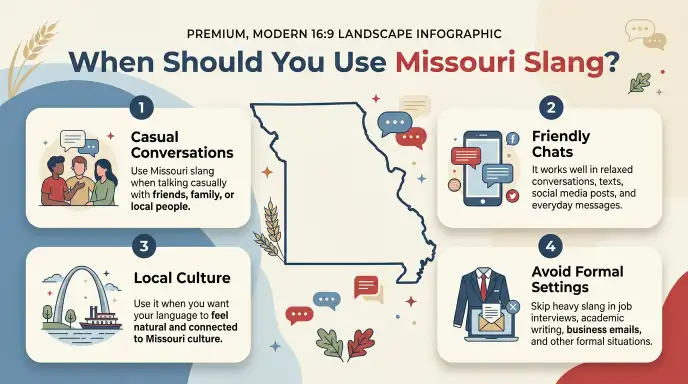
Missouri slang works best in casual settings. It can fit friendly talks, local conversations, and informal messages.
Formal writing needs a different style. School work, business emails, and official documents usually work better with standard English.
If you are unsure about a slang word, listen to local speakers first. Then use it only when it feels natural.
Missouri Slang in Modern Conversations
Missouri slang keeps changing with time. Social media has also changed the way people talk.
A Missouri speaker may use a local word in one sentence and modern internet slang in the next. This mix is common in casual speech.
Still, not every slang word used in Missouri is Missouri slang. Many online terms are popular across the United States.
Missouri Slang and Social Media
Social media helps local language reach more people. A word that starts in one community can spread through videos and posts.
Young people may also use fewer old regional terms. They often pick up new words from TikTok, gaming, music, and online chats.
This does not mean local slang has disappeared. Many regional words still appear in everyday speech.
Missouri Slang for Visitors
Visitors may hear unfamiliar words during a trip to Missouri. The best way to understand them is to look at the full sentence.
You can also ask the speaker what a word means. Most casual conversations make the meaning clear.
Do not worry if a local phrase sounds strange at first. Regional speech can take time to understand.
Frequently Asked Questions About Missouri Slang
Q1. What is Missouri slang?
Missouri slang is casual language linked to the state. It includes local words, phrases, and speech styles.
Q2. What is the most famous Missouri slang?
“T-Rav” is one of the best-known local terms. It is a short name for toasted ravioli in St. Louis.
Q3. What does “fixin’ to” mean?
“Fixin’ to” means getting ready to do something soon.
Q4. What does “yonder” mean?
“Yonder” means a place that is over there or some distance away.
Q5. What does “sack” mean in Missouri?
In some local speech, “sack” can mean a grocery bag.
Q6. What is a slinger in Missouri?
A slinger is a hearty diner meal linked to St. Louis. It usually contains several breakfast-style foods.
Q7. Do all Missourians use the same slang?
No. Missouri has different regional speech patterns. Local words can vary by area.
Conclusion
Missouri slang reflects the state’s history, culture, and regional diversity.
Some words are tied to local food. Others come from older speech or nearby regions.
The language also keeps changing. New generations add modern terms while some older words fade.
If you want to understand Missouri slang, focus on context and region. That will help you understand local speech without forcing words into your own conversations.

I am Emma Collins, a content writer at SlangAura specializing in internet slang, texting abbreviations, and online language. I create simple and accurate guides to help readers understand modern slang easily and confidently.