Im sorry in spanish slang is a popular search because many people hear casual Spanish apologies in TV shows, TikTok videos, text messages, online games, and conversations with native speakers.
While most Spanish learners know the formal word lo siento, they often notice people using different expressions with friends or family. These informal phrases can sound more natural, depending on the country and situation.
Spanish slang is not the same everywhere. A phrase commonly used in Mexico may sound unusual in Spain or Argentina. That is why understanding the context is just as important as learning the words themselves. if you’re chatting online, traveling, or talking with Spanish-speaking friends, knowing the right casual apology helps you communicate more naturally and respectfully.
Quick Answer:
There is no single Spanish slang phrase that directly means “I’m sorry.” Instead, native speakers often use informal expressions like perdón, perdona, perdóname, or regional slang depending on the country and the situation.
What Does Im Sorry in Spanish Slang Mean in Text?
When people search for im sorry in spanish slang, they usually want to know how native Spanish speakers apologize in casual conversations rather than using textbook phrases.
Unlike English slang, Spanish does not have one universal slang word for “I’m sorry.” Instead, speakers choose different expressions based on the relationship, the seriousness of the mistake, and the country they are in.
Some casual apologies are very short, while others sound warmer or more sincere.
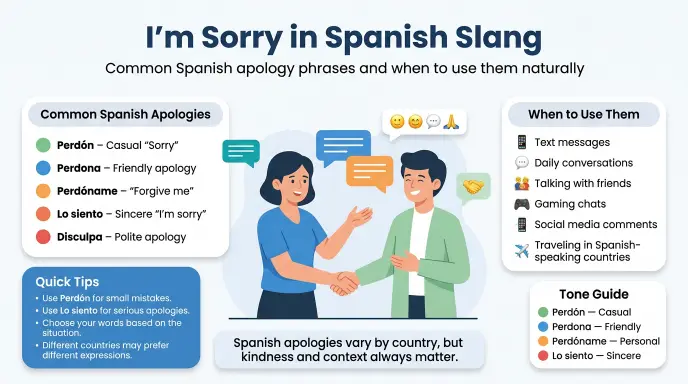
Common informal expressions include:
- Perdón ; Sorry or excuse me.
- Perdona : Sorry (used when speaking to one person informally).
- Perdóname ;Forgive me.
- Lo siento : I’m sorry (more sincere and standard).
- Mil disculpas: A thousand apologies (more expressive).
The best choice depends on the situation rather than a single slang meaning.
Im Sorry in Spanish Slang Full Form and Definition
Unlike internet abbreviations such as LOL or BRB, im sorry in spanish slang does not have a full form because it is not an acronym.
Instead, it refers to informal Spanish expressions people use to apologize naturally.
Here are the most common meanings:
| Expression | Meaning | Tone |
| Perdón | Sorry | Casual |
| Perdona | Sorry | Friendly |
| Perdóname | Forgive me | Personal |
| Lo siento | I’m sorry | Sincere |
| Disculpa | Excuse me / Sorry | Polite |
Each phrase carries a slightly different feeling. Choosing the right one depends on how serious the situation is and who you are speaking to.
Is Im Sorry in Spanish Slang Rude, Offensive, or Neutral?
Most informal Spanish apology phrases are completely neutral and respectful.
They are used every day in conversations with friends, classmates, coworkers, and family members.
Generally speaking:
- Perdón is casual and polite.
- Perdona sounds friendly and natural.
- Perdóname shows genuine regret.
- Lo siento expresses deeper sympathy or remorse.
These expressions are not offensive. However, using a very casual apology after making a serious mistake may sound insincere.
For example, saying only perdón after hurting someone’s feelings might not feel enough. In that case, lo siento mucho or perdóname is usually more appropriate.
Understanding the tone helps you choose the apology that fits the moment.
Where Is Im Sorry in Spanish Slang Commonly Used?
Informal Spanish apologies appear in many everyday situations.
People commonly use them in:
- Text messages
- WhatsApp chats
- TikTok comments
- Instagram direct messages
- Snapchat conversations
- Discord chats
- Online gaming
- Daily conversations
- School and college
- Family discussions
On social media, shorter expressions are especially common because they are quick and easy to type.
For example:
- “Perdón 😅”
- “Perdona, no vi tu mensaje.”
- “Ups, perdón.”
These messages sound natural and friendly among native speakers.
Remember that regional vocabulary may change. Someone from Spain may apologize differently than someone from Mexico, Colombia, or Argentina, even though the meaning remains the same.
Why There Isn’t One Universal Spanish Slang for “I’m Sorry”
One common misunderstanding is believing that Spanish has a single slang phrase that every native speaker uses. In reality, Spanish is spoken in more than 20 countries, and everyday language varies widely from one region to another.
For example:
- In Mexico, people often use perdón in casual conversations.
- In Spain, perdona is very common in everyday speech.
- In Argentina, speakers may combine an apology with local expressions or a different tone.
- In Colombia, polite forms are often preferred, even among friends.
This regional diversity means there is no exact equivalent to an English slang term that works everywhere. Learning the local context will help you sound more natural and avoid misunderstandings.
Origin and Background of Im Sorry in Spanish Slang
Spanish has been spoken for hundreds of years, so its apology expressions developed naturally through everyday conversation rather than internet culture. Traditional phrases like perdón, perdona, and lo siento have existed for generations. Over time, people began using them in shorter, more relaxed ways when talking with friends or sending text messages.
Today, social media platforms such as TikTok, Instagram, WhatsApp, Discord, and Snapchat have made these casual expressions even more common. Emojis, GIFs, and voice messages are often added to make an apology sound warmer or more sincere.
Although many people refer to these expressions as “Spanish slang,” most are better described as informal everyday Spanish rather than true slang. Their meaning stays the same, but pronunciation, tone, and frequency can change from one Spanish-speaking country to another.
Comparison with Similar Slang
Many Spanish apology expressions have similar meanings, but they are not always interchangeable. Some sound more casual, while others express deeper regret.
| Expression | Meaning | Best Used When | Tone |
| Perdón | Sorry | Small mistakes | Casual |
| Perdona | Sorry | Talking to one friend | Friendly |
| Perdóname | Forgive me | Personal mistakes | Sincere |
| Lo siento | I’m sorry | Serious situations | Respectful |
| Lo siento mucho | I’m very sorry | Deep regret | Very sincere |
| Disculpa | Excuse me / Sorry | Polite conversations | Polite |
Choose your words based on the situation instead of using the same phrase every time.
When to Avoid Using Im Sorry in Spanish Slang
Even casual apology phrases have limits. Using an informal expression in the wrong situation may sound careless or disrespectful.
Avoid very casual apologies when:
- Speaking to your boss or teacher.
- Writing professional emails.
- Offering condolences.
- Apologizing for a serious mistake.
- Talking to someone much older if formal language is expected.
For example, saying only “Perdón.” after causing a major problem may not sound sincere enough. In these situations, “Lo siento mucho” or “Perdóname” is usually a better choice.
Understanding the seriousness of the situation helps you communicate respectfully.
Polite Alternatives
If you are unsure which casual apology to use, choose a more polite expression. It is always safer to sound respectful than overly informal.
Some polite alternatives include:
- Lo siento.
- Lo siento mucho.
- Disculpe.
- Perdón por el error.
- Perdóname, fue mi culpa.
These phrases work well in both spoken and written Spanish and are understood across most Spanish-speaking countries.
Why People Use This Slang
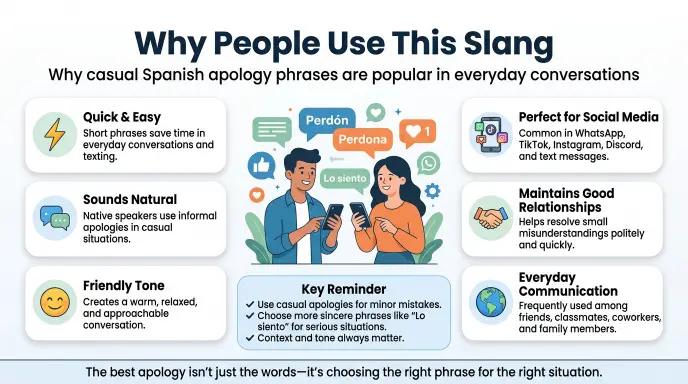
People prefer informal Spanish apologies because they sound natural in everyday conversations.
Common reasons include:
- They are quick to type.
- They feel friendly.
- They make conversations less formal.
- They fit texting and social media.
- They help maintain close relationships.
- They match the relaxed tone of casual conversations.
Instead of writing a long apology, many people simply type:
- “Perdón 😂”
- “Perdona.”
- “Ups, perdón.”
These short messages often communicate enough when the mistake is minor.
Impact of Using Slang in Communication
Using casual apology expressions can make conversations feel more personal and approachable. They help create a friendly atmosphere, especially between people who already know each other well.
However, context always matters.
Using an informal apology in the wrong setting may:
- Sound disrespectful.
- Seem insincere.
- Cause misunderstandings.
- Make the apology feel less meaningful.
On the other hand, choosing the right expression can:
- Show kindness.
- Reduce tension.
- Build trust.
- Keep conversations natural.
- Improve communication with native speakers.
The goal is not simply to know the words but to understand when each one fits best.
Is Im Sorry in Spanish Slang Safe for Social Media?
Yes. Most informal Spanish apology expressions are completely safe to use on social media.
People regularly use them on:
- TikTok
- X (formerly Twitter)
- Snapchat
- Discord
Because these phrases are polite and widely understood, they rarely cause problems when used appropriately.
Still, remember that online messages lack facial expressions and tone of voice. If your apology involves a serious issue, writing a more complete message instead of a single word usually sounds more genuine.
Real-Life Examples of Usage
Below are examples showing how different apology expressions are used in everyday conversations.
Friendly
Friend: You forgot my birthday message.
You: Perdón, I honestly thought it was tomorrow!
Casual
Person A: You took my notebook by mistake.
Person B: Perdona! I’ll bring it back this afternoon.
Argumentative
Person A: That comment really upset me.
Person B: Lo siento. I didn’t mean to offend you.
Gaming or Social Media Context
Player: Sorry, I accidentally eliminated our teammate.
Reply: Perdón 😅 That was completely my mistake.
Or in a group chat:
User: Perdón por responder tan tarde.
This simply means:
“Sorry for replying so late.”
These examples show that Spanish speakers choose different apology expressions depending on the situation, the relationship, and the level of seriousness.
Frequently Asked Questions
What does im sorry in spanish slang mean?
The phrase refers to informal Spanish expressions people use to apologize in everyday conversations. Instead of one universal slang word, native speakers commonly say perdón, perdona, perdóname, or lo siento, depending on the situation.
What is the full form of im sorry in spanish slang?
There is no full form because it is not an abbreviation or acronym. It describes casual Spanish apology phrases rather than a shortened word.
Is im sorry in spanish slang offensive?
No. Most informal Spanish apology expressions are polite and neutral. However, using a very casual apology in a serious situation may sound less sincere, so choose your words based on the context.
Which Spanish phrase is closest to “I’m sorry”?
The closest standard translation is lo siento. For casual conversations, many native speakers also use perdón or perdona when apologizing for small mistakes.
Is the same apology used in every Spanish-speaking country?
Not always. While expressions like perdón and lo siento are widely understood, pronunciation, frequency, and preferred wording can vary between countries such as Mexico, Spain, Argentina, Colombia, and others.
Can I use these expressions in text messages?
Yes. Informal apologies are commonly used in text messages, WhatsApp, Instagram, TikTok comments, Discord chats, and other online conversations. Just remember that a more detailed apology is better when the situation is serious.
Conclusion
Understanding im sorry in spanish slang is about more than memorizing a single phrase. Spanish does not have one universal slang expression for saying “I’m sorry.” Instead, native speakers choose from several informal and standard phrases, such as perdón, perdona, perdóname, and lo siento, depending on the relationship, the situation, and the country.
If you are apologizing for a small mistake, a simple perdón or perdona usually sounds natural. For more meaningful apologies, lo siento or perdóname expresses greater sincerity. Paying attention to context and tone will help you communicate respectfully and confidently with Spanish speakers, if you’re chatting online, traveling, or having everyday conversations.
By learning when and how to use these expressions, you’ll sound more natural and better understand how apologies work in real-life Spanish communication.
Read more articles:
Diesel Slang Meaning in Text:Diesel Slang Explained
Jumper British Slang Meaning in Text:What Does “Jumper” Mean?

I am Masson Caldwell, a language enthusiast and content writer at SlangAura. I write about internet slang, texting trends, and modern expressions to help readers understand the evolving world of online language with simple and clear explanations.