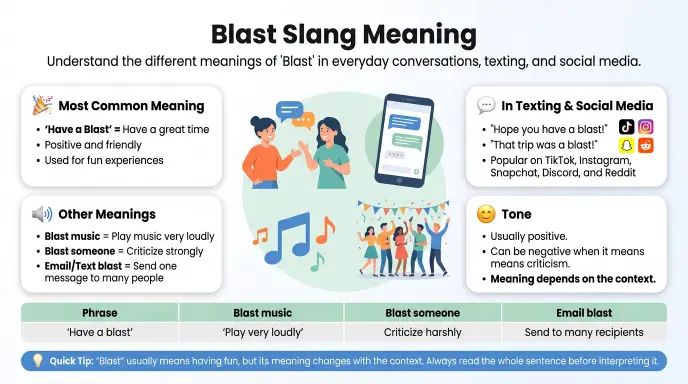
People use blast slang in different ways depending on the conversation. Most commonly, “a blast” means something was very fun, exciting, or enjoyable. In other situations, “blast” can mean to criticize someone strongly, play music very loudly, or send a message to many people at once. The meaning depends on the context, which is why many people search for the true meaning of blast slang.
In this guide, you’ll learn what blast slang means, where people use it, if it’s rude, how it became popular, and how to use it correctly in real conversations. if you saw it in a text, on TikTok, Reddit, Discord, or heard someone say, “That party was a blast,” this article will help you understand exactly what they meant.
Quick Answer: Blast Slang
What is blast slang?
Blast slang most often means having a great time or enjoying something a lot, especially in the phrase “have a blast.” It can also mean to criticize someone harshly, play something at a very high volume, or send a message to many people at once. The correct meaning depends on the situation and the words around it.
What Does Blast Slang Mean?
The most common meaning
The most popular slang use of blast is found in the expression “have a blast.” It means someone had an exciting, enjoyable, or memorable experience.
For example:
- “We had a blast at the beach.”
- “Hope you have a blast on your vacation.”
- “The concert was a blast.”
In these examples, blast has nothing to do with explosions. Instead, it describes a very fun experience.
Understanding the tone
When someone says “That was a blast,” the tone is positive and friendly. It tells others that the activity was entertaining and worth remembering.
You’ll often hear this phrase among:
- Friends
- Family members
- Students
- Travelers
- Coworkers in casual conversations
Different Meanings of Blast Slang
The meaning of blast changes depending on how it is used. Here are the most common meanings.
“Have a blast” = Have a lot of fun
This is by far the most common slang meaning.
Examples:
- “The kids had a blast at the amusement park.”
- “We had a blast playing video games all night.”
Tone:
- Positive
- Friendly
- Informal
Popularity:
- Very common
- Still widely used today
Blast someone = Criticize strongly
Sometimes blast means to publicly criticize or attack someone with words.
Examples:
- “Fans blasted the company after the update.”
- “People online blasted the celebrity for the comment.”
This meaning is common in:
- News headlines
- Social media discussions
- Online debates
Tone:
- Negative
- Strong
- Critical
Blast music = Play very loudly
People also use blast when talking about loud sounds.
Examples:
- “He was blasting music from his car.”
- “Don’t blast the TV while everyone is sleeping.”
Tone:
- Neutral
- Casual
This meaning appears in everyday speech more than internet slang.
Blast a message = Send to many people
In digital communication, blast can describe sending one message to many recipients.
Examples include:
- Email blast
- Text blast
- Marketing blast
- Announcement blast
This meaning is common in:
- Business communication
- Marketing
- Schools
- Community organizations
Although people use the word casually, it is more of a communication term than internet slang.
Where Is Blast Slang Commonly Used?
Everyday conversations
The phrase “have a blast” is common in daily speech.
Examples include:
- Family gatherings
- Birthday parties
- Vacations
- School events
- Weekend plans
Text messages
Friends often use blast in casual texting.
Examples:
- “Have a blast tonight!”
- “Looks like you had a blast!”
The phrase sounds warm, supportive, and friendly.
Social media
You’ll see blast in captions, comments, and posts across platforms such as:
- TikTok
- X
Examples:
- “Had a blast with everyone today!”
- “Summer vacation was a blast.”
Gaming communities
Gamers sometimes use blast in two different ways.
One meaning is simply having fun:
- “We had a blast playing together.”
Another meaning refers to an in-game explosion, attack, or special ability. In that case, blast is part of the game’s vocabulary rather than slang.
Always look at the context before deciding what the word means.
News and online discussions
News websites and social media often use blast to describe strong public criticism.
Examples include headlines like:
- “Users blast new app update.”
- “Experts blast controversial proposal.”
Here, blast means to criticize forcefully rather than physically attack.
Is Blast Slang Rude, Offensive, or Harmless?
In most cases, it is harmless
When someone says “have a blast,” the phrase is completely friendly and appropriate. It simply wishes someone a fun and enjoyable time.
Examples:
- “Have a blast on your trip!”
- “We had a blast at the wedding.”
These uses are polite and widely accepted.
When it sounds negative
The word becomes stronger when it means to criticize someone harshly.
For example:
- “The coach blasted the team’s performance.”
- “Customers blasted the company online.”
In these situations, blast expresses strong disapproval, but it is still not considered profanity or offensive language.
Can you use it at work?
It depends on the meaning.
- “Have a blast” is usually acceptable in friendly workplace conversations.
- “Blast” meaning harsh criticism may sound too aggressive in professional communication. In formal settings, words like criticized, questioned, or expressed concern about are often better choices.
Overall, blast slang is generally safe to use, but understanding the context helps you avoid misunderstandings.
Origin and History of Blast Slang
Where did the word “blast” come from?
The word blast originally referred to a powerful burst of air or an explosion. It has been part of the English language for centuries in its literal sense.
Over time, English speakers began using blast in a figurative way to describe strong emotions, excitement, or intensity. This change led to several informal meanings that are still common today.
The exact date when “have a blast” first became slang is difficult to confirm. However, the phrase became widely recognized in American English during the mid-to-late 20th century and has remained popular ever since.
Unlike many internet slang terms, blast did not begin on social media. It was already part of everyday spoken English before platforms like TikTok, Instagram, Reddit, and Discord existed.
Why Do People Use Blast Slang?
It expresses excitement quickly
People like short phrases that clearly show emotion. Saying “We had a blast” instantly tells others that the experience was fun without needing a long explanation.
It sounds natural
The phrase is easy to remember and fits many situations.
Examples include:
- Birthday parties
- Road trips
- Family vacations
- School events
- Concerts
- Sports activities
It works across generations
Unlike some modern internet slang that changes every year, “have a blast” is understood by both younger and older English speakers.
Parents, teachers, coworkers, and friends all commonly use it.
It adds energy to conversations
Compared with saying “It was fun,” saying “It was a blast” sounds more enthusiastic and memorable.
Similar Slang and Related Terms
Other ways to say “have a blast”
If you want to express the same idea, these phrases have a similar meaning.
| Phrase | Meaning | Tone |
| Have fun | Enjoy yourself | Neutral |
| Have a great time | Enjoy the experience | Friendly |
| Have an awesome time | Very enjoyable | Casual |
| Enjoy yourself | Relax and have fun | Polite |
| Have the best time | Extremely enjoyable | Positive |
| It was amazing | Very impressive | Casual |
| It was a good time | Enjoyable experience | Neutral |
| Had so much fun | Very enjoyable | Informal |
Although these phrases are similar, “have a blast” usually expresses a higher level of excitement.
Real-Life Examples
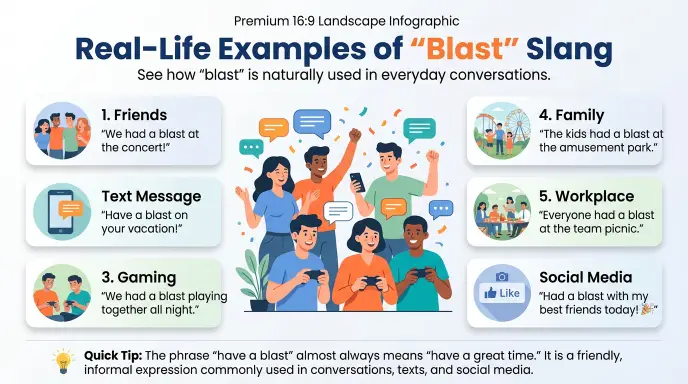
Friendly conversation
Emma: Are you excited about your trip?
Liam: Definitely! I hope we have a blast.
Text message
Alex: Happy birthday! Have a blast tonight!
Jordan: Thanks! I can’t wait.
School
“We had a blast during the science fair.”
Family
“The whole family had a blast at the amusement park.”
Workplace
“I hope everyone has a blast at the company picnic.”
Social media caption
“Had a blast celebrating with my best friends!”
Gaming
“We had a blast playing together all weekend.”
Reddit or Discord
“Last night’s game session was a blast. Let’s do it again next week!”
Common Misunderstandings
People think it always means an explosion
Because blast originally refers to an explosion, some learners believe every use has a violent meaning.
In everyday conversation, that is usually not true.
For example:
- “The fireworks made a loud blast.” ✅ Literal meaning
- “The party was a blast.” ✅ Slang meaning
The two meanings are completely different.
People confuse “blast” with “roast”
Both words can involve criticism, but they are not identical.
- Blast usually means to criticize someone strongly.
- Roast often means making jokes about someone, sometimes in a humorous way.
Although both may appear online, they serve different purposes.
People think “have a blast” is outdated
Some people assume the phrase is old-fashioned because it has existed for many years.
In reality, it is still widely used in:
- Text messages
- Social media posts
- Family conversations
- Schools
- Everyday spoken English
It remains a common and natural expression today.
When Should You Avoid Using It?
Formal business writing
Avoid using “have a blast” in very formal documents, legal writing, or academic papers.
Instead, choose expressions like:
- Enjoy your event.
- Best wishes for your trip.
- Have a pleasant experience.
Professional criticism
Using blast to describe criticism can sound dramatic.
Instead of writing:
- “The manager blasted the employee.”
A more professional choice may be:
- “The manager criticized the employee.”
- “The manager expressed concerns.”
Serious situations
Avoid saying “have a blast” when discussing sad or sensitive events.
For example, it would not fit conversations about:
- Funerals
- Medical emergencies
- Natural disasters
- Serious workplace issues
Choose language that matches the situation and shows appropriate respect.
Frequently Asked Questions
What does blast slang mean?
The most common meaning of blast slang is having a great time. When someone says, “We had a blast,” they mean they enjoyed themselves very much. In other contexts, blast can also mean to criticize someone strongly, play music loudly, or send a message to many people at once.
Is “have a blast” a slang phrase?
Yes. “Have a blast” is an informal English expression that means have a lot of fun. It is commonly used in casual conversations, text messages, and social media posts.
Is blast slang rude?
No. In most situations, blast is not rude. The phrase “have a blast” is friendly and positive. However, when blast means to criticize someone harshly, it can sound strong or negative depending on the context.
Is blast slang appropriate at work?
It depends on how you use it. Saying “Have a blast at the company picnic!” is perfectly acceptable in a casual workplace. However, using blast to describe criticism may sound too aggressive in formal business communication.
Is blast slang used on social media?
Yes. People regularly use blast on platforms such as TikTok, Instagram, Reddit, Facebook, X, and Discord. Most social media posts use it in the positive sense of having fun, while news posts may use it to describe public criticism.
Does blast have more than one meaning?
Yes. Depending on the context, blast can mean:
- Having a great time (“We had a blast.”)
- Criticizing someone strongly (“Fans blasted the decision.”)
- Playing music very loudly (“They were blasting music.”)
- Sending a message to many people (“The school sent a text blast.”)
Reading the surrounding words makes it easy to identify the intended meaning.
Is “have a blast” still popular?
Yes. Although it has been used for many years, “have a blast” remains a common and natural expression in everyday English. It is widely understood by people of different ages and is still frequently used in conversations, texts, and online posts.
Conclusion
Blast slang is a flexible expression with several meanings, but the most common one is simple: having a great time. When someone says, “We had a blast,” they are sharing that they enjoyed an experience and had lots of fun.
The word can also mean to criticize someone strongly, play music at a high volume, or send a message to many people, so context is always important. Looking at the rest of the sentence will usually make the meaning clear.
Unlike many internet slang terms that appear and disappear quickly, blast has remained popular for decades because it is easy to understand and fits many everyday situations. if you’re reading a social media post, chatting with friends, or hearing it in a movie, knowing these different meanings will help you use the term naturally and avoid confusion.
By understanding the context, tone, and common usage of blast slang, you can confidently recognize and use the expression in conversations both online and offline.
Get more articlees:
La Semilla Dominican Slang Meaning in Text
Cops Slang Meaning in Text:Cops Slang: Meaning & Examples

I am Masson Caldwell, a language enthusiast and content writer at SlangAura. I write about internet slang, texting trends, and modern expressions to help readers understand the evolving world of online language with simple and clear explanations.