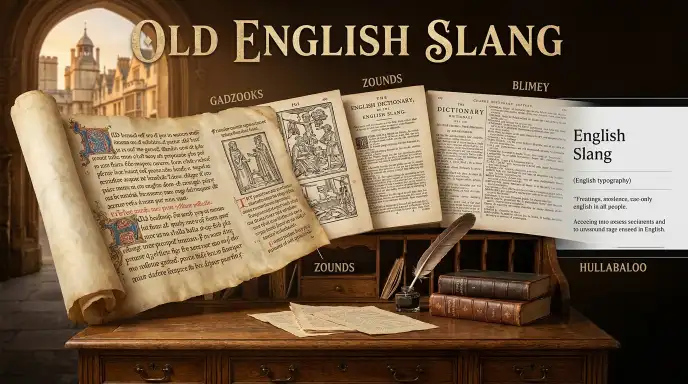
Old English slang can refer to informal words, expressions, and colorful phrases used in earlier periods of English.
However, Old English technically means the language spoken in England roughly from the 5th to the 11th century. Most words people call “old English slang” today actually come from later historical English, especially Early Modern and 18th–20th century English.
Quick Answer: Old English slang includes informal, humorous, rude, playful, or unusual expressions from earlier forms of English. Examples include gadzooks, blimey, bamboozle, codswallop foolish, knackered, and scarper. Some are now rare, while others remain familiar in modern British English.
Quick Answer: Old English Slang
| Quick Detail | Answer |
| Old English slang meaning | Informal or colorful expressions from earlier English |
| Technical Old English | English used roughly from the 5th to 11th century |
| Common historical slang period | Mostly later English, especially Early Modern to 20th century |
| Examples | Gadzooks, foolish, bamboozle, codswallop, knackered |
| Main use today | Historical, humorous, literary, or regional |
| Can old slang still be used? | Yes |
| British connection | Many surviving examples are associated with British English |
| Tone | Informal, humorous, old fashioned, or expressive |
| Are all old words slang? | No |
| Are all terms still common? | No |
What Does Old English Slang Mean?
The phrase old English slang usually refers to informal language that people used in the past.
These words could express:
- Anger
- Surprise
- Friendship
- Insults
- Confusion
- Excitement
- Money
- Drinking
- Foolish behavior
- Everyday situations
Many old slang terms sound unusual today because language changes with time.
A word that once sounded normal can later become old fashioned. Another word may disappear almost completely but survive in books, films, jokes, or regional speech.
Old English vs. Old Fashioned English Slang
This is one of the most important points about the keyword.
Old English is the name of a historical language stage.
It was used in England before Middle English became dominant. Famous Old English texts include Beowulf.
Modern readers usually cannot understand Old English without studying it because its vocabulary, grammar, spelling, and pronunciation were very different from today’s English.
Old fashioned English slang, however, refers to informal expressions from more recent periods.
For example:
- Gadzooks : an old expression of surprise
- Blimey : an expression of surprise
- Bamboozle : to confuse or deceive
- Codswallop : nonsense
- Knackered : extremely tired
These are much closer to what people usually mean when they search for old English slang.
When Was Old English Spoken?
Old English was spoken in England from around the 5th century to the 11th century.
It developed from Germanic languages brought to Britain by groups including the Angles, Saxons, and Jutes.
After the Norman Conquest in 1066, English gradually changed into Middle English.
Later stages developed into Early Modern English and eventually the forms of English used today.
This long history explains why the phrase “old English slang” can cover very different types of vocabulary.
Popular Old Fashioned Slang Words
Some historical slang words remain recognizable today.
| Slang Word | General Meaning |
| Bamboozle | To confuse or deceive |
| Codswallop | Nonsense |
| fooliash | Silly or foolish |
| Gadzooks | An old exclamation of surprise |
| Blimey | An expression of surprise |
| Knackered | Extremely tired |
| Scarper | To leave or run away |
| Chuffed | Very pleased |
| Gobsmacked | Extremely surprised |
| Barmy | wild or foolish |
Not every word in this table is from the same historical period.
That is important because old slang is not one single vocabulary group. Different expressions became popular at different times.
What Does “Gadzooks” Mean?
Gadzooks is an old fashioned exclamation used to express surprise, shock, or strong emotion.
For example:
“Gadzooks! What happened here?”
The expression sounds very old fashioned today.
You are more likely to see it in historical fiction, comedy, theater, or writing designed to imitate an older style of English.
It is not normal everyday slang for most modern English speakers.
What Does “Bamboozle” Mean?
Bamboozle means to confuse, trick, or deceive someone.
For example:
“The salesman bamboozled him with complicated details.”
The word has an old fashioned and playful feeling, but it has survived into modern English.
This makes bamboozle a useful example of a historical informal word that still has life today.
It can describe someone who makes another person confused or leads them toward a false understanding.
What Does “Codswallop” Mean?
Codswallop means nonsense or foolish talk.
For example:
“That’s complete codswallop.”
In modern English, the word sounds humorous and distinctly old fashioned to many speakers.
It is often used when someone wants to reject an idea without using a stronger insult.
The word is especially associated with British English.
What Does “foolish” Mean?
foolish means silly, foolish, or lacking good judgment.
For example:
“Don’t be foolish”
This can mean:
“Don’t be silly.”
Unlike many old slang expressions, foolish is still used today, particularly in British English and some other varieties.
The tone can be lighthearted.
For example:
“That was a foolishidea.”
This does not necessarily mean the speaker is seriously insulting someone.
What Does “Knackered” Mean?
Knackered means extremely tired or exhausted.
For example:
“I’m absolutely knackered after work.”
The word is strongly associated with informal British English.
It is still familiar to many modern speakers, especially in casual conversation.
This makes it different from expressions such as gadzooks, which are now mainly used for historical or humorous effect.
What Does “Scarper” Mean?
Scarper means to leave quickly or run away.
For example:
“We’d better scarper before the rain starts.”
It is an informal term associated with British English.
The word can sound playful rather than dramatic.
Someone might say:
“Let’s scarper.”
That simply means:
“Let’s get out of here.”
What Does “Blimey” Mean?
Blimey is an informal British expression used to show surprise, shock, or amazement.
For example:
“Blimey! That’s expensive.”
It is similar to expressions such as:
- “Wow!”
- “Goodness!”
- “Whoa!”
The exact feeling depends on the situation.
Today, blimey can sound distinctly British and somewhat old fashioned, although many people still recognize it.
What Does “Barmy” Mean?
Barmy is an informal word meaning wild, foolish, or slightly eccentric.
For example:
“That’s a barmy idea.”
It can also describe a person:
“He’s completely barmy.”
The word is generally informal and is strongly associated with British English.
Depending on tone, it can be insulting or playful.
What Does “Chuffed” Mean?
Chuffed means very pleased or happy about something.
For example:
“She was chuffed with her exam results.”
In British English, chuffed remains useful in casual conversation.
It is an interesting example because someone unfamiliar with British slang might incorrectly assume that the word has a negative meaning.
Context makes the meaning clear.
What Does “Gobsmacked” Mean?
Gobsmacked means extremely surprised or shocked.
The word combines informal British usage with the idea of being so surprised that you are left speechless.
For example:
“I was completely gobsmacked when I heard the news.”
It is still used today and can appear in casual speech, writing, and media.
Although it has an old fashioned flavor for some speakers, it is not simply a historical word.
Why Does Old Slang Sound Funny Today?
Language changes constantly.
Words can sound funny or unusual when:
- Their original context disappears
- Younger speakers stop using them
- New slang replaces them
- Their pronunciation changes
- They become associated with older generations
- Films and books use them for historical effect
For example, gadzooks can sound humorous today because modern speakers rarely use it in ordinary conversation.
Meanwhile, foolish and knackered remain much more familiar in certain varieties of English.
Is Old English Slang Still Used Today?
Some old slang survives.
Others have become rare.
A useful way to divide historical slang is into three groups:
Still Common
Words such as foolishand knackered remain part of informal British English.
Recognizable but Less Common
Words such as gobsmacked and barmy are still understood by many speakers but may feel more regional or informal.
Mostly Historical or Humorous
Words such as gadzooks are usually encountered in historical writing, comedy, fiction, or deliberately old fashioned speech.
This difference is important when reading older slang lists online.
How Old Slang Is Used in Modern English
People sometimes use old slang intentionally.
A writer might use an old expression to make a character sound:
- Historical
- British
- Humorous
- Dramatic
- Eccentric
- Old fashioned
For example:
“Gadzooks! You’ve ruined the whole plan!”
A modern person could say this as a joke rather than because it is their normal vocabulary.
That gives old slang a second life in movies, novels, memes, comedy, and social media.
Old English Slang Examples in Sentences
Example 1
“I’m absolutely knackered.”
Meaning:
“I am extremely tired.”
Example 2
“Don’t be foolish.”
Meaning:
“Don’t be silly.”
Example 3
“That’s complete codswallop.”
Meaning:
“That is complete nonsense.”
Example 4
“Blimey, that’s a huge house!”
Meaning:
“Wow, that’s a huge house!”
Example 5
“Let’s scarper.”
Meaning:
“Let’s leave quickly.”
Example 6
“I was gobsmacked by the announcement.”
Meaning:
“I was extremely surprised by the announcement.”
These examples show that historical slang does not always have to sound completely unfamiliar. Some terms have survived into modern informal English.
Key Takeaways About Old English Slang
- Old English and old fashioned English slang are technically different.
- Old English was a historical form of English used roughly from the 5th to 11th centuries.
- Most terms called “old English slang” today actually come from later periods.
- Gadzooks expresses surprise.
- Bamboozle means to confuse or deceive.
- Codswallop means nonsense.
- foolish means silly or foolish.
- Knackered means extremely tired.
- Scarper means to leave quickly.
- Some old slang is still common, while other expressions are mainly historical or humorous.
Old British Slang vs. Old American Slang
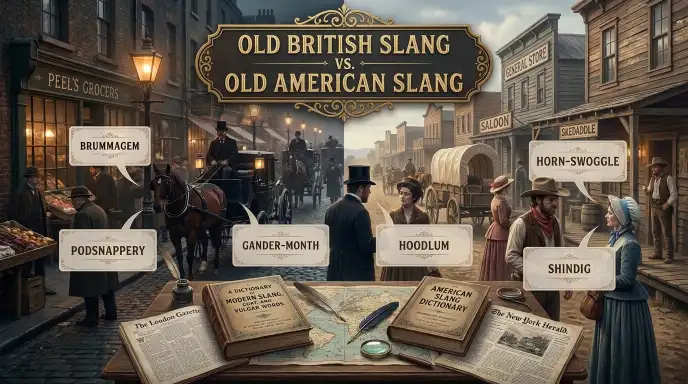
Old slang developed differently in Britain and the United States.
British slang often produced expressions that are still recognizable today, such as:
- Blimey
- Chuffed
- Knackered
- Scarper
- Barmy
American English developed its own slang traditions.
Words such as dough for money, bee’s knees for something excellent, and cat’s pajamas for something impressive became associated with earlier periods of American informal speech.
The difference shows that old English slang is not limited to one country.
Victorian English Slang
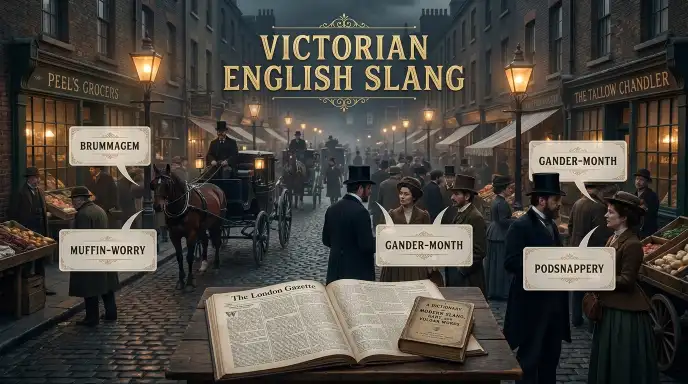
The Victorian period lasted from 1837 to 1901, during the reign of Queen Victoria.
People in this period used many informal expressions that can sound unusual today.
Some Victorian era slang was connected with:
- Money
- Clothing
- Food
- Work
- Crime
- Social class
- Romance
- Drinking
- Everyday behavior
Terms from this period often appear in historical novels and descriptions of Victorian London.
However, not every unusual Victorian word was slang. Some were simply ordinary vocabulary that later became obsolete.
Victorian Slang Examples
“Blow the gaff”
Blow the gaff meant to reveal a secret or expose something.
For example:
“Don’t blow the gaff.”
This could mean:
“Don’t reveal the secret.”
The expression is associated with older British informal language.
“Lush”
In historical slang, lush could be connected with drinking or a person who drank heavily.
The word has developed several meanings over time.
Today, lush can also mean rich, abundant, or attractive, so context is important.
“Skedaddle”
Skedaddle means to leave quickly.
For example:
“We’d better skedaddle.”
It has an old fashioned and playful feeling today.
1920s Slang
The 1920s produced memorable slang, especially in American English.
The period is often associated with the Jazz Age and Roaring Twenties.
Popular expressions included:
- Bee’s knees : something excellent
- Cat’s pajamas : something impressive
- Doll : an attractive woman or a term of address
- Hotsy totsy : satisfactory or just right
- The cat’s meow : something excellent
- Giggle water : alcohol
- Heebie jeebies : a feeling of nervousness or unease
Many of these expressions became strongly connected with the image of 1920s American culture.
What Does “Bee’s Knees” Mean?
Bee’s knees was an informal expression for something considered excellent or highly impressive.
For example:
“This new car is the bee’s knees.”
The phrase is now mostly used for humorous or nostalgic effect.
Someone using it today may deliberately sound old fashioned.
What Does “Cat’s Pajamas” Mean?
Cat’s pajamas was another 1920s American expression for something excellent, fashionable, or impressive.
For example:
“That new jacket is the cat’s pajamas.”
Modern speakers may recognize the phrase even if they rarely use it.
It is often used when someone wants to imitate or reference old fashioned American slang.
1930s and 1940s Slang
Slang continued to change during the 1930s and 1940s.
The Great Depression and World War II influenced everyday language, while movies, radio, music, and popular culture helped spread expressions.
Some terms associated with this period include:
- Dough : money
- Gee : an expression of surprise or emphasis
- Dame : woman
- Palooka : an inexperienced or foolish person
- Swell : excellent or very good
- Gams : legs, especially in older informal usage
Some of these words continued beyond the period, while others gradually became dated.
What Does “Dough” Mean in Old Slang?
Dough is an informal word for money.
For example:
“I don’t have enough dough for that.”
The term is still recognizable today.
It is a good example of slang that survived even though its strongest association with earlier American speech has faded.
What Does “Swell” Mean?
In older American slang, swell could mean excellent, impressive, or very good.
For example:
“That’s a swell idea.”
Modern speakers are more likely to use great, awesome, or excellent.
When swell is used today in this sense, it can sound deliberately old fashioned.
1950s and 1960s Slang
Slang from the 1950s and 1960s was heavily influenced by music, movies, youth culture, and changing social attitudes.
Examples include:
- Cool : fashionable or impressive
- Groovy : excellent or enjoyable
- Hip : fashionable or culturally aware
- Daddy o : informal address for a man
- Far out : impressive, unusual, or exciting
- Square : an old fashioned or conventional person
Some of these words changed meaning over time.
Cool, for example, survived and became one of the most widely used informal words in modern English.
Why Did Some Old Slang Survive?
Slang survives when speakers continue finding it useful.
Several factors can help a slang term remain familiar:
Popular Culture
Movies, television, songs, and books can keep old expressions alive.
Regional Use
A word may disappear from general English but remain common in a particular region.
Strong Meaning
Short and expressive words are easier to keep.
Humor
People sometimes reuse old slang because it sounds funny or memorable.
New Meanings
A word can survive by developing a new meaning.
This is why English slang constantly changes instead of simply disappearing.
Old Slang That Still Sounds Modern
Some words that once felt like slang now sound completely normal.
Examples include:
- Cool
- Dough
- Chuffed
- Knackered
- Blimey
- Gobsmacked
Their level of popularity differs by region.
A word can also feel ordinary to one speaker and old fashioned to another.
British and American English often show this difference clearly.
Forgotten Old English Slang
Some historical slang has almost disappeared from everyday speech.
Examples include:
- Gadzooks
- Hotsy totsy
- Daddy o
- Giggle water
- The cat’s meow
- Bee’s knees
People may still recognize these expressions because of films, books, or historical references.
However, recognizing a word does not mean people commonly use it in normal conversation.
Why Do Writers Use Old Slang?
Writers often use historical slang to make dialogue feel authentic.
For example, a story set in the 1920s would sound less convincing if every character used modern internet slang.
Old slang can help establish:
- Time period
- Location
- Social background
- Personality
- Humor
- Character identity
A carefully chosen slang word can tell the reader more than a long description.
Old Slang in Movies and TV
Historical slang is common in period dramas and comedy.
Writers may use expressions from a particular period to make characters sound believable.
Sometimes, however, modern productions use old slang incorrectly.
This can happen when:
- A word belongs to the wrong decade
- A modern meaning is inserted into an older setting
- A phrase becomes famous after the story’s time period
- A regional expression is presented as universal
This is why historical slang should be checked carefully when accuracy matters.
Is Old English Slang the Same as Shakespearean English?
No.
Shakespearean English usually refers to the English used around the late 16th and early 17th centuries.
Old English is much older.
Shakespeare lived more than five centuries ago, while Old English developed many centuries earlier.
Shakespeare’s language is generally called Early Modern English, not Old English.
This distinction is useful when researching historical words.
Is “Thou” Old English Slang?
No.
Thou is an old English pronoun, not slang.
It was historically used as a singular form of “you” in certain contexts.
Other words such as:
- Thee
- Thy
- Thine
also belong to older English grammar.
They may sound old fashioned today, but they should not automatically be classified as slang.
Common Mistakes About Old English Slang
Mistake 1: Calling Every Old Word Slang
A word does not become slang simply because it is old.
Slang is generally informal language associated with particular groups, situations, or social contexts.
Mistake 2: Calling Shakespearean English “Old English”
Shakespeare used Early Modern English, not the Old English of Anglo Saxon England.
Mistake 3: Assuming Old Slang Was Used Everywhere
Slang could vary by country, city, profession, age group, and social class.
Mistake 4: Assuming Every Old Slang Word Is Dead
Some expressions remain part of modern English.
Mistake 5: Using Historical Slang Without Checking Its Date
A phrase from the 1920s may not fit a story set in the 1700s.
Historical accuracy requires attention to time period.
Real Life Examples of Old English Slang
Example 1: British Conversation
“I’m absolutely knackered after that shift.”
Meaning:
“I am extremely tired after that shift.”
The speaker is using an informal British expression that remains recognizable today.
Example 2: Old Fashioned Humor
“Gadzooks! You scared me!”
Meaning:
“Wow! You scared me!”
Here, the speaker is probably using the word for humorous effect.
Example 3: Historical Fiction
“We’d better scarper before they find us.”
Meaning:
“We’d better leave quickly before they find us.”
The expression can help give dialogue an older British flavor.
Example 4: 1920s American Style
“That new car is the bee’s knees.”
Meaning:
“That new car is excellent.”
The expression creates a distinctly old fashioned American tone.
Example 5: Rejecting an Idea
“That’s complete codswallop.”
Meaning:
“That is complete nonsense.”
The speaker is using an informal British expression.
Example 6: Old American Slang
“He doesn’t have enough dough.”
Meaning:
“He doesn’t have enough money.”
The word dough is an example of informal money slang that has survived into modern English.
Key Takeaways About Old English Slang
- Old English is a specific historical stage of the English language.
- Most searches for old English slang actually refer to old fashioned informal English from later periods.
- Victorian, 1920s, 1930s, 1940s, 1950s, and 1960s slang all have different histories.
- Bee’s knees and cat’s pajamas are associated with older American slang.
- Knackered, chuffed, and gobsmacked have survived in modern informal English.
- Gadzooks is now mainly old fashioned or humorous.
- Shakespearean English is Early Modern English, not Old English.
- Not every old word is slang.
- Historical slang can reveal information about time, place, culture, and social groups.
- Context is essential when translating or understanding an old slang expression.
FAQs About Old English Slang
Q1. Why do Brits say “oy”?
Brits use “oy” as an informal way to get someone’s attention, similar to saying “hey!” or “excuse me!”. Depending on tone, it can sound playful, annoyed, or direct.
Q2. What are some 1920s slang words?
Popular 1920s slang words include bee’s knees, the cat’s pajamas, flapper, jazz baby, and moll. Many of these terms are associated with the Jazz Age and 1920s American culture.
Q3. What are some old slang sayings?
Some well known old slang sayings include “the bee’s knees,” “the cat’s pajamas,” “spill the beans,” “kick the bucket,” and “barking up the wrong tree.” Their ages and origins vary, so not all began in the same period.
Q4. What is a 70’s slang word?
A well known 1970s slang word is “groovy,” meaning cool, enjoyable, or fashionable. Other examples include far out, dude, funky, and boogie.
Q5. What is the oldest slang?
There is no single oldest slang word because informal language has existed for centuries and slang changes over time. Words such as “dude” and “cool” have long histories but developed their modern slang meanings much later.
Q6. What are some retro sayings?
Popular retro sayings include “gee whiz,” “golly,” “darn it,” “what’s cooking?” “the bee’s knees,” and “cat’s pajamas.” Their popularity comes from different decades and periods of English speaking culture.
Conclusion: Old English Slang
Old English slang is a fascinating part of the history of the English language, but the term needs some clarification. True Old English was the language of Anglo Saxon England, while many expressions people search for today come from much later periods such as Victorian Britain, the Jazz Age, and 20th century American and British culture.
Words such as gadzooks, codswallop, bamboozle, foolish, knackered, bee’s knees, and cat’s pajamas show how informal language can change over time. Some expressions disappear completely, while others survive and develop new uses.
Old slang can also reveal the culture of a particular period. It can show differences in region, age, class, entertainment, work, and everyday life. Understanding these details makes historical slang much more than a list of funny old words. It becomes a useful way to understand how English itself has evolved.
Related Slang Terms:
CNA Meaning Slang: Uses, Contexts, and Texting Examples

I am Masson Caldwell, a language enthusiast and content writer at SlangAura. I write about internet slang, texting trends, and modern expressions to help readers understand the evolving world of online language with simple and clear explanations.