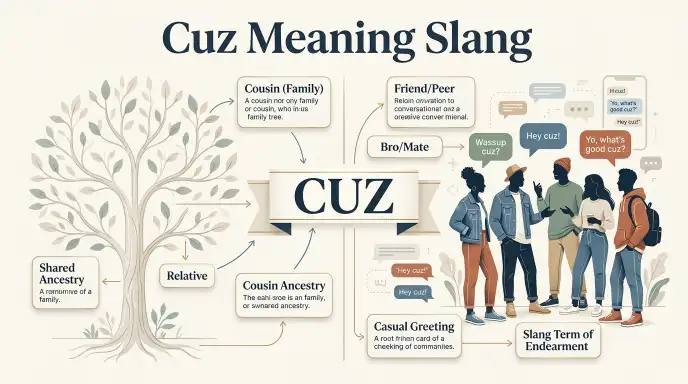
Cuz is a popular internet slang word that means “because” or “cousin.” People search for this term because seeing it in text messages or social media comments can be confusing if you are new to online abbreviations.
Understanding this simple term helps you decode fast chats, connect with friends online, and avoid awkward misunderstandings in daily conversations.Slang words change how we communicate, and short abbreviations like this one save time while typing on mobile devices.
While it usually replaces the conjunction “because,” it can also serve as a warm, friendly nickname for a family member or a close buddy depending on where you live. This simple guide breaks down its full meaning, origin, common uses, regional differences, and real life examples so you always know how to respond naturally.
Cuz Meaning Slang : Quick Answer
The slang word cuz is a short form used in informal conversations across texting and social media. It has two main meanings:
- Because: Used as a fast shortcut in texting to explain a reason.
- Example: “I stayed home cuz it was raining outside.”
- Cousin or Close Friend: Used as a warm nickname for a relative or a trusted buddy.
- Example: “What is up, cuz?”
if someone is giving a quick excuse or greeting a pal, context always reveals which meaning fits best.
Definition and Meaning of Cuz Meaning Slang
Clear Definition
Cuz (also commonly written as cause, cos, or coz) is an informal phonetic abbreviation. In text messaging and online discourse, it acts as a casual substitute for either the conjunction because or the noun cousin.
Simple Meaning
When people type it online, they usually mean one of two things:
- They are providing a reason for an action (“I called you cuz I missed you”).
- They are greeting or addressing someone they feel close to (“Hey cuz, how are you doing today?”).
Context and Usage
You will see this word everywhere in modern digital spaces—including text message threads, TikTok video captions, Snapchat snaps, Instagram comment sections, Discord servers, and online gaming lobbies. It is light, fast, informal, and designed to keep conversations moving without pause.
Different Meanings by Context
- Casual Texting: Serves as a quick alternative to typing out the full seven letter word because.
- Urban & Regional Dialects: Serves as an affectionate term for a cousin, family friend, or local peer (commonly found in American urban speech, West Coast culture, and UK roadman slang).
- Technical Terms (Non Slang): Outside of popular slang, CUZ can occasionally stand for technical acronyms like “Control Unit Zone” in specialized engineering fields, though this is virtually never what someone means in a text conversation.
The Origin of Cuz Meaning Slang
The slang term grew naturally out of spoken language patterns long before the internet existed. In spoken English, people frequently shorten the word “because” to “’cause” or “cos” simply because it takes less vocal effort.
When text messaging became popular in the late 1990s and early 2000s, phone keypads relied on T9 predictive text or multi tap typing. Typing long words on a small number pad was slow and tedious. Additionally, early mobile carriers charged users per text message, which had strict 160 character limits.
To save time, money, and effort, texters began writing words phonetically. Spelling “because” as cuz reduced a seven letter word down to three letters while perfectly capturing how the word sounds in casual spoken conversation. Over time, as smartphones replaced older flip phones, the abbreviation stayed popular because it maintained a relaxed, effortless tone in digital chats.
British English vs. American English Spelling
While the concept is identical across English speaking countries, the exact spelling of the slang word often depends on regional accents and local texting traditions.
In American English, cuz and ’cause are the most dominant informal spellings. In British English, Australian English, and New Zealand English, speakers phonetically spell the shortened sound as cos or coz.
Here is a side by side comparison of how these variations function across regions:
| Feature / Region | American English | British / Commonwealth English |
| Primary Slang Form | Cuz / ‘Cause | Cos / Coz |
| Friend/Family Meaning | Short for Cousin / Buddy | Short for Cousin / Mate |
| Texting Frequency | Very High | Very High |
| Formal Acceptance | Informal only | Informal only |
- American Texting Style: “I can’t go to the movie cuz I have to work late.”
- British Texting Style: “I can’t go to the cinema coz I have to work late.”
Despite these small regional spelling tweaks, readers from any English speaking country will instantly understand what you mean regardless of which version you type.
Which Spelling Should You Use?
Choosing the right spelling comes down to knowing your audience, your platform, and the formality of the situation:
- United States Audience: Stick with cuz or ’cause for casual text conversations, social media posts, and informal chats.
- United Kingdom & Commonwealth Audience: Use cos or coz if you want to match local texting habits seamlessly.
- Global Online Audience: Cuz is universally recognized across global platforms like TikTok, Discord, X, and Instagram.
- Professional & Academic Settings: Never use any slang variation. Always write out the full words because or cousin in work emails, job applications, school essays, business proposals, and official documents.
Understanding Tone and Nuance in Daily Communication
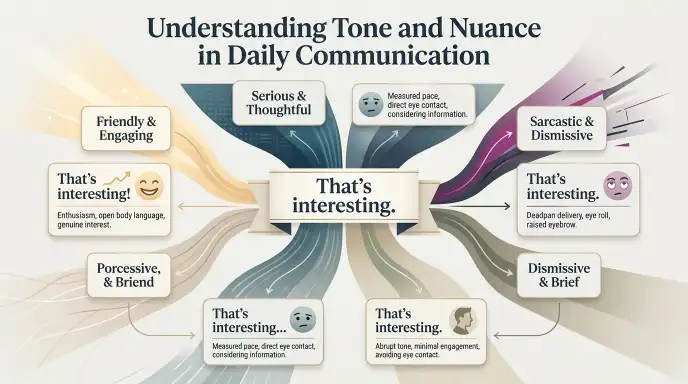
Slang is not just about changing letters; it is about conveying a specific mood. Using short forms changes how your message feels to the person reading it.
When you write the full word because, your sentence sounds clear, neutral, and polite. When you swap it for cuz, the sentence immediately feels more relaxed, informal, and intimate.
Consider the subtle difference in tone between these two messages:
- Option A (Standard): “I am not coming tonight because I am very tired.” (Sounds formal, straightforward, or even slightly distant.)
- Option B (Slang): “I’m not coming tonight cuz I’m mad tired.” (Sounds relaxed, friendly, and casual.)
Using informal language signals to the reader that you consider them a friend and feel comfortable dropping formal grammar rules around them.
Common Mistakes with Cuz Meaning Slang
- Using it in professional or formal writing: Adding informal slang to a resume, work email, cover letter, or school assignment instantly creates an unprofessional impression.
- Confusing “because” with “cousin” in ambiguous sentences: Writing “I’m meeting my cuz” is clear, but writing “I called cuz my cuz was here” gets repetitive and confusing.
- Overusing it in a single paragraph: Typing “I left cuz he arrived cuz it was getting late cuz of the rain” makes your message hard to read and grammatically messy.
- Misinterpreting the sender’s tone: Assuming someone is being lazy or rude simply because they used a three letter slang word, when they are merely typing quickly on the go.
Cuz Meaning Slang in Everyday Examples
Here is how the slang word looks across different everyday formats and communication channels:
Text Messaging Between Friends
- Alex: “Are you coming to the gym today?”
- Taylor: “Nah, can’t make it cuz my knee is hurting.”
Social Media Comments
- User 1: “This recipe video is viral for a reason!”
- User 2: “Saved this post cuz that dessert looks incredible 😋”
Casual Chat & Greetings
- Jordan: “Yo cuz! Long time no see. How have you been?”
- Sam: “Doing great, man! Good to see you.”
Music Lyrics & Pop Culture
- Quote: “I gotta keep pushing cuz quitting is not an option.”
Formal Writing (Correct Usage Slang Avoided)
- Official Report: “The team rescheduled the outdoor event because heavy rainfall was forecasted for the afternoon.”
Cuz Meaning Slang : Google Trends & Usage Data
Search engine metrics show that queries regarding informal slang meanings remain high year round, especially among younger demographic groups like Gen Z and Millennials.
- Top Search Regions: Search volume for this keyword is highest in English speaking nations, led by the United States, the United Kingdom, Canada, Australia, South Africa, and Nigeria.
- Popular Messaging Apps: The term sees its highest real time usage on fast paced mobile communication platforms including WhatsApp, Snapchat, TikTok, iMessage, Instagram DMs, and Discord.
- User Intent: Most users who look up this term are seeking a direct, quick definition to clarify a text message, comment, or song lyric they recently encountered online.
Slang Variations Comparison
To help you understand how cuz compares with other common text shortcuts, here is a detailed breakdown of related slang variations:
| Keyword Variation | Full Word | Primary Usage | Tone | Best Platform |
| Cuz | Because / Cousin | Texting, Social Media | Casual & Friendly | iMessage, TikTok, Instagram |
| Coz | Because | UK / Australian Texting | Casual & Local | WhatsApp, Snapchat |
| Cos | Because | British Chat & Lyrics | Informal | Texting, Music |
| ‘Cause | Because | Lyrics & Informal Writing | Relaxed | Song Lyrics, Novels |
| Bc | Because | Ultra fast Texting | Direct & Short | Twitter/X, Gaming Chat |
Frequently Asked Questions
Q1. What is a slang term for cousin?
Common slang terms for cousin include cuz, cuzzo, and cousin bro. The exact term depends on the speaker, region, and relationship.
Q2. What does “cuz” mean in Australia?
In Australian slang, “cuz” can mean cousin and is often used casually when addressing or referring to someone. It can also be used as a friendly form of address.
Q3. What is cuz in texting?
In texting, “cuz” commonly means “cousin.” It is a shortened, informal term often used in casual messages and social media.
Q4. Does “cuz” mean friend?
“Cuz” can sometimes be used for a close friend, especially as a friendly nickname. However, its most direct meaning is usually cousin.
Q5. What does “cuz” mean?
“Cuz” can mean “cousin” when used as slang. In some texting contexts, it can also mean “because,” so the surrounding sentence determines the meaning.
Q6. Can I use cuz instead of because?
Yes, “cuz” can be used as a casual abbreviation for “because” in texting and informal online conversations. It is not appropriate for formal writing.
Conclusion
Understanding informal internet terms makes online communication smoother, faster, and far more enjoyable. The slang term cuz stands out as a reliable, everyday shortcut for the conjunction “because,” while simultaneously serving as a warm nickname for a close relative or trusted buddy. What started decades ago as a natural pattern in spoken speech quickly evolved into a permanent staple of modern text messaging and global social media culture.
Using short forms like this allows you to keep up with fast group chats and social media feeds effortlessly. However, knowing your audience is always key to good communication. Keep casual abbreviations for relaxed conversations with friends, and switch back to standard English whenever you write for school or work. Now that you fully understand its meaning, origin, regional variations, and proper usage rules, you can read and write it in your daily chats with complete confidence.
Keep Exploring:
Fresa Slang Meaning: Uses, Contexts, and Examples

I am Emma Collins, a content writer at SlangAura specializing in internet slang, texting abbreviations, and online language. I create simple and accurate guides to help readers understand modern slang easily and confidently.