GSYM in text can mean “Go Suck Your Mother,” a highly offensive expression associated with Jamaican slang. It is used to insult or dismiss someone during an argument. However, GSYM is not a universally recognised texting abbreviation, so its meaning should be understood through the conversation and the person using it.
You might come across these four letters in a social media comment, a private message, a gaming chat, or an online argument. Because the abbreviation is short and unfamiliar, it can be difficult to understand if someone is joking, insulting you, or using a regional expression.
The confusion becomes even greater when people search for GSYM without knowing its cultural background. Unlike everyday abbreviations such as IDK or BRB, this expression carries an aggressive meaning that can easily offend someone.
This guide explains what the abbreviation can stand for, where it comes from, how people may use it online, and how to respond if someone sends it to you.
GSYM Meaning in Text
GSYM is used as an abbreviation for “Go Suck Your Mother.” It is a vulgar insult associated with Jamaican slang and is generally intended to disrespect, provoke, or dismiss another person.
The expression is sometimes written using Jamaican Patois influenced spelling, such as “Go Suck Yuh Mudda.” In this form, yuh means “your,” while mudda represents “mother.”
It is important to understand that this is not simply a playful way to tell someone to go away. The reference to someone’s mother makes the expression deeply disrespectful, particularly in conversations where family insults are considered unacceptable.
Is GSYM Slang or an Acronym?
GSYM is an abbreviation formed from the initial letters of a longer expression. It can be described as an insulting slang acronym rather than a standard English word.
Unlike common texting shortcuts, it does not have a widely established place in everyday English conversations. Its documented use appears in user submitted slang definitions, including an entry describing it as Jamaican slang used to dismiss someone during a heated argument.
That distinction matters because not every person who sees GSYM will recognise it. Some may understand the insult immediately, while others may need to search for its meaning.
What Does It Communicate in a Conversation?
The message behind GSYM is usually hostile. Depending on the situation, it may communicate:
- Anger toward another person.
- Disrespect during an argument.
- An attempt to provoke someone.
- A strong way of telling someone to leave or stop talking.
- Frustration expressed through offensive language.
For example:
Person A: You keep making excuses instead of admitting you were wrong.
Person B: GSYM.
In this situation, the abbreviation does not contribute to a meaningful discussion. It is being used as an insult instead of a proper response.
Is GSYM Always Used With the Same Meaning?
The documented slang interpretation is offensive, but that does not mean every appearance of these four letters automatically carries that meaning.
People sometimes create private abbreviations using their own initials, usernames, group names, or inside jokes. A person could also type an unfamiliar combination of letters by mistake.
Therefore, the surrounding conversation matters. If the abbreviation appears during an argument, the insulting interpretation becomes more plausible. If it appears in an unrelated username or private group, you should not immediately assume that the person intended an insult.
Where People Use GSYM
GSYM does not have the same recognised presence as popular abbreviations such as LOL, IMO, or IDK. Its appearance is more likely to be associated with informal online conversations, particularly situations involving arguments, provocative comments, or regional slang.
Here is how you can understand it across different platforms.
GSYM on TikTok
TikTok comments often contain short expressions, regional slang, and abbreviations that viewers may not immediately recognise.
If someone writes GSYM beneath a video, the meaning may depend on the subject and tone of the discussion. For example, a disagreement between two commenters could explain why someone uses an insulting abbreviation.
However, it would be inaccurate to say that GSYM is a standard or widely popular TikTok expression. A single comment does not establish that an abbreviation is common across the platform.
If you see it under a video, check the conversation before deciding what the commenter intended.
GSYM on Snapchat
Snapchat is built around quick messages, disappearing content, and informal communication.
Someone might send an abbreviation during a disagreement because typing four letters is faster than writing an entire sentence. If GSYM appears in an angry message, it may be intended as a personal insult.
For instance:
Friend: Why did you share that private screenshot?
Other person: GSYM.
The reply is confrontational rather than friendly. If you receive a message like this, you do not have to respond with another insult.
GSYM on Instagram
Instagram users communicate through comments, story replies, group chats, and direct messages.
An unfamiliar abbreviation can appear in any of these places. If GSYM appears in a heated comment exchange, its offensive interpretation may fit the situation.
It is also possible that someone is quoting another person’s message or discussing the expression itself. Always distinguish between using an insult and simply mentioning it.
For example, a comment saying “What does GSYM mean?” is a question, not an insult directed at another person.
GSYM on WhatsApp
WhatsApp conversations are often more personal because people communicate with friends, relatives, classmates, and colleagues.
If someone sends GSYM during a disagreement, it may be an attempt to insult or provoke the recipient. The expression is especially inappropriate in family groups, professional chats, and conversations with people who do not understand its cultural background.
If the sender is someone you know, you can ask what they intended. However, if the conversation is already aggressive, stepping away may be a better choice.
GSYM in SMS Text Messages
Traditional SMS messages have also encouraged short forms because people often prefer quick communication.
Still, GSYM is not a standard abbreviation that everyone understands. A recipient who has never encountered it may have no idea what the sender means.
If you need to communicate frustration through a text message, direct but respectful language is a better option.
Real Chat Examples of GSYM
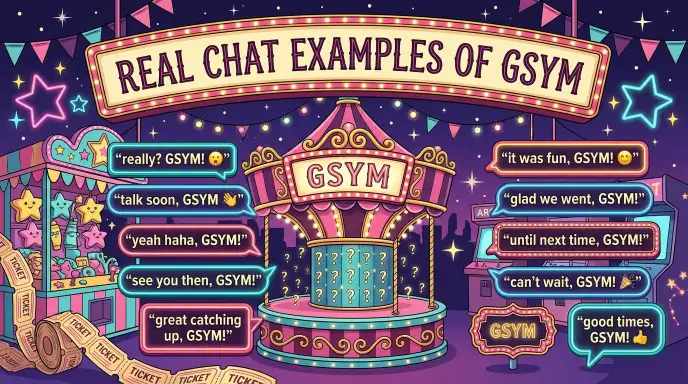
The following examples show how the abbreviation might appear when someone uses its documented insulting meaning. They are illustrative conversations, not evidence that GSYM is widely used in everyday texting.
Example 1: During an Argument
A: You always blame everyone else for your mistakes.
B: GSYM.
A: I was trying to explain the problem, but okay.
Meaning: The second person responds with an insult instead of continuing the discussion.
Example 2: In a Social Media Comment
A: Your comment makes absolutely no sense.
B: GSYM.
A: No need to get personal.
Meaning: The abbreviation is used to attack or dismiss another commenter.
Example 3: In a Snapchat Conversation
A: Why did you tell everyone about our conversation?
B: I didn’t even say anything.
A: GSYM.
Meaning: The sender expresses anger through an offensive abbreviation.
Example 4: In a WhatsApp Group
A: Can everyone please stop arguing?
B: GSYM.
A: Let’s keep this group respectful.
Meaning: Someone uses the expression aggressively in a group conversation.
Example 5: When Someone Feels Provoked
A: You think you’re better than everyone else.
B: I never said that.
A: GSYM.
Meaning: The sender uses the abbreviation to provoke or insult the other person.
Example 6: In an Instagram DM
A: You could have simply told me you weren’t interested.
B: GSYM.
A: I’m not going to argue with you.
Meaning: The abbreviation replaces a respectful response with an offensive one.
Example 7: After a Disagreement
A: I think we should stop discussing this.
B: GSYM.
A: Fine. I’m leaving the conversation.
Meaning: The sender uses the insult while trying to end the interaction.
Example 8: When Someone Is Being Rude
A: Why are you speaking to me like that?
B: GSYM.
A: Don’t contact me if you can’t be respectful.
Meaning: The abbreviation is being used to show hostility.
Example 9: In a Gaming Chat
A: You lost the match. Stop blaming your teammates.
B: GSYM.
A: It’s only a game. Relax.
Meaning: A player uses the insulting expression after becoming frustrated.
Example 10: Asking About the Abbreviation
A: Someone commented GSYM on my post. Do you know what it means?
B: It can stand for a very offensive insult.
A: Oh, that explains the argument.
Meaning: Here, the abbreviation is being discussed rather than directed at someone.
How to Reply When Someone Says GSYM
Your response should depend on the situation and your relationship with the sender. If someone uses an offensive expression toward you, you do not need to match their language.
A calm reply can help prevent a small disagreement from becoming a bigger argument.
Funny Replies
Use humour only when you know the person and are confident they are not trying to threaten or seriously upset you.
- “Someone woke up angry today.”
- “That’s a dramatic way to end a conversation.”
- “Take a deep breath first.”
- “I see we’re skipping the polite conversation.”
- “You could have just said you disagree.”
These replies avoid repeating the insult while keeping the tone light.
Casual Replies
If you do not want to make the situation more serious, keep your response short.
- “Okay, calm down.”
- “What’s your problem?”
- “Let’s not make this personal.”
- “I don’t want to argue.”
- “We can talk when you’re ready.”
Friendly Replies
If the sender is a friend and you believe the message may have been sent out of frustration, try a more understanding approach.
- “Are you actually upset with me?”
- “Did I do something wrong?”
- “Let’s sort this out properly.”
- “You can tell me what’s bothering you.”
- “I don’t want us to fall out over this.”
A friendly reply is useful when you want to understand the problem without accepting disrespectful behaviour.
Neutral Replies
When you do not know the sender well, a neutral response is usually safer.
- “What do you mean by that?”
- “Please explain your message.”
- “I don’t appreciate that language.”
- “Let’s keep this respectful.”
- “I’m ending this conversation.”
If the person continues sending abusive messages, you can stop replying, block them, or report the behaviour where appropriate.
Is GSYM Rude or Offensive?
Yes. GSYM is highly offensive when used with its documented slang meaning. It contains a vulgar insult directed at someone’s mother and is generally associated with anger, disrespect, or provocation.
The expression is not suitable for ordinary polite conversation. Even if a sender uses it casually, the recipient may interpret it as a serious personal insult.
Why Can It Be Offensive?
The meaning refers to a person’s mother, which makes it more personal than a simple disagreement.
Family related insults can carry strong emotional and cultural significance. In Jamaican and wider Caribbean language contexts, expressions involving family members should not be treated as harmless internet jokes simply because they appear in abbreviated form.
The spelling may look less obvious than the full expression, but shortening an insult does not remove its meaning.
Is It Safe to Use With Friends?
That depends on the relationship, shared language, and boundaries between the people involved.
Some close friends may understand offensive expressions as part of their private joking style. However, that does not make the abbreviation universally acceptable.
A person who is unfamiliar with the expression may feel genuinely insulted. Even among friends, using it during a serious disagreement can damage trust.
Is GSYM Appropriate at School or Work?
No. It is best avoided in educational and professional environments.
Using it with teachers, classmates, managers, clients, or colleagues could create unnecessary conflict. It may also be viewed as bullying or abusive language depending on the situation and the relevant rules.
If you want to disagree with someone, use clear language such as:
- “I don’t agree with you.”
- “Please stop speaking to me that way.”
- “Let’s discuss this respectfully.”
- “I don’t think this conversation is productive.”
These expressions communicate your position without attacking someone’s family.
Who Uses This Term?
It is difficult to identify a specific age group or online community that commonly uses GSYM. There is not enough reliable evidence to describe it as a mainstream abbreviation or to claim that it is especially popular among Gen Z.
The available slang documentation associates the expression with Jamaican slang and heated exchanges. That gives some cultural context, but it does not establish how frequently people use it today.
Does Gen Z Use GSYM?
Gen Z frequently encounters unfamiliar abbreviations through social media, gaming, memes, and online conversations. However, that general pattern does not prove that GSYM is a common Gen Z expression.
Some younger users may recognise it through online discussions or regional slang communities. Others may have never seen it before.
It is more accurate to describe GSYM as a niche, offensive abbreviation rather than a widely established Gen Z texting term.
Is It Used in Jamaican Slang?
The documented interpretation connects the expression with Jamaican slang and a Patois influenced way of writing the phrase.
The spelling “yuh” and “mudda” reflects an informal representation of pronunciation. However, one online definition should not be treated as a complete explanation of Jamaican Patois or as proof that every Jamaican speaker uses the expression.
Language varies by speaker, community, age, and situation. Regional expressions also change over time.
Which Platforms Might Show It?
You could encounter unfamiliar slang or abbreviations in:
- TikTok comment sections.
- Instagram discussions.
- Snapchat messages.
- WhatsApp group chats.
- Online gaming conversations.
- Informal text messages.
These are possible places where people communicate using short expressions. They should not be interpreted as evidence that GSYM is common on every platform.
Origin of the Term GSYM
The documented slang interpretation of GSYM is connected with the expression “Go Suck Your Mother,” including the Jamaican Patois influenced spelling “Go Suck Yuh Mudda.”
An Urban Dictionary entry submitted in 2012 describes it as Jamaican slang used to dismiss someone during a heated conversation or argument. A later entry on the same page also records the “yuh” spelling.
This provides a useful clue about how the abbreviation has been used online. However, Urban Dictionary is a user submitted slang resource, not an official linguistic authority. Its entries can document how individuals use expressions, but they do not independently establish a word’s exact historical origin or its popularity across an entire community.
The Role of Jamaican Patois
Jamaican Patois, also known as Jamaican Creole, has its own vocabulary, grammar, pronunciation, and expressive styles.
Online users sometimes represent spoken expressions through informal spellings. Words such as “yuh” and “mudda” can reflect pronunciation and familiar regional speech patterns.
When these expressions move into online conversations, users may shorten them into initialisms to save typing time or to communicate with people who already know the phrase.
How Internet Culture Spreads Abbreviations
Social media makes it easy for regional expressions to travel beyond their original communities.
A phrase may appear in a comment, get repeated in a group chat, or become part of a discussion about unfamiliar slang. Over time, people outside the original language community may encounter it without knowing its background.
That does not mean every regional expression becomes mainstream. Some remain limited to particular communities or online conversations.
Is the Exact Origin Known?
The available documentation gives a recorded interpretation and an example of its use, but it does not establish the exact person who created the abbreviation or the date it first entered spoken language.
For that reason, it is more accurate to describe GSYM as a documented Jamaican slang abbreviation with an uncertain precise history.
GSYM Compared With IDK, IDC, IMO, and BRB
It is different from everyday texting shortcuts because it carries an offensive meaning, while the other abbreviations in this comparison are generally used for ordinary communication.
| Term | Meaning | Type | Usage | Popularity |
| GSYM | Go Suck Your Mother | Offensive slang abbreviation | Used as an insult or dismissal | Niche |
| IDK | I Don’t Know | Texting abbreviation | Shows uncertainty or lack of knowledge | Very common |
| IDC | I Don’t Care | Texting abbreviation | Expresses indifference | Common |
| IMO | In My Opinion | Texting abbreviation | Introduces a personal viewpoint | Common |
| BRB | Be Right Back | Texting abbreviation | Indicates a short absence | Very common |
GSYM vs. IDK
IDK means “I Don’t Know.” People use it when they do not have an answer or are unsure about something.
GSYM, on the other hand, has an insulting meaning in its documented slang use. The two expressions serve completely different purposes.
GSYM vs. IDC
IDC means “I Don’t Care.” It can sound dismissive depending on the conversation, but it is not automatically a personal insult.
GSYM is much more aggressive because it contains a vulgar expression directed at another person’s family.
GSYM vs. IMO
IMO stands for “In My Opinion.” It helps people introduce their thoughts without writing a longer sentence.
GSYM does not introduce an opinion. It is an offensive expression used to attack or dismiss someone.
GSYM vs. BRB
BRB means “Be Right Back.” It is a practical abbreviation used when someone temporarily leaves a conversation.
GSYM is not a practical status update or ordinary chat shortcut. Its documented meaning is confrontational.
Real World Usage Example
Imagine two people are discussing a disagreement in a WhatsApp group.
One person believes that a friend shared private information without permission. They send a message asking why it happened.
Instead of explaining the situation, the other person responds with GSYM.
The first person may initially be confused because the message contains only four letters. After discovering its meaning, they realise that the sender has responded with an offensive insult rather than addressing the actual issue.
A sensible response could be:
“There’s no need to make this personal. If you want to discuss what happened, we can talk respectfully.”
This situation shows why understanding an abbreviation involves more than recognising its letters. The tone, cultural background, and surrounding conversation all help explain what the sender intends.
It also shows why replying with another insult is rarely useful. A calm response can prevent the disagreement from becoming more serious.
Common Misunderstandings About GSYM
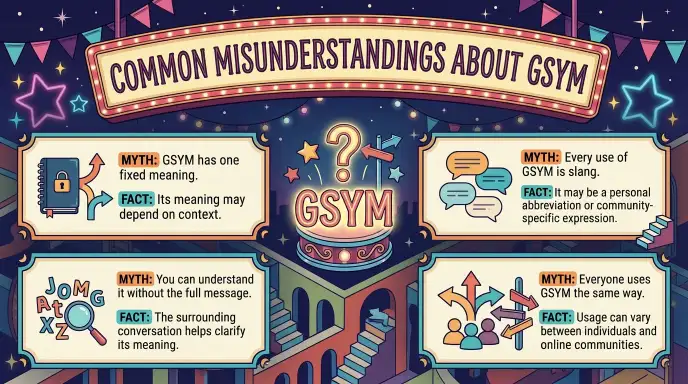
Short abbreviations can be confusing, especially when they come from regional slang. Here are a few mistakes worth avoiding.
Assuming It Is a Friendly Expression
Because some texting abbreviations are playful, readers may assume GSYM is another harmless internet shortcut.
That is not a safe assumption. Its documented meaning is highly offensive, so it should not be treated like a friendly greeting or compliment.
Thinking It Is a Mainstream Gen Z Term
An abbreviation appearing online does not automatically make it popular among younger users.
There is not enough reliable evidence to describe GSYM as a mainstream Gen Z expression. Its documented use is better understood as niche slang.
Confusing Mentioning It With Using It
Someone asking, “What does GSYM mean?” is not necessarily insulting anyone.
A person may be discussing the abbreviation, explaining its meaning, or quoting a message they received. The purpose of the message matters.
Assuming Every Jamaican Speaker Uses It
A regional slang expression does not represent every person from a country or language community.
Jamaican Patois contains a wide range of expressions, and individual speakers have different language preferences. Avoid making assumptions about someone based on one abbreviation.
Using It Without Knowing Its Meaning
Repeating an unfamiliar abbreviation can create an uncomfortable situation.
If you do not understand a term, look it up or ask someone who knows the context. This is especially important when the expression may contain profanity or cultural references.
Frequently Asked Questions
What does GSYM mean in text messages?
GSYM can stand for “Go Suck Your Mother,” a highly offensive expression associated with Jamaican slang. It is generally used to insult or dismiss someone during an argument.
What does GSYM mean on TikTok?
On TikTok, it may carry the same insulting meaning when used in a heated comment exchange. However, it is not established as a universally popular TikTok abbreviation.
Is GSYM slang?
Yes. It is a slang abbreviation associated with a vulgar expression and Jamaican Patois influenced wording.
Is GSYM rude or offensive?
Yes. Its documented meaning is highly offensive because it refers disrespectfully to someone’s mother. It is best avoided in polite, educational, and professional conversations.
How should you reply to GSYM?
You can ask what the person means, tell them to keep the conversation respectful, or stop replying if they are being abusive. There is no need to respond with another insult.
Conclusion
GSYM is an abbreviation with a highly offensive documented slang meaning: “Go Suck Your Mother.” It is associated with Jamaican slang and may appear in heated online conversations, social media comments, or informal messages.
Unlike everyday texting shortcuts such as IDK, IMO, and BRB, this expression is not a neutral communication tool. Its meaning is aggressive, and using it without understanding its cultural context can easily offend someone.
If you encounter it online, consider the surrounding conversation before deciding what the sender intends. If someone directs it toward you, a calm response or simply ending the conversation is often the better choice.
Understanding internet slang is not only about learning what letters stand for. It is also about recognising tone, context, and the impact words can have on other people.
💬 Keep Discovering New Slang:
HKM Meaning in Text: Definition, Uses, and Examples

I am Emma Collins, a content writer at SlangAura specializing in internet slang, texting abbreviations, and online language. I create simple and accurate guides to help readers understand modern slang easily and confidently.