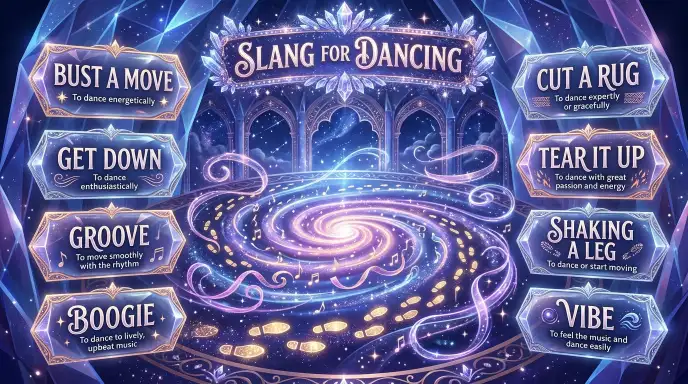
Slang for dancing includes casual words and expressions people use to describe moving to music, showing off dance skills, enjoying a party, or having fun on the dance floor. Expressions such as bust a move, boogie, get down, and throw shapes make conversations about dancing sound more lively and natural.
You might see these phrases in TikTok captions, Instagram Reels, Snapchat stories, music videos, party invitations, or everyday text messages. Some describe impressive dance moves, while others simply mean enjoying a song and letting yourself move.
The interesting part is that not every expression means exactly the same thing. Saying someone is grooving gives a different impression from saying they are throwing shapes or hitting the Griddy.
if you want a funny caption, a cool way to compliment someone’s dancing, or a natural expression for your next conversation, this guide explores the words people use and what they really communicate.
Slang for Dancing: What Does It Mean?
The phrase slang for dancing refers to informal words, expressions, and idioms that describe dancing or moving along with music. These expressions can make an ordinary sentence more energetic, playful, humorous, or expressive.
For example, instead of saying:
“I’m going to dance at the party tonight.”
You could say:
“I’m going to bust a move tonight!”
Both sentences communicate the same basic idea, but the second sounds more casual and enthusiastic.
Unlike an acronym such as IDK or BRB, dancing slang is not one fixed abbreviation. It is a collection of expressions that have developed through music, regional speech, nightlife, dance communities, and internet culture.
Why Do People Use Dancing Slang?
People often choose informal expressions because they communicate a feeling, not just an action.
Consider these differences:
- Boogie: Sounds playful, cheerful, and sometimes nostalgic.
- Groove: Suggests moving naturally with the rhythm.
- Bust a move: Implies suddenly showing off a dance move.
- Throw shapes: Describes energetic or expressive dancing.
- Hit the Griddy: Refers to performing a recognisable dance move.
- Cut a rug: A colourful, slightly old fashioned way to say dance.
The right phrase depends on the music, the person, and the situation. Some expressions work beautifully in party captions, while others sound more natural in conversations between friends.
35 Popular Slang Words and Phrases for Dancing
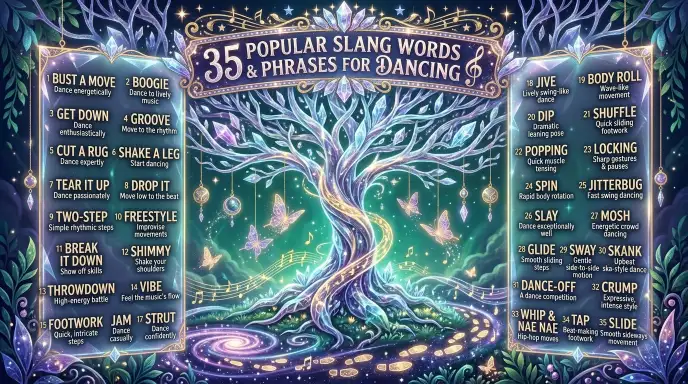
Let’s explore the expressions individually, including their meanings, tones, and examples. Some are familiar idioms, some describe particular movements, and others are closely connected with modern dance trends.
1. Bust a Move
Bust a move means to start dancing, perform a dance move, or show off your dancing skills.
It is one of the most recognisable informal expressions for dancing. People often use it when someone suddenly gets up and starts moving to a good song.
Example: “That song came on, and everyone started busting a move.”
Best for: Parties, celebrations, playful conversations, and energetic captions.
2. Boogie
Boogie means to dance in a relaxed, cheerful, and carefree way.
The expression has an old school musical feel, but it still works in modern conversations. It can describe anything from dancing around your bedroom to enjoying music at a party.
Example: “Forget your worries and let’s boogie!”
Best for: Fun gatherings, retro playlists, family parties, and cheerful captions.
3. Get Down
Get down is an informal expression meaning to dance enthusiastically or enjoy the music.
It often suggests that someone is fully enjoying the beat rather than standing around watching everyone else.
Example: “The DJ played our favourite song, and the whole crowd got down.”
Best for: Clubs, concerts, parties, and music related conversations.
4. Groove
To groove means to move comfortably and naturally with the rhythm of music.
Unlike expressions that suggest complicated choreography, grooving can involve simple movements. You might nod your head, move your shoulders, or sway from side to side.
Example: “I love how she grooves to old school R&B.”
Best for: Describing natural rhythm, relaxed dancing, and musical enjoyment.
5. Cut a Rug
Cut a rug is a playful idiom meaning to dance, often with enthusiasm or skill.
It has a vintage feel and is especially charming when used in humorous conversations about parties or older generations.
Example: “Grandpa still knows how to cut a rug at weddings.”
Best for: Funny comments, family celebrations, and nostalgic writing.
6. Throw Shapes
Throw shapes is a British expression for dancing with energetic, noticeable, or expressive movements.
It can suggest someone is moving their body in different ways rather than following formal choreography.
Example: “Everyone was throwing shapes when the DJ played that track.”
Best for: British English, nightlife conversations, and party descriptions.
7. Shake a Leg
Shake a leg can mean to start dancing or move quickly, depending on the context.
It is also used to encourage someone to hurry up. This makes it important to read the surrounding sentence before interpreting it.
Example: “Come on, shake a leg! The music is already playing.”
Best for: Friendly invitations, casual conversations, and playful encouragement.
8. Hit the Dance Floor
Hit the dance floor means to go where people are dancing and join them.
It does not necessarily mean someone is an excellent dancer. It simply suggests they are ready to participate.
Example: “As soon as the wedding music started, we hit the dance floor.”
Best for: Weddings, clubs, celebrations, and party invitations.
9. Shake It
Shake it is a casual expression encouraging someone to move their body to music.
The exact meaning depends on the situation. It can be playful and general, but in some contexts it can suggest more suggestive dancing.
Example: “The beat is too good. Shake it!”
Best for: Dance challenges, party conversations, and informal encouragement.
10. Let Loose
Let loose means to relax, stop worrying about how you look, and enjoy yourself.
It is not exclusively a dancing expression, but it is frequently useful when describing someone having fun on the dance floor.
Example: “She finally let loose and danced all night.”
Best for: Parties, celebrations, and carefree moments.
11. Get Your Groove On
Get your groove on means to start dancing and enjoy the rhythm.
It has a cheerful, slightly playful tone. The phrase can also suggest getting into a good mood through music.
Example: “Put on some music and get your groove on!”
Best for: Casual invitations, social captions, and upbeat conversations.
12. Hit the Griddy
Hit the Griddy means to perform the Griddy, a recognisable celebratory dance associated with sports and internet culture.
The dance includes characteristic steps and arm movements. It became particularly visible through football celebrations, gaming culture, and social media videos.
Example: “He scored the winning goal and immediately hit the Griddy.”
Best for: Sports celebrations, gaming clips, and dance related memes.
13. Twerk
Twerk refers to a dance movement involving rhythmic hip and lower body movements.
It is a specific style of dancing rather than a general synonym for every type of dance. The term often appears in music, entertainment, and social media challenges.
Example: “The dance challenge included a short twerking sequence.”
Best for: Describing a particular dance style. Be mindful that it can be suggestive and may not suit every audience.
14. Two Step
Two step refers to a simple dance pattern involving alternating steps. It is also associated with particular country and partner dance traditions.
People may use it casually when inviting someone to dance.
Example: “I don’t know the full routine, but I can manage a two step.”
Best for: Country music, social dancing, and beginner friendly dance conversations.
15. Freestyle
Freestyle means dancing without following a fixed routine or strict choreography.
A person may create movements spontaneously, responding to the beat and their own style.
Example: “The music changed, so everyone started freestyling.”
Best for: Dance battles, casual parties, and creative performances.
16. Shuffle
Shuffle can describe a style of dancing involving quick footwork and sliding or rhythmic steps.
The word can also refer to moving the feet in a particular way rather than naming one universal dance routine.
Example: “He practised his shuffle moves before recording the video.”
Best for: Dance tutorials, electronic music, and footwork videos.
17. Sway
Sway means to move gently from side to side, usually in time with music.
It is a softer expression than bust a move and often describes slow dancing or relaxed movement.
Example: “They swayed together while the slow song played.”
Best for: Romantic songs, slow dancing, and gentle movements.
18. Dance Like Nobody’s Watching
This phrase means dancing freely without worrying about other people’s opinions.
It is more of an expression than a slang word, but it is popular in everyday conversation because it captures the carefree side of dancing.
Example: “Turn up the music and dance like nobody’s watching.”
Best for: Confidence captions, funny posts, and self expression.
19. Get Your Steps In
Get your steps in usually means walking enough to reach a physical activity goal. In a dance context, however, it can be used playfully to describe getting plenty of movement through dancing.
Example: “We danced for two hours, so we definitely got our steps in.”
Best for: Fitness related conversations and humorous dance captions.
20. Move to the Beat
Move to the beat means dancing or moving in time with the rhythm of a song.
It is a simple expression that works for almost any age group and does not suggest a particular dance style.
Example: “Even the people sitting down were moving to the beat.”
Best for: General dancing, music descriptions, and beginner friendly writing.
21. Drop It Low
Drop it low is an informal expression encouraging someone to lower their body while dancing.
It is often associated with hip hop and club dance movements. Because the phrase can have a suggestive tone, context matters.
Example: “The dancers dropped it low during the chorus.”
Best for: Describing particular energetic dance movements.
22. Spin Around
Spin around means turning your body in a circle while dancing.
It is not exclusive slang, but it is a natural informal way to describe a dance move.
Example: “She spun around when the music reached its favourite part.”
Best for: Describing simple movements and playful choreography.
23. Dance It Out
Dance it out means using dancing to release stress, express emotions, or simply have fun.
It is often used when someone wants to stop overthinking and enjoy the moment.
Example: “It’s been a long week. Let’s dance it out.”
Best for: Stress relief captions, friendship conversations, and feel good moments.
24. Throw Down
Throw down can mean to perform energetically or show impressive skills, including dancing.
The expression has several meanings outside dance, so the context is important.
Example: “The two dancers really threw down during the competition.”
Best for: Dance battles, performances, and energetic events.
25. Light Up the Dance Floor
This expression means dancing with so much energy or skill that you attract attention.
It is not a fixed slang term, but it is a lively way to compliment someone’s performance.
Example: “She lit up the dance floor at her sister’s wedding.”
Best for: Compliments, celebrations, and event descriptions.
26. Dance Off
A dance off is a friendly or competitive contest in which two or more people take turns showing their dance moves.
It can happen spontaneously between friends or as part of an organised event.
Example: “The party turned into a dance off between the cousins.”
Best for: Competitions, parties, and entertaining videos.
27. Slay
Slay means to do something exceptionally well or impress people.
When someone says a dancer slayed, they are complimenting the person’s performance, confidence, or overall style.
Example: “She absolutely slayed that choreography.”
Best for: Complimenting dancers, performances, and social media comments.
28. Ate That
Ate that is internet slang meaning someone performed extremely well.
It can describe a dance routine, outfit, performance, or any impressive action. The expression is often used as enthusiastic praise.
Example: “That dance transition? She ate that!”
Best for: TikTok comments, Instagram Reels, and enthusiastic compliments.
29. Left No Crumbs
Left no crumbs is a phrase used to praise someone for doing something so well that there is seemingly nothing left to criticise.
When applied to dancing, it means the person performed exceptionally well.
Example: “That final dance move was flawless. Left no crumbs!”
Best for: Strong compliments and expressive online reactions.
30. Hit Every Beat
Hit every beat means matching movements accurately with the rhythm or timing of the music.
It is especially useful when describing a dancer who has excellent timing.
Example: “His choreography hit every beat perfectly.”
Best for: Dance videos, choreography reviews, and performance compliments.
31. Go Off
Go off can mean to perform with impressive energy, confidence, or intensity.
When someone says “Go off!” while watching a dancer, they are encouraging them to keep showing their skills.
Example: “Go off! Those moves are amazing.”
Best for: Encouraging friends and reacting to impressive performances.
32. Bring the Heat
Bring the heat means to deliver an exciting, powerful, or impressive performance.
In dancing, it describes someone bringing serious energy to the floor.
Example: “The dance crew brought the heat at the competition.”
Best for: Dance crews, stage performances, and energetic events.
33. Throw It Back
Throw it back can refer to moving the hips backward rhythmically while dancing. It may also refer to revisiting something from the past in other contexts.
Its dance related meaning can be suggestive, so it is not suitable for every audience.
Example: “The dancers threw it back during the final part of the song.”
Best for: Informal music and dance conversations where the tone is appropriate.
34. Body Roll
A body roll is a dance movement in which the body moves in a flowing wave like motion, often from the upper body toward the hips.
It is a named movement rather than a general expression for dancing.
Example: “She added a smooth body roll to the choreography.”
Best for: Dance tutorials, choreography, and performance descriptions.
35. Get in the Rhythm
Get in the rhythm means finding the timing and flow of the music.
It can describe someone becoming comfortable with a song or gradually joining the dancing.
Example: “Give me one more song. I’m just getting in the rhythm.”
Best for: Beginners, casual dancing, and music related conversations.
Where People Use Dancing Slang
These expressions are not limited to dance studios or nightclubs. People use them in everyday messages, social media posts, music discussions, and videos.
The meaning usually stays similar, but the platform can change how the expression feels.
TikTok
TikTok is a natural place to encounter dance related language because short videos often feature choreography, music challenges, dance trends, and performance reactions.
You might see comments such as:
- “She ate that routine!”
- “Bro hit the Griddy.”
- “Those transitions are clean.”
- “He really knows how to bust a move.”
Some phrases describe the movement itself, while others praise the creator. For example, ate that is a compliment, not the name of a dance.
Snapchat
On Snapchat, friends might use dancing expressions in quick messages, private stories, and video replies.
Examples include:
- “We’re going to boogie tonight.”
- “You were throwing shapes yesterday.”
- “Send me that dance video!”
- “I need to learn that shuffle.”
The language is usually casual and depends on the friendship.
Instagram Reels and Stories make dance expressions useful for captions and comments.
Someone might write “She left no crumbs” under a choreography video or “Hit the dance floor!” on a party story.
These phrases help communicate excitement without writing a long review.
WhatsApp is more conversation focused. People may use dance expressions while planning celebrations, sharing videos, or talking about a memorable night.
For example:
A: Are you coming to the wedding?
B: Of course! I’m ready to hit the dance floor.
SMS Text Messages
Traditional text messages can also include simple expressions such as boogie, bust a move, and shake a leg.
For instance:
A: The party starts at eight.
B: Perfect. Time to bust a move!
These phrases are easy to understand even when someone does not regularly use social media.
Real Chat Examples: How People Talk About Dancing
Here are ten natural conversations showing how different expressions fit into everyday messages.
Example 1: Planning a Party
A: Are you ready for Saturday?
B: Absolutely. I’m ready to hit the dance floor.
A: Same! This party is going to be amazing.
Meaning: Both friends are excited about dancing at the party.
Example 2: Complimenting a Friend
A: Did you watch Maya’s dance video?
B: Yes! She ate that routine.
A: Seriously, every move was perfect.
Meaning: The friends are praising someone’s dancing skills.
Example 3: Encouraging Someone
A: I’m too shy to dance in front of everyone.
B: Come on, bust a move!
A: Only if you dance with me.
Meaning: One friend encourages the other to start dancing.
Example 4: Talking About a Song
A: This song is so good.
B: I know. I can’t stop grooving.
A: It’s definitely going on my playlist.
Meaning: Both people enjoy the rhythm and want to move to the music.
Example 5: A Funny Family Moment
A: Your dad was dancing at the wedding!
B: Don’t laugh. He knows how to cut a rug.
A: He was honestly the star of the night.
Meaning: They are jokingly praising someone’s dancing.
Example 6: Discussing a Dance Trend
A: Have you learned the Griddy yet?
B: I’ve tried, but my feet have other plans.
A: Just keep practising!
Meaning: The friends are talking about learning a recognisable dance move.
Example 7: A Night Out
A: How was the club last night?
B: Amazing. Everyone was getting down.
A: I wish I had come!
Meaning: The person describes an energetic dancing atmosphere.
Example 8: A Dance Competition
A: Did you see the final performance?
B: They really threw down.
A: That crew deserved the applause.
Meaning: The speakers are impressed by the dancers’ performance.
Example 9: A Slow Song
A: That was such a beautiful song.
B: Yeah, everyone was swaying together.
A: It made the whole moment special.
Meaning: The friends describe gentle dancing to slow music.
Example 10: Dancing at Home
A: What are you doing?
B: Just dancing around my room.
A: Living your best life!
B: Exactly. Time to dance it out.
Meaning: Someone is enjoying music and dancing privately.
How to Reply When Someone Talks About Dancing
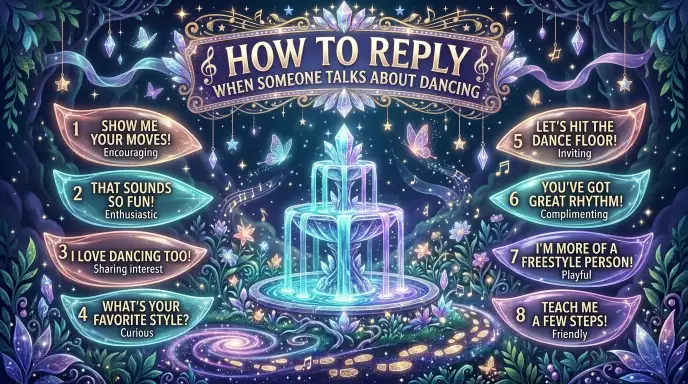
If someone says they want to dance, invites you to a party, or compliments your moves, your reply can be funny, friendly, casual, or simple.
Here are some natural responses.
Funny Replies
- “Only if nobody records me!”
- “My feet have their own plans.”
- “I’m a professional dancer in my imagination.”
- “Warning: terrible moves incoming.”
- “I’ll bring the energy, not the technique.”
Casual Replies
- “Let’s do it!”
- “I’m definitely in.”
- “Put on a good song.”
- “Sounds like a plan.”
- “Save me a spot on the dance floor.”
Friendly Replies
- “I’ll dance with you!”
- “Let’s learn that routine together.”
- “You always make dancing fun.”
- “I can’t wait to see your moves.”
- “We’re going to have the best time.”
Neutral Replies
- “Maybe I’ll join later.”
- “I’m happy to watch for now.”
- “That sounds fun.”
- “I don’t know that dance, but I can try.”
- “Enjoy yourself!”
Is Dancing Slang Rude or Offensive?
Most expressions used to describe dancing are harmless in everyday conversation. Words such as boogie, groove, bust a move, and hit the dance floor are generally playful or positive.
However, not every dance related phrase is suitable for every audience.
Some expressions describe movements that may be considered suggestive, while others have meanings beyond dancing.
Which Expressions Are Generally Safe?
These expressions are usually appropriate in casual conversations:
- Boogie
- Groove
- Bust a move
- Hit the dance floor
- Sway
- Two step
- Freestyle
- Dance it out
They can be used with friends, classmates, and family members without normally creating an awkward impression.
Which Expressions Need More Context?
Terms such as twerk, drop it low, and throw it back can describe suggestive movements.
They may be perfectly understandable in an adult entertainment or music context, but they are not always appropriate for school, work, or family conversations.
Can You Use Dancing Slang at School or Work?
Yes, many expressions are perfectly fine in informal situations.
For example, saying “Let’s hit the dance floor at the school celebration” is natural. However, suggestive phrases may be inappropriate in professional messages or formal school settings.
The simplest rule is to consider your audience before using an expression.
Who Uses Dancing Slang?
Dance related expressions are used by people of different ages and backgrounds. Their familiarity depends on music preferences, cultural experiences, regional language, and online habits.
Do Gen Z Users Say These Expressions?
Many younger social media users encounter expressions such as ate, slay, hit the Griddy, and left no crumbs through dance videos and performance comments.
However, these expressions do different jobs. Some describe dancing, while others praise how well someone performs.
For example:
- “He hit the Griddy” identifies a particular dance.
- “She ate that dance” compliments the performance.
- “He was grooving” describes how someone moved with the music.
- “They left no crumbs” expresses strong admiration.
Understanding this difference helps you use the words naturally rather than adding trendy phrases randomly.
Do Older Generations Use Dancing Slang?
Absolutely. Expressions such as boogie, cut a rug, and shake a leg have a familiar old school feel.
Older expressions do not automatically disappear when newer ones become popular. They can return through music, films, family conversations, and social media.
How Often Do These Expressions Appear Online?
There is no reliable universal usage figure for this collection of phrases. Some are widely recognisable, while others are more regional or connected to particular dance styles.
The Griddy, for instance, is associated with a recognisable dance trend. Meanwhile, throw shapes has a more specific British English flavour.
It is more useful to understand each phrase’s context than to assume all 35 expressions are equally popular.
Origin of Dancing Slang
There is no single origin for dancing slang. These expressions developed across different periods, communities, music scenes, and regional varieties of English.
Some came from older spoken idioms. Others became familiar through musical performances, dance competitions, sports celebrations, and social media.
Expressions That Came From Older Everyday Speech
Phrases such as shake a leg and cut a rug existed long before TikTok and Instagram.
They show how people have traditionally used colourful language to describe movement and entertainment.
Boogie also carries a strong connection with music and dance culture, giving it a playful, familiar sound.
The Influence of Music and Dance Communities
Music has always influenced the way people talk about dancing.
Different musical scenes have developed their own vocabulary, from swing and jazz culture to hip hop and club music. Some expressions have crossed into everyday English, while others remain closely associated with particular communities.
For example, the term slay has important roots in Black and LGBTQ+ ballroom culture, where it was associated with impressive style, presentation, and performance. It later spread into wider popular culture and social media.
This history is worth recognising. Online slang often travels from communities that created or developed it into mainstream conversations.
How TikTok Changed Dance Language
Short form video platforms made it easier for dance moves and their names to reach huge audiences.
A creator performs a routine, viewers recreate it, and the movement becomes recognisable through repeated videos. Expressions such as hit the Griddy became familiar beyond the communities where people first encountered the dance.
Social media also changed how people compliment dancers. Instead of writing “That was an excellent performance,” someone might comment “She ate that!”
Not every phrase began on TikTok, though. The platform often helps older language reach new audiences.
Comparison Table: Dancing Slang and Common Texting Abbreviations
Dancing expressions and texting abbreviations serve different purposes. The following table compares the topic with familiar shortcuts so beginners can see the difference.
| Term | Meaning | Type | Usage | Popularity |
| Slang for dancing | Informal expressions describing dancing | Slang category | Parties, music, social media | Varies by expression |
| IDK | I Don’t Know | Text abbreviation | Showing uncertainty | Very common |
| IDC | I Don’t Care | Text abbreviation | Expressing indifference | Common |
| IMO | In My Opinion | Text abbreviation | Sharing an opinion | Common |
| BRB | Be Right Back | Text abbreviation | Saying you will return shortly | Very common |
Dancing Slang vs. IDK
IDK communicates that someone does not know an answer. Dancing slang describes movement, rhythm, performance, or enjoyment.
For example, “IDK that dance” combines both types of language naturally.
Dancing Slang vs. IDC
IDC expresses indifference. A phrase such as let’s boogie encourages someone to dance.
They have completely different purposes in a conversation.
Dancing Slang vs. IMO
IMO introduces a personal opinion, while expressions such as she slayed that routine communicate a reaction or compliment.
Dancing Slang vs. BRB
BRB tells someone that you will return shortly. Dancing expressions describe an activity rather than a messaging status.
For example: “BRB, the DJ just played my favourite song. I’m hitting the dance floor!”
Real World Usage Example: A Night at a Friend’s Wedding
Imagine you attend a friend’s wedding where the music starts slowly. At first, everyone is sitting at their tables, enjoying the food and watching the performances.
Then the DJ plays a popular song. A few cousins head toward the dance floor, and one of them starts showing off some impressive moves.
Someone nearby laughs and says:
“Look at him bust a move!”
Another friend records a short video and posts it on Instagram with the caption:
“Bro ate that dance!”
Later, when an older relative joins the group, someone jokes:
“Grandpa still knows how to cut a rug!”
All three expressions describe the same general activity, but each creates a different feeling. One sounds energetic, another is a modern compliment, and the last one adds a little nostalgia.
That is what makes informal dance vocabulary interesting. It gives people more ways to describe the same moment without making every sentence sound identical.
Frequently Asked Questions
Q1:What is slang for dancing?
Slang for dancing includes informal expressions such as bust a move, boogie, groove, get down, and throw shapes. People use them to describe dancing, enjoying music, or showing off their moves.
Q2:What does dancing slang mean on TikTok?
On TikTok, dance related expressions appear in captions, comments, and videos. Phrases such as hit the Griddy describe a particular move, while ate that praises someone’s performance.
Q3:Is dancing slang informal language?
Yes. Most dancing expressions are informal words, idioms, or phrases. They are generally used in everyday conversations, music discussions, and social media rather than formal writing.
Q4:Is dancing slang rude or offensive?
Most expressions are harmless. However, phrases such as twerk, drop it low, and throw it back can have suggestive meanings, so consider the audience and situation.
Q5:How should you reply when someone says they want to dance?
You can reply with “Let’s do it!”, “I’m in!”, or “Save me a spot!” If you prefer not to dance, say “I’ll watch for now” or “Maybe later.”
Conclusion
Dancing has its own colourful vocabulary, and the right expression can make a simple conversation feel much more lively. From classic phrases such as boogie and cut a rug to modern expressions such as ate that and hit the Griddy, each term adds a different flavour.
Use bust a move when someone starts showing off their moves, groove when they move naturally with the rhythm, and slay or ate that when you want to compliment an impressive performance.
Remember that some expressions describe specific dance styles, while others simply communicate excitement or praise. A little attention to tone and context will help you choose the right words.
if you’re writing a TikTok caption, replying to a friend’s dance video, or getting ready for a party, these expressions give you plenty of ways to talk about dancing without repeating the same old word.
🪄 Let’s Explore More:
GSYM Meaning in Text: Definition, Uses, and Examples
I am Emma Collins, a content writer at SlangAura specializing in internet slang, texting abbreviations, and online language. I create simple and accurate guides to help readers understand modern slang easily and confidently.