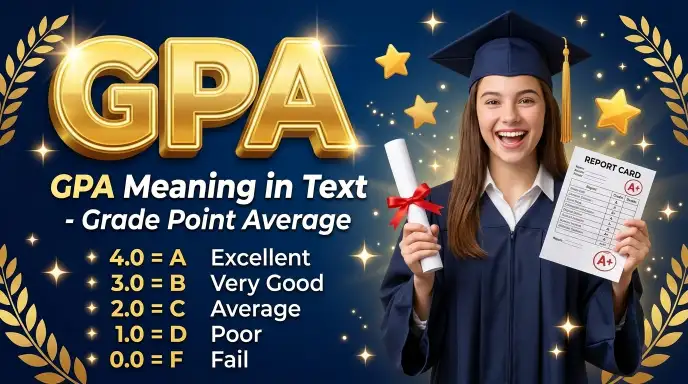
GPA meaning in text usually refers to Grade Point Average, a measure of a student’s academic performance. People commonly use GPA when discussing school grades, college results, exams, scholarships, and university applications. Although GPA is not traditional internet slang, it frequently appears in casual text messages and social media conversations about student life.
The exact meaning depends on the conversation, but when someone mentions grades or school, GPA almost always refers to their academic average.
Quick Answer: What Does GPA Mean in Text?
GPA stands for Grade Point Average. It is a numerical measure used to summarize a student’s academic performance. For example, if someone texts, “I got a 3.8 GPA,” they are sharing their academic average.
On Snapchat, Instagram, TikTok, and in everyday messages, GPA usually has the same meaning. It is an academic abbreviation rather than a typical texting acronym like LOL or BRB.
What Does GPA Stand For?
GPA stands for Grade Point Average. Schools and colleges use it to summarize grades earned across different subjects or courses. The calculation method depends on the educational institution.
In many US schools and colleges, GPA uses a 4.0 scale. However, some institutions use different grading systems, weighted GPAs, or alternative scales.
For example, someone might text:
- “My GPA is 3.7.” : They are sharing their academic average.
- “I need to raise my GPA.” : They want to improve their grades.
- “What’s your GPA?” : They are asking about someone’s academic performance.
Therefore, GPA helps people discuss grades without listing every individual subject or exam result.
How GPA Is Used in Text Messages

People use GPA in messages when discussing academic progress, upcoming exams, college plans, or personal achievements. The abbreviation makes conversations shorter while keeping the subject clear.
1. Talking About Academic Results
Students often mention GPA when sharing their grades with friends or classmates.
Example:
A: “How did you do this semester?”
B: “Pretty good! My GPA is 3.6.”
Here, the sender is sharing their overall academic average.
2. Discussing Exams and Studying
GPA also appears in messages about finals, difficult subjects, and academic pressure.
Example:
“I have to study harder if I want to keep my GPA up.”
This means the student wants to maintain their academic performance.
3. Talking About College Applications
Students may discuss GPA when applying to universities or checking scholarship requirements.
Example:
“Do you know the minimum GPA for admission?”
The person wants to know the academic average required by a particular institution.
4. Celebrating Good Grades
Some students use GPA when celebrating their hard work or academic achievements.
Example:
“Finally improved my GPA this year!”
This means their academic average has increased.
GPA Meaning on TikTok, Instagram, and Snapchat
GPA can appear across social media platforms, especially in content about school, studying, exams, and college life. Its standard meaning generally stays the same.
GPA Meaning on TikTok
On TikTok, GPA often appears in student life videos, study routines, academic memes, and posts about exam stress.
Example:
“When you study all night just to protect your GPA.”
This caption suggests that the student is working hard to maintain good grades.
GPA Meaning on Instagram
On Instagram, people may mention GPA in stories, captions, graduation posts, or academic achievement updates.
Example:
“All that hard work finally paid off. My GPA improved!”
The person is celebrating progress in their studies.
GPA Meaning on Snapchat
On Snapchat, GPA commonly appears in private messages between classmates and friends.
Example:
“Bro, what’s your GPA this semester?”
The sender is asking about their friend’s academic average.
In each situation, the surrounding words help confirm that GPA refers to Grade Point Average.
Real Life Examples of GPA Meaning in Text
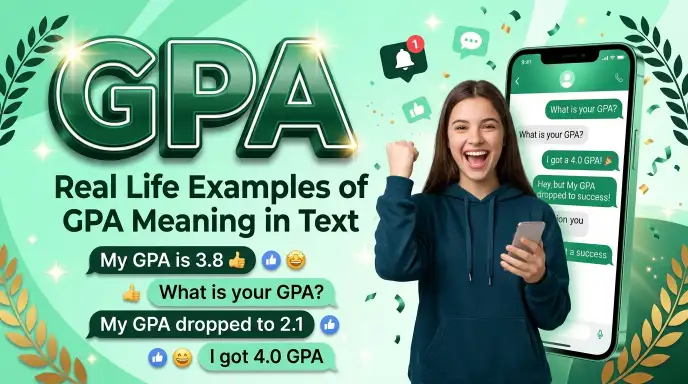
These realistic conversations show how people use GPA in everyday messages.
Example 1: Asking About Grades
A: “Did your results come out?”
B: “Yeah, I got a 3.5 GPA.”
Meaning: The student is sharing their academic average.
Example 2: Worrying About Exams
A: “Why are you studying so much?”
B: “I don’t want my GPA to drop.”
Meaning: The student wants to maintain their grades.
Example 3: Discussing College
A: “Are you applying to that university?”
B: “Yes, but I need to check the GPA requirements.”
Meaning: The student wants to confirm the academic admission criteria.
Example 4: Celebrating Success
A: “I finally got my semester results!”
B: “Nice! What’s your GPA?”
Meaning: The sender is asking about the person’s academic performance.
Example 5: Offering Support
A: “My GPA isn’t as high as I expected.”
B: “Don’t worry. You can work on improving it next semester.”
Meaning: One student is expressing disappointment, and the other is offering encouragement.
Example 6: Talking About Scholarships
A: “I really want to apply for this scholarship.”
B: “Check if your GPA meets the requirements.”
Meaning: The conversation is about academic eligibility.
Example 7: Sharing Academic Goals
A: “My goal is to get a 4.0 GPA.”
B: “Good luck! Keep working hard.”
Meaning: The student is sharing a target for their academic performance.
Is GPA Slang or an Abbreviation?
GPA is an abbreviation, not traditional internet slang. Its established meaning is Grade Point Average, and it is commonly used in education.
However, students often include academic abbreviations in informal messages because they are familiar and convenient.
For example:
“My GPA is cooked after those finals.”
In this sentence, GPA refers to Grade Point Average, while “cooked” is informal slang suggesting that the student’s grades may be in trouble.
This distinction matters because not every abbreviation used in texting is slang. Some terms come from education, technology, business, or other specialized fields.
Does GPA Have Other Meanings in Text?
Although Grade Point Average is the standard meaning in educational conversations, GPA may have other meanings in specialized settings. An organization, workplace, or online community could use the same letters for a different phrase.
However, there is no single alternative meaning that is universally recognized across everyday texting.
Use the conversation to understand the intended meaning:
- School or college: Grade Point Average.
- Exam results: A student’s academic average.
- University admissions: An academic measure considered during applications.
- A specialized group: Potentially an organization specific abbreviation.
For example, if someone asks, “What’s your GPA?” while discussing college, they are almost certainly asking about grades. If the conversation has nothing to do with education, you can ask them what GPA means in that context.
GPA vs. CGPA: Understanding the Difference
GPA and CGPA are related academic terms, but they do not always refer to the same measurement.
GPA stands for Grade Point Average. Depending on the institution, it may refer to performance during a particular semester, term, or academic period.
CGPA stands for Cumulative Grade Point Average. It generally summarizes academic performance across multiple semesters or a larger portion of a student’s program.
For example, a student might earn a GPA of 3.7 in one semester while having a CGPA of 3.4 across several semesters.
The exact calculation and terminology vary between educational institutions. Therefore, students should check their school’s grading policy when comparing results.
How to Reply When Someone Says GPA
Your response depends on if the person is asking about your grades, sharing their results, or expressing concern about academic performance.
If Someone Asks About Your GPA
You can answer honestly if you’re comfortable sharing your grades.
- “Mine is 3.5 right now.”
- “I’m still waiting for my results.”
- “I’m trying to improve it this semester.”
- “I’d rather keep my grades private.”
If Someone Shares a High GPA
A positive reply can acknowledge their effort.
- “That’s amazing! Congrats!”
- “Your hard work paid off.”
- “That’s a great achievement.”
- “Keep it up!”
If Someone Is Worried About Their GPA
A supportive response can help them feel encouraged.
- “Don’t be too hard on yourself.”
- “You can work on it next semester.”
- “One result doesn’t define your future.”
- “Keep going. You’ve got this.”
You are not required to share your own GPA simply because someone asks. It is fine to keep academic information private.
Common Mistakes When Understanding GPA
Understanding GPA is straightforward, but a few common misunderstandings can cause confusion.
Assuming GPA Is Internet Slang
GPA is primarily an academic abbreviation. Although people use it in casual chats, it is not a standard slang expression.
Thinking Every School Uses the Same Scale
Many US institutions use a 4.0 scale, but other schools and countries may use different systems. A GPA should be interpreted according to the institution’s grading rules.
Confusing GPA With One Exam Score
GPA generally summarizes academic performance across courses or a defined academic period. It does not necessarily represent the result of a single test.
Assuming GPA Always Has One Meaning
Context matters. Grade Point Average is the standard meaning in educational conversations, but a specialized organization may use GPA differently.
By considering the topic and surrounding message, you can usually understand the intended meaning without confusion.
FAQs About GPA Meaning in Text
Q1. What does GPA mean in text messages?
GPA usually means Grade Point Average, a numerical measure of academic performance. People use it when discussing grades, school, college, exams, and scholarships.
Q2. What does GPA stand for in texting?
GPA stands for Grade Point Average. It is an academic abbreviation rather than a traditional internet slang term.
Q3. What does GPA mean on Snapchat?
On Snapchat, GPA generally means Grade Point Average when friends discuss school, grades, report cards, or college results.
Q4. What does GPA mean on TikTok?
On TikTok, GPA usually refers to Grade Point Average. It often appears in student life videos, academic memes, study content, and exam related posts.
Q5. Is GPA slang?
No, GPA is primarily an academic abbreviation. People may use it in casual texting, but its standard meaning is Grade Point Average.
Q6. Is a 4.0 GPA good?
On a typical US 4.0 scale, a 4.0 GPA generally represents excellent academic performance. However, grading methods and weighted scales vary between institutions.
Q7. What is the difference between GPA and CGPA?
GPA may refer to an academic average for a specific period, while CGPA generally represents cumulative performance across several periods. Exact definitions depend on the institution.
Q8. Can GPA have a different meaning in a text?
Yes, a specialized group or organization may use GPA differently. In conversations about school or college, however, Grade Point Average is the standard interpretation.
Q9. How do I use GPA in a sentence?
You can write, “My GPA improved this semester,” or “I need a higher GPA to apply for this scholarship.” Both examples refer to academic performance.
Q10. What does GPA mean in college conversations?
In college conversations, GPA refers to Grade Point Average. Students often discuss it when talking about grades, academic progress, graduation requirements, or university applications.
Conclusion
GPA meaning in text is usually Grade Point Average, a numerical measure of a student’s academic performance. It commonly appears in messages about grades, exams, college admissions, scholarships, and student life.
On TikTok, Instagram, and Snapchat, GPA generally keeps the same academic meaning. Although it may appear alongside internet slang in casual conversations, GPA itself is an established academic abbreviation rather than traditional texting slang.
When you see GPA in a message, consider the surrounding conversation. If the topic involves school or college, it almost certainly refers to Grade Point Average.
💬 Keep Discovering New Slang:
GP Meaning in Text: Definition, Uses, and Examples

I am Masson Caldwell, a language enthusiast and content writer at SlangAura. I write about internet slang, texting trends, and modern expressions to help readers understand the evolving world of online language with simple and clear explanations.