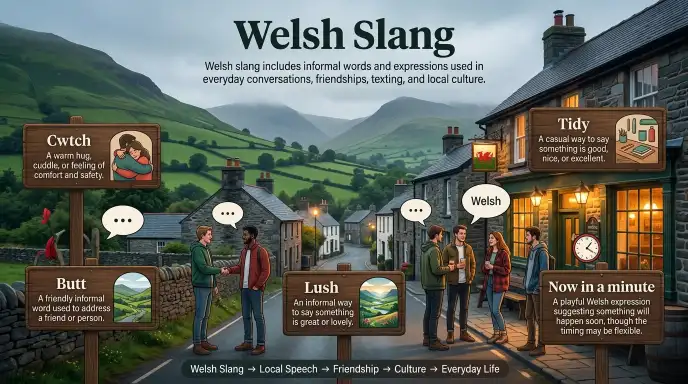
Welsh slang means informal words and phrases used in Wales. Some come from Welsh English, while others come from the Welsh language. Common examples include “cwtch,” “lush,” “tidy,” and “butt.”
People use these words in relaxed conversations with friends and family. Their use can vary across Wales. Some terms are more common in South Wales, while others have a wider reach.
If you are learning Welsh slang, context can help you understand each word. This guide explains common terms in simple English. It also shows where people use them and when to avoid them.
Quick Answer: What Is Welsh Slang?
Welsh slang is informal language used in Wales. It includes local words, phrases, and expressions. Some common examples are “cwtch” for a cuddle, “lush” for very good, and “tidy” for good or great.
What Does Welsh Slang Mean?
Welsh slang refers to casual language used in Wales.
It is not one fixed set of words. Different areas have different expressions. Age and local culture can also affect word choice.
Some terms come from Welsh. Others developed within Welsh English.
For example, “cwtch” comes from the Welsh language. English speakers in Wales also use it in casual speech.
Cwtch
“Cwtch” means a cuddle or a comforting hug.
It can also describe a safe and cozy feeling.
Example:
“I need a cwtch after that long day.”
The word has strong links to Welsh culture. It is now known well beyond Wales too.
Lush
“Lush” can mean very good, lovely, or excellent.
Example:
“That cake was lush.”
Here, the speaker is praising the cake.
The word is informal. It works best in relaxed conversations.
Tidy
“Tidy” can mean good, great, or satisfactory in Welsh English.
Example:
“That new place is tidy.”
The speaker is showing approval. The word does not mean that the place is clean in this sentence.
Butt
“Butt” can be a friendly way to address someone.
Example:
“Alright, butt?”
In this use, the word does not refer to a body part.
It is linked with informal speech in Wales. It is especially associated with South Wales.
Mun
“Mun” can appear at the end of an informal sentence.
Example:
“Come on, mun!”
It adds feeling or emphasis.
The word is strongly linked with South Wales. It is most natural in casual speech.
Common Welsh Slang Words
Here are some Welsh slang words and their simple meanings.
| Welsh slang | Meaning | Tone |
| Cwtch | Cuddle or comforting hug | Warm |
| Lush | Very good or lovely | Positive |
| Tidy | Good or great | Casual |
| Butt | Friendly form of address | Informal |
| Mun | Adds emphasis | Casual |
| Bach | Small or little | Informal |
| Daps | Sports shoes or trainers | Regional |
| Poteen | Small amount of alcohol | Regional |
| Now in a minute | Soon, not always right away | Casual |
Not every word is common across Wales.
Some terms are linked to certain areas. Others may be more familiar to older or younger speakers.
Is Welsh Slang the Same as the Welsh Language?
No. Welsh slang and the Welsh language are different.
Welsh is a Celtic language spoken in Wales. It has its own grammar, words, and writing system.
Welsh English is a form of English spoken in Wales. It can contain local words and expressions.
Welsh slang is a wider term for informal speech used in Wales.
Some slang words come from Welsh. Others come from Welsh English.
Welsh Language
Welsh is a complete language.
People use it in homes, schools, media, and daily life. It has its own rules and vocabulary.
Welsh English
Welsh English is English spoken in Wales.
It can have local words, phrases, and speech patterns. Some of these show the influence of the Welsh language.
Welsh Slang
Welsh slang means informal expressions used in Wales.
The term can include words from Welsh English. It can also include Welsh words used in casual English speech.
“Cwtch” is one clear example. The word comes from Welsh and is also used in English conversations in Wales.
Where Is Welsh Slang Used?
Welsh slang is mainly used in casual settings.
People may use it with friends, family, coworkers, or local communities. The exact words can change from one place to another.
Welsh Slang in Daily Speech
Daily conversations often include local expressions.
A person may use “butt” as a friendly greeting. Someone may also call food “lush” when they really like it.
These words can make speech feel relaxed and familiar.
Welsh Slang on Social Media
Welsh users may use local expressions in posts and messages.
Slang can appear in comments, captions, and online chats. Younger users may also mix local words with newer internet slang.
Welsh Slang in Text Messages
Texting is usually informal.
Friends may use local expressions when sending quick messages.
For example:
“See you later, butt.”
The message sounds friendly and casual.
Welsh Slang in Entertainment
Welsh slang can also appear in music, comedy, television, and online videos.
Entertainment can help local expressions reach people outside Wales.
Still, one show or song does not mean that every person in Wales uses the same word.
Is Welsh Slang Friendly?
Much Welsh slang has a friendly tone.
Words such as “cwtch” can show comfort and affection. “Lush” can show strong approval. “Tidy” can also show that someone likes something.
Other expressions may sound rude in a different setting.
Tone matters too. A word used between close friends may sound strange when used with a stranger.
When you learn a new slang word, check its meaning and tone first.
Can You Use Welsh Slang at Work?
Some mild slang can work in casual workplace chats.
Formal writing needs more neutral language. This includes job applications, reports, official emails, and business documents.
For example, “That sounds tidy” may work in a friendly chat with a coworker.
A formal message could simply say:
“That sounds good.”
This choice keeps the message clear and professional.
Who Uses Welsh Slang?
People of different ages can use Welsh slang.
Some words are common across several age groups. Others may be more common among younger speakers or in certain areas.
Location also matters.
A word that sounds normal in South Wales may be less familiar in another part of the country.
For this reason, there is no single list that represents every Welsh speaker.
Real-Life Examples of Welsh Slang
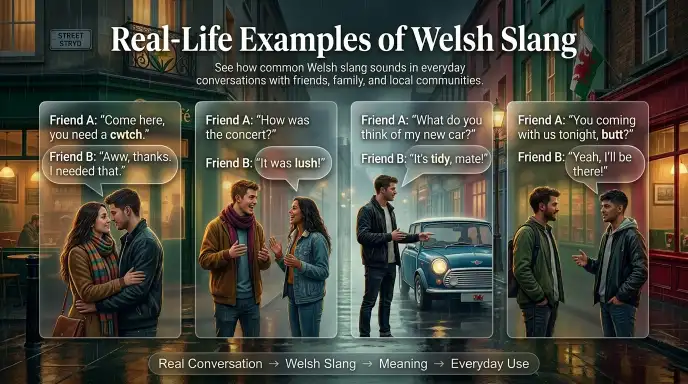
Welsh slang sounds natural in relaxed conversations. Here are a few simple examples.
Example 1: Cwtch
“I had a hard day. I need a cwtch.”
Here, “cwtch” means a comforting hug.
Example 2: Lush
“That meal was lush!”
Here, “lush” means very good or excellent.
Example 3: Tidy
“Your new car is tidy.”
Here, “tidy” means good or impressive.
Example 4: Butt
“Alright, butt?”
Here, “butt” is a friendly form of address.
Example 5: Mun
“Come on, mun!”
Here, “mun” adds emphasis to the sentence.
When Should You Avoid Welsh Slang?
Welsh slang is best for casual situations.
Avoid unfamiliar slang in:
- Job interviews
- Formal emails
- School assignments
- Business documents
- Official messages
- Academic writing
Some slang words may also sound strange to people outside Wales.
If you are unsure, use standard English. It is clear and safe for formal settings.
Polite Alternatives to Welsh Slang
Standard English can replace slang in formal situations.
| Welsh slang | Neutral English | Meaning |
| Butt | Friend / mate | Friendly address |
| Lush | Excellent / very good | Strong praise |
| Tidy | Good / great | Approval |
| Cwtch | Hug | Comforting embrace |
Some words do not have a direct replacement.
For example, “mun” mainly adds feeling or emphasis. The sentence can simply be written without it.
Common Misunderstandings About Welsh Slang
Welsh slang can confuse people who are new to it.
Welsh slang means the Welsh language
No.
Welsh slang and the Welsh language are different. Some slang words come from Welsh, but Welsh is a complete language.
Everyone in Wales uses the same slang
No.
Slang can change by region, age, and local community.
Cwtch only means a hug
Not always.
It can mean a cuddle or a feeling of comfort and safety.
Butt is always rude
No.
“Butt” can be a friendly form of address in Welsh English.
Tidy only means clean
Not always.
In Welsh English, “tidy” can also mean good, great, or satisfactory.
Is Welsh Slang Still Used Today?
Yes, many Welsh slang terms are still used.
Some words are strongly linked to local speech. Others have become known outside Wales.
“Cwtch” is a good example. The word has strong links to Welsh culture and is now familiar to many English speakers.
Slang can change over time. New expressions can also appear.
That means older and newer slang may exist together.
Frequently Asked Questions About Welsh Slang
Q1. What are some Welsh slang words?
Common Welsh slang includes “cwtch” for a hug or cuddle, “butt” as a friendly form of address, “tidy” for good or great, and “lush” for excellent. Many of these terms are especially linked with South Wales.
Q2. What does Welsh mean in slang?
“Welsh” does not have one standard slang meaning in English. It usually refers to Wales, its people, the Welsh language, or Welsh culture.
Q3. What is slang for a Welsh person?
“Welshie” is sometimes used as an informal name for a Welsh person. It can sound friendly, but the tone depends on the speaker and situation.
Q4. What is Welsh for “I love you”?
“I love you” in Welsh is “Rwy’n dy garu di.” “Dw i’n dy garu di” is also used to express the same meaning.
Q5. How to flirt in Welsh?
“Rwyt ti’n brydferth” means “You are beautiful.” “Rwyt ti’n hyfryd” means “You are lovely” and can be used as a warm compliment.
Q6. What is “miss you” in Welsh?
“Dw i’n dy golli di” means “I miss you.” It is a simple way to tell someone that you miss them.
Conclusion
Welsh slang is a natural part of informal speech in Wales. Words such as “cwtch,” “lush,” “tidy,” and “butt” can add a local feel to casual conversations.
Usage can vary across Wales. Age, location, and community can affect the words people use.
Learning the meaning is only the first step. You should also check the tone and setting before using a slang word.
For formal situations, standard English is usually the better choice.
More Slang Insights:
2011 Slang: Popular Words, Phrases, and Their Meanings
I am Emma Collins, a content writer at SlangAura specializing in internet slang, texting abbreviations, and online language. I create simple and accurate guides to help readers understand modern slang easily and confidently.