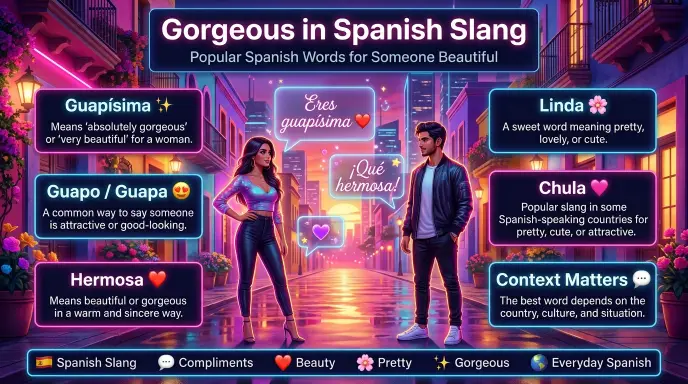
Gorgeous in Spanish slang is a phrase many English speakers search for when they want to compliment someone in a natural and authentic way.
While Spanish has several standard words for “gorgeous,” native speakers also use many informal and slang expressions that vary by country and situation. A word that sounds friendly in Mexico may have a different meaning in Spain or Argentina. Learning these expressions helps you communicate more naturally and understand compliments you hear in conversations, movies, music, and social media.
Quick Answer:Gorgeous in Spanish Slang
Gorgeous in Spanish slang is commonly expressed with words like “guapo,” “guapa,” “bombón,” “mamacita,” “papacito,” and “chula.” The best choice depends on the country, the relationship between the speakers, and the context.
What Does Gorgeous Mean in Spanish Slang?
Unlike English, Spanish does not have one universal slang word that always means “gorgeous.” Instead, native speakers use different expressions to compliment someone’s appearance, style, or attractiveness.
Some expressions are friendly and casual, while others are romantic or flirtatious. A few are also specific to certain countries.
Here are some of the most common options.
| Spanish Slang | English Meaning | Commonly Used In | Tone |
| Guapo / Guapa | Handsome / Gorgeous | Spain, Mexico, many countries | Friendly |
| Bombón | Gorgeous, attractive person | Latin America | Flirty |
| Chulo / Chula | Cute, gorgeous, stylish | Spain, Mexico (varies) | Casual |
| Mamacita | Gorgeous woman | Latin America | Flirtatious |
| Papacito | Handsome man | Latin America | Flirtatious |
The most suitable expression depends on who you are speaking to and where you are.
Guapo / Guapa
“Guapo” for men and “guapa” for women are among the most common compliments in Spanish.
Although the literal translation is “handsome” or “beautiful,” many native speakers also use these words to mean “gorgeous.”
Examples:
- “¡Qué guapa estás!”
- “Es muy guapo.”
- “Hoy te ves guapísima.”
These expressions are friendly and widely accepted.
Bombón
“Bombón” literally means “chocolate candy,” but as slang it describes someone who is extremely attractive.
Examples:
- “Es un bombón.”
- “Mira ese bombón.”
- “Todo el mundo dice que es un bombón.”
The expression is affectionate and often flirtatious.
Chulo / Chula
Depending on the country, “chulo” or “chula” can mean stylish, attractive, cool, or gorgeous.
Examples:
- “Qué chula está tu chaqueta.”
- “Ella se ve muy chula.”
- “Ese estilo está muy chulo.”
In Spain, it often means “cool” or “nice.” In some Latin American countries, the meaning changes, so context is important.
Mamacita and Papacito
These expressions are common in several Latin American countries.
“Mamacita” compliments an attractive woman.
“Papacito” compliments an attractive man.
Examples:
- “Ella es una mamacita.”
- “Ese actor es un papacito.”
These expressions usually sound flirtatious rather than neutral.
Gorgeous in Spanish Slang Full Form and Definition
“Gorgeous in Spanish slang” is not an abbreviation, so it does not have a full form.
Instead, it refers to the informal Spanish words and expressions people use to describe someone who is very attractive, stylish, or good-looking.
Here are the most common meanings.
| Expression | Meaning | Typical Use |
| Guapo / Guapa | Attractive or gorgeous | Everyday conversation |
| Bombón | Extremely attractive person | Flirting |
| Chulo / Chula | Stylish, pretty, or cool | Casual conversation |
| Mamacita | Very attractive woman | Informal compliment |
| Papacito | Very attractive man | Informal compliment |
Learning several expressions helps you understand conversations across different Spanish-speaking countries.
Is Gorgeous in Spanish Slang Rude, Offensive, or Neutral?
Most Spanish slang compliments are positive. However, the tone depends on the situation.
Friendly Compliments
Words such as “guapo” and “guapa” are generally friendly.
Examples:
- “Hola, guapa.”
- “Buenos días, guapo.”
Friends, family members, and even shopkeepers may use these expressions in some countries.
Flirtatious Compliments
Expressions like “bombón,” “mamacita,” and “papacito” often sound more romantic.
Examples:
- “Eres un bombón.”
- “Qué mamacita.”
These phrases may be appropriate in informal settings but can make someone uncomfortable if they are unwanted.
Regional Differences
Some expressions change meaning from one country to another.
For example:
- “Chulo” usually has a positive meaning in Spain.
- In some regions, it can have a completely different meaning.
When learning Spanish slang, understanding regional differences is just as important as learning the vocabulary itself.
Where Is Gorgeous in Spanish Slang Commonly Used?
These expressions appear in many everyday situations.
Text Messages
Friends often compliment each other using casual slang.
Examples:
- “Hola, guapa.”
- “Te ves increíble.”
- “Qué bombón.”
TikTok
TikTok creators regularly use these expressions in beauty, fashion, and lifestyle videos.
Popular captions include:
- “Guapa vibes.”
- “Bombón energy.”
- “Feeling chula today.”
Instagram captions frequently include compliments about appearance.
Examples:
- “Mi guapa favorita.”
- “Siempre tan hermosa.”
- “Qué chula.”
Many influencers also use these words in comments and stories.
Snapchat
Snapchat conversations often include short compliments.
Examples:
- “Guapa ❤️”
- “Bombón 😍”
The tone is usually warm and casual.
Everyday Conversations
Native Spanish speakers use these compliments while greeting friends, family members, partners, and people they know well.
The exact expression depends on the country and the relationship between the speakers.
Why Context Matters
Spanish slang changes from one country to another.
Consider these examples:
- “Ella es muy guapa.”
- “Es un bombón.”
- “Qué chula está esa chaqueta.”
Each compliment expresses admiration, but the exact meaning changes depending on the word and the region.
A phrase that sounds perfectly natural in Spain may sound unusual somewhere else.
For that reason, always pay attention to where the speaker is from and how they are using the expression.
Why People Use Spanish Slang for Gorgeous
Native speakers often prefer slang because it sounds more natural than formal vocabulary.
People use these expressions to:
- Give friendly compliments.
- Show admiration.
- Flirt respectfully.
- Sound more conversational.
- Express appreciation naturally.
Using the appropriate slang helps conversations feel more authentic while showing that you understand everyday Spanish.
Origin and Background of Gorgeous in Spanish Slang
Spanish has evolved over hundreds of years, and every Spanish-speaking country has developed its own informal vocabulary. While standard Spanish includes words such as “hermoso,” “hermosa,” “bonito,” and “precioso,” everyday conversations often use more relaxed and expressive slang.
Many slang compliments became popular through music, television, movies, social media, and local culture. As a result, the same compliment may have a different meaning depending on the country where it is spoken.
For example, someone in Spain may naturally say “guapa,” while a speaker in Mexico, Colombia, or Puerto Rico might choose a different expression.
Learning these regional differences helps you sound more natural and avoid misunderstandings.
Gorgeous in Spanish Slang Compared with Similar Expressions
Spanish offers many ways to compliment someone’s appearance. Each expression has its own tone and level of formality.
| Expression | Meaning | Common Region | Tone |
| Guapo / Guapa | Handsome or gorgeous | Spain, Mexico, many countries | Friendly |
| Hermoso / Hermosa | Beautiful or gorgeous | All Spanish-speaking countries | Neutral |
| Precioso / Preciosa | Gorgeous, lovely | Most regions | Warm |
| Bombón | Very attractive person | Latin America | Flirty |
| Chulo / Chula | Stylish, cute, or cool | Spain, Mexico (varies) | Casual |
| Mamacita | Attractive woman | Latin America | Flirtatious |
| Papacito | Attractive man | Latin America | Flirtatious |
| Divino / Divina | Gorgeous or wonderful | Many countries | Positive |
Although all these expressions can describe an attractive person, “guapo” and “guapa” are the safest choices because they are widely understood across the Spanish-speaking world.
Real-Life Examples of Gorgeous in Spanish Slang
These examples show how native speakers use different expressions in everyday situations.
Friendly Conversation
Friends often compliment each other in a relaxed and respectful way.
Examples:
- “¡Qué guapa estás hoy!”
- “Siempre te ves muy guapo.”
- “Ese color te queda muy bien, guapa.”
- “Qué chula está tu camisa.”
These compliments sound friendly and natural.
Casual Texting
Many Spanish speakers use short compliments while chatting online.
Examples:
- “Hola, guapa 😊”
- “Te ves increíble.”
- “Qué bombón.”
- “Siempre tan preciosa.”
These messages are common between friends, family members, or partners.
Flirty Conversation
Some slang expressions are better suited for romantic situations.
Examples:
- “Eres un bombón.”
- “Qué papacito.”
- “Hola, mamacita.”
- “No puedo dejar de mirarte.”
Use these expressions only when the relationship and situation make them appropriate and welcome.
Social Media Context
Social media users frequently compliment appearance, fashion, and confidence.
Examples:
- “Guapa como siempre.”
- “Esa foto quedó preciosa.”
- “Bombón total.”
- “Hoy te ves divina.”
These compliments often appear in comments, captions, and stories.
When Should You Avoid Using Spanish Slang for Gorgeous?
Although these expressions are common, they are not appropriate in every situation.
Avoid using slang compliments when:
- Writing professional emails.
- Speaking with clients.
- Giving formal presentations.
- Writing academic assignments.
- Complimenting someone you do not know well.
Choosing respectful and clear language helps create a comfortable conversation for everyone.
For example, instead of saying:
“Qué bombón.”
You could say:
“Te ves muy bien.”
Instead of writing:
“Hola, mamacita.”
You could write:
“Hola. Espero que tengas un buen día.”
These alternatives are more suitable in formal or unfamiliar settings.
Polite Alternatives to Gorgeous in Spanish Slang
If you prefer compliments that work in most situations, these expressions are excellent choices.
Friendly Compliments
You can say:
- Hermoso / Hermosa
- Bonito / Bonita
- Precioso / Preciosa
- Muy elegante
- Muy atractivo / Muy atractiva
These words are widely understood and appropriate in many conversations.
Respectful Compliments
You might also say:
- Te ves muy bien.
- Tienes un gran estilo.
- Ese color te queda muy bien.
- Qué elegante.
- Me gusta tu estilo.
These compliments focus on appearance or style without sounding overly personal.
Why People Use Gorgeous in Spanish Slang
Spanish slang often makes compliments feel warmer and more personal.
People use these expressions to:
- Show appreciation.
- Compliment someone’s appearance.
- Flirt respectfully.
- Build friendly conversations.
- Sound more natural in everyday speech.
Using the right expression at the right time can make conversations feel more genuine and engaging.
Impact of Using Slang in Communication
Slang plays an important role in everyday Spanish because it helps conversations sound relaxed and authentic.
Some benefits include:
- Creating natural conversations.
- Building stronger social connections.
- Expressing compliments more creatively.
- Reflecting local culture.
- Making conversations more engaging.
However, slang also has limitations.
Not every expression is understood in every country. Some words change meaning from one region to another, so considering your audience helps you communicate more clearly.
Is Gorgeous in Spanish Slang Safe for Social Media?
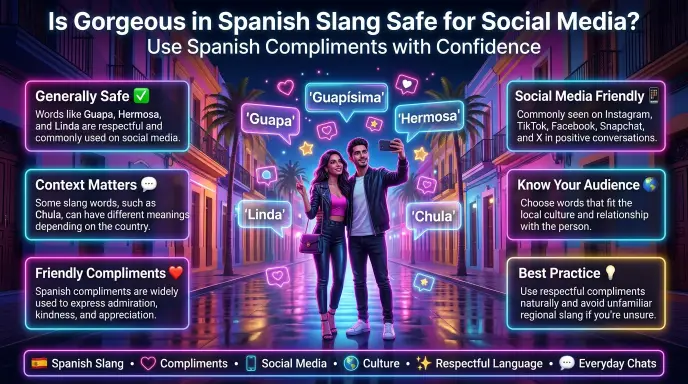
Yes. Most of these expressions are commonly used on social media.
You will often see them on:
- TikTok
- Snapchat
- X (formerly Twitter)
- Threads
Expressions such as “guapa,” “guapo,” “preciosa,” and “hermosa” are generally safe and widely accepted.
More flirtatious expressions, including “mamacita,” “papacito,” and “bombón,” are better reserved for situations where the compliment is welcome and appropriate.
Using respectful language helps create positive interactions on every platform.
Common Mistakes People Make
People who are learning Spanish sometimes make these mistakes:
- Assuming one slang word works in every country.
- Using flirtatious expressions with strangers.
- Translating English compliments word for word.
- Forgetting that regional meanings vary.
- Choosing slang in formal situations.
Learning where and when to use each expression makes your Spanish sound more natural.
Tips for Using Spanish Slang Naturally
If you want to sound more like a native speaker, keep these tips in mind:
- Learn the regional meaning of each expression.
- Match the compliment to the situation.
- Use respectful language with people you do not know well.
- Listen to native speakers in movies, podcasts, and social media.
- When unsure, choose widely accepted words such as “guapo” or “guapa.”
These simple habits will help you use Spanish slang confidently while communicating respectfully.
Frequently Asked Questions
Q1. How do you say gorgeous in Spanish slang?
A common Spanish slang word for “gorgeous” is guapísima for a woman or guapísimo for a man. These words express that someone is extremely attractive.
Q2. What is Spanish slang for pretty girl?
Spanish speakers often say guapa, chula, or linda for a pretty girl. The best choice depends on the country and local slang.
Q3. Is guapa or bonita better?
Guapa usually means attractive or good-looking, while bonita means pretty or lovely. Both are correct, though guapa often sounds more confident and flattering.
Q4. How do Mexicans say “pretty”?
In Mexico, people commonly say bonita, guapa, or hermosa to mean pretty. Friends may also use linda as a warm compliment.
Q5. How do you say “pretty girl” in Spanish?
The most common translation is chica bonita or chica guapa. Both phrases mean “pretty girl” in everyday Spanish.
Q6. How to tell a Latina she’s beautiful?
You can politely say “Eres hermosa” (You are beautiful) or “Qué guapa eres” (You’re so gorgeous). These are respectful and widely understood compliments.
Conclusion
Learning how to say gorgeous in Spanish slang helps you understand everyday conversations and give compliments that sound more natural. Since Spanish is spoken in many countries, there is no single slang word that works everywhere. Instead, native speakers use different expressions based on their region, culture, and relationship with the other person.
Among all the options, “guapo” and “guapa” are the most widely used and easiest to understand. Other expressions, such as “bombón,” “chula,” “mamacita,” and “papacito,” can also mean “gorgeous,” but they often carry a more playful or flirtatious tone and may vary by country.
The best way to choose the right expression is to consider the context, your audience, and the local culture. Using respectful language and understanding regional differences will help you communicate with confidence while making your compliments feel genuine and appropriate.
More Internet Slang Guides:
“Medieval Slang: A Journey Into the Language of Knights
“TP Meaning in Texting Slang: What Does TP Really Mean?”
Pirate Slang Insults Meaning in Text:Pirate Slang Insults Explained

I am Masson Caldwell, a language enthusiast and content writer at SlangAura. I write about internet slang, texting trends, and modern expressions to help readers understand the evolving world of online language with simple and clear explanations.