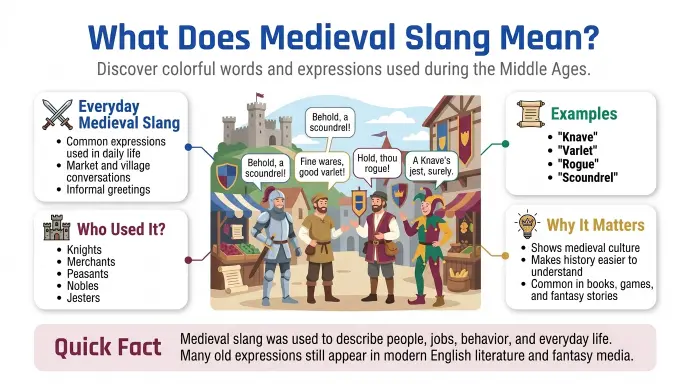
Medieval slang refers to the informal words and expressions people used during the Middle Ages. Unlike modern internet slang, these terms developed through everyday conversations, local dialects, trades, and social customs.
People search for medieval slang to better understand historical books, films, games, and medieval culture. While many of these expressions are no longer used today, some have influenced modern English and still appear in literature or historical discussions. This guide explains what medieval slang means, where it was used, and how these old expressions shaped everyday communication.
Quick Answer:
Medieval slang includes informal words and phrases commonly used by ordinary people during the Middle Ages. These expressions reflected daily life, occupations, humor, and local traditions rather than modern internet culture.
What Is Medieval Slang?
Medieval slang is the collection of informal words and expressions used by people living during the Middle Ages, roughly between the 5th and 15th centuries.
Unlike formal writing found in royal documents or religious texts, everyday speech often included colorful phrases, nicknames, insults, and humorous expressions that varied from one region to another.
People commonly used medieval slang to:
- Describe everyday life.
- Make jokes.
- Tease friends.
- Express emotions.
- Talk about work and village life.
Because spelling and pronunciation were not standardized, the same expression could appear in different forms depending on the region.
Is Medieval Slang an Official Language?
No. Medieval slang was not an official language.
Instead, it was informal speech used alongside languages such as:
- Middle English
- Anglo-Norman French
- Latin
- Regional dialects
Most slang developed naturally among ordinary people rather than being recorded in official documents.
Does Medieval Slang Have a Full Form?
No. Medieval slang does not have a full form.
Unlike modern abbreviations such as LOL or BRB, medieval slang consists of ordinary words and phrases that gained informal meanings through everyday use.
Is Medieval Slang Rude, Offensive, or Neutral?
Most medieval slang was neutral or humorous, although some expressions were intended as insults or jokes.
if a phrase sounded offensive depended on who said it and the situation.
Friendly Expressions
Many informal expressions were used among friends and family.
Examples include:
- Playful nicknames.
- Humorous sayings.
- Casual greetings.
These phrases helped make conversations more relaxed.
Neutral Expressions
Some slang simply described occupations, food, clothing, or everyday activities.
They carried no negative meaning and were commonly understood within local communities.
Insults and Mocking Language
Like every society, medieval communities also used slang to tease or insult others.
Some words questioned a person’s honesty, intelligence, or manners. However, many of these expressions sound unusual or outdated to modern readers and are rarely used today.
Where Was Medieval Slang Commonly Used?
Medieval slang was mainly spoken in everyday life rather than written in official records. Ordinary people used informal language while working, trading, traveling, and socializing.
Villages and Towns
Most slang developed in villages, marketplaces, and small towns where people interacted daily.
Farmers, blacksmiths, merchants, and craftsmen often created colorful expressions that reflected their work and local customs.
Taverns and Inns
Taverns were popular meeting places where travelers, merchants, and local residents gathered to eat, drink, and share stories.
Many humorous sayings, nicknames, and playful insults became popular through these conversations.
Markets and Trade
Busy marketplaces brought together people from different regions, allowing slang words to spread from one town to another.
Traders often used informal expressions to bargain, joke with customers, or describe goods.
Literature and Storytelling
Although slang was mostly spoken, some expressions appeared in medieval poems, plays, folk tales, and later historical writings.
These works help historians understand how ordinary people communicated during the Middle Ages.
Common Medieval Slang Words
Below are some well-known medieval expressions and informal terms that appear in historical records or literature.
Knave
Originally, knave meant a young servant or boy. Over time, it became an insult for someone considered dishonest or untrustworthy.
Example:
- “Don’t trust that knave.”
- “The merchant called him a knave.”
Churl
A churl referred to a common farmer but later came to describe someone who was rude, unfriendly, or ill-mannered.
Example:
- “He behaved like a churl.”
- “Nobody enjoyed the churl’s company.”
Varlet
A varlet was originally a servant or attendant. It later became an insult for a dishonest or troublesome person.
Example:
- “You lying varlet!”
- “The guard chased the varlet away.”
Rogue
Although still used today, rogue was a common medieval term for someone known for dishonest or mischievous behavior.
Example:
- “That rogue tricked the travelers.”
- “Everyone knew the rogue’s reputation.”
Wench
Historically, wench referred to a young woman or serving girl.
Today, the word is considered old-fashioned and can sound disrespectful depending on the context, so it is rarely used outside historical discussions.
Example:
- “The wench served food at the inn.”
- “The story mentioned a village wench.”
Scoundrel
A scoundrel described someone believed to be dishonest or lacking good character.
Example:
- “The scoundrel fled before sunrise.”
- “Everyone avoided the scoundrel.”
Real-Life Examples of Medieval Slang
Understanding these expressions is easier when you see them used in context.
Friendly Conversation
- “Greetings, good fellow!”
- “Come, let’s visit the tavern together.”
Casual Conversation
- “That rogue won another wager.”
- “The merchant called him a clever knave.”
Humorous Conversation
- “Stop acting like a churl.”
- “Only a scoundrel would make that bargain.”
Historical Games and Movies
Many medieval-themed games, books, and films still use these expressions to create an authentic atmosphere.
Examples include:
- “You foolish varlet!”
- “Guard the castle, knave!”
- “That rogue escaped again.”
These examples show how medieval slang continues to appear in modern entertainment.
Origin and Background of Medieval Slang
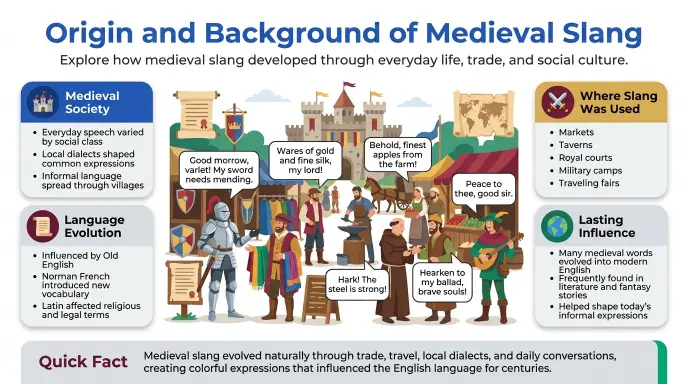
Medieval slang developed naturally as people from different regions interacted through farming, trade, travel, and village life.
Unlike modern slang, which often spreads through social media, medieval expressions spread by word of mouth.
Several languages influenced medieval slang, including:
- Middle English
- Old English
- Anglo-Norman French
- Latin
- Local regional dialects
Because very few ordinary people could write, many slang expressions were never officially recorded. Historians know about them through surviving literature, legal documents, and historical accounts.
Comparison with Modern Slang
Some medieval slang words have survived into modern English, while others have disappeared completely.
| Medieval Slang | Modern Equivalent | Meaning |
| Knave | Crook | Dishonest person |
| Rogue | Troublemaker | Mischievous person |
| Churl | Rude person | Someone with bad manners |
| Scoundrel | Villain | Dishonest individual |
| Wench | Young woman (historical) | Serving girl or young woman |
| Varlet | Rascal | Dishonest servant or troublemaker |
Many modern English words have historical roots, even though their meanings have changed over time.
When Should You Avoid Using Medieval Slang?
Although medieval slang is interesting, many expressions are outdated and may confuse modern readers.
Professional Communication
Avoid medieval slang in:
- Business emails
- Workplace meetings
- Academic reports (unless discussing history)
- Professional presentations
Modern English is much clearer for everyday communication.
Everyday Conversations
Words like knave, varlet, and wench sound unusual today and may not be understood by most people.
Sensitive Situations
Some historical terms, especially wench, may sound disrespectful or offensive in modern conversations because their meanings have changed over time.
Use these expressions mainly when discussing history, literature, or medieval-themed entertainment.
Polite Alternatives to Medieval Slang
If you want to express similar ideas using modern English, these alternatives are easier to understand.
Instead of “Knave”
Use:
- Dishonest person
- Trickster
- Crook
Instead of “Churl”
Use:
- Rude person
- Unfriendly person
- Ill-mannered person
Instead of “Scoundrel”
Use:
- Villain
- Troublemaker
- Bad person
These modern alternatives communicate the same ideas without sounding outdated or confusing.
Why Do People Learn Medieval Slang?
People learn medieval slang to better understand history, literature, movies, games, and historical reenactments. These old expressions offer a glimpse into how ordinary people communicated during the Middle Ages.
Some common reasons people explore medieval slang include:
- To understand historical books and documents.
- To enjoy medieval-themed movies and TV shows.
- To follow dialogue in fantasy and historical games.
- To improve historical writing or role-playing.
- To learn how English has changed over time.
Although many expressions are no longer used today, they remain an important part of the history of the English language.
Impact of Medieval Slang on Modern English
Many words once considered medieval slang have influenced modern English. While some have disappeared, others have survived with similar or slightly different meanings.
Positive Impact
- Preserved historical language and culture.
- Influenced modern English vocabulary.
- Added colorful expressions to literature.
- Helped shape regional dialects.
- Inspired historical fiction and fantasy writing.
Limitations Today
- Many expressions are outdated.
- Some words have changed meaning over time.
- Certain terms may confuse modern readers.
- A few historical words can sound offensive today because language has evolved.
Understanding the historical context helps readers appreciate these expressions without misusing them.
Is Medieval Slang Safe to Use Today?
Yes, but it depends on the situation.
Most medieval slang is harmless when used in discussions about history, literature, theater, cosplay, or medieval-themed games.
Before using these expressions, keep these tips in mind:
- Use them when discussing historical topics.
- Avoid outdated insults in everyday conversations.
- Remember that some words have different meanings today.
- Explain uncommon expressions if your audience may not recognize them.
In most cases, medieval slang is best suited to educational or historical contexts rather than modern casual conversations.
Frequently Asked Questions
Q1. What is medieval slang?
Medieval slang refers to the informal words and expressions used by ordinary people during the Middle Ages. These terms reflected daily life, occupations, humor, and local culture.
Q2. Is medieval slang still used today?
Most medieval slang is no longer used in everyday speech. However, some words like rogue and scoundrel have survived and are still understood in modern English.
Q3. Was medieval slang the same everywhere?
No. Medieval slang varied by region, language, and local dialect. People in different parts of England and Europe often used different informal expressions.
Q4. Is medieval slang offensive?
Most medieval slang is neutral or historical. However, some old insults and terms may sound rude or outdated in modern conversations.
Q5. Where can I hear medieval slang today?
You may hear medieval slang in historical films, television series, fantasy games, Renaissance fairs, historical reenactments, and classic English literature.
Q6. Did medieval people use abbreviations like modern texting slang?
No. Medieval slang was based on spoken words and phrases rather than internet-style abbreviations like LOL or BRB.
Q7. Is medieval slang useful for writers?
Yes. Writers of historical fiction and fantasy often use medieval slang to make dialogue sound more authentic. However, it should be used carefully to match the historical setting.
Q8. What is the most famous medieval slang word?
One of the best-known medieval slang words is knave, which originally meant a servant or boy but later became an insult for a dishonest person. Other famous terms include rogue, churl, and scoundrel.
Q9. Why did medieval slang change over time?
Medieval slang changed as languages evolved, societies developed, and people from different regions interacted through trade, travel, and cultural exchange. Many expressions disappeared, while others became part of modern English.
Q10. What are some medieval sayings?
Some well-known medieval sayings include “Many hands make light work,” “Time and tide wait for no man,” and “All that glitters is not gold.” Many of these old sayings are still used in modern English today.
Q11. How do you say “I love you” in medieval?
In Middle English, you could say “Ich love thee” or “I love thee.” These expressions were commonly used in medieval literature and poetry to express affection.
Q12. How do I say “I” in medieval?
In Middle English, the word “I” was often written as “Ich” in earlier forms, although “I” also became common in later Middle English. The exact form depended on the time period and region.
Q13. How did medieval people flirt?
Medieval people often flirted through poetry, songs, compliments, courteous manners, and exchanging small gifts or tokens of affection. In noble society, courtly love traditions also encouraged polite and romantic expressions of admiration.
Conclusion
Medieval slang offers a fascinating look at how ordinary people communicated during the Middle Ages. These informal expressions reflected everyday life, occupations, humor, and local traditions rather than the formal language found in historical records.
Although many medieval slang words are no longer used, as rogue and scoundrel have remained part of modern English. if you’re reading historical literature, watching medieval films, playing fantasy games, or simply exploring the history of the English language, understanding medieval slang can make the experience more enjoyable and meaningful. Always remember that some historical terms have changed in meaning, so using them with the right context is important.
Trending Slang Meanings:

I am Masson Caldwell, a language enthusiast and content writer at SlangAura. I write about internet slang, texting trends, and modern expressions to help readers understand the evolving world of online language with simple and clear explanations.