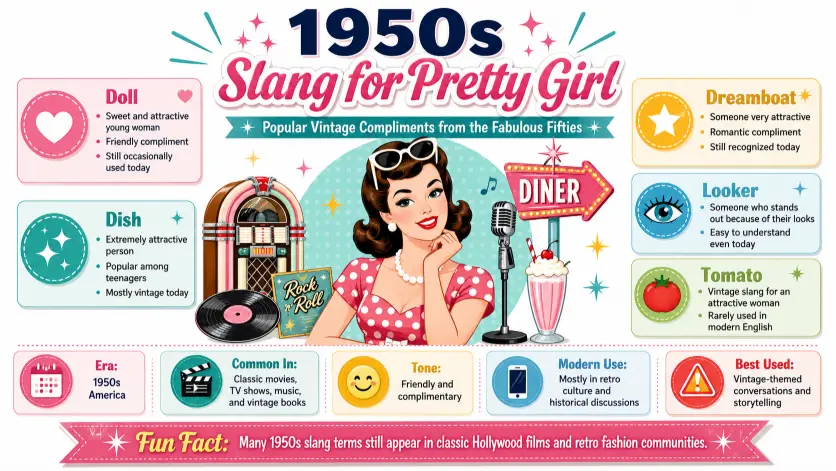
1950s slang for pretty girl is a popular search because many people come across vintage expressions in old Hollywood movies, classic TV shows, rock and roll songs, and retro books.
These colorful slang words were once part of everyday conversations and reflected the fun, fashionable, and lively culture of the 1950s. Today, many people are curious about what these old-fashioned compliments mean and if they are still appropriate to use.
Unlike modern internet slang, these expressions were spoken face-to-face and were used to describe someone in a friendly or admiring way. if you’re writing a story set in the 1950s, watching classic films, or simply interested in vintage American English, understanding these slang terms can make the language much easier to follow.
Quick Answer:
1950s slang for pretty girl refers to informal words and phrases people used during the 1950s to describe an attractive, stylish, or charming young woman. Popular examples include doll, dish, dreamboat, looker, and tomato.
What Does 1950s Slang for Pretty Girl Mean in Text?
The phrase 1950s slang for pretty girl doesn’t refer to just one word. Instead, it describes a group of informal expressions that people commonly used during the 1950s to compliment a woman’s appearance.
Most of these terms were considered friendly compliments. They reflected the fashion, music, and social culture of the decade, when appearance and personal style played a big role in youth culture.
Today, you’ll mostly hear these expressions in:
- Classic Hollywood movies
- Vintage television shows
- Old novels
- Rock and roll documentaries
- Retro-themed social media posts
- Historical discussions about American culture
Although some of these words are still recognized, many now sound nostalgic or old-fashioned.
1950s Slang for Pretty Girl Full Form and Definition
Unlike texting abbreviations such as LOL or BRB, 1950s slang for pretty girl has no full form.
Instead, it is a category of informal words that describe an attractive woman.
These slang terms generally mean:
- A beautiful young woman
- Someone who is stylish or fashionable
- An attractive date
- A charming or admired girl
- A woman considered especially good-looking
Because these expressions come from a specific time period, their meanings can sometimes vary slightly depending on the speaker and context.
Is 1950s Slang for Pretty Girl Rude, Offensive, or Neutral?
In most situations, these expressions were intended as compliments.
Today, they are generally considered:
| Slang Term | Modern Tone | Notes |
| Doll | Friendly | Still occasionally used affectionately |
| Dreamboat | Positive | Playful and nostalgic |
| Dish | Neutral | Mostly heard in vintage contexts |
| Looker | Neutral | Still understandable today |
| Tomato | Outdated | Rarely used in modern speech |
While these words are not usually offensive, some people may find them old-fashioned. Modern audiences often prefer more contemporary compliments like beautiful, gorgeous, or stunning.
Popular 1950s Slang Words for a Pretty Girl
Doll
One of the most famous compliments of the 1950s, doll referred to a beautiful, sweet, or fashionable young woman.
People often used it affectionately when talking to girlfriends, wives, or female friends.
Dish
Calling someone a dish meant they were extremely attractive.
This expression was especially popular among teenagers and young adults during the decade.
Dreamboat
Although often used for handsome men today, dreamboat could also describe someone considered especially attractive or admired.
It suggested that someone was the perfect romantic partner.
Looker
A looker was someone whose appearance immediately caught attention.
Unlike some vintage slang, this word is still occasionally heard today.
Tomato
During the 1950s, tomato became slang for a very attractive woman.
The term is rarely used today and is mostly found in older movies and books.
Where Is 1950s Slang for Pretty Girl Commonly Used?
Today, these expressions are mainly found in historical and entertainment settings rather than everyday conversations.
You may come across them in:
- Classic Hollywood films
- Vintage magazines
- Historical novels
- Rock and roll documentaries
- Retro fashion blogs
- Museum exhibits
- Social media posts celebrating 1950s culture
- Costume party discussions
Unlike today’s internet slang, these expressions are not commonly used in texting, gaming, or online chats.
Origin and Background of 1950s Slang for Pretty Girl
The slang used to describe a pretty girl in the 1950s grew out of a unique period in American history. After World War II, the economy improved, teenagers had more spending power, and popular culture began to influence everyday language.
Movies, radio, television, magazines, and rock and roll music all helped spread new slang across the country. Teenagers wanted words that sounded fun, modern, and different from the language their parents used. As a result, many creative compliments became part of everyday speech.
Unlike today’s internet slang, these expressions were usually spoken in person. Friends used them at school, dances, diners, parties, and social events. Some of the words eventually faded away, while others are still recognized because they appear in classic films and vintage television shows.
Although these slang terms are strongly linked to the United States, similar expressions later appeared in other English-speaking countries through American entertainment.
Why People Used This Slang
People in the 1950s enjoyed using colorful language because it made conversations feel more lively and memorable.
These expressions were popular for several reasons:
- They sounded fun and fashionable.
- They made compliments feel more personal.
- They reflected the youth culture of the decade.
- They helped people fit in with friends.
- They added personality to everyday conversations.
- They were easy to remember and widely understood at the time.
Many teenagers also copied the language they heard in movies, music, and television, which helped these slang words become even more popular.
Comparison with Similar Slang
| Slang Term | Time Period | Meaning | Still Used Today? |
| Doll | 1950s | Pretty or charming girl | Sometimes |
| Dish | 1950s | Attractive person | Rarely |
| Dreamboat | 1950s | Extremely attractive person | Occasionally |
| Looker | 1950s | Good-looking person | Yes |
| Tomato | 1950s | Attractive woman | Very rare |
| Babe | Modern | Attractive woman | Very common |
| Gorgeous | Modern | Extremely beautiful | Very common |
| Stunning | Modern | Exceptionally attractive | Very common |
The biggest difference is that modern compliments are more familiar to today’s audiences, while 1950s slang creates a nostalgic or vintage feel.
Impact of Using Slang in Communication
Using vintage slang can make your writing or conversation more interesting, especially when discussing classic culture or historical topics.
Some positive effects include:
- Creating a nostalgic atmosphere.
- Making stories feel historically accurate.
- Adding personality to conversations.
- Showing knowledge of vintage American culture.
- Making retro-themed content more authentic.
However, there are also a few drawbacks.
Some younger people may not recognize these expressions, and others might misunderstand what they mean. Because language changes over time, old slang does not always communicate as clearly as modern vocabulary.
For that reason, it is usually best to use these terms when the audience understands the historical context.
Is It Safe for Social Media?
Yes. Most 1950s slang for pretty girl expressions are completely safe to use on social media.
They are commonly used in posts about:
- Vintage fashion
- Classic Hollywood
- Rock and roll history
- Retro hairstyles
- 1950s-themed events
- Historical trivia
- Throwback photographs
Since these expressions are generally compliments rather than insults, they do not normally violate community guidelines.
That said, some words may sound outdated, so it’s helpful to consider your audience before using them.
When to Avoid Using 1950s Slang for Pretty Girl
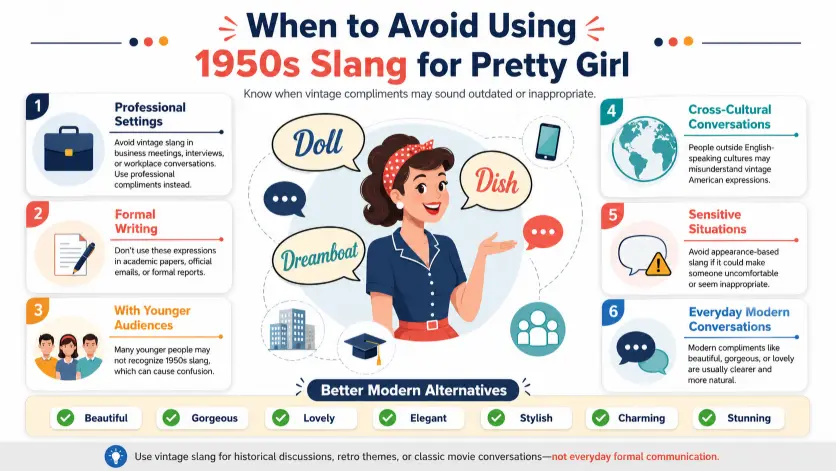
Although these expressions are usually harmless, there are situations where modern language is a better choice.
Avoid using them:
- In professional emails.
- During job interviews.
- In business presentations.
- In academic papers.
- With people who may not understand vintage slang.
- When a simple modern compliment would be clearer.
If you’re unsure if someone will understand the expression, choosing straightforward language is usually the safest option.
Polite Alternatives
If you want to compliment someone’s appearance using words that feel more natural today, consider these alternatives:
- Beautiful
- Gorgeous
- Lovely
- Elegant
- Charming
- Attractive
- Stylish
- Stunning
- Graceful
- Pretty
These compliments are widely understood and work well in both spoken and written English.
Real-Life Examples of 1950s Slang for Pretty Girl
The meaning of these expressions becomes much clearer when you see how they might be used in everyday conversations. Here are examples in different situations.
Friendly
Sarah: “Your grandmother looked beautiful in those old photos.”
Emma: “Thanks! Grandpa always called her a real doll.”
Casual
“I watched a 1950s movie last night, and the main character kept calling his girlfriend a dreamboat.”
Argumentative
“I know those old expressions sound funny today, but they were common compliments back in the 1950s.”
Social Media
“Vintage dress, red lipstick, and classic curls I finally achieved that 1950s glamour girl look! ✨”
Frequently Asked Questions
What does 1950s slang for pretty girl mean?
It refers to old-fashioned informal words used during the 1950s to describe an attractive, stylish, or charming young woman.
Does 1950s slang for pretty girl have a full form?
No. It is not an abbreviation, so it does not have a full form. Instead, it refers to a collection of vintage slang expressions.
What are some common 1950s slang words for a pretty girl?
Popular examples include doll, dish, dreamboat, looker, tomato, and glamour girl.
Is 1950s slang for pretty girl still used today?
Some expressions, such as doll and looker, are still heard occasionally. Others are mostly found in classic movies, books, or discussions about vintage culture.
Is this slang offensive?
Generally, no. Most of these expressions were intended as compliments. However, because language changes over time, some words may sound outdated to modern listeners.
Can I use these words on social media?
Yes. They are suitable for social media posts about classic fashion, old Hollywood, vintage events, or 1950s history. Just remember that younger audiences may not recognize every expression.
Conclusion
1950s slang for pretty girl includes a variety of charming expressions that reflected the style and culture of the decade. Words such as doll, dish, dreamboat, looker, and tomato were commonly used to compliment an attractive young woman and were a natural part of everyday conversations in the 1950s.
While many of these expressions are no longer common in daily speech, they continue to appear in classic films, vintage books, retro fashion communities, and historical discussions. Understanding these terms can help you appreciate older forms of American English and better understand the language used in classic entertainment.
If you decide to use 1950s slang for pretty girl today, keep the context in mind. These nostalgic expressions work best in conversations about vintage culture, storytelling, or retro-themed content, while modern compliments are usually a better choice for everyday communication.
Get more infformation:

I am Emma Collins, a content writer at SlangAura specializing in internet slang, texting abbreviations, and online language. I create simple and accurate guides to help readers understand modern slang easily and confidently.