Tripping meaning slang is a popular expression that you may see in text messages, social media posts, videos, or everyday conversations. If someone tells you, “You’re tripping,” they usually do not mean you literally stumbled or fell.
Instead, they are saying that you are overreacting, mistaken, acting strangely, or saying something they believe is unreasonable. Depending on the situation, the phrase can be playful, humorous, or slightly critical. In some contexts, “tripping” can also refer to experiencing hallucinations after taking psychedelic drugs, but that is a separate meaning. Understanding the context helps you know which definition applies and prevents misunderstandings.
Quick Answer:Tripping Slang:
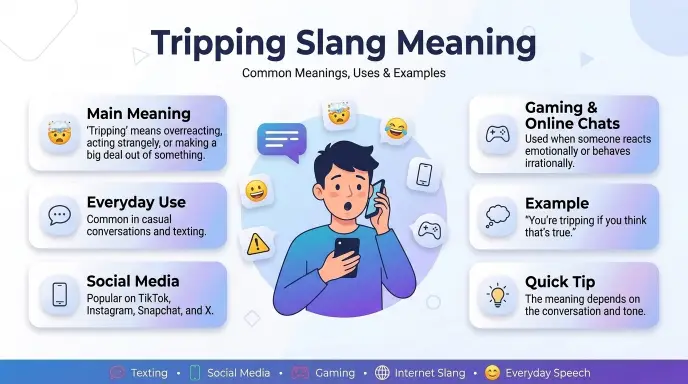
Tripping meaning slang most commonly means someone is overreacting, thinking irrationally, or saying something that others believe is unreasonable. The exact meaning depends on the context of the conversation.
What Does Tripping Mean in Text?
In texting and online conversations, “tripping” usually means someone is acting in a way that seems unreasonable or overly emotional.
If a friend says, “You’re tripping,” they often mean:
- You’re overthinking the situation.
- You’re worrying too much.
- You’re mistaken.
- You’re acting irrationally.
- You’re making a bigger deal out of something than necessary.
The phrase is usually informal and is commonly used between friends or people who know each other well.
Here are a few examples:
- “You’re tripping if you think I’m waking up at 5 a.m. on my day off.”
- “Relax, you’re tripping over nothing.”
- “I think you’re tripping. Everything is fine.”
In these examples, “tripping” suggests that someone is exaggerating or seeing the situation differently from everyone else.
Tripping as “Overreacting”
This is the most common slang meaning.
People use “tripping” when they think another person is making a problem seem bigger than it really is.
Examples:
- “Why are you tripping? It was just a joke.”
- “She’s tripping because her package arrived one day late.”
- “Don’t start tripping before you know all the facts.”
The tone may be friendly, teasing, or slightly critical depending on how it is said.
Tripping as “Being Mistaken”
Sometimes “tripping” simply means someone is wrong.
Examples:
- “You’re tripping if you think that movie was boring.”
- “Nah, you’re tripping. That team definitely played better.”
- “He’s tripping if he believes that rumor.”
Here, the speaker politely or sometimes playfully disagrees with another person’s opinion.
Tripping as “Hallucinating”
In another context, “tripping” refers to the effects of psychedelic drugs that can cause hallucinations or altered perceptions.
Examples include:
- “He said he was tripping after taking mushrooms.”
- “The movie shows characters tripping during the story.”
This meaning is separate from the everyday slang used in texting. Unless the conversation is specifically about drugs, people usually mean “overreacting” or “being mistaken.”
Tripping Full Form and Definition
Unlike many internet abbreviations, “tripping” is not an acronym and does not have a full form.
Instead, it is a slang expression with several meanings based on context.
The most common definitions include:
| Meaning | Description | Common Context |
| Overreacting | Acting as though a situation is worse than it is | Texting, conversations |
| Mistaken | Believing something that others think is incorrect | Friends, debates |
| Acting irrationally | Behaving in a way that seems unreasonable | Social media, chat |
| Hallucinating | Experiencing altered perception after psychedelic drugs | Medical or drug-related discussions |
Because these meanings differ, reading the surrounding conversation is always important.
Is Tripping Rude, Offensive, or Neutral?
Most of the time, “tripping” is considered neutral slang.
However, the tone depends on how it is used.
Friendly Tone
Friends often say “You’re tripping” while joking with each other.
Example:
“You’re tripping if you think I’m eating that spicy burger.”
In this situation, nobody is trying to insult anyone.
Playful Disagreement
People also use the phrase when they disagree with someone’s opinion.
Example:
“You’re tripping. That was the best game of the season.”
The expression shows disagreement without necessarily creating conflict.
Slightly Critical Tone
Sometimes the phrase can sound dismissive if someone uses it to ignore another person’s feelings.
For example:
“You’re just tripping.”
If a person is genuinely worried or upset, this response may feel unsupportive.
For that reason, consider the other person’s emotions before using the expression.
Where Is Tripping Commonly Used?
The slang “tripping” appears across many online platforms and everyday conversations.
Text Messages
Friends often use it in casual chats.
Examples:
- “You’re tripping.”
- “Stop tripping and enjoy the trip.”
- “Why are you tripping about that?”
TikTok
TikTok creators frequently use the phrase in funny videos, reaction clips, and storytelling content.
Typical captions include:
- “POV: Everyone says you’re tripping.”
- “My friend thought this was real… they’re tripping.”
You’ll find “tripping” in comments, memes, reels, and direct messages.
Examples:
- “Bro, you’re tripping 😂”
- “People really be tripping over everything.”
Snapchat
Snapchat conversations are often casual, making this slang a natural fit.
Examples:
- “Quit tripping.”
- “You tripping again?”
Discord
Discord communities use “tripping” during conversations about games, movies, sports, and everyday topics.
Example:
- “You’re tripping if you think that’s the strongest character.”
Reddit users often write “you’re tripping” while discussing opinions or debating different viewpoints.
The phrase usually signals disagreement without being overly formal.
Why Context Matters
Context is the key to understanding the meaning of “tripping.”
Compare these examples:
- “You’re tripping if you think that’s expensive.”
- “He’s tripping after taking LSD.”
- “I kept tripping over the rug.”
Each sentence uses the same word, but the meaning changes completely.
The first is slang for overreacting or being mistaken.
The second refers to hallucinations caused by psychedelic drugs.
The third uses the literal meaning of stumbling or losing your balance.
Looking at the surrounding words makes it much easier to understand which meaning the speaker intends.
Why People Use the Word “Tripping”
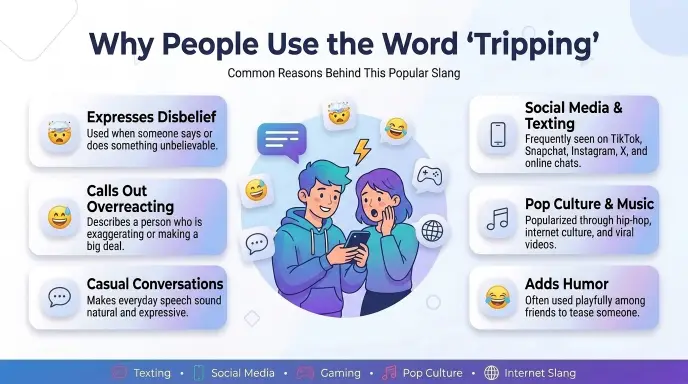
People continue using “tripping” because it quickly communicates disagreement or surprise without needing a long explanation.
Some common reasons include:
- It makes conversations sound natural.
- It is widely understood in casual settings.
- It adds humor to friendly discussions.
- It helps express disbelief.
- It keeps text messages short and conversational.
Because the phrase is informal, it is most appropriate when talking with friends, classmates, teammates, or people who are familiar with internet slang.
Origin and Background of Tripping Slang
The slang use of “tripping” has been part of American English for several decades. It became especially popular through everyday conversations, hip-hop culture, movies, television, and later social media.
Originally, the word “trip” referred to stumbling while walking. Over time, people began using it figuratively to describe unusual behavior, exaggerated reactions, or unrealistic thinking.
Another meaning developed in the 1960s and 1970s, when “tripping” became associated with psychedelic drug experiences because users often described their hallucinations as a “trip.”
Today, the everyday slang meaning is far more common in casual conversations. Most people who say “You’re tripping” simply mean that someone is overreacting or mistaken.
Tripping Meaning Slang Compared with Similar Expressions
Several slang expressions have meanings close to “tripping.” Although they sound similar, each one has a slightly different tone.
| Slang | Meaning | Common Context | Tone |
| Tripping | Overreacting or being mistaken | Texting, social media | Casual |
| Bugging | Becoming upset or acting strangely | Friends, texting | Casual |
| Tweaking | Acting unusually or overreacting | Social media | Informal |
| Wilding | Behaving in an extreme or unexpected way | Social media | Informal |
| Capping | Saying something untrue or exaggerated | Online conversations | Playful |
| Delulu | Having unrealistic beliefs or expectations | TikTok, memes | Humorous |
While these expressions are related, “tripping” is often the most flexible because it can describe overreacting, making incorrect assumptions, or behaving irrationally.
Real-Life Examples of Tripping Usage
The meaning of “tripping” becomes clearer when you see it used in different situations.
Friendly Conversation
Friends often use the phrase jokingly.
Examples:
- “You’re tripping if you think I’m eating another pizza.”
- “Don’t worry so much. You’re tripping.”
- “You’re seriously tripping today.”
- “I think you’re tripping about that.”
The tone is usually lighthearted and playful.
Casual Texting
The slang fits naturally into everyday messages.
Examples:
- “Why are you tripping?”
- “You’re tripping over something small.”
- “Stop tripping and enjoy yourself.”
- “Nobody is upset. You’re just tripping.”
These examples sound relaxed and informal.
Argumentative Situation
Sometimes “tripping” appears during disagreements.
Examples:
- “You’re tripping if you think that’s fair.”
- “Nah, you’re tripping. That’s not what happened.”
- “People keep saying I’m tripping, but I’m telling the truth.”
- “He’s tripping if he believes that rumor.”
In these situations, the phrase expresses disagreement without using harsh language.
Gaming and Social Media Context
Gamers and social media users often use “tripping” when reacting to surprising opinions or unexpected actions.
Examples:
- “You’re tripping if you think that update made the game worse.”
- “The comments say everyone is tripping.”
- “Bro is tripping after that announcement.”
- “People on the server are tripping over the new rules.”
The expression helps make conversations sound natural and conversational.
When Should You Avoid Using Tripping?
Although “tripping” is common in casual conversations, it is not suitable for every situation.
Avoid using it when:
- Writing professional emails.
- Preparing school assignments.
- Communicating with clients.
- Speaking in formal business meetings.
- Talking with people who may not understand internet slang.
In formal settings, clear language is usually the better choice.
Instead of writing:
“You’re tripping.”
You could say:
“I think there may be a misunderstanding.”
Instead of saying:
“Stop tripping.”
You could say:
“Let’s look at the situation calmly.”
These alternatives sound more respectful in professional environments.
Polite Alternatives to Tripping
If you want to express the same idea without using slang, try one of these alternatives.
When Someone Is Overreacting
You can say:
- I think you’re worrying too much.
- Let’s stay calm.
- It may not be as serious as it seems.
- Let’s look at the facts first.
- I see the situation differently.
When Someone Is Mistaken
You might say:
- I don’t think that’s correct.
- I have a different opinion.
- There may be another explanation.
- I believe that’s inaccurate.
- Let’s check the information again.
These alternatives help keep conversations respectful while expressing disagreement.
Why People Use Tripping
The slang remains popular because it communicates an idea quickly and naturally.
People use it to:
- Express disagreement.
- Point out an overreaction.
- Add humor to conversations.
- React to surprising opinions.
- Keep messages short and informal.
Because many people already understand the phrase, it has become part of everyday online communication.
Impact of Using Slang in Communication
Slang such as “tripping” makes conversations feel more relaxed and personal.
Some advantages include:
- Faster communication.
- Natural conversations.
- Stronger connection with friends.
- More expressive online discussions.
- Easier communication on social media.
However, slang is not always the best choice.
Not everyone understands internet expressions, and some people may interpret them differently. Using plain language in formal situations helps everyone understand your message clearly.
Choosing the right words for your audience leads to better communication.
Is Tripping Safe for Social Media?
Yes. In most cases, “tripping” is safe to use on social media.
You can commonly see it on:
- TikTok
- Snapchat
- Discord
- X (formerly Twitter)
People usually use it to react to opinions, jokes, or unexpected situations.
Keep in mind that telling someone “You’re tripping” may sound dismissive if they are sharing genuine concerns. If the topic is sensitive, responding with empathy often leads to a more positive conversation.
The phrase itself is not considered offensive, but your tone and the context still matter.
Common Mistakes People Make with Tripping
Many people misunderstand this slang because it has several meanings.
Here are some common mistakes to avoid:
- Assuming “tripping” always refers to drug use.
- Forgetting that it often means overreacting.
- Using the phrase in formal writing.
- Ignoring the surrounding context.
- Assuming everyone understands the slang.
Reading the entire conversation helps you identify the intended meaning.
Tips for Understanding Slang Like Tripping
Learning internet slang becomes easier when you pay attention to context.
Here are a few helpful tips:
- Read the complete conversation.
- Notice the platform where the slang appears.
- Consider the speaker’s tone.
- Look for clues in nearby words.
- Ask for clarification if the meaning is unclear.
These habits can help you understand modern slang more confidently and avoid misunderstandings.
Frequently Asked Questions
Q1. What does tripping up mean in slang?
In slang, tripping up means acting confused, making a mistake, or overreacting. It can also mean causing someone else to make a mistake.
Q2. What does set tripping mean in slang?
Set tripping is gang-related slang that means aggressively claiming or defending a gang or neighborhood. It can also refer to provoking others over gang affiliation.
Q3. What does jit tripping mean in slang?
Jit tripping means a young person is acting foolish, overreacting, or behaving disrespectfully. It is often used as criticism in casual speech.
Q4. What is jit in Gen Z slang?
In Gen Z slang, jit refers to a young kid or an inexperienced person. The term is especially common in Florida and Southern U.S. slang.
Q5. What does jhit mean in slang?
Jhit is a spelling variation of jit and has the same meaning. It refers to a young person, kid, or someone considered immature.
Conclusion
Tripping meaning slang is most commonly used to describe someone who is overreacting, thinking irrationally, or making an incorrect assumption. Although the word has multiple meanings, the everyday slang version is by far the most common in text messages, social media, and casual conversations.
The best way to understand the meaning is to pay attention to the context. A discussion among friends usually means someone is exaggerating or mistaken, while conversations about psychedelic drugs use the word in a completely different sense. The literal meaning of stumbling or falling is also still common in everyday English.
Because “tripping” is informal, it works best in friendly conversations and online communities. For professional or formal communication, using clear and complete language is a better choice. By understanding the different meanings and the tone behind the expression, you can confidently recognize and use “tripping” in the right situation.
you May also like:
“ROFL Meaning Slang: What It Stands For and How to Use It”

I am Emma Collins, a content writer at SlangAura specializing in internet slang, texting abbreviations, and online language. I create simple and accurate guides to help readers understand modern slang easily and confidently.