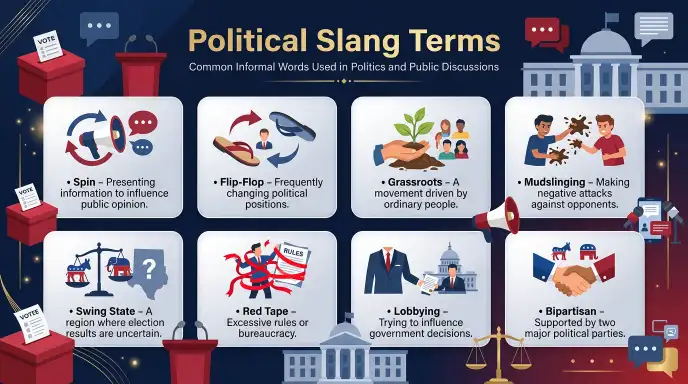
Political slang terms are informal words and phrases people use to talk about politics, politicians, political parties, elections, government actions, and public debates.
These expressions often appear in news reports, social media, online discussions, and everyday conversations. Some political slang terms are humorous, while others criticize, praise, or describe political ideas. Knowing these terms helps you understand political discussions more easily.
This guide explains the most common political slang terms, what they mean, where people use them, and how to use them correctly. It also covers modern internet slang related to politics and a few traditional political expressions that remain popular today.
Quick Answer:Political Slang Terms
Political slang terms are informal words and phrases used to discuss politics, politicians, governments, elections, and political opinions. They often appear in conversations, memes, news commentary, social media posts, and online debates.
What Are Political Slang Terms?
Political slang terms are unofficial expressions that make political conversations shorter, funnier, or more expressive.
Some slang words describe politicians.
Others describe voters, government policies, political movements, or election campaigns.
Many of these expressions begin online before becoming common in everyday language.
For example:
- “That debate became a complete mudslinging match.”
- “The candidate is trying to win over swing voters.”
- “People accused the official of being a career politician.”
Each phrase has a political meaning that goes beyond its literal definition.
Why Do People Use Political Slang?
People use political slang for several reasons.
- To make political topics easier to discuss.
- To express opinions quickly.
- To add humor to serious conversations.
- To create memorable phrases.
- To simplify complex political ideas.
Political slang also spreads quickly because people share short expressions on social media.
Where Are Political Slang Terms Commonly Used?
Political slang appears in many places.
Social Media
Platforms like X, TikTok, Facebook, Instagram, Reddit, and Threads often include political slang in posts and comments.
News Commentary
Television hosts and political analysts sometimes use informal political expressions to explain current events.
Podcasts
Political podcasts often mix formal discussion with everyday slang.
Public Speeches
Some politicians intentionally use slang to connect with younger audiences.
Everyday Conversations
Friends, family members, students, and coworkers often use political slang while discussing elections or current events.
Common Political Slang Terms and Their Meanings
1. Lefty
A casual name for someone with left-wing political views.
Example:
- “My cousin calls himself a lefty.”
2. Righty
An informal term for someone with conservative or right-wing views.
Example:
- “He describes himself as a righty.”
3. Swing Voter
A voter who may support different political parties in different elections.
Example:
- “Swing voters could decide the election.”
4. Flip-Flop
When a politician changes their opinion on an issue.
Example:
- “Critics said the senator did a flip-flop.”
5. Mudslinging
Making negative or personal attacks against political opponents.
Example:
- “The campaign turned into nonstop mudslinging.”
6. Grassroots
A movement started and supported by ordinary people instead of political leaders.
Example:
- “The campaign grew through grassroots support.”
7. Political Machine
A powerful political organization that strongly influences elections.
Example:
- “The city was controlled by a political machine.”
8. boring Duck
A leader who still holds office but has little remaining political power.
Example:
- “The president became a boring duck after the election.”
9. Spin
Presenting information in a way that supports one side.
Example:
- “Many viewers believed the interview included political spin.”
10. Pork Barrel
Government spending meant to benefit a specific area or group.
Example:
- “Opponents criticized the bill as pork barrel spending.”
Modern Political Slang on Social Media
The internet creates new political slang every year.
Many terms become popular through memes and short videos.
Some disappear quickly.
Others become part of everyday language.
Here are a few modern examples.
Cancel Culture
Public criticism that can lead to someone losing support because of their words or actions.
Echo Chamber
An environment where people mostly hear opinions that match their own beliefs.
Doomscrolling
Spending a long time reading negative political or world news online.
Keyboard Warrior
Someone who strongly argues online but rarely takes action in real life.
Fact-Check
Checking if a political statement is accurate.
Although “fact-check” is not pure slang, people often use it casually during political discussions.
Are Political Slang Terms Always Negative?
No.
Some political slang terms are neutral.
Others are positive.
Some carry a negative meaning.
For example:
Neutral:
- Swing voter
- Grassroots
Positive:
- Reformer
- Independent thinker
Negative:
- Flip-flop
- Mudslinging
- Political machine
The tone depends on the speaker and the situation.
More Political Slang Terms You Should Know
Here are more political slang terms that often appear in news, social media, and public discussions.
11. Beltway
A nickname for the political world in Washington, D.C.
Example:
- “Many Beltway insiders expected that decision.”
12. Bipartisan
Supported by members of two major political parties.
Example:
- “The lawmakers reached a bipartisan agreement.”
13. Blue State
A U.S. state that usually supports the Democratic Party.
Example:
- “California is often called a blue state.”
14. Red State
A U.S. state that usually supports the Republican Party.
Example:
- “Texas is commonly known as a red state.”
15. Purple State
A state where elections are usually very close.
Example:
- “The campaign focused on several purple states.”
16. Rubber Chicken Circuit
A humorous term for attending many political dinners and public events.
Example:
- “The candidate spent weeks on the rubber chicken circuit.”
17. Stump Speech
A speech that a politician repeats during a campaign.
Example:
- “She delivered the same stump speech in every city.”
18. Whistle-Stop Tour
A campaign trip with many short stops in different places.
Example:
- “The candidate began a whistle-stop tour across the country.”
19. Smoke-Filled Room
A private place where political deals are believed to happen.
Example:
- “Critics said the decision came from a smoke-filled room.”
20. Political Football
An issue that politicians keep arguing about without finding a solution.
Example:
- “Healthcare has become a political football.”
How to Use Political Slang Correctly
Political slang works best in informal conversations.
You can use it when talking with friends, joining online discussions, or commenting on political news.
For example:
- “The debate included a lot of political spin.”
- “Many swing voters have not decided yet.”
- “That campaign started as a grassroots movement.”
Use the term only if you understand its meaning. This helps you avoid confusion.
When Should You Avoid Political Slang?
Political slang is not suitable for every situation.
Avoid using it in:
- Academic research papers
- Legal documents
- Official government reports
- Professional business emails
- Formal presentations
- Job applications
In these situations, clear and formal language is the better choice.
Political Slang Around the World
Political slang changes from one country to another.
Some expressions are popular in the United States.
Others are common in the United Kingdom, Canada, Australia, and many other countries.
For example:
- “Blue state” and “red state” are mainly American terms.
- “boring duck” is understood in many English-speaking countries.
- “Grassroots” is used around the world.
Always consider the country before using political slang.
Why Does Political Slang Change So Often?
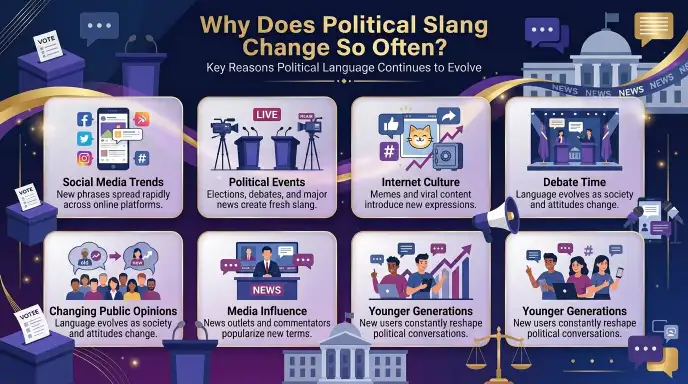
Politics changes every year.
New leaders, elections, and social media trends introduce fresh expressions.
Some terms remain popular for decades.
Others disappear after a single election.
News events also influence political language.
That is why political slang continues to grow.
Common Mistakes People Make
Many people misunderstand political slang.
These mistakes happen most often.
Taking Every Term Literally
Many expressions are figurative.
For example, a “boring duck” is not an injured bird. It describes a leader with limited remaining power.
Ignoring the Country
A political term may be common in one country but unfamiliar in another.
Always check where the conversation is happening.
Using Slang in Formal Writing
Political slang belongs in casual communication.
Formal writing should use standard political vocabulary.
Assuming Every Term Is Negative
Some expressions are neutral.
Others describe facts instead of opinions.
Read the full conversation before deciding how a term is being used.
Tips for Understanding Political Slang
These simple tips can help you understand political conversations.
- Read the complete sentence.
- Notice the topic being discussed.
- Consider the country.
- Check if the term has a literal meaning.
- Look for clues in nearby words.
- Learn common election vocabulary.
- Stay updated with current events.
These habits make political discussions much easier to follow.
Is Political Slang Always About Politicians?
No.
Political slang can describe many different topics.
These include:
- Elections
- Political parties
- Government decisions
- Public opinion
- Campaigns
- Protest movements
- News coverage
- Political debates
Some expressions describe people.
Others describe events or ideas.
Why Is Political Slang Popular on Social Media?
Short expressions spread quickly online.
They save time and make posts easier to read.
Many people also use political slang in memes and short videos.
As a result, millions of users see these terms every day.
Some phrases become part of everyday English after going viral.
Real-Life Examples of Political Slang Terms
These examples show how political slang terms appear in everyday conversations.
Example 1: News Discussion
Person A: “The debate included a lot of political spin.”
Person B: “I noticed that too.”
Example 2: Social Media
Post:
“Many swing voters are still undecided.”
Comment:
“This election could be very close.”
Example 3: Election Conversation
Friend 1: “The campaign started as a grassroots movement.”
Friend 2: “That helped them gain public support.”
Example 4: Office Chat
Employee 1: “People say he did a complete flip-flop.”
Employee 2: “His opinion changed very quickly.”
Example 5: Podcast
Host:
“Healthcare has become another political football.”
Guest:
“Every election brings the topic back.”
These examples show how political slang helps people discuss politics in a simple and engaging way.
The Origin of Political Slang Terms
Political slang has existed for hundreds of years.
Many expressions began in newspapers, election campaigns, and public speeches.
Others became popular through television and radio.
Today, social media plays the biggest role.
Platforms like X, Reddit, TikTok, Facebook, and YouTube help new political slang spread around the world within hours.
Some terms disappear after one election.
Others become part of everyday English and stay popular for many years.
Frequently Asked Questions
Q1. What are political slang terms?
Political slang terms are informal words and phrases people use to talk about politics, elections, governments, political parties, public policies, and politicians in casual conversations.
Q2. Why do people use political slang?
People use political slang because it makes conversations shorter, easier to understand, and more engaging. It also helps express opinions, humor, and reactions quickly.
Q3. Where are political slang terms most commonly used?
Political slang is common on social media, news programs, podcasts, blogs, online forums, election campaigns, and everyday conversations with friends or family.
Q4. Are political slang terms always offensive?
No. Many political slang terms are neutral. Some are humorous, while others criticize or support political ideas. The meaning depends on the context and the speaker’s intent.
Q5. Can political slang have different meanings?
Yes. Some political slang terms have more than one meaning. Others may mean different things in different countries or political systems.
Q6. Are political slang terms different in every country?
Yes. Every country has its own political history and culture, so many slang terms are unique. However, some expressions like “grassroots” and “boring duck” are widely understood in English-speaking countries.
Q7. What is the difference between political slang and political jargon?
Political slang is informal and used in everyday conversations. Political jargon is more formal and is often used by politicians, journalists, researchers, and government officials.
Q8. Can I use political slang in school assignments or business writing?
No. Political slang is best for informal conversations. Academic papers, professional emails, official reports, and business documents should use formal language instead.
Q9. How can I understand unfamiliar political slang?
Read the complete sentence, identify the topic, consider the country, and look for clues in the surrounding conversation. Context usually reveals the correct meaning.
Q10. What are the most common political slang terms?
Some of the best-known political slang terms include grassroots, swing voter, flip-flop, mudslinging, boring duck, political spin, political machine, pork barrel, red state, blue state, and echo chamber.
Conclusion
Understanding political slang terms helps you follow modern political conversations with confidence. These informal expressions appear in news reports, social media posts, podcasts, debates, and everyday discussions. Some terms describe politicians, while others explain elections, public opinion, or government actions.
Because political slang changes over time, always pay attention to the context before deciding what a term means. The more political conversations you read and hear, the easier these expressions become to understand and use correctly.
You May Also Like:
Pirate Slang Insults Meaning in Text:Pirate Slang Insults Explained

I am Masson Caldwell, a language enthusiast and content writer at SlangAura. I write about internet slang, texting trends, and modern expressions to help readers understand the evolving world of online language with simple and clear explanations.