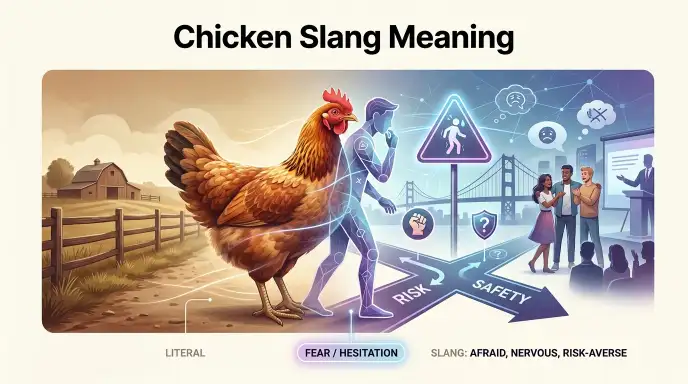
Chicken slang means a person who is scared, nervous, or unwilling to take a risk. When someone calls another person “chicken,” they usually mean that the person is acting like a coward. The term is informal and can sound playful among friends, but it may also sound rude in a serious situation.
Quick Answer: In slang, chicken means a coward or a person who is afraid to do something. It is often used when someone loses courage, avoids a challenge, or backs away from a risky situation. The related phrase “chicken out” means to stop or back out because of fear.
Quick Answer: Chicken Slang Meaning
| Quick Detail | Answer |
| Chicken slang meaning | A scared or cowardly person |
| Chicken out meaning | To back out because of fear |
| Part of speech | Noun, adjective, or part of a phrasal verb |
| Tone | Casual, teasing, or insulting |
| Used by | Teens and adults |
| Common platforms | Texting, social media, gaming, everyday speech |
| Formal or informal? | Informal |
| A swear word? | No |
| Can it sound rude? | Yes, depending on the context |
| Related phrase | Playing chicken |
The word does not always describe someone’s whole personality. A person might be brave in most situations but still get called “chicken” after backing out of one scary challenge.
What Does Chicken Mean in Slang?
In slang, chicken describes someone who is acting afraid or showing a lack of courage.
For example:
“Don’t be a chicken. Just try it.”
The speaker is telling the other person not to let fear stop them.
Another example is:
“Jake was too chicken to go on the ride.”
This means Jake was too scared to try the ride.
The slang meaning is different from the normal meaning of chicken, which refers to the bird. The sentence gives you the clue. When “chicken” describes a person’s behavior, it can carry the slang meaning of cowardly or fearful.
Why Do People Call Someone a Chicken?
People use chicken when someone appears too afraid to face a challenge.
The challenge can be big or small. It might involve a scary ride, a difficult conversation, a competition, a social situation, or a risky decision.
For example:
“You said you would ask him. Why are you being a chicken now?”
Here, the speaker thinks the person is avoiding the situation because of fear.
The expression can also be used for teasing. Friends may call each other “chicken” without making a serious judgment about courage.
That is why tone matters when you see this word in a conversation.
What Does Chicken Mean in Texting?
In texting, chicken usually keeps the same meaning: someone who is scared, nervous, or afraid to take action.
People may use it in short messages such as:
“Are you chicken?”
“Don’t be a chicken 😂”
“He totally chickened out.”
Texting often makes the word feel more playful. Emojis can make that tone even clearer.
For example, “You’re a chicken 😂” may sound like friendly teasing. The same words during an argument may feel like an insult.
The meaning comes from both the word and the situation around it.
What Does “Chicken Out” Mean?
Chicken out means to back out of something because you become afraid or lose confidence.
For example:
“I planned to speak on stage, but I chickened out.”
The person intended to speak but became too nervous and decided not to do it.
The phrase can describe a last:minute change of mind. Someone may confidently agree to a plan at first. Fear then causes them to stop.
This makes chicken out slightly different from simply being scared.
Chicken vs. Chicken Out
Chicken usually describes the person:
“He is such a chicken.”
Chicken out describes the action:
“He chickened out.”
The two expressions are closely connected, but they have different roles in a sentence.
Is Chicken a Slang Word?
Yes. Chicken is used as informal slang when it means a coward or a fearful person.
This meaning is not new internet slang. It existed long before TikTok, Instagram, texting, and modern online communities.
The slang sense developed from the idea of a chicken being associated with fear or nervous behavior. Dictionaries continue to record this informal meaning.
That also explains why the word can feel familiar even to people who do not spend much time online.
Where Is Chicken Slang Used?
| Place | Common Use | Example |
| Texting | Teasing someone who is scared | “Don’t be chicken.” |
| Social media | Jokes and comments | “He chickened out 😂” |
| Gaming | Calling out someone who avoids a challenge | “Why are you being chicken?” |
| Friend groups | Playful teasing | “You’re such a chicken.” |
| Everyday speech | Describing fear | “She was too chicken to try.” |
The expression works best in casual communication. It can sound strange in professional writing.
Is Chicken Formal or Informal?
Chicken is informal when used to mean a coward.
You might use it while talking with friends, chatting online, playing games, or joking with someone.
A formal sentence would usually use a clearer word.
Instead of:
“He was too chicken to speak.”
formal writing could say:
“He was too nervous to speak.”
Words such as afraid, nervous, hesitant, or unwilling can work better in professional situations.
Is Calling Someone Chicken Rude?
Calling someone chicken can be rude, but it is usually a mild insult rather than an offensive swear word.
The relationship between the speakers makes a big difference.
A friend might say:
“Come on, don’t be a chicken!”
This can sound playful.
During an argument, someone might say:
“You’re too chicken to face me.”
That sounds much more insulting.
The word itself is not extremely harsh. Still, it can embarrass someone by suggesting that they lack courage.
Does Chicken Mean Coward?
Yes. In slang, chicken can mean coward.
However, the two words do not always feel the same.
Coward sounds more direct and serious.
Chicken sounds more casual and often carries a teasing tone.
Compare these examples:
“He is a coward.”
“He is such a chicken.”
The first sentence gives a stronger judgment. The second can sound lighter, especially between friends.
This difference is useful when choosing the right word for a situation.
Can Chicken Describe an Adult?
Yes. Chicken can describe both adults and younger people.
For example:
“My brother was too chicken to watch the horror movie.”
The expression does not belong to one particular age group.
Adults may use it in casual conversations, jokes, sports, games, and online discussions.
It is still informal, so it should not be treated like a professional term.
Chicken as a Noun, Adjective, and Verb
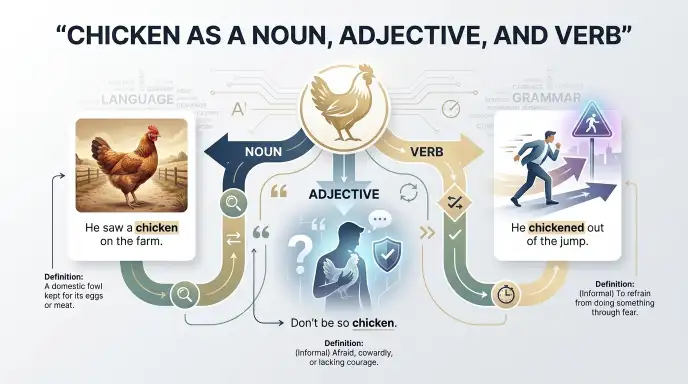
The word can appear in different forms.
Chicken as a Noun
“Don’t be a chicken.”
Here, “chicken” refers to a person who is acting cowardly.
Chicken as an Adjective
“He was too chicken to jump.”
Here, “chicken” describes someone as afraid.
Chicken as Part of a Verb
“She chickened out.”
Here, chickened out means she backed out because of fear.
Learning these forms makes it easier to understand the word in texts and conversations.
Why “Chicken Out” Is So Common
“Chicken out” describes a very specific kind of fear.
Imagine someone agreeing to ride a huge roller coaster. They wait in line with their friends. When the ride gets closer, they become nervous and leave the line.
A friend might say:
“You chickened out!”
The phrase focuses on the decision to stop.
The person may not be scared of everything. They simply lost confidence in that particular moment.
This is one reason “chicken out” is useful in everyday English.
Chicken Slang and Losing Your Nerve
A good way to understand chicken slang is to connect it with the phrase “lose your nerve.”
If someone loses their nerve, they stop feeling confident enough to continue.
For example:
“Nora wanted to perform, but she lost her nerve.”
In casual speech, someone might instead say:
“Nora chickened out.”
Both sentences describe a similar situation.
The slang version sounds more conversational and less formal.
What Does “Don’t Be a Chicken” Mean?
“Don’t be a chicken” means “Don’t be afraid” or “Don’t let fear stop you.”
People often say this when encouraging someone to take a challenge.
For example:
“Come on, don’t be a chicken. It’s just a small ride.”
The expression can be friendly. It can also feel like pressure if the other person has a real reason for saying no.
Fear is not always a sign of cowardice. Sometimes a person simply does not want to take an unnecessary risk.
Chicken Slang Examples
Example 1: A Roller Coaster
“Ali said he would ride the roller coaster, but he chickened out.”
Meaning: Ali became afraid and decided not to ride it.
Example 2: Sending a Message
“Why are you being a chicken? Just send the text.”
Meaning: The person is too nervous to send the message.
Example 3: A Competition
“Mina called him a chicken after he refused the challenge.”
Meaning: Mina was teasing him for not accepting the challenge.
Example 4: Watching a Horror Movie
“I’m not chicken. I just don’t like scary movies.”
Meaning: The speaker rejects the idea that they are afraid.
These examples show that chicken can describe fear, hesitation, or a refusal to take a risk.
Chicken vs. Scaredy:Cat
Chicken and scaredy:cat both describe someone who is easily scared. However, they have a slightly different feel.
“Chicken” can sound direct and teasing. “Scaredy:cat” usually sounds more playful and childish.
For example:
“Don’t be a chicken. Just go for it.”
This can sound like friendly teasing between people who know each other well.
A person might also say:
“My little brother is such a scaredy:cat.”
That sentence usually has a lighter and more playful tone.
Neither expression is normally a swear word. Still, both can become insulting when used to embarrass someone.
What Does “Playing Chicken” Mean?
Playing chicken is a different expression from simply calling someone a chicken.
It describes a situation where two people face a risky challenge and wait for the other person to back down first.
The person who gives up first is seen as the less brave one.
For example:
“The two teams were playing chicken and neither wanted to give up.”
The phrase can also describe arguments, competitions, negotiations, and other situations where two sides refuse to back down.
The expression is often used figuratively today. It does not require an actual dangerous activity.
What Does Chicken Mean in Gaming?
In gaming, chicken can describe a player who avoids a fight, challenge, or risky move.
For example:
“He ran away when the fight started. What a chicken!”
The speaker is saying that the player acted cowardly.
Gaming communities often use this type of language as trash talk. Friends may use it for fun, while strangers may use it to provoke another player.
The exact tone depends on the game and the relationship between the players.
Chicken Slang on Social Media
People can use chicken in social media captions, comments, memes, and replies.
A comment such as:
“Bro chickened out 😂”
usually means that someone became scared and backed out.
The chicken emoji 🐔 can also add a humorous connection to the word.
For example:
“You really didn’t do it? 🐔😂”
The emojis make the message feel more playful.
Social media users also exaggerate words for humor. So calling someone a “chicken” does not always mean the writer seriously thinks that person is a coward.
Can Chicken Be a Friendly Joke?
Yes. Chicken can be friendly teasing when the people involved understand the joke.
Imagine two friends making a challenge. One friend suddenly refuses to continue.
The other might say:
“Haha, you’re such a chicken!”
The speaker may not actually believe the friend is cowardly.
Tone, facial expression, emojis, and the relationship between people can change the meaning.
That is why slang should not be judged by the word alone. The surrounding conversation gives important clues.
When Should You Avoid Calling Someone Chicken?
It is better to avoid the word when the situation is serious.
Someone may refuse a challenge because they feel unsafe, uncomfortable, or unprepared. Calling them “chicken” can make them feel pressured.
For example, if someone does not want to take a dangerous risk, saying:
“Don’t be a chicken.”
may sound disrespectful.
A safer choice is to respect their decision.
This matters because being cautious is not always the same as being cowardly.
Chicken vs. Coward

The words chicken and coward have similar meanings, but their tone is different.
Coward is stronger and more serious.
Chicken is more casual and often used as teasing.
Compare:
“He is a coward.”
with:
“He’s being a chicken.”
The first sentence sounds like a serious judgment of someone’s character.
The second sentence can describe a temporary reaction to fear.
This difference makes “chicken” more common in casual conversations.
Chicken vs. Afraid
Afraid simply describes a feeling.
Chicken adds a judgment about how someone responds to that feeling.
For example:
“Sara is afraid of heights.”
This is a neutral statement.
“Sara is being a chicken.”
This suggests that Sara is allowing fear to stop her from doing something.
So “afraid” is not automatically negative, while “chicken” can carry a teasing or critical meaning.
Is Chicken Still Used as Slang Today?
Yes. Chicken is still understood as casual slang for a fearful or cowardly person.
It is not limited to one social media platform or age group.
People can use it in everyday conversations, texting, gaming, jokes, and online comments.
The related phrase “chicken out” is also still common.
New slang appears quickly online, but older slang does not automatically disappear. Some expressions stay useful because their meaning is simple and easy to understand.
Common Mistakes With Chicken Slang
Mistake 1: Thinking It Always Means the Animal
“Chicken” has its normal food and animal meanings too.
For example:
“We had chicken for dinner.”
Here, there is no slang meaning.
But:
“He is too chicken to try it.”
Here, the word refers to fear.
The surrounding sentence tells you which meaning is intended.
Mistake 2: Confusing Chicken With Chicken Out
These expressions are related but not identical.
“Don’t be a chicken.”
describes someone as fearful.
“Don’t chicken out.”
means do not back out because of fear.
Mistake 3: Assuming Chicken Is Always Offensive
The word can be an insult, but it is not normally considered a swear word.
Friends may use it as harmless teasing.
Mistake 4: Assuming Chicken Is New Internet Slang
The slang meaning is much older than TikTok, Instagram, and texting.
Modern platforms may help people see the word more often, but they did not create this meaning.
Real:Life Examples of Chicken Slang
Example 1: A Scary Ride
Areeba agrees to ride a huge roller coaster. When she sees how high it is, she changes her mind.
Her friend says:
“You chickened out!”
Here, chickened out means Areeba became afraid and decided not to ride.
Example 2: A Difficult Message
Usman wants to send an important message but keeps deleting it.
His friend says:
“Stop being a chicken and send it.”
Here, “chicken” means he is too nervous to take action.
Example 3: A Gaming Match
Hassan has a strong position in a game but refuses to attack.
Another player says:
“Why are you playing like a chicken?”
The speaker is criticizing him for avoiding the challenge.
Example 4: A Public Performance
Sana agrees to sing at a small event. When her name is announced, she refuses to go on stage.
Her friend later says:
“You totally chickened out.”
The phrase describes her sudden loss of confidence.
Example 5: A Friendly Challenge
Zoya challenges her cousin to try a very spicy snack. He refuses after seeing it.
Zoya laughs and says:
“You’re such a chicken!”
Here, the expression is most likely playful teasing.
What Are Similar Slang Words for Chicken?
Several casual expressions can describe someone who is afraid.
Scaredy:cat means someone who gets scared easily.
Coward means someone who lacks courage.
Wimp can describe someone seen as weak or lacking confidence.
Yellow can also describe someone as cowardly in informal English.
These words are not perfect replacements in every sentence. Their tone can range from playful to insulting.
“Chicken” is often chosen because it sounds casual and easygoing.
What Does “Too Chicken” Mean?
“Too chicken” means too afraid or nervous to do something.
For example:
“He was too chicken to ask for help.”
This means he was too nervous to ask.
Another example is:
“I was too chicken to watch the movie alone.”
Here, the speaker is saying fear stopped them from doing it.
The expression is informal and often used in casual speech.
What Does “Chickenhearted” Mean?
Chickenhearted is another word connected with cowardice.
It describes someone who lacks courage.
For example:
“He was called chickenhearted because he refused to face the problem.”
The word is less common in everyday texting than “chicken.”
It is useful to recognize it when reading older writing or more descriptive English.
Is Chicken Positive or Negative Slang?
The slang meaning of chicken is usually negative, because it suggests fear or a lack of courage.
However, the emotional effect can be much lighter when friends use it as a joke.
For example:
“You’re a chicken 😂”
may be playful.
But:
“You’re a coward and a chicken.”
sounds clearly insulting.
So the meaning is generally negative, while the tone can range from playful to harsh.
Key Takeaways
- Chicken slang means a person who is scared, nervous, or cowardly.
- It is informal and common in casual communication.
- Chicken out means backing out because of fear.
- Playing chicken describes a situation where people wait for the other side to back down.
- Chicken can appear in texting, gaming, social media, and everyday conversations.
- It is not normally a swear word.
- The expression can still sound rude when used seriously.
- “Chicken” is older slang, not a word created by TikTok or Gen Z.
- Scaredy:cat, coward, and wimp are related expressions, but their tone can differ.
- Being cautious does not always mean being a chicken.
FAQs About Chicken Slang
Q1. What Does a Chicken Mean in Slang?
In slang, “chicken” can mean different things depending on context. Most commonly, calling someone a chicken means they are scared, nervous, or unwilling to take a risk.
Q2. Is Chicken a Slang for Money?
Yes, “chicken” can sometimes be used as slang for money, especially in certain rap, street, or regional contexts. However, this meaning is less common than other slang terms for money, so context matters.
Q3. What Does It Mean When Someone Calls You “Chicken”?
If someone calls you “chicken,” they usually mean you are afraid or too nervous to do something. For example, “Don’t be a chicken” means “Don’t be afraid.”
Q4. What Is a Slang Term for Chickens?
Common informal names for chickens include “chooks” and “hens” when referring specifically to female chickens. “Chook” is especially common in Australian and New Zealand English.
Q5. What Does “Chicken” Mean in Rap?
In rap and hip:hop, “chicken” can have different meanings depending on the song and context. It may refer to money, a person, or even food. The surrounding lyrics are important for understanding the intended meaning.
Q6. Why Do We Call Someone a Chicken?
Calling someone a “chicken” to mean cowardly or afraid comes from the long:standing association of chickens with being timid or easily frightened. Over time, the word became a common informal way to describe someone who lacks courage.
Conclusion
Chicken slang is a simple informal way to describe someone who is acting scared, nervous, or unwilling to take a risk. The expression can be serious in some conversations, but friends often use it as playful teasing.
The related phrase “chicken out” is especially useful because it describes the moment someone loses confidence and backs away from an action. “Playing chicken” has a different meaning and describes a situation where people wait for someone else to give up first.
You can see chicken slang in texting, gaming, social media comments, jokes, and everyday speech. It is not a swear word, but it can still sound rude when used to criticize someone.
The easiest way to remember it is simple: “chicken” describes someone acting afraid, while “chicken out” describes backing away because of fear.
Other Slang Meanings to Know:
What Does TBF Mean in Slang? Uses, Examples, and Context
What Does “That’s Cap” Mean in Slang? Definition,Uses, Examples

I am Emma Collins, a content writer at SlangAura specializing in internet slang, texting abbreviations, and online language. I create simple and accurate guides to help readers understand modern slang easily and confidently.